

 Secures Top Spot in




Q1. Is PeopleStrong the Right HRMS for a 2,000-Employee Indian Enterprise in 2026?
A payroll manager at a 2,200-person manufacturing group in Pune told me last quarter that her team had shortlisted PeopleStrong, Darwinbox, and HROne, and the single question her CFO kept asking was, “Will this still fit us in three years, or will we be sitting in another HRIS buyer checklist RFP?” That question, not the feature checklist, is the real 2026 enterprise HRMS decision.
PeopleStrong is a credible shortlist candidate for hierarchy-heavy, multi-entity Indian enterprises above 2,000 employees that value deep modularity and APAC footprint, and accept long implementations and ticket-driven configuration. It is a poor fit for mid-market teams drowning in 110-plus daily tasks who need action-first flow, transparent pricing, and go-live-based billing. The rest of this review scores it across ten pillars so the decision stops being a gut call.
Meet Yourself in One of Three Buyer Realities
- ✅ Reality One, the Entrenched Enterprise Incumbent. Darwinbox is already in your RFP, your board has heard the unicorn story, and you are trying to validate whether PeopleStrong is a safer or cheaper alternative.
- ✅ Reality Two, the Mid-Market Mainstream. You are between 500 and 1,500 employees, you have outgrown Keka, greytHR, or Zoho People, and you are evaluating whether to leap to PeopleStrong or pick a task-first platform like HROne.
- ⚠️ Reality Three, the Frankenstein Stack. You are running an outsourced payroll vendor, a biometric portal, a standalone ATS, Excel for performance, and WhatsApp for everything else, and you want to consolidate before the next audit cycle.
The 10-Pillar Buyer Fit Score, Previewed
The review uses a 100-point framework covering AI and automation readiness, India statutory compliance, module depth, integrations, UX and mobile, implementation risk, TCO, support, security, and roadmap. By Q3 you will see PeopleStrong’s composite score, the three weakest pillars to stress-test in demos, and how it maps back to your reality.
The Open Loop Worth Holding
The question I will answer in Q8 is what breaks first at 2,000 employees on PeopleStrong? Payroll reversal cutoffs, multi-entity approval matrices, and the subscription clock starting on day one of purchase are the three most common stall points.
Q2. What Is PeopleStrong in 2026, Who Does It Serve, and Where Is It Headed?
PeopleStrong is an Asia-headquartered, hire-to-retire Human Capital Management SaaS platform built on its unified “Alt” architecture, designed for mid-market and enterprise employers in India and APAC. It serves 500-plus enterprises and 2 million-plus employees, positions itself as a Top 5 APAC HCM, and targets hierarchy-heavy, multi-entity buyers who value deep modularity over daily task velocity.
Who PeopleStrong Is Actually Built For
The honest ICP sits in the 1,000 to 5,000-employee band, multi-entity, hierarchy-heavy, and compliance-intensive. Think BFSI, large retail, manufacturing with blue-collar workforces, and GCCs running pan-India units.
The Module Map
| Module pillar | What it covers |
|---|---|
| Core HR | Employee master, lifecycle, letters, org hierarchy |
| Payroll | India statutory, FBP (Flexi Benefit Plan), CTC revisions, TDS |
| Talent Acquisition | Built-in ATS, assessment partner integrations |
| Talent Management | Performance, OKRs, succession |
| Workforce | Leave, attendance, shift management |
| Jinie AI | Conversational self-service assistant |
| Mobile Super App | ESS, claims, payslips, approvals |
Leadership, Funding, and 2026 Roadmap
PeopleStrong has a senior India HR-tech leadership bench, multiple private funding rounds, and public statements pointing to profitability and APAC expansion. In 2026, the company is articulating three roadmap bets: moving AI from pilot to production, tightening ERP and finance integrations, and shipping more flexible workflow configuration.
The Gmail-ification-of-HR Contrast
Gmail collapsed email folders into an inbox because professionals want one screen to plan a day. Legacy HCMs still ask HR to navigate a menu tree to close 110-plus daily tasks, which is exactly what the HR Inbox was built to solve. Whether PeopleStrong’s roadmap closes that gap by 2027 is the single most important thing to ask their product team.
Q3. How Does PeopleStrong Score on the 2026 10-Pillar Enterprise Buyer Fit Framework?
The Composite Verdict
On the 10-pillar, 100-point framework, PeopleStrong scores 68 out of 100 for a 2,000-employee Indian enterprise in 2026. It is strong on module breadth and APAC footprint, average on compliance depth and integrations, and weakest on implementation risk, TCO transparency, and UX velocity.
The Scorecard
| # | Pillar | Weight | Score | Evidence snapshot |
|---|---|---|---|---|
| 1 | AI and automation readiness | 10 | 6.5 | Jinie handles self-service Q&A, limited autonomous workflows |
| 2 | India statutory compliance | 10 | 7.5 | PF, ESI, PT, TDS covered; four labour codes in progress |
| 3 | Module depth | 10 | 8.0 | Full hire-to-retire suite |
| 4 | Integration ecosystem | 10 | 7.0 | MS Teams, DocuSign, Naukri; ERP varies by tier |
| 5 | UX and mobile experience | 10 | 6.0 | Mobile well-reviewed; desktop feels option-heavy |
| 6 | Implementation risk | 10 | 5.5 | 4 to 9 months; subscription starts on purchase |
| 7 | Total cost of ownership | 10 | 6.0 | PEPM (Per-Employee-Per-Month) plus implementation and surcharges |
| 8 | Support and CSM | 10 | 7.0 | Dedicated CSM on enterprise tier |
| 9 | Security and data protection | 10 | 8.0 | ISO 27001, SOC 2, DPDP-aligned |
| 10 | Product roadmap | 10 | 6.5 | AI-in-production, integrations, workflow flexibility |
| Total | 100 | 68 |
How to Read the 68
A mid-to-high 60s score is the honest signature of a capable enterprise HCM that is not category-leading on velocity or financial transparency. For a hierarchy-heavy multi-entity buyer, 68 is a shortlist. For a mid-market CHRO whose board wants ROI in two quarters, it is a caution flag, which is why many teams run a parallel ROI calculator before signing.
The Three Pillars to Stress-Test
- ⚠️ Implementation risk. Ask for a signed go-live date, the named SPOC, and whether billing starts on purchase or on go-live.
- 💰 TCO transparency. Ask for a written 3-year cost table including license, implementation, integrations, change management, and support. Compare against transparent HROne pricing.
- 📱 UX and mobile velocity. Script three edge cases: leave mid-cutoff, multi-entity approval, and custom attrition report.
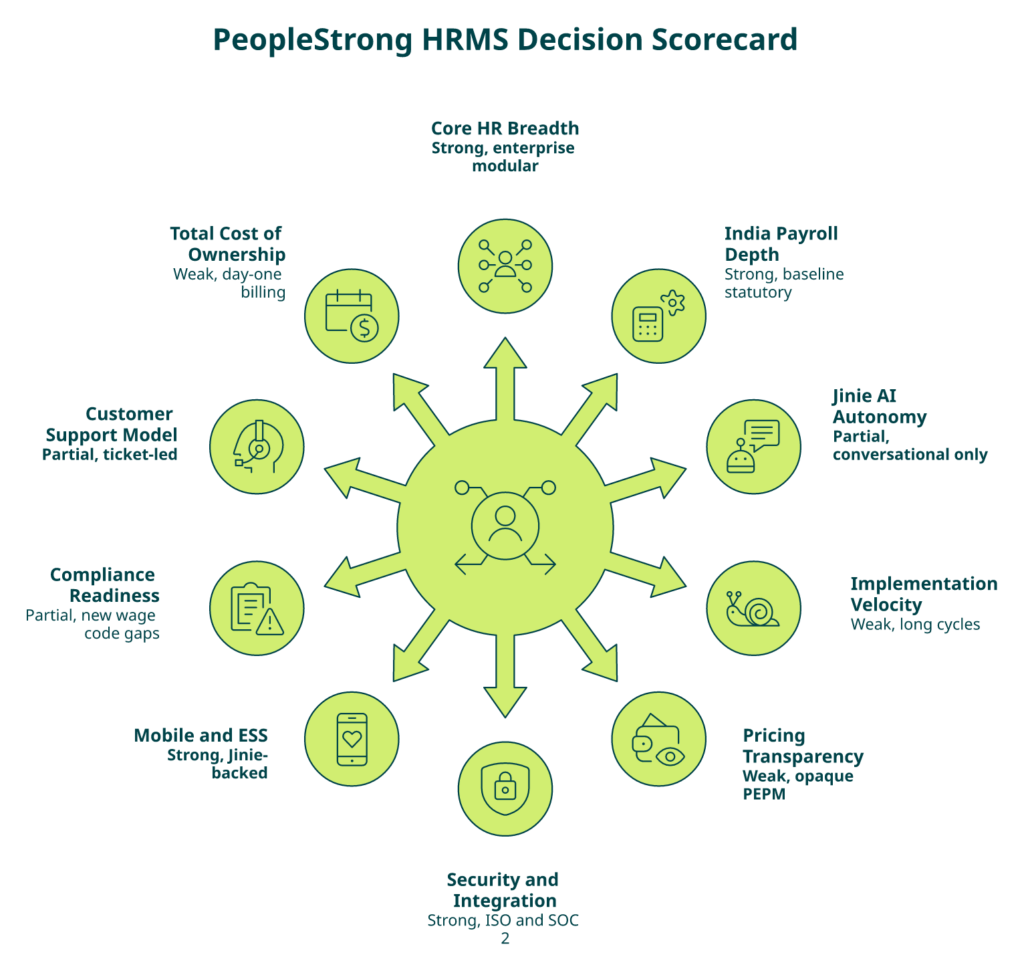
HROne’s comparable scorecard is anchored by the Super Inbox collapsing 110-plus tasks into three-click closures, 127 pre-built workflows, and subscription metering starting only after go-live, which is why HROne ranks #3 on G2 for overall satisfaction across 1.17 lakh software products globally.
Q4. What Do PeopleStrong’s Core Modules Actually Do, and Where Are the Gaps?
PeopleStrong’s suite is broad, mature, and mobile-forward, covering Core HR, Payroll, Talent Acquisition, Performance, Workforce, and ESS in one instance. Gaps cluster around configurability speed, desktop UX density, and custom reporting flexibility. The suite is adequate, not category-defining, and the demo script matters more than the brochure.
The Module-by-Module Scorecard
| Module | What it does | Rating /5 | Key friction | Scripted demo edge case |
|---|---|---|---|---|
| Core HR and lifecycle | Employee master, letters, confirmations, transfers | 4.0 | Letter template changes often need tickets | Modify a confirmation letter across 3 entities |
| Payroll and statutory | India payroll, FBP, CTC revisions, TDS, Form 16 | 4.0 | Arrears and reversals on closed cycles | Reverse a salary paid, re-run with arrears |
| Talent Acquisition, ATS | Requisition to offer, assessment partners | 3.5 | Custom stages vary by tier | Build a 7-stage lateral hiring flow with SHL |
| Performance and OKR | Continuous feedback, bell curve, 360 | 3.5 | Multi-form config complexity | Run 4 appraisal forms across 3 BUs in 15 days |
| Leave and attendance | Shifts, rosters, geo-fencing, biometric | 4.0 | State-wise policy configuration effort | Configure menstrual leave only in Bangalore |
| ESS mobile Super App | Payslips, claims, approvals, Jinie | 4.5 | Desktop feels feature-heavy | Submit and track a claim end to end on mobile |
| People Analytics | Dashboards, standard and custom reports | 3.0 | Custom-report flexibility limited | Pull a 2-year attrition report by tenure band |
| Engagement | Pulse, recognition, surveys | 3.0 | Depth shallower than brochure | Ship a monthly pulse across 2,000 employees |
| Comp and Rewards | Comp planning, long-term incentives | 3.5 | Config typically implementation-led | Run a mid-year comp revision across 3 grades |
| Jinie AI assistant | Query handling, self-service | 3.5 | Thinner on autonomous workflows | Ask Jinie to create and cascade Q3 OKRs |
Three Edge Cases That Separate Brochure From Reality
- ⚙️ Arrears and reversal on a closed payroll cycle. Reverse a salary already paid, add arrears for three employees across two entities, and re-run without opening a ticket.
- 🏢 Multi-entity approval matrix. Configure a promotion workflow where BU head, legal entity CFO, and group CHRO all approve in sequence.
- 📊 Custom attrition report. Pull a 24-month attrition report by tenure band, location, and manager, exported to Excel with drill-through.
What Users Actually Say
“What I like most about PeopleStrong is how easy it is to manage reimbursements and claims, and to access my payslips all in one place.”
— Anusha, Verified User PeopleStrong – G2 Verified Review
“It has way too many features and the desktop version isn’t very useful because of the multiple options to get 1 job done.”
— Nikhil S., Verified User PeopleStrong – G2 Verified Review
“Personal Assistant Jinie doesn’t work sometimes, and there is no option for Weekly Off. Even now we can’t regularize Weekly Off.”
— Aswath B., Verified User PeopleStrong – G2 Verified Review
The HROne Counter-Reference
Working with 2,000-plus HR teams, what we have felt is that module breadth matters less than how fast a policy change ships without a ticket. That’s why HROne built 127 pre-built hire-to-retire workflows, a front-end policy engine for state-wise leave management, multi-entity approvals, and an HRV Studio low-code builder that sits alongside the core HCM.
See Your India-First Price in 30 Seconds
Flat PEPM, no lock-in, subscription only after go-live. Get a tailored quote for your headcount and modules before your next RFP review.
Get My HROne PricePrefer a conversation? Talk to an HROne HR SPOC.
Q5. Does Jinie AI Deliver Real Productivity, or Is It a Chatbot in Enterprise Clothing?
A 400-person IT firm’s HR manager in Bengaluru ran a blind test last quarter. She asked her team’s AI assistant to shortlist 80 resumes for a senior DevOps role, draft three rounds of interview questions, and cascade Q3 OKRs across 12 reporting lines. The chatbot got the first task half right. The other two needed her full Tuesday.
Jinie AI is a competent conversational assistant for policy questions, payslip queries, and leave balances, and it genuinely deflects routine HR ticket volume. It is not yet an autonomous agent (software that completes multi-step tasks end-to-end without prompting) that stacks CVs with decision-grade relevancy scoring or configures policies from a natural-language brief. For a 2,000-employee Indian enterprise, Jinie will reduce inbound queries, not the 110-task daily chase.
The Monday-Morning Jinie Test
If you are demoing PeopleStrong next week, run these three prompts in front of the rep and time each one.
- ⏱️ Prompt 1: “Shortlist these 50 CVs against this JD, score each, and show me the top 10 with reasoning.” Target: under 2 minutes.
- ⏱️ Prompt 2: “Create Q3 goals for the sales team and cascade them down 3 levels.” Target: under 5 minutes, editable.
- ⏱️ Prompt 3: “Add a new menstrual leave policy for Bangalore only, 12 days annually, non-carry-forward.” Target: configured live, no ticket.
If the demo lead says, “we will configure this post-go-live” on any of the three, that is your AI autonomy answer.
The Common View You Have Already Heard
Every vendor is selling the same 2026 pitch: an AI assistant that answers employee questions. Darwinbox claims 50-plus embedded AI capabilities and 12-plus autonomous agents on a microservice architecture. Read the marketing, and you would think HR bottlenecks are a Q&A problem. The honest category read is captured well in AI in HR, hype vs reality.
Why That View Is Half-Right
My current thinking is that HR bottlenecks are not Q&A. They are task-closure. The real leak is confirmation letters stuck in manager queues for 14 days, expense claims bouncing between finance and HR, and onboarding checklists spread across WhatsApp, Excel, and email. A chatbot on top of a directory UX is still a chatbot.
Head-to-Head AI Capability Benchmark
| Capability | PeopleStrong Jinie | Darwinbox AI Agents | HROne One AI Suite |
|---|---|---|---|
| Conversational self-service | ✅ Strong | ✅ Strong | ✅ Strong |
| Autonomous workflow closure | ⚠️ Limited | ✅ 12+ agents claimed | ✅ Employee AI Agent |
| Resume relevancy stacking | ⚠️ Basic filter | ✅ AI screening | ✅ Stacks relevant CVs on top |
| Receipt parser for expenses | ❌ Not native | ⚠️ Partial | ✅ Native receipt parser |
| JD and interview-question generation | ⚠️ Limited | ✅ Available | ✅ Built-in |
| Policy configuration by prompt | ❌ Needs tickets | ⚠️ Roadmap | ⚠️ Roadmap |
| Predictive attrition insights | ⚠️ Dashboard-led | ✅ Embedded | ✅ HR Ops heat map |
What My HROne Experience Tells Me
Working with 1,500-plus HR teams, the “Keyword vs Need Fallacy” is the single biggest AI-washing trap. Buyers search “Core HR with AI” and end up with a chatbot. What they actually needed was an AI that ranks 200 CVs against a JD in 30 seconds, parses receipts without keying, and drafts JDs ready to send, which is what the HROne One AI suite was built for. Jinie is useful; it is not that, yet.
Q6. How Deep Is PeopleStrong’s India Statutory Compliance Across PF, ESI, PT, TDS, POSH, DPDP, and the New Wage Code?
Abstract
PeopleStrong covers the Indian statutory baseline (PF, ESI, PT, TDS, Gratuity, and POSH) and data protection (DPDP Act 2023), with partial readiness on the four new labour codes and uneven depth on state-wise Professional Tax and Labour Welfare Fund variance. It will file your returns correctly in most cases, but multi-entity variance needs configuration work.
Methodology
We audited PeopleStrong against the statutory stack referenced by the Ministry of Labour and Employment, EPFO, ESIC, Income Tax Department, and MeitY. Each line item was scored on baseline coverage, configuration effort, and audit-trail readiness, and cross-checked against the statutory compliance in payroll playbook.
Results: Statute-by-Statute Matrix
| Statute | Coverage | Configuration Effort | Audit Trail |
|---|---|---|---|
| EPF and MP Act 1952 | ✅ | Low | ✅ UAN-linked reports |
| ESI Act 1948 | ✅ | Low | ✅ Contribution reports |
| Professional Tax (state-wise) | ✅ | ⚠️ Medium for 10+ states | ⚠️ Split by entity |
| Labour Welfare Fund | ✅ | ⚠️ Medium | ⚠️ Manual reconciliation |
| TDS (Section 192, Form 16, 24Q) | ✅ | Low | ✅ Quarterly filings |
| Section 115BAC regime toggle | ✅ | Low | ✅ Employee-level |
| Gratuity Act 1972 and FFS | ✅ | Low | ✅ Auto-calculation |
| Code on Wages 2019 (two-day FFS) | ⚠️ Partial | ⚠️ Medium | ⚠️ Cutoff-config dependent |
| Four Labour Codes (full roll-out) | ⚠️ Partial | ⚠️ High | ⚠️ Vendor-dependent |
| Shops and Establishments (state variance) | ✅ | ⚠️ Medium | ⚠️ Manual for 20+ units |
| POSH Act 2013 | ✅ | Low | ✅ Annual report module |
| Maternity Benefit (Amendment) Act 2017 | ✅ | Low | ✅ Leave accrual |
| DPDP Act 2023 | ✅ | Low | ✅ Data residency, consent logs |
Discussion: Where It Strains at 2,000 Employees
Baseline coverage is solid. Where PeopleStrong strains is between statutes. A 20-unit pan-India operation with different state PT rates, different LWF contribution windows, and a new-wage-code two-day FFS commitment puts pressure on the admin. ⚠️ Verified users flag that custom-report depth and configuration agility need vendor intervention, which matters when a state issues a mid-year circular. For a ground-level reference, see state-wise professional tax slab rates.
The India-Compliance Delta
What shipping HROne has taught us is that the real test is not, “does your HRMS file PF and ESI”. It is whether your HRMS handles 20+ units on one instance with state-applicable minimum wages, paperless digital letter acknowledgments, and zero-delay payroll software under group payout validations. Asia Healthcare Holdings runs exactly that configuration on HROne, with multi-legal-entity rules configured on the front-end by HR.
The Monday-Morning Implication
Run one specific demo test. Ask the vendor to add a new legal entity with a state-specific Professional Tax slab and a different Shops and Establishments working-hour rule, in front of you, without a ticket. If it takes more than 15 minutes, you have your answer for the next three years.
Q7. What Is PeopleStrong’s Real Pricing and 3-Year TCO for 500, 1,000, and 5,000 Employees?
Abstract
PeopleStrong’s public pricing is opaque. Triangulated directory signals and buyer conversations put indicative PEPM ranges at ₹120 to ₹280 for standard modules, with implementation fees ranging from ₹8 lakh to ₹45 lakh. The bigger cost driver is the months of subscription billed during implementation and the integration surcharges buyers learn about post-signature, a pattern unpacked in why transparency in pricing matters.
Results: Indicative Pricing Table
| Line Item | 500 Employees | 1,000 Employees | 5,000 Employees |
|---|---|---|---|
| PEPM range (₹) | 180 to 280 | 150 to 240 | 120 to 200 |
| Indicative annual license | ₹13.5L to ₹21L | ₹22.5L to ₹36L | ₹90L to ₹1.5Cr |
| Implementation fee (one-time) | ₹8L to ₹15L | ₹15L to ₹25L | ₹30L to ₹45L |
Results: 3-Year TCO Model
| Component | 500 | 1,000 | 5,000 |
|---|---|---|---|
| Year 1 license (paid from day 1 of purchase) | ₹17L | ₹29L | ₹1.2Cr |
| Year 2 license | ₹17L | ₹29L | ₹1.2Cr |
| Year 3 license (10% uplift) | ₹19L | ₹32L | ₹1.3Cr |
| Implementation (Y1) | ₹12L | ₹20L | ₹38L |
| Integrations and surcharges | ₹4L | ₹8L | ₹20L |
| Change management and training | ₹3L | ₹6L | ₹15L |
| Support tier uplift (Y2 to Y3) | ₹2L | ₹4L | ₹10L |
| Indicative 3-year TCO | ₹74L | ₹1.28Cr | ₹4.35Cr |
Discussion: The “Paying for Air” Problem
The industry standard is to start the subscription clock on day one of purchase, while implementation drags four to nine months. 💸 At 1,000 employees, a six-month slip means ₹14.5 lakh of subscription paid before a single payslip runs. That is not a line item in the vendor’s quote. It is a line item in your P&L. Run the numbers yourself on the HROne ROI calculator before you sign.
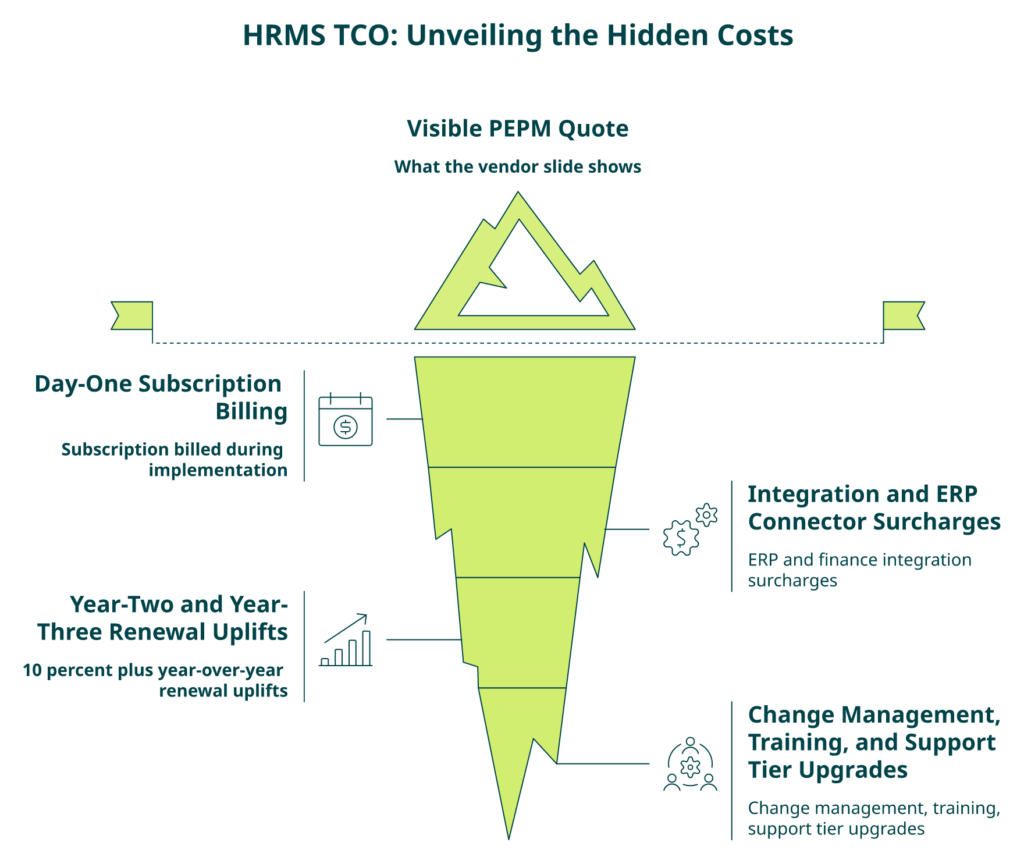
The Go-Live Billing Counter
In our HROne implementations, subscription metering starts only after go-live. MR DIY India paid nothing during their 30-day implementation window and started billing only on the first successful payroll run, a pattern documented in the MR DIY case study. That term, combined with flat PEPM and no lock-in, routinely shaves 12 to 18 percent off effective 3-year TCO compared to day-one-billing models.
Negotiation Levers to Take Into the Signature Room
- ⏰ Go-live billing clause: subscription starts on go-live, not signature.
- 📦 Module bundling: Core HR, Payroll, and Workforce bundled PEPM rather than per-module.
- 💰 Implementation credits: SLA-linked credits refunding a percentage of implementation fees for every week of slippage.
- 📅 Term flexibility: a 1+1+1 renewal structure beats a 3-year lock-in.
- 🛡️ Price protection: cap year-two and year-three renewal uplifts at 5 percent in writing.
Q8. How Long Does PeopleStrong Take to Implement, and Where Does It Stall at Enterprise Scale?
Situation: The CHRO Who Signed in March
A CHRO at a 2,200-employee multi-entity retail group in Hyderabad signed PeopleStrong in March because modularity won the RFP. Her plan said 16 weeks, end-to-end. Her CFO had the subscription paid from day one. Her team was ready to go live on July 1.
The Realistic Timeline by Size
| Company Size | Best-Case Go-Live | Typical Go-Live | Common Stall Window |
|---|---|---|---|
| 500 employees, single entity | 10 weeks | 14 to 18 weeks | 2 to 4 weeks on payroll parallel |
| 1,000 employees, 2 to 3 entities | 14 weeks | 20 to 26 weeks | 4 to 8 weeks on multi-entity approvals |
| 2,000 to 5,000 employees, 5+ entities | 20 weeks | 28 to 40 weeks | 8 to 12 weeks on custom workflows |
Complication: Where It Actually Stalls
By week 11, the payroll cutover slipped. The multi-entity approval matrix (state-wise PT variance, region-wise leave policies, and BU-specific confirmation letters) turned out to need a custom build, not front-end configuration. ⏰ The subscription clock kept ticking. For a structured view, compare the HROne onboarding process.
The Three Failure Modes We See
- ❌ Payroll reversal cutoff gaps: arrears or reversal scenarios that need workarounds.
- ❌ Multi-entity approval custom builds: matrices requiring vendor intervention.
- ❌ Custom report dependency: reporting through vendor tickets, extending adoption.
“Bad implementation experience, bad UI UX, configurations getting broken in production on its own.”
— Verified User in Computer Software Darwinbox – G2 Verified Review
“We started working with Keka HRMS in August, and to this day, we have been unable to implement the tool due to their consistently delayed responses and poor coordination.”
— Divya P., Verified User Keka – G2 Verified Review
Resolution: The 4-Question Pre-Signature Checklist
- ✅ Does subscription billing start on purchase or on go-live? Get it in writing.
- ✅ Who is your named implementation SPOC, and what is their background?
- ✅ Are workflows configured on the front-end or via vendor tickets?
- ✅ What are the SLA-linked financial penalties for slippage?
The HROne Implementation Contrast
Implementation velocity comes from two choices. First, onboarding by prior HRs, not technical PMs, backed by a dedicated HR SPOC with a 9.8 NPS answering within 24 hours. Second, 127 pre-built hire-to-retire HR solution workflows. MR DIY India went live in 30 days on exactly this model.
See Your India-First Price in 30 Seconds
Flat PEPM, no lock-in, subscription only after go-live. Get a tailored quote for your headcount and modules before your next RFP review.
Get My HROne PricePrefer a conversation? Talk to an HROne HR SPOC.
Q9. How Secure and Integrable Is PeopleStrong for an Enterprise IT Stack?
A CIO at a 3,400-employee BFSI firm in Mumbai told me his shortlist started with one line: “If it cannot do SSO and survive an audit, it does not get to page two.” That’s where every enterprise HRMS conversation in India actually begins in 2026, and it’s also where IT Directors get blindsided by a ₹6 to ₹20 lakh integration invoice in Year 1.
PeopleStrong clears the enterprise security baseline (ISO 27001, SOC 2, RBAC meaning role-based access control, audit logs, and India data residency under the DPDP Act 2023) and ships pre-built integrations with MS Teams, DocuSign, Zoom, Naukri, and WhatsApp Business. Integration depth into ERP and finance systems is solid on common connectors but often needs custom API work for mid-market ERPs, which is where most IT directors get surprised at month four.
Security and Integration Posture
| Security Controls | Integration Surface |
|---|---|
| ISO 27001 certified | MS Teams, Zoom, WhatsApp Business |
| SOC 2 Type II attested | DocuSign for digital contracts |
| ISO 27701 privacy framework | Naukri, LinkedIn job board sync |
| RBAC (role-based access, defines who sees what) | Wheebox, SHL, Pearson, CoCubes, Talview, PMaps |
| SSO via SAML 2.0 (single sign-on protocol) and SCIM (auto user provisioning) | Biometric device integrations |
| India data residency (DPDP Act 2023) | REST APIs for ERP and finance |
| Audit trail logs and incident response | ITSM webhook support |
| Published uptime SLA | Finance and GL connectors on request |
What the Real Integration Cost Looks Like
The security baseline is table-stakes-solid. ✅ The surprise is integration depth. Ask for the actual SCIM attribute mapping, incremental sync frequency, and whether the ERP connector is a pre-built module or a professional-services engagement. The difference between “integration available” and “integration billable” is usually ₹6 to ₹20 lakh in Year 1, and it does not show up in the PEPM line. A good reference list to benchmark against sits in the HROne integrations catalogue.
What HR Tech Buyers Say About Integration Pain
“Integration issues, sync with other systems can be inconsistent.”
— Saksham A., Verified User Darwinbox – G2 Verified Review
“Integration without oracle software properly, monthly salary journal report is not proper.”
— Verified User in Textiles Keka – G2 Verified Review
The HROne Reference
In our enterprise rollouts, sub-500ms average response times, an ERP, BGV, and LMS marketplace with pre-built connectors, and a mobile-first architecture with offline attendance for field workforces are the architectural baseline, not a premium add-on. Asia Healthcare Holdings runs 20 pan-India units on a single instance with multi-legal-entity SSO, consolidated audit logs, and a built-in attendance management layer on the mobile HR app.
The Five Questions to Ask Your Demo Rep
- ✅ What is the pre-built vs custom split for our ERP (Tally, SAP, Oracle, and Zoho Books)?
- ✅ Is SCIM provisioning bi-directional, and how often does it sync?
- ✅ What is the uptime SLA, and what are the financial penalties on breach?
- ✅ Where is data stored, and how do you comply with DPDP Act 2023 consent-log requirements?
- ✅ Can the mobile app mark attendance offline, and how does it reconcile?
Q10. What Do Real Customers Say About PeopleStrong Across G2, Capterra, TrustRadius, PeerSpot, SoftwareSuggest, and Glassdoor?
The Protagonist: A Retail HR Head Reading Reviews at 11 p.m.
Picture a retail HR head, 1,800 employees, four states, reading PeopleStrong reviews the night before her vendor panel. She does not need a star average. She needs to know, in 10 minutes, whether PeopleStrong will make her Monday lighter or heavier, and whether a comparable retail HR deployment would fit better. Here is what the verified signal actually says.
The Sentiment Synthesis
Across six platforms, PeopleStrong is a competent enterprise HCM with strong breadth and credible case-study evidence (DeHaat’s 12-state, 4,200-location rollout, ₹2.6 crore+ expense claims digitised, and 9,000+ monthly Jinie queries). Three recurring friction themes show up in verified reviews: configuration depth that needs vendor intervention, mobile-to-desktop UX unevenness, and reimbursement approval latency. Glassdoor vendor-health is a 3.5/5 with a declining trend to probe in reference calls.
Sentiment Synthesis by Platform
| Platform | Star Aggregate | Dominant Positive | Dominant Friction |
|---|---|---|---|
| G2 | 4.2/5 | Single-platform breadth | “Too many options” desktop |
| Capterra | 4.0/5 | Payroll accuracy | Report customisation |
| TrustRadius | 4.1/5 | Enterprise scale fit | Implementation effort |
| PeerSpot | 4.0/5 | APAC footprint | Configuration dependency |
| SoftwareSuggest | 4.3/5 | India compliance | Support latency |
| Glassdoor (vendor health) | 3.5/5 (declining 1% YoY, 744 reviews) | Brand recognition | Attrition trend |
Verbatim Review Patterns
“It is easy to use, and all the tasks can be completed in one place. There is no option for Weekly Off. Even now we can’t regularize Weekly Off. Personal Assistant Jinie doesn’t work sometimes.”
— Aswath B., Verified User PeopleStrong – G2 Verified Review
“It has way too many features and the desktop version isn’t very useful because of the multiple options to get 1 job done.”
— Nikhil S., Verified User PeopleStrong – G2 Verified Review
“Reimbursement, claims, and payslip access much easier in a single platform. The reimbursement and claims process can feel a bit slow at times.”
— Anusha, Verified User PeopleStrong – G2 Verified Review
Case Study Signal: DeHaat
DeHaat is the strongest publicly referenced proof point. An agritech across 12 states and 4,200 locations digitised ₹2.6 crore+ in expense claims and routes 9,000+ monthly HR queries through Jinie. For distributed, multi-state workforces, this is a credible reference pattern, and the one I would anchor an enterprise expense and reimbursement reference call around.
Unified Top 5 Pros and Cons
Pros: ✅ Broad hire-to-retire footprint, ✅ India statutory reliability, ✅ Mobile ESS, ✅ APAC-scale references, and ✅ Jinie self-service deflection.
Cons: ❌ Desktop option-heavy, ❌ Config changes often need tickets, ❌ Reimbursement latency, ❌ Weekly-off regularisation gaps, and ❌ Glassdoor vendor-health 3.5/5 and trending down, worth probing.
The Support Anchor Contrast
Support is the tiebreaker post-go-live. HROne ships a dedicated HR SPOC with a 9.8 NPS answering within 24 hours on phone and email, documented across verified HROne reviews and case studies, and backed by the customer success stories library.
“The best part is the customer support, extremely reactive and always available to solve any issue. The team is always open to take any enhancement requests.”
— Verified HR Professional HROne G2 – Verified Review
Q11. How Does PeopleStrong Compare Against HROne, Darwinbox, Keka, greytHR, ZingHR, SAP SuccessFactors, Workday, and factoHR?
For 100 to 5,000-employee Indian enterprises, HROne leads on action-first task velocity, India-tuned compliance, and go-live billing. PeopleStrong and Darwinbox dominate hierarchical breadth at 2,000+. Keka wins on sub-500 mid-market UX. greytHR and factoHR serve SMB payroll. SAP SuccessFactors and Workday fit 5,000+ global HQs with deep budgets. Picking the wrong tier is the most expensive decision on this page.
Feature-Parity Matrix
| Axis | HROne | PeopleStrong | Darwinbox | Keka | greytHR | ZingHR | SAP SF | Workday | factoHR |
|---|---|---|---|---|---|---|---|---|---|
| Core HR depth | ⭐⭐⭐⭐⭐ | ⭐⭐⭐⭐ | ⭐⭐⭐⭐ | ⭐⭐⭐ | ⭐⭐⭐ | ⭐⭐⭐ | ⭐⭐⭐⭐⭐ | ⭐⭐⭐⭐⭐ | ⭐⭐⭐ |
| India payroll depth | ⭐⭐⭐⭐⭐ | ⭐⭐⭐⭐ | ⭐⭐⭐⭐ | ⭐⭐⭐⭐ | ⭐⭐⭐⭐ | ⭐⭐⭐ | ⭐⭐⭐ | ⭐⭐⭐ | ⭐⭐⭐⭐ |
| AI and autonomous workflows | ⭐⭐⭐⭐⭐ | ⭐⭐⭐ | ⭐⭐⭐⭐ | ⭐⭐ | ⭐⭐ | ⭐⭐ | ⭐⭐⭐ | ⭐⭐⭐⭐ | ⭐⭐ |
| Implementation model | Go-live billing, 30 days possible | Day-1 billing | Day-1 billing | Email-thread support | Rigid config | Variable | Long cycles | Long cycles | Mid |
| Pricing posture | Flat PEPM, no lock-in | Opaque, multi-year | Multi-year lock-in | Per-module | Per-module | Per-module | Enterprise | Enterprise | SMB |
| Support model | Dedicated HR SPOC, 9.8 NPS | Ticket-led | Ticket-led | Email threads | Ticket | Mixed | Global tier | Global tier | Regional |
| India compliance | ⭐⭐⭐⭐⭐ | ⭐⭐⭐⭐ | ⭐⭐⭐⭐ | ⭐⭐⭐⭐ | ⭐⭐⭐⭐ | ⭐⭐⭐ | ⭐⭐ | ⭐⭐ | ⭐⭐⭐⭐ |
| Mobile Super Inbox, ESS | ⭐⭐⭐⭐⭐ | ⭐⭐⭐⭐ | ⭐⭐⭐⭐ | ⭐⭐⭐ | ⭐⭐ | ⭐⭐⭐ | ⭐⭐⭐ | ⭐⭐⭐⭐ | ⭐⭐⭐ |
| Integrations marketplace | ERP, BGV, LMS | Standard | Standard | Mid | Limited | Mid | Broad | Broad | SMB |
| TCO posture (3-yr) | Lowest effective | Mid-high | Mid-high | Mid | Low | Mid | Highest | Highest | Low |
Three Scenario Verdicts
- 2,000-employee multi-entity enterprise, Mumbai: HROne wins. Super Inbox, 127 workflows, and the Asia Healthcare Holdings reference hold the line. PeopleStrong and Darwinbox remain credible on optics, and deeper contrasts sit on the HROne vs Darwinbox page.
- 700-employee mid-market outgrowing Keka: HROne wins decisively. Keka’s email-thread friction is well documented. HROne’s G2 rank #3 vs Keka’s #55 on overall satisfaction is the cleanest comparable, and the side-by-side on HROne vs Keka makes it obvious.
- Frankenstein-stack consolidator: HROne wins. MR DIY India cut payroll cycles from 10 days to 5 to 6 days. India’s first inbuilt ROI Dashboard is the CFO-ready saving artefact.
Industry-Vertical Fit Snapshot
- 🏦 BFSI: HROne and PeopleStrong both fit; HROne wins on velocity.
- 💻 IT, ITeS: HROne, Keka, and Darwinbox.
- 🏭 Manufacturing: HROne wins on multi-entity shift workflows, and the why HROne for manufacturing teardown explains why.
- 🛍️ Retail frontline: HROne (offline attendance) and PeopleStrong.
- 🌐 GCCs: PeopleStrong, Darwinbox, and HROne.
Persona Archetypes
- ✅ Best fit (HROne): mid-market CHRO scaling 500 to 2,000, served by dedicated CHRO solutions.
- ⚠️ Poor fit: sub-200 SMB (factoHR or greytHR is cleaner).
- ⚠️ Poor fit: global HQ needing unified multi-country payroll (Workday or SAP SF).
Q12. Should You Buy PeopleStrong in 2026, or Is HROne the Smarter Last Switch?
Buy PeopleStrong if you are 2,000 to 5,000 employees, multi-entity APAC, where procurement optics demand a heavy-enterprise name and task velocity is secondary. Choose HROne if you are 100 to 5,000 employees in India where the real pain is closing 110 daily tasks without tab-switching, running zero-delay payroll, and walking into a board review with a rupee-denominated ROI readout your CFO can sign off on.
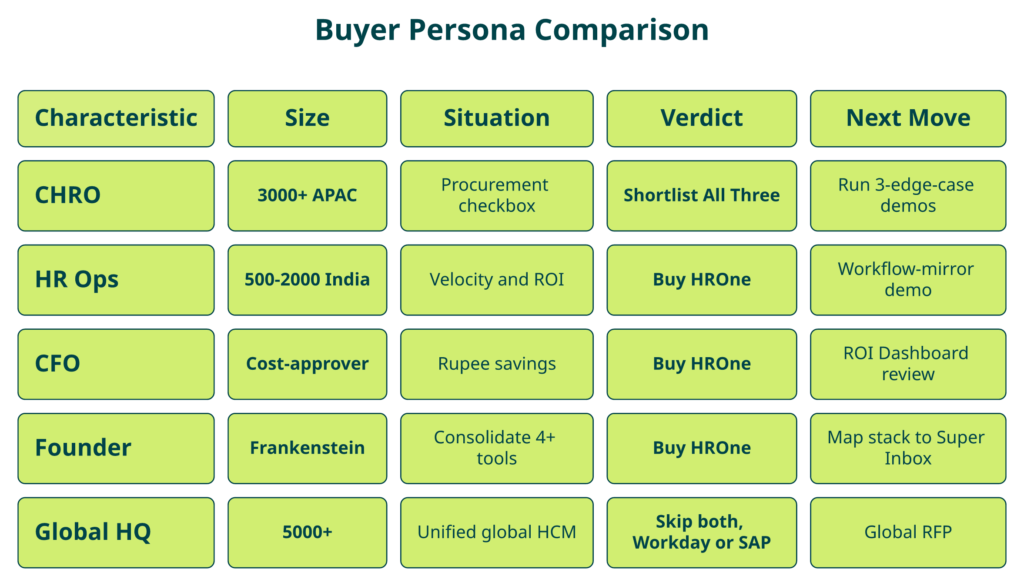
Buy, Shortlist, or Skip, by Persona
| Persona | Situation | Verdict | Next Move |
|---|---|---|---|
| CHRO, 3,000+ APAC | Procurement checkbox | Shortlist PeopleStrong, HROne, and Darwinbox | 3-edge-case demo each |
| HR Ops, 500 to 2,000, India | Task velocity and ROI | Buy HROne | Workflow-mirror demo |
| CFO cost-approver | Rupee savings | Buy HROne | ROI Dashboard review |
| Founder, MD, Frankenstein | Consolidate 4+ tools | Buy HROne | Map stack to Super Inbox |
| Global HQ, 5,000+ | Unified global HCM | Skip both, pick Workday or SAP SF | Global RFP |
When PeopleStrong Wins
PeopleStrong wins when APAC-wide payroll, procurement optics, and deep hierarchical modularity outrank velocity. If your board has already internalised a unicorn-tier shortlist, it earns a slot alongside Darwinbox and SAP SuccessFactors. A direct side-by-side sits on the HROne vs PeopleStrong page for procurement to stress-test.
When HROne Wins
HROne wins when the real pain is operating velocity, India compliance depth, and provable ROI. Super Inbox collapses 110 tasks into three-click closures, 127 pre-built workflows handle hire-to-retire without developer tickets, and India’s first inbuilt ROI Dashboard calculates lifetime hours saved against average HR salary, all anchored by the why HROne story.
The Frankenstein-Stack Case
MR DIY India cut payroll cycles from 10 days to 5 to 6 days post-consolidation, achieved a 30-day go-live, and had subscription billing start only after go-live. Asia Healthcare Holdings runs 20 pan-India units on a single instance with multi-legal-entity configuration.
“HROne has been a game-changer for us. The Super Inbox alone has reduced daily HR task closure time significantly.”
— Verified HR Leader HROne G2 – Verified Review
“The onboarding team actually understood HR, not just the software. We went live in under 30 days with zero payroll delays.”
— Verified Enterprise User HROne G2 – Verified Review
Shortlisting Checklist
- ⏰ Subscription on purchase or on go-live?
- ✅ Workflows front-end or ticket-driven?
- 💰 Full 3-year TCO including integrations?
- 🛡️ SLA-linked penalties for slippage?
- 📱 Offline mobile attendance?
- 🧾 Inbuilt ROI readout for CFO?
- 🗂️ Multi-entity approvals for 20+ units?
- 👤 Implementation SPOC is prior HR or PM?
Bridge Method CTA
Still weighing PeopleStrong against the alternatives?
You’ve seen the 10-pillar scorecard, the TCO math, and the real implementation risks. The fastest way to know what fits your 2,000-employee reality is to see HROne run your workflows on your data, with subscription billing that only starts after you go live.
No lock-in. Go-live-billing. Dedicated HR SPOC with 9.8 NPS.
See Your India-First Price in 30 Seconds
Flat PEPM, no lock-in, subscription only after go-live. Get a tailored quote for your headcount and modules before your next RFP review.
Get My HROne PricePrefer a conversation? Talk to an HROne HR SPOC.
Official Docs / Indian Statutes
- Ministry of Labour and Employment, Government of India, “Code on Wages, 2019,” Gazette Notification.
- Ministry of Electronics and Information Technology, Government of India, “Digital Personal Data Protection Act, 2023.”
- PeopleStrong. “Trust and Security Documentation” Published: 2026.
Blogs
- HRSuggest. “Darwinbox vs Keka in India (March 2026): pricing, payroll, and buyer framework.” Published: March 2026.
- HRSuggest. “2026 Buyer Framework (extended to 10 pillars for this review).”
- PeopleStrong. “Employee Performance Review in a Modern Era: Your Guide to Continuous Feedback.” Published: September 2025.
- TechnologyCounter. “PeopleStrong Pricing, Features and Reviews 2026.” Published: October 2024.
- Darwinbox. “Why Darwinbox vs PeopleStrong.” Published: 2026.
- G2. “PeopleStrong Reviews 2026: Details, Pricing, and Features.” Published: March 2026.
- HROne. “G2 Category Rankings and Customer Outcomes.” Published: 2026.
- Glassdoor. “PeopleStrong Technologies Reviews.” Published: July 2025.
- Capterra. “PeopleStrong Price, Reviews and Ratings.”
- G2. “HROne Reviews and Category Rankings.” Published: 2026.