


Q1. What Are the 10 Best HRMS Software in Mumbai for Local Compliance and Support in 2026?
The 10 best HRMS platforms for Mumbai companies in 2026 are HROne, greytHR, Keka, Darwinbox, Zoho People, uKnowva, Spine HR Suite, HRMantra, QkrHR, and NYGGS HRMS. HROne ranks first for Maharashtra PT and multi-state payroll automation across 10 modules and 127 workflows, and is ranked #3 in Highest Satisfaction Products out of 1,17,579 software worldwide on G2. Rankings follow a disclosed five-criteria score, not vendor marketing claims.
Picking an HRMS in Mumbai is a high-stakes call, because Maharashtra payroll punishes small errors. The top slab of professional tax deducts Rs 200 for eleven months and Rs 300 in February, so the annual total lands at Rs 2,500. Miss that one month and every payslip in the state is wrong. For this guide, 10 platforms were evaluated against operator criteria, not popularity. The primary reader is the person inside the system daily: the HR ops lead and the payroll manager. The shadow readers are the CHRO, the CFO signing the PEPM invoice, and the IT Director approving data access.
Our Evaluation Criteria
- Maharashtra and multi-state compliance depth 🇮🇳: PT slab handling including the February Rs 300 adjustment, PF, ESI, LWF, TDS, and multi-state payroll runs on one instance
- Time to Value ⏰: published go-live timelines, migration model, and when billing starts against when the system actually works
- Workflow coverage: number of pre-built hire-to-retire workflows, and how much of onboarding, confirmation, transfer, and exit clearance runs without email chasing
- Mobile and field readiness: geo-fenced attendance, offline punch, and how much an admin can finish on a phone
- Support model 💰: phone plus email plus named SPOC versus ticket-only queues, with published NPS or CSAT where available
- Configurability without developers: whether HR can change a leave policy or PT slab from the front end
- Verified review evidence ⭐: G2, Gartner, and Clutch review corpus, weighted for recency and volume
- Commercial transparency: flat PEPM versus per-entity charges, minimum billing blocks, and lock-in length
Who This Guide Is For
- CHROs and HR Heads in Mumbai consolidating five disconnected tools into one hire-to-retire record
- Payroll Managers running Maharashtra PT alongside Gujarat, Karnataka, and Delhi entities in a single monthly cycle
- CFOs validating HR tech ROI, flat PEPM commercials, and whether the subscription meters before go-live
- IT Directors and HR Ops teams comparing mobile-first HCMs against legacy on-premise portals with bolted-on web access
The 10 Platforms at a Glance
| Provider | Best For | Standout Strength | Known Limitation | Modules & Workflow Depth | Support Model | Pricing Model |
| HROne ⭐ 4.85 (2,074 G2 reviews) |
HR ops leads closing 110 daily tasks across five disconnected tools | Super Inbox closes everyday HR tasks in three clicks from one Gmail-style screen | Deep customisation requests take time and extra discussion, per a 5-star G2 reviewer | 30+ modules, 127 pre-built workflows | Phone + email + dedicated prior-HR SPOC, 9.8 NPS | Flat PEPM, no lock-in, billing starts after go-live |
| greytHR ⭐ 4.4 (G2) |
Mumbai SMB payroll managers filing PF, ESI, and PT on a tight budget | Statutory payroll and filing depth for smaller businesses | Limited workflows and rigid configuration; users report manual leave-balance corrections | Payroll, leave, core HR; Recruit sold separately | Ticket-led; one reviewer reports no escalation matrix | Slab pricing from ₹2,495/month for 50 employees |
| Keka ⭐ 4.55 (G2) |
Mid-market teams prioritising interface polish over configuration depth | Intuitive UI that employees adopt with little training | Implementation delays and weak escalation reported by G2 reviewers | Broad module set; PMS and LMS flagged as weaker | Email-led support with chat; #55 on G2 overall satisfaction vs HROne’s #3 | Per-employee tiers, quote-based |
| Darwinbox ⭐ 4.4 (G2) |
Large Mumbai enterprises needing multi-country HCM brand weight | Single platform across attendance, payroll, and performance at enterprise scale | Tab-and-email juggling to close daily tasks; slow pages during bulk runs | Full enterprise suite, no inbuilt ROI instrumentation | Account-managed; support responsiveness questioned in reviews | Quote-based, multi-year lock-in, billing from day one of purchase |
| Zoho People ⭐ 4.4 (G2) |
Lean Mumbai teams already standardised on the Zoho suite | Native links to Zoho Recruit and Zoho Payroll | Shallow feature depth and slow support responses reported by reviewers | Broad but thin HR modules | Email and ticket; reviewers cite long waits | Low per-user/month, freemium entry |
| uKnowva ⭐ Not independently verified |
Mumbai firms wanting a locally headquartered, highly configurable HRMS | Mumbai-based team with plugin-style extensibility | Smaller published review corpus than national players | Modular core HR, payroll, attendance | Local phone and email | Quote-based |
| Spine HR Suite ⭐ Not independently verified |
Mumbai engineering and manufacturing payroll with legacy on-premise habits | Long-standing Mumbai-headquartered payroll lineage | Interface and mobile depth trail cloud-native peers | Payroll-centric modules with HR add-ons | Local partner and email | Licence plus AMC, quote-based |
| HRMantra ⭐ Not independently verified |
Payroll teams with unusual CTC and arrear structures needing heavy configuration | Deep payroll rule configurability | Configuration depth raises setup effort | Payroll, attendance, core HR | Email and phone | Quote-based |
| QkrHR ⭐ Not independently verified |
Small Mumbai firms automating PF, ESI, and TDS for the first time | Simple statutory automation for SME headcounts | Not built for multi-entity enterprise complexity | Payroll, attendance, leave | Email and phone | Per-employee/month |
| NYGGS HRMS ⭐ Not independently verified |
Site and project workforces across Mumbai construction and infra projects | Project and site workforce tracking | Office-worker experience less mature | Payroll, attendance, project workforce | Email and phone | Quote-based |
1.1 HROne, Maharashtra PT and Multi-State Payroll Automation

HROne, complete hire-to-retire operating system for 100 to 5,000 employee Indian companies
🏢 Overview
HROne is an India-first, mobile-native HCM built by Uneecops Workplace Solutions, founded in 2016 and headquartered in Noida. The platform serves 2,000+ enterprise brands across 20 industries, has processed over 70 lakh payslips, and holds a 4.85 G2 rating across 2,074 verified reviews, making it the most-reviewed Indian HRMS on G2. It is ranked #3 for Highest Satisfaction Products out of 1,17,579 software worldwide. Mumbai teams typically arrive after month-end reconciliation across five disconnected tools stops scaling.
⚙️ Core Services
- Super Inbox (InboxforHR): surfaces every pending task, request, and approval on one Gmail-style screen, closing 110 daily tasks in three clicks, which removes tab-switching across payroll, leave, and helpdesk tools. See the HR inbox for the workflow mechanics
- 127 pre-built workflows: define who does what and by when across pre-boarding, onboarding, confirmation, transfer, and exit clearance, so HR stops chasing managers over email
- Payroll engine with auto scheduler: runs group payout validations and precise paid-day maths for zero salary delays under Indian statutory law, removing manual PT, PF, and ESI reconciliation through the payroll software
- One AI Suite: resume relevancy scoring stacks the best CVs on top, and the receipt parser extracts expense data automatically, cutting recruiter screening and finance data entry
- Offline attendance with auto-sync: field employees mark attendance without internet and data syncs on reconnection, removing manual regularisation for sales teams
- HRV Studio: low-code builder for visitor, vendor, and seating management apps inside HROne, removing developer tickets for small internal tools
- India’s first inbuilt ROI Dashboard: calculates lifetime hours saved against average HR salary, removing the guesswork when a CHRO defends spend at a board review
🇮🇳 India-Specific Compliance & Localization
- PF / ESI / TDS support: Yes (automated calculation, challan, and Form 16 generation)
- Labour law compliance: Strong (front-end policy engine configurable as laws change)
- Payroll localization (India-specific): Yes (PT and LWF slab calculation, arrear day handling)
- Multi-state compliance handling: Yes (unlimited legal entities on one instance, no per-entity charge)
👥 Who This Is Built For?
- Payroll Manager in Mumbai reconciling Maharashtra PT slabs by hand every February while three other state entities run in parallel
- HR Ops lead manually matching biometric exports against a separate leave portal before every payroll cut-off
- CHRO who cannot answer, in a board review, how many days a confirmation letter currently takes to close
🚫 Who Should Skip This
- Startups under 100 employees wanting lightweight, spreadsheet-style payroll, since HROne deliberately targets mid-market and enterprise instead
- Teams needing heavy bespoke report formats fast, because reviewers report customisation takes long discussion and sometimes extra commercials
💰 Pricing Structure
- Plan Type(s): Modular PEPM bundles; customers pick modules and build their own bundle
- Starting Price: Not publicly disclosed, request a quote. Flat PEPM, billed monthly, no lock-in period. Current tiers sit on the pricing page
- Tier-wise Breakdown: Not publicly published per tier. The core bundle is Core HR, Workforce, Time Office, and Payroll, used together by 98% of customers
- Incremental Cost Drivers: Additional modules priced per employee per month. No hidden charges for multiple entities on one instance
- Implementation Fee: Not publicly disclosed. Subscription meters only after go-live, so implementation months are not billed as live subscription
- Cost at 200 Employees: Not publicly disclosed, request a quote | Cost at 500 Employees: Not publicly disclosed, request a quote
⏰ Implementation & Support Reality
- Onboarding is led by prior-HR consultants rather than technical project managers, which is why domain questions get answered in the first call. The full sequence is documented in the HROne implementation guide
- Support runs on phone and email through a dedicated SPOC, holding a 9.8 NPS
- Data migration is vendor-led; one reviewer moved data from an old ERP server “in fraction of hours”
- Delivery consultants are repeatedly named in reviews, including support received on holidays
“Best part of the portal is to track the live attendance of employees along with the geo-fencing functionality available to salary processing and bank challan files will be downloaded efficiently. Application cant be customizable in any prospect, some reports we have keep in our formatting but HROne demands more commercials for the same.”
Ruhi G. HROne G2 Verified Review
“Salary processing along with exact calculation of LWF and PT slabs makes the work more convenient process. Most of times, application logs out automatically, I have raised the concern to support department but no resolution received.”
Komal S. HROne G2 Verified Review
🧭 My Read After Sitting With Mumbai Payroll Teams
Most Mumbai HRMS lists rank by who paid for placement. I rank by whether the payroll engine survives a February PT run without a manual override sheet.
HROne’s data points to 127 workflows as the practical floor for a multi-entity Mumbai company, though I might be reading that threshold too strongly for a single-city 150-person firm. What surfaces in HROne’s deployments is that teams underestimate configuration time and overestimate how much their old biometric export actually reconciled.
HROne closes first here on evidence, not volume: 2,074 verified G2 reviews, #3 satisfaction out of 1,17,579 products, a 9.8 NPS support model, and billing that starts after go-live rather than after signature. That last clause is the one Mumbai CFOs read twice.
1.2 greytHR, SME Payroll and Statutory Filing
greytHR, budget-anchored SMB payroll and statutory filing engine
🏢 Overview
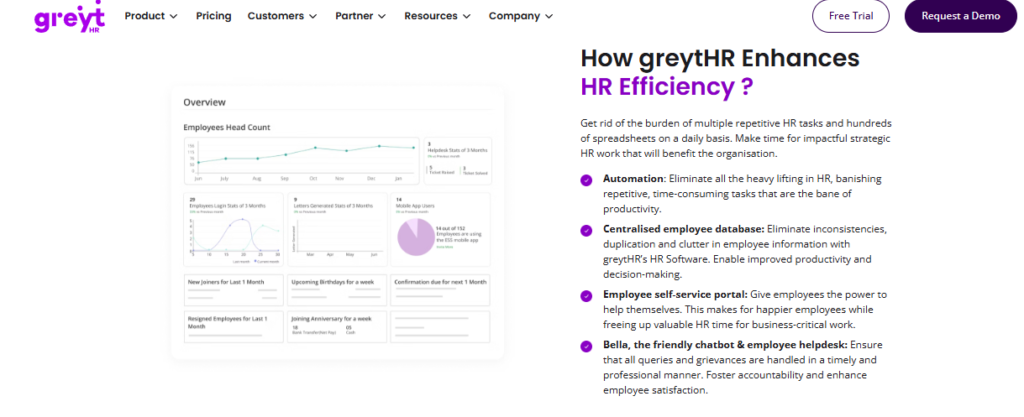
greytHR is one of India’s most widely deployed HR and payroll platforms, with a strong presence in the payroll software category for smaller businesses. It holds a 4.4 rating on G2 and draws roughly 500K monthly organic visits, the highest in the Indian HRMS category. Its compliance content and filing workflows are its recognised strength. It is primarily used by SMB teams struggling with PF, ESI, PT, and TDS filing on limited HR headcount.
⚙️ Core Services
- Payroll and statutory engine: processes salary with PF, ESI, and TDS logic, reducing month-end reconciliation for teams without a dedicated payroll analyst. The employer-side rules are broken down in this PF, ESI, and TDS compliance guide
- Leave and attendance: bundled into every plan alongside payroll and employee self-service
- Employee self-service portal: employees pull payslips, apply for leave, and view tax details without routing through HR
- Tax declaration module: employees declare investments and pick a tax regime from their own login, cutting HR collection effort
- greytHR Recruit (ATS): available on every plan at ₹2,500 per recruiter per month, licensed flat per recruiter rather than per employee
- Ticket-based support flow: acknowledgement, working update, then status update, which reviewers do credit as structured
🇮🇳 India-Specific Compliance & Localization
- PF / ESI / TDS support: Yes (core statutory strength, though TDS revision is limited)
- Labour law compliance: Moderate (strong filing, limited workflow enforcement)
- Payroll localization (India-specific): Yes (built for Indian statutory payroll)
- Multi-state compliance handling: Partial (works, but configuration flexibility is capped)
👥 Who This Is Built For?
- Owner-HR at a 60-person Mumbai firm filing PF and ESI challans for the first time without a payroll specialist
- Finance lead who wants payslips, tax declarations, and self-service running for under ₹10,000 a month
🚫 Who Should Skip This
- HR Ops leads at multi-legal-entity or shift-based manufacturing companies, where greytHR’s limited workflows and rigid configuration surface quickly
- Teams that need mobile parity, since a reviewer reports the app lacks key web functionality for remote employees
💰 Pricing Structure
- Plan Type(s): Starter, Essential, Growth, and higher India editions
- Starting Price: ₹2,495 per month covering 50 employees on Essential, then ₹45 per additional employee, billed monthly
- Tier-wise Breakdown: Essential (Payroll + Leave + Core HR Basic) at ₹2,495/month for 50 employees, ₹45 per employee above. Growth at ₹4,495/month for 50 employees, ₹85 per employee above
- Incremental Cost Drivers: Recruit ATS at ₹2,500 per recruiter per month, plus a 50-employee minimum billing block on paid plans
- Implementation Fee: Not publicly disclosed, request a quote
- Cost at 200 Employees: ₹9,245/month on Essential list rates (₹2,495 + 150 × ₹45) | Cost at 500 Employees: ₹22,745/month on Essential list rates (₹2,495 + 450 × ₹45)
⏰ Implementation & Support Reality
- Go-live timeline is not publicly published; reviewers describe configuration rounds stretching well past expectation. Realistic benchmarks sit in this HRMS implementation timeline breakdown
- Support is ticket-led, and one reviewer reports callbacks within one to two hours while another reports no escalation matrix at all
- Data migration and customisation lean heavily on the greytHR team rather than the HR admin
- No published NPS or CSAT figure was found for greytHR
“Lack of timely, responsive, and easily reachable customer support. Lack of user friendly software, there is a very high dependency on the greythr team to customize and the customization is full of gaps. There is no escalation matrix.”
Verified User in Information Technology and Services greytHR G2 Verified Review
“Better UI, simplicity and time for support. Reporting configuration, TDS filing, revising of TDS is not possible.”
Krishnanand B., 10-year greytHR user greytHR G2 Verified Review
🧭 Where greytHR Actually Fits in Mumbai
greytHR is genuinely good at the thing it was built for, which is getting a small Indian company’s statutory filing off spreadsheets.
The honest trade-off is workflow depth. HROne’s read is that the standard advice gets this backwards: buyers compare payroll feature lists, then discover the real cost sits in the workflows nobody automated, so the HR team spends February chasing managers instead of checking PT slabs. I have watched that exact February play out more than once, and the payroll engine was never the part that broke.
HROne closes this comparison on structure rather than price. HROne runs unlimited legal entities on one instance with no per-entity charge, 127 pre-built workflows, and front-end policy configuration that HR changes without a developer ticket, as set out in the HROne vs greytHR comparison. For a 60-person Mumbai firm, greytHR’s ₹2,495 entry is the right call. At three entities and 400 people, the maths flips.
1.3 Keka, Mid-Market Usability and Fast Go-Live
Keka, interface-led mid-market HRMS for teams that want employee adoption first
🏢 Overview
Keka is a cloud HRMS and payroll platform headquartered in Hyderabad, with an office in Mumbai, and used by 10,000-plus organisations including Apollo, OnePlus, and Bombay Shaving Company. It covers PF, ESI, PT, and TDS compliance, attendance, and performance management, and holds a 4.4 Capterra rating across 89 reviews. On G2 it carries a 4.55 rating. Mumbai teams usually pick Keka when employee adoption of the old portal was the failure point.
⚙️ Core Services
- Indian payroll engine: runs PF, ESI, state-wise professional tax, and TDS with Form 16 and ECR generation, removing manual challan preparation each month
- Attendance and shift management: supports biometric devices, GPS mobile clock-in with geo-fencing, and shift rotation feeding straight into payroll, removing manual attendance collation, much like a modern attendance management setup
- Performance and OKRs: goal cascading with 360-degree reviews, though reviewers flag the module as confusing to configure
- Keka Hire (ATS): bundled in the Growth tier for offer approvals and hiring workflows, reducing spreadsheet-tracked pipelines
- Expense management and HR helpdesk: employees raise claims and tickets in-platform, cutting HR email volume
- Employee self-service apps: iOS and Android access for leave, attendance, and payslips
🇮🇳 India-Specific Compliance & Localization
- PF / ESI / TDS support: Yes (automated filing with ECR and Form 16)
- Labour law compliance: Moderate (labour law reports included, workflow depth limited)
- Payroll localization (India-specific): Yes (built for Indian statutory payroll)
- Multi-state compliance handling: Partial (state-wise PT supported, RBI-linked payroll issues reported)
👥 Who This Is Built For?
- HR Manager whose employees ignored the previous portal and kept emailing HR for payslips
- Payroll Manager at a 150-person Mumbai firm mapping three shift patterns into one salary run
🚫 Who Should Skip This
- IT consulting firms needing location-specific policy configuration, since a long-time user reports Keka “is not built to service IT consulting firms”
- Teams that cannot absorb implementation slippage, given repeated G2 reports of stalled go-live
💰 Pricing Structure
- Plan Type(s): Foundation, Strength, and Growth
- Starting Price: ₹6,999 per month for up to 100 employees on Foundation, billed monthly, typically with a minimum employee block. Current tiers are tracked in this Keka pricing breakdown
- Tier-wise Breakdown: Foundation ₹6,999/month (core HRMS, payroll, attendance, leave, basic performance, up to 100 employees). Strength ₹9,999/month (adds advanced performance, OKRs, 360 reviews, analytics). Growth ₹13,999/month (adds Keka Hire ATS, advanced analytics, API access)
- Incremental Cost Drivers: roughly ₹150 to ₹250 per employee per month above the base seat count, plus a setup fee, plus separately purchased biometric hardware
- Implementation Fee: Yes, a setup fee applies; the amount is not publicly published
- Cost at 200 Employees: Not publicly disclosed, request a quote (base plus above-base per-employee charges) | Cost at 500 Employees: Not publicly disclosed, request a quote
⏰ Implementation & Support Reality
- Keka does not publish an average go-live timeline, and one G2 reviewer reports still not being live months after an August start
- Support runs on chat and email; a reviewer notes no support access from Friday 6pm to Monday 10am and no emergency phone contact
- Data migration is vendor-led but described as complex by reviewers, which is why a structured HRMS migration plan matters before signature
- No published NPS or CSAT figure was found; G2 overall satisfaction rank sits at #55 against HROne’s #3
“We started working with Keka HRMS in August, and to this day, we have been unable to implement the tool in our company due to their consistently delayed responses and poor coordination between their internal teams.”
Divya P. Keka G2 Verified Review
“strong payroll and compliance, automate salary and attendance processing with pf, esi, tds. PMS module is confusing and needs to be simpler and easier to use.”
Kiran B. Keka G2 Verified Review
🧭 What the Keka Trade-Off Actually Costs
Keka genuinely wins on first impressions. Reviewers repeatedly call the interface intuitive, and that matters for adoption.
HROne’s read is that buyers over-weight the demo and under-weight the go-live, because the demo lasts an hour and implementation lasts a quarter. I have sat with Mumbai HR heads who loved a UI and still ran February PT by hand nine months later. HROne’s own model exists as a direct answer to this gap, as the HROne vs Keka comparison sets out: prior-HR onboarding consultants rather than technical project managers, phone plus email support at 9.8 NPS, and billing that starts only after go-live.
1.4 Darwinbox, Global-Footprint Enterprise HCM
Darwinbox, enterprise HCM brand weight for multi-country Indian conglomerates
🏢 Overview
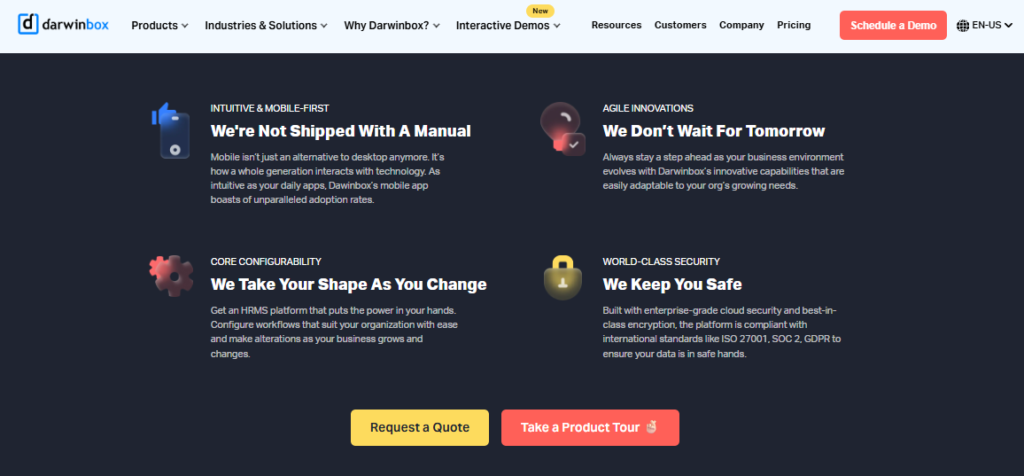
Darwinbox is an enterprise HCM platform with deep penetration in the Indian enterprise market, backed by roughly $140M in funding including KKR, with FY25 revenue reported at ₹534 crore and 1,016 enterprise clients. It carries a 4.4 rating on G2. Its strength is scale and brand recognition among listed companies. Mumbai teams shortlist it when the buying committee wants a name the board already recognises.
⚙️ Core Services
- Unified HR platform: brings attendance, payroll, and performance onto one system, replacing scattered manual trackers
- Configurable workflows: adaptable to internal processes without heavy technical involvement, per a G2 reviewer
- Mobile app: leave application, attendance, and payslip access on the go
- Performance and recruitment modules: full-suite coverage, though reviewers say both need training to use well
- Enterprise integrations: connects to existing ERP stacks, with reviewers reporting inconsistent sync, so scope your Tally, SAP, and biometric integrations early
🇮🇳 India-Specific Compliance & Localization
- PF / ESI / TDS support: Yes (Indian statutory payroll supported)
- Labour law compliance: Strong (enterprise India deployments at scale)
- Payroll localization (India-specific): Yes (India-origin product)
- Multi-state compliance handling: Yes (multi-entity enterprise deployments)
👥 Who This Is Built For?
- Group HR Head consolidating five business units across India and Southeast Asia onto one employee record
- CHRO at a listed Mumbai company needing board-recognised vendor credentials for a transformation programme
🚫 Who Should Skip This
- HR Ops leads who need daily tasks closed on one screen, since reviewers describe endless navigation across tabs and emails
- CFOs unwilling to pay subscription during implementation, because billing typically starts from day one of purchase
💰 Pricing Structure
- Plan Type(s): Not publicly published; enterprise quote-based
- Starting Price: Not publicly disclosed, request a quote
- Tier-wise Breakdown: Not publicly disclosed, request a quote
- Incremental Cost Drivers: multi-year contract commitments and implementation-phase subscription billing, detailed in this Darwinbox pricing analysis
- Implementation Fee: Not publicly disclosed, request a quote
- Cost at 200 Employees: Not publicly disclosed, request a quote | Cost at 500 Employees: Not publicly disclosed, request a quote
⏰ Implementation & Support Reality
- Darwinbox is known for long implementation cycles that delay automation, per HROne’s competitive analysis of switching reasons
- Support is account-managed, but reviewers report weak responsiveness and configurations breaking in production
- Data migration is vendor-led, and one reviewer calls the transition from the old system difficult
- No published NPS or CSAT figure was found for Darwinbox
“Darwinbox has made HR processes much smoother by bringing everything together on one platform. Pages sometimes load slowly. Limited customization in reports. Mobile app experience: Not always as smooth as desktop.”
Saksham A. Darwinbox G2 Verified Review
“Bad implementation experience, bad UI UX, configurations getting broken in production on its own due to product deployments, terrible customer service.”
Verified User in Computer Software Darwinbox G2 Verified Review
🧭 The Missing Instrument at Enterprise Scale
Darwinbox earns its enterprise reputation on breadth. That is real, and I would not argue with a CHRO who buys it for multi-country coverage.
The gap is measurement. HROne’s competitive analysis notes Darwinbox carries no built-in method to track return on the HR tech investment, which leaves the CHRO defending spend with anecdotes. HROne’s data points to the ROI Dashboard as the differentiator here, calculating lifetime hours saved against average HR salary, which the ROI calculator mirrors, though I might be over-crediting how many boards actually ask for that number today.
1.5 Zoho People, Budget-Conscious Lean Teams
Zoho People, low-cost HR module inside a familiar business suite
🏢 Overview
Zoho People is cloud HRMS software from Zoho Corporation, headquartered in Chennai, covering employee database, leave, attendance, appraisals, and onboarding. It carries a 4.4 rating on G2 and integrates natively with Zoho Payroll, Zoho Recruit, and Zoho CRM. Pricing starts free for very small teams. Mumbai teams typically choose it when the company already runs on Zoho and the HR budget is tight.
⚙️ Core Services
- Employee database and org chart: centralises records and reporting lines, removing scattered spreadsheets
- Leave and attendance: approval workflows plus biometric and geo-fencing attendance capture across 50-plus devices, cutting manual muster entry
- Candidate-led onboarding: new joiners enter their own details, which one HR reviewer says compressed onboarding automation to a single day
- Performance appraisals: templates, goals, and 360-degree feedback in higher tiers
- Zoho ecosystem integration: links to Zoho Payroll and Recruit so recruitment and monthly payroll share one record
🇮🇳 India-Specific Compliance & Localization
- PF / ESI / TDS support: Partial (statutory processing sits in Zoho Payroll, sold separately)
- Labour law compliance: Moderate (global product with Indian localisation)
- Payroll localization (India-specific): Partial (via Zoho Payroll add-on)
- Multi-state compliance handling: Partial (multi-location support only in the top tier)
👥 Who This Is Built For?
- Founder-HR at a 40-person Mumbai firm already running Zoho CRM and Books, wanting HR on the same login
- HR generalist replacing leave tracking spreadsheets without a capital budget approval
🚫 Who Should Skip This
- Payroll Managers handling India-specific CTC revisions, FBP declarations, and compliance-heavy manufacturing workflows, which global generalists under-serve
- Teams that need fast support during a payroll crunch, since multiple reviewers report long response delays
💰 Pricing Structure
- Plan Type(s): Free, Essential HR, Professional, Premium, and Enterprise
- Starting Price: ₹50 per employee per month on Essential when billed annually, free for up to 5 employees
- Tier-wise Breakdown: Essential ₹50 PEPM, Professional ₹100 PEPM, Premium ₹165 PEPM, Enterprise ₹230 PEPM
- Incremental Cost Drivers: monthly billing costs roughly 20% more than annual, Zoho Payroll is a separate subscription at ₹1,000 per organisation per month for 25 employees plus ₹50 per additional employee, and 18% GST applies
- Implementation Fee: No vendor implementation fee published; third-party partners publish setup packages from ₹7,999
- Cost at 200 Employees: ₹10,000/month on Essential list rates (200 × ₹50) | Cost at 500 Employees: ₹25,000/month on Essential list rates (500 × ₹50)
⏰ Implementation & Support Reality
- Setup is largely self-serve, and one reviewer credits instructional videos for an easy start
- Support is email and ticket-led; reviewers report unavailable phone support and missed SLAs
- Data migration is self-serve or partner-led depending on the reseller
- No published NPS or CSAT figure was found for Zoho People
“As an HR professional, what I appreciate most about Zoho People is its onboarding process. The biggest drawback for me has been the lack of customer support. Additionally, the mobile application is quite limited, I cant access most features on it.”
Dhana C. Zoho People G2 Verified Review
“The breadth of applications and the price of it. Features are shallow and there is no depth in each application.”
Verified User in Information Technology and Services Zoho People G2 Verified Review
🧭 Where Cheap Stops Being Cheap
At ₹50 per employee per month, Zoho People is the cheapest credible option on this list. For a 40-person Mumbai team, that is the right answer.
The maths changes once payroll gets complicated. HROne’s competitive analysis frames global generalists as under-serving Indian CTC revisions, FBP declarations, and new wage-code full-and-final rules, which is exactly where a Maharashtra payroll manager lives, as the HROne vs Zoho People comparison lays out. My honest take: the licence saving disappears the first month someone rebuilds a salary register in Excel.
1.6 uKnowva, Mumbai-Based Flexible HRMS
uKnowva, locally headquartered, plugin-extensible HRMS for Mumbai firms
🏢 Overview
uKnowva is an HRMS headquartered in Mumbai, covering core HR, leave and attendance, and payroll and expenses. Its listed entry pricing starts around $1 per user per month with a 20-user minimum and a free trial. Its differentiator is proximity: a local team that can sit across the table in the same city. Mumbai firms typically consider it when they want face-to-face support during setup.
⚙️ Core Services
- Core HR: centralised employee records and org structure, removing paper personnel files
- Leave and attendance: policy-based leave and attendance capture, cutting manual muster reconciliation
- Payroll and expenses: salary processing with expense claims in the same platform, removing separate reimbursement trackers, comparable to an integrated expense and reimbursement module
- Extensible architecture: plugin-style extensions for teams wanting non-standard modules
🇮🇳 India-Specific Compliance & Localization
- PF / ESI / TDS support: Yes (India-built payroll platform)
- Labour law compliance: Moderate (India-focused, limited public compliance documentation)
- Payroll localization (India-specific): Yes (Mumbai-headquartered, India-first)
- Multi-state compliance handling: Not publicly documented, verify during evaluation
👥 Who This Is Built For?
- HR Manager in Mumbai who wants an implementation consultant physically in the same city during go-live
- HR Ops lead needing a small custom module without a large enterprise contract
🚫 Who Should Skip This
- CHROs who require a large independent verified review corpus before signing, since uKnowva’s public review volume is thin against national players
- Multi-country groups needing global HCM coverage
💰 Pricing Structure
- Plan Type(s): Premium, plus call-for-pricing enterprise plans
- Starting Price: $1 per user per month with a 20-user minimum, free trial available
- Tier-wise Breakdown: Premium at $1 per user per month; higher plans are call-for-pricing
- Incremental Cost Drivers: Not publicly disclosed, request a quote
- Implementation Fee: Not publicly disclosed, request a quote
- Cost at 200 Employees: Not publicly disclosed, request a quote | Cost at 500 Employees: Not publicly disclosed, request a quote
⏰ Implementation & Support Reality
- Average go-live timeline is not publicly published
- Support is local phone and email from the Mumbai office
- Data migration model is vendor-led; confirm scope in writing
- No published NPS or CSAT figure was found for uKnowva
🧭 Why Local Presence Is Not the Same as Local Compliance
Being headquartered in Mumbai is a real comfort factor, and I understand why HR heads value it.
It is not the same thing as compliance depth, though. HROne’s deployment experience across 20 industries suggests the February PT adjustment and multi-entity payroll break more implementations than support distance ever does, which is what a proper HRMS evaluation checklist is for. My advice on this one is boring and practical: ask for a test payroll run covering February before you sign.
1.7 Spine HR Suite, Mumbai-Headquartered Engineering and Manufacturing
Spine HR Suite, long-standing Mumbai payroll lineage for engineering and manufacturing setups
🏢 Overview
Spine HR Suite is a Mumbai-headquartered HR and payroll product family with a long presence in Indian engineering, manufacturing, and services firms. Its recognition comes from payroll and statutory processing rather than modern cloud UX. Public independent review volume is limited compared with national cloud players. Mumbai manufacturers typically evaluate it when an existing on-premise payroll setup needs a structured upgrade path.
⚙️ Core Services
- Payroll processing: statutory salary computation with PF, ESI, PT, and TDS handling, removing manual register preparation
- Attendance and leave: shift and leave tracking feeding payroll inputs, cutting duplicate data entry
- Statutory reports and challans: generates filing outputs, reducing manual form preparation
- Employee records: centralised master data across plant and office locations
🇮🇳 India-Specific Compliance & Localization
- PF / ESI / TDS support: Yes (payroll-first Indian product)
- Labour law compliance: Moderate (statutory reporting focus)
- Payroll localization (India-specific): Yes (Mumbai-built for Indian payroll)
- Multi-state compliance handling: Partial, verify entity-level configuration during evaluation
👥 Who This Is Built For?
- Payroll Manager at a Mumbai engineering firm preparing statutory challans from a legacy on-premise system
- HR Ops lead at a plant needing shift-linked wage computation rather than modern engagement features, the classic manufacturing HR requirement
🚫 Who Should Skip This
- HR teams whose primary requirement is mobile-first employee self-service and geo-fenced field attendance
- CHROs who need process health dashboards and ROI instrumentation for board reporting
💰 Pricing Structure
- Plan Type(s): Not publicly published; module-based quotes
- Starting Price: Not publicly disclosed, request a quote
- Tier-wise Breakdown: Not publicly disclosed, request a quote
- Incremental Cost Drivers: Not publicly disclosed, request a quote
- Implementation Fee: Not publicly disclosed, request a quote
- Cost at 200 Employees: Not publicly disclosed, request a quote | Cost at 500 Employees: Not publicly disclosed, request a quote
⏰ Implementation & Support Reality
- Average go-live timeline is not publicly published
- Support runs through local Mumbai channels and partners
- Data migration is typically vendor or partner-led
- No published NPS or CSAT figure was found for Spine HR Suite
🧭 The Real Question for Legacy Payroll Upgrades
Legacy Mumbai payroll products are often better at raw computation than buyers expect. I would not dismiss them on age alone.
The gap shows up on the shop floor. HROne’s offline attendance lets field and plant employees mark attendance without internet, syncing automatically on reconnection, which is the specific problem a plant with weak connectivity actually has, and the same case made for field and blue-collar workforces. My current thinking is that this single capability decides more manufacturing deals than the payroll engine comparison does.
1.8 HRMantra, Deep Payroll Configurability
HRMantra, configuration-heavy payroll for unusual CTC and arrear structures
🏢 Overview
HRMantra is an India-based HR and payroll platform known for depth of payroll rule configuration rather than interface simplicity. Its positioning suits companies whose salary structures do not fit standard templates. Independent verified review volume is modest against the larger national players. It is primarily used by teams struggling with non-standard CTC components and complex arrear calculations.
⚙️ Core Services
- Configurable payroll rules: builds custom salary components and formulas, removing off-system Excel workarounds
- Attendance and leave engine: policy-driven capture that feeds payroll inputs, cutting manual regularisation
- Statutory computation: PF, ESI, PT, and TDS processing with filing outputs, the core of any statutory compliance software
- Employee self-service: payslip and request access to reduce HR query volume
🇮🇳 India-Specific Compliance & Localization
- PF / ESI / TDS support: Yes (India-focused statutory processing)
- Labour law compliance: Moderate (payroll-centric coverage)
- Payroll localization (India-specific): Yes (built for Indian payroll rules)
- Multi-state compliance handling: Partial, confirm PT and LWF slab coverage in a demo
👥 Who This Is Built For?
- Payroll Manager firefighting non-standard CTC revision arrears every month-end
- HR Ops lead whose salary structure has components no template product accepts
🚫 Who Should Skip This
- Small HR teams wanting fast, low-effort setup, since configuration depth raises implementation workload
- CHROs prioritising employee-facing experience and engagement modules over payroll rule flexibility
💰 Pricing Structure
- Plan Type(s): Not publicly published; quote-based
- Starting Price: Not publicly disclosed, request a quote
- Tier-wise Breakdown: Not publicly disclosed, request a quote
- Incremental Cost Drivers: Not publicly disclosed, request a quote
- Implementation Fee: Not publicly disclosed, request a quote
- Cost at 200 Employees: Not publicly disclosed, request a quote | Cost at 500 Employees: Not publicly disclosed, request a quote
⏰ Implementation & Support Reality
- Average go-live timeline is not publicly published
- Support channels are email and phone
- Data migration is vendor-led
- No published NPS or CSAT figure was found for HRMantra
🧭 Configurability Has a Hidden Owner Cost
Deep configurability sounds like pure upside until you ask who maintains it. Usually one person, and usually they leave.
HROne’s approach puts the full setup module on the front end, so whoever holds access can configure policies and organisational structures without a developer ticket, a contrast drawn out in the HROne vs HRMantra comparison. That is the distinction I care about: flexibility the HR team owns, not flexibility that requires a vendor consultant every time Maharashtra revises a slab.
1.9 QkrHR, SME PF, ESI and TDS Automation
QkrHR, first-time statutory automation for small Mumbai teams
🏢 Overview
QkrHR is an India-focused HR and payroll platform aimed at small and mid-sized businesses automating statutory payroll for the first time. Its scope centres on payroll, attendance, and leave rather than full hire-to-retire coverage. Public independent review volume is limited. It is primarily used by small firms struggling with PF, ESI, and TDS filing on a lean HR headcount.
⚙️ Core Services
- Payroll with statutory automation: computes PF, ESI, and TDS deductions, removing manual challan maths
- Attendance capture: mobile and biometric-linked attendance feeding payroll, cutting register upkeep
- Leave management: policy-based accruals and approvals, reducing WhatsApp leave requests, the same job a dedicated leave management module does
- Employee self-service: payslip and leave balance access without HR intervention
🇮🇳 India-Specific Compliance & Localization
- PF / ESI / TDS support: Yes (core SME statutory automation)
- Labour law compliance: Limited (SME scope, not audit-heavy enterprise coverage)
- Payroll localization (India-specific): Yes (India-built)
- Multi-state compliance handling: Limited, verify PT slab coverage per state before purchase
👥 Who This Is Built For?
- Founder or admin lead at a 50-person Mumbai firm filing PF and ESI for the first time
- HR generalist replacing a paper leave register without a software budget conversation
🚫 Who Should Skip This
- Multi-legal-entity groups running pan-India payroll on a single instance
- HR teams needing 100-plus pre-built workflows across confirmation, transfer, and exit clearance
💰 Pricing Structure
- Plan Type(s): Not publicly published; per-employee plans
- Starting Price: Not publicly disclosed, request a quote
- Tier-wise Breakdown: Not publicly disclosed, request a quote
- Incremental Cost Drivers: Not publicly disclosed, request a quote
- Implementation Fee: Not publicly disclosed, request a quote
- Cost at 200 Employees: Not publicly disclosed, request a quote | Cost at 500 Employees: Not publicly disclosed, request a quote
⏰ Implementation & Support Reality
- Average go-live timeline is not publicly published
- Support channels are email and phone
- Data migration is typically self-serve with vendor assistance
- No published NPS or CSAT figure was found for QkrHR
🧭 The Right Tool for the First 100 Employees
There is no shame in buying an SME tool at 50 people. Buying enterprise software early wastes cash that should sit in hiring.
The switch point is structural, not emotional. HROne deliberately targets 100-plus employees, with founder Karan Jain drawing the line at mid-market above 100 and enterprise above 500, which is the same threshold discussed in this guide to scaling HR processes from 100 to 1,000 employees. If you are below that line and your compliance is simple, an SME product is the honest answer this year.
1.10 NYGGS HRMS, Project and Site Workforce
NYGGS HRMS, site and project workforce tracking for construction and infra teams
🏢 Overview
NYGGS HRMS is an India-based HR platform positioned for project-driven and site-based workforces, common in construction and infrastructure. Its emphasis sits on tracking labour across project locations rather than office employee experience. Public independent review volume is limited against national HRMS players. Mumbai infra firms consider it when the workforce moves between sites every few weeks.
⚙️ Core Services
- Site and project workforce tracking: maps employees and contract labour to projects, removing site-wise Excel headcount sheets, close to what workforce management is built to do
- Attendance for distributed sites: mobile and device-based capture across locations, cutting supervisor phone-call roll calls
- Payroll with statutory deductions: PF, ESI, and TDS computation for wage-heavy workforces
- Leave and approvals: structured requests replacing verbal site-level approvals
🇮🇳 India-Specific Compliance & Localization
- PF / ESI / TDS support: Yes (wage workforce statutory processing)
- Labour law compliance: Moderate (site and contract labour orientation)
- Payroll localization (India-specific): Yes (India-built)
- Multi-state compliance handling: Partial, verify state-wise PT and LWF handling for each project state
👥 Who This Is Built For?
- Project HR lead tracking daily site attendance across four Mumbai construction sites at once
- Payroll Manager computing wages for contract labour rotating between project locations
🚫 Who Should Skip This
- Corporate HR teams whose priority is performance management, engagement, and white-collar employee experience
- CHROs needing an integrated ATS-to-FFS workflow chain with process health reporting
💰 Pricing Structure
- Plan Type(s): Not publicly published; quote-based
- Starting Price: Not publicly disclosed, request a quote
- Tier-wise Breakdown: Not publicly disclosed, request a quote
- Incremental Cost Drivers: Not publicly disclosed, request a quote
- Implementation Fee: Not publicly disclosed, request a quote
- Cost at 200 Employees: Not publicly disclosed, request a quote | Cost at 500 Employees: Not publicly disclosed, request a quote
⏰ Implementation & Support Reality
- Average go-live timeline is not publicly published
- Support channels are email and phone
- Data migration is vendor-led
- No published NPS or CSAT figure was found for NYGGS HRMS
🧭 Site Tracking Is Half the Problem
Site attendance is the loudest pain in construction, so it gets solved first. Fair enough.
The quieter cost is everything after attendance. HROne’s client Asia Healthcare Holdings runs 20 pan-India units on a single instance with multi-legal-entity configuration, which is the same structural problem an infra group faces across project companies. What surfaces in HROne’s deployments is that groups underestimate how much time month-end consolidation across entities eats, and I think that number is bigger than most CFOs believe.
HROne ranks first in this Mumbai list on disclosed evidence: 2,074 verified G2 reviews at 4.85, #3 for Highest Satisfaction out of 1,17,579 products, 127 pre-built workflows, unlimited legal entities on one instance with no per-entity charge, and subscription that meters only after go-live. The full module map sits on the HR software page.
Q2. How Did We Score These Mumbai HRMS Platforms, and What Do the Stars Mean?
Each platform scored out of 100 on five criteria: Maharashtra Statutory Depth (30%), Verified User Reviews (20%), Local Implementation and Support Reality (20%), Workflow and Module Coverage (20%), and Pricing Transparency (10%). Bands: 0-20 is 1 star, 21-40 is 2, 41-60 is 3, 61-80 is 4, and 81-100 is 5. HROne scores 5 stars; global-first tools score lowest on statutory depth.
⚖️ Why Statutory Depth Carries the Heaviest Weight
Maharashtra compliance is the criterion that fails silently. The PTRC annual return deadline moved from 31 March to 15 March under a notification dated 28 February 2026.
A platform can have a beautiful interface and still deduct Rs 200 in February instead of Rs 300. That is why statutory depth takes 30% of the score, more than any other criterion.
🔍 What Each Criterion Actually Tested
- Maharashtra Statutory Depth (30%): PT slab automation including the February adjustment, PTRC challan generation, LWF returns, and PF, ESI, and TDS filing outputs, the baseline any statutory compliance software should clear
- Verified User Reviews (20%): G2 and Capterra volume and recency, weighted for negative reviews, not just averages
- Local Implementation and Support Reality (20%): published go-live timelines, phone access, and named-SPOC availability during a payroll crunch
- Workflow and Module Coverage (20%): pre-built workflow count across pre-boarding to exit separation, and whether HR can reconfigure without a developer
- Pricing Transparency (10%): whether a buyer can compute cost at 200 and 500 employees from public pages
HROne measures its own support quality on this last dimension differently, publishing a 9.8 NPS on its dedicated prior-HR SPOC model, which is one of the few support numbers any Indian HRMS discloses.
⚠️ The Honest Limits of This Rubric
Pricing scored on public disclosure, not negotiated rates. Six of these ten vendors publish nothing usable, so they lose points for opacity rather than for being expensive.
Academic HRIS research consistently finds that organisational readiness, user capability, and management support drive implementation success as much as the software itself. That is why implementation reality carries 20%, equal to features, and why a realistic HRMS implementation timeline belongs in the evaluation.
📊 The Scored Table
| Platform | Statutory (30) | Reviews (20) | Implementation (20) | Workflows (20) | Pricing (10) | Total | Stars |
| HROne | 28 | 19 | 18 | 19 | 8 | 92 | ⭐⭐⭐⭐⭐ |
| greytHR | 24 | 14 | 12 | 11 | 9 | 70 | ⭐⭐⭐⭐ |
| Keka | 23 | 15 | 11 | 15 | 7 | 71 | ⭐⭐⭐⭐ |
| Darwinbox | 25 | 14 | 11 | 17 | 3 | 70 | ⭐⭐⭐⭐ |
| Zoho People | 15 | 14 | 12 | 12 | 9 | 62 | ⭐⭐⭐⭐ |
| uKnowva | 18 | 7 | 14 | 11 | 5 | 55 | ⭐⭐⭐ |
| Spine HR Suite | 20 | 6 | 13 | 10 | 3 | 52 | ⭐⭐⭐ |
| HRMantra | 21 | 6 | 11 | 12 | 3 | 53 | ⭐⭐⭐ |
| QkrHR | 17 | 6 | 12 | 9 | 4 | 48 | ⭐⭐⭐ |
| NYGGS HRMS | 18 | 5 | 11 | 10 | 3 | 47 | ⭐⭐⭐ |
🧭 Build Your Own Bulletpointed RFP
You have every right to write down what your company actually needs and demand it from all ten vendors. I have watched a company burn a large ERP budget and still run payroll in Excel afterwards, because nobody scored rollout. A structured HRMS evaluation checklist prevents exactly that.
Most lists score features. Buyers fail on rollout. HROne’s read is that the standard advice gets this backwards, which is why implementation weight here matches feature weight.
“The workflows are pretty handy as they allow us to map our policies automatically. There could be more admin-related features, like planning an event or other similar things.”
Rishiraj R. HROne G2 Verified Review
“Nothing of importance given the current set of problems faced. Lack of timely, responsive, and easily reachable customer support. There is no escalation matrix.”
Verified User in Information Technology and Services greytHR G2 Verified Review
HROne tops this rubric on disclosed evidence rather than order of appearance: 2,074 verified G2 reviews at 4.85, #3 for satisfaction out of 1,17,579 products, 127 pre-built workflows, and billing that meters only after go-live. The full feature map sits on the HR software page.
Q3. What Maharashtra and Central Compliance Must a Mumbai HRMS Handle in 2026?
A Mumbai-ready HRMS must auto-apply Maharashtra PT (nil up to Rs 7,500 monthly for men, Rs 175 for Rs 7,501 to Rs 10,000, Rs 200 above that, Rs 300 in February only, Rs 2,500 annual cap, women exempt up to Rs 25,000), generate PTRC challans by the revised 15 March deadline, produce LWF half-yearly returns, map each site to the Shops and Establishments or Factories Act, and file PF, ESI, TDS, Form 16, and contractor Form 16A.
📅 The February Ritual Nobody Should Still Be Doing
Every February, a Mumbai payroll manager opens a spreadsheet and manually changes one deduction. The top slab deducts Rs 200 for eleven months and Rs 300 in February, so the annual total lands exactly at Rs 2,500.
Miss it once and every payslip in the state is wrong. That is one line of logic, and it should never touch a human hand, which is the whole case for payroll software in Mumbai.
💰 The Slab Table and the PTEC-PTRC Split
PT means professional tax, a state tax on salary income. PTRC is the employer registration used to deduct from employees. PTEC is the enrolment certificate for the entity, directors, and partners themselves.
| Monthly salary (men) | Deduction |
| Up to Rs 7,500 | Nil |
| Rs 7,501 to Rs 10,000 | Rs 175 (Rs 2,100 per year) |
| Above Rs 10,000 | Rs 200, and Rs 300 in February |
| Women up to Rs 25,000 | Nil |
PTEC is a flat Rs 2,500 per person per year. Both registrations sit with one Mumbai company, and buyers routinely assume one system handles both.
⚠️ What Changed in 2026
The Finance Department notification dated 28 February 2026 amended Rule 11(3) of the Maharashtra Profession Tax Rules, 1975. The annual deadline moved from 31 March to 15 March, and monthly deadlines moved from the last day to the 15th, effective 1 March 2026.
Then the department granted relief. A trade circular dated 17 April 2026 waived late fees on the March 2026 monthly return and the FY 2025-26 annual return if returns were filed by 30 April, provided the tax was paid by 15 March. File after that and the Rs 200 late fee applies. Your compliance calendar needed a mid-year edit, and most HRMS platforms did not send you one.
🗺️ The Statute-to-Location Mapping Rule
LWF means Labour Welfare Fund, a half-yearly contribution filed in the board’s prescribed format. Separately, an office in BKC falls under Shops and Establishments, while a plant in Navi Mumbai falls under the Factories Act.
Same group, same payroll run, two different statutes. The system must map each site to its governing act, not apply one rule to everyone, which is where labour law compliance software earns its place.
🏛️ The Central Cluster
- PF and ESI monthly contributions with ECR generation, as set out in this PF, ESI, and TDS employer guide
- TDS deduction on salary, with Form 16 issued to employees
- Contractor payments under Section 194J (professional fees) and 194C (contract work), with Form 16A
- Full-and-final settlement under current wage-code rules
HROne runs multi-entity Mumbai groups in a single instance with entity-specific policy applicability, so a BKC holding company and a Navi Mumbai subsidiary can operate distinct rules on one payroll engine, with no per-entity charge.
🧭 The System Is an Optimiser, Not a Saviour
No software replaces an HR professional’s judgment on a labour notice. What it does is drive accuracy and consistency on the repeatable parts, which is most of statutory work.
HROne’s deployment experience suggests the February PT adjustment and multi-state slab mapping break more Mumbai implementations than any interface complaint, though I might be weighting my own client sample too heavily here. My practical ask before you sign anything: request a test payroll for February and a PTRC challan preview, then check it against your multi-state payroll compliance map.
HROne’s payroll engine applies Maharashtra PT slabs including the February adjustment automatically, and reviewers specifically cite accurate LWF and PT slab calculation as a reason the month-end run stopped being manual.
Q4. Which Mumbai HRMS Fits Your Headcount, Locations and Industry?
Above 1,000 employees, the deciding factors are workflow depth, three-layer role-based access, and multi-state payroll from a Mumbai HQ. Under 200, entry pricing and go-live speed dominate, but configuration ceilings force early migrations. Sector then overrides both: BFSI needs one-click audit history for SEBI and RBI reviews, media needs 194J and 194C contractor payroll, and MMR manufacturing needs Factories Act shift payroll.
🏢 Enterprise: Above 1,000 Employees
The pain at this size is not features. It is zero operational transparency, with HR chasing managers for sheet updates before every review.
RBAC means role-based access control, which decides who can see and change what. Three layers matter here: module rights, organisational-unit rights, and pending-activity visibility per user.
HROne targets 100 to 5,000 employee companies with 127 workflows and three-layer role-based access, so a Mumbai NBFC can export a full employee change history for an audit window without stitching data from a separate time-tracking tool, the pattern described in this guide to the best enterprise HRMS for 1,000-plus employees. Darwinbox wins when the group needs multi-country coverage and board-recognised brand weight. It loses when the CFO refuses to pay subscription during a long implementation.
💸 SME: Under 200 Employees
The frugal-CEO reality is Excel plus a biometric machine, and it works until it does not. Entry bands here run from Zoho People at ₹50 per employee per month to greytHR at ₹2,495 per month for 50 employees.
What those tiers exclude is the expensive part: workflow enforcement, multi-entity handling, and configuration you own. Buy for today’s headcount and you rebuy in two years, which is how companies end up changing systems three times in four years, the trap this SMB HRMS guide walks through.
| Headcount | Deciding factor | Reasonable shortlist | Not recommended |
| Under 200 | Entry price, go-live speed | Zoho People, greytHR, QkrHR | Darwinbox (enterprise pricing) |
| 200 to 1,000 | Workflow depth, multi-entity | HROne, Keka, greytHR | Zoho People (shallow modules) |
| Above 1,000 | RBAC layers, multi-state payroll | HROne, Darwinbox | QkrHR, NYGGS (SME scope) |
🗺️ Multi-Location Across the MMR
A single Mumbai group often runs BKC, Andheri, Lower Parel, Goregaon, and Navi Mumbai, plus offices in other states. Each site needs its own policy, statute mapping, and shift pattern on one instance.
HROne’s client Asia Healthcare Holdings runs 20 pan-India units on a single instance with multi-legal-entity configuration, which is the same structural problem a Mumbai group faces across subsidiaries, as covered in this piece on HR software for multi-entity companies. The Middle Market Lockout is real: the largest global systems effectively serve 3,000-plus employee firms, leaving Mumbai’s 500 to 2,000 employee companies underserved.
🏭 Sector Fit and the Demo Question That Tests It
| Sector | Statutory trigger | Capability demanded | Demo question |
| BFSI | SEBI and RBI audit trails | One-click employee change history for any date range | “Export every change to one employee’s record for FY 2024-25” |
| Media | 194J and 194C contractor payments | Contractor payroll with Form 16A | “Show a freelancer paid under 194J with TDS and Form 16A” |
| Manufacturing (MMR) | Factories Act | Shift-linked wage payroll and offline attendance | “Mark attendance with no internet, then sync it” |
🧭 ATS-Only Is Strategic Negligence
Buying a standalone applicant tracking system while payroll stays in Excel feels cheap and is not. Real return arrives when payroll brings leave and attendance with it, because those three share one data spine.
HROne’s data shows 98% of customers use Core HR, Workforce, Time Office, and Payroll together, which tells me the bundle is the unit of value, not the module. I might be reading too much into one customer base, but I have never seen a fragmented stack produce a clean board number, and the HR software versus Excel comparison shows why.
“Salary processing along with deduction slabs are working perfectly as per Indian tax compliances, previously there are lot of mess in this section. Sometimes biometric punch dont sync properly, we have to manually execute the services which is a time taking purpose.”
Sanjeev K. HROne G2 Verified Review
“Its a simple to use tool with minimum experience people can use it for basic tasks. Lack of customizations options are not expected from a full service HRMS. No self onboard options as well. lot of manual work that the team still has to do.”
Verified User in Internet Keka G2 Verified Review
HROne sits in the 100 to 5,000 employee band deliberately, with unlimited legal entities on one instance, no per-entity charge, and front-end policy configuration HR owns without a developer ticket.
Q5. Why Do Global HR Platforms Fail Mumbai Payroll Compliance?
Global HR platforms fail Mumbai payroll because they carry no state-level statutory engine: no Maharashtra PT slab logic with the February Rs 300 adjustment, no PTRC challan generation, no LWF half-yearly return in board format, and no Shops and Establishments versus Factories Act location mapping. Several widely-ranked “HR software in Mumbai” directory lists include global names like Deel, BambooHR, and Paylocity, none of which file Maharashtra returns.
🌍 Why the Global Brand Feels Safer
A global platform looks like the lower-risk choice. Bigger logo, bigger funding, familiar interface, and a procurement team that has heard the name before.
That instinct is not stupid. It is just measuring the wrong risk, because the risk in Mumbai is not vendor survival. The risk is a February payslip that deducts Rs 200 instead of Rs 300.
⚠️ Where the Flaw Actually Sits
The statutory gaps are specific, not vague:
- No Maharashtra PT slab engine with the February adjustment and the Rs 2,500 annual cap
- No PTRC challan generation against the revised 15 March deadline set by the 28 February 2026 notification
- No LWF half-yearly return in the board’s prescribed format
- No mapping of a BKC office to Shops and Establishments and a plant to the Factories Act, the gap a dedicated labour law compliance software is meant to close
Directory lists blur this completely. A “best HR software in Mumbai” page that lists a US payroll provider alongside an Indian HRMS is comparing a database to a compliance engine, which is why a city-specific HR software Mumbai evaluation matters.
🔧 The Real Failure Mode Nobody Budgets For
Here is the part that hurts. Nobody actually runs Maharashtra payroll on a global HRIS, so they bolt an Indian payroll vendor onto it.
HRIS means human resource information system, a record-keeping database. That bolt-on creates a month-end reconciliation job: attendance sits in one system, salary in another, and someone matches them by hand every cycle. Academic HRIS research repeatedly names integration difficulty as a top adoption barrier, and this is what that phrase means in practice, as this guide to HRMS integrations with Tally, SAP, and biometrics sets out.
HROne keeps core HR, time office, and payroll on one engine, so PT, PTRC, and LWF outputs come from the same system that holds attendance, with no separate payroll vendor in the loop.
🧭 Apples to Oranges
Moving from a database to human capital management is not a like-for-like swap, and buyers treat it like one. A database gathers data. An operating system acts on it, which is the distinction drawn in this explainer on HCM software.
HROne’s data shows 98% of customers run Core HR, Workforce, Time Office, and Payroll together, which suggests the integration is the product, not a feature. My current thinking is that most “global versus India” debates are really debates about who owns the reconciliation, and that answer decides your month-end.
HROne runs Maharashtra PT, PTRC, and LWF from the same instance that holds attendance and salary structures, with unlimited legal entities and no per-entity charge, which removes the bolt-on reconciliation entirely.
Q6. What Does a Mumbai HRMS Actually Cost, and What Is the Real TCO?
Quoted per-employee-per-month pricing is rarely the real number. Total cost of ownership adds implementation, data migration, integrations with Tally, SAP, or biometric devices, and training. High upfront cost and integration difficulty are the two most documented reasons HRIS projects stall. Against that, late Maharashtra PT payment accrues interest at 1.25% per month plus a 10% penalty, so compliance automation often pays for itself before the feature list does.
💰 The Quoted-Price Illusion
The PEPM number on a proposal is the smallest line in your total cost. PEPM means per employee per month.
Zoho People lists ₹50 PEPM and greytHR starts near ₹2,495 per month for 50 employees, but neither number includes the four hidden lines. Those are implementation, data migration, integration work, and training time your HR team gives up, all of which this breakdown of HR software pricing unpacks.
📊 The TCO Worksheet
| Cost line | What to ask for in writing |
| Licence (PEPM) | Price at your exact headcount, annual and monthly |
| Implementation fee | Amount, and whether it is bundled or separate |
| Data migration | Who does it, and what file formats are accepted |
| Integrations | Named list: Tally, SAP, biometric device models |
| Training | Hours included, and cost per extra session |
| Billing start date | Day of purchase, or day of go-live |
That last row is a real cash variable. Several enterprise HRMS contracts begin billing from purchase while implementation runs for months, so you pay for software nobody is using. HROne meters subscription only after go-live, which shifts that risk back to the vendor.
💸 The Compliance Line That Pays for Itself
Work the penalty maths once. A Mumbai company with 400 employees above the top slab owes roughly Rs 80,000 in PT for a month.
Delay it and interest runs at 1.25% for the first month, rising to 1.50% per month after that, plus a 10% penalty on the tax due. That is real money for a mistake a single automated rule prevents, which is the core argument for statutory compliance software.
⏰ ROI Blindness Is the Expensive Part
I have watched a company spend a very large ERP budget and still run payroll in Excel a year later. Spend does not equal outcome, which is why implementation reality deserves as much scrutiny as price.
HROne reports task-time and hours-saved data in-product, which let one client team cut occupancy load by 70% and reclaim roughly 30% of team time for other work. I might be over-indexing on one deployment, but the underlying ask is fair: demand a dashboard that shows minutes per task and hours saved, not a feature list, and model it yourself on the ROI calculator.
🔍 What to Ask Before You Sign
- Cost at your headcount today, and at headcount plus 40%
- Per-entity charges, if any, for a multi-company Mumbai group, a point covered in this piece on HR software for multi-entity companies
- Whether AI features and the mobile app are priced separately
- Written confirmation of when billing starts
HROne prices flat PEPM with no lock-in, no per-entity charge for unlimited legal entities, and an inbuilt ROI Dashboard that calculates lifetime hours saved against average HR salary, so the CFO gets a rupee figure rather than a claim. Current plans sit on the pricing page.
Q7. What Does Real Mumbai Support Look Like, and How Do You Test It in a Demo?
Real local support is measurable: a named single point of contact, a stated response SLA, on-site implementation availability across Mumbai offices, and honest configuration timelines. Deep modules like payroll and performance genuinely need roughly 10 to 11 settings each and an hour to ninety minutes per module. HROne assigns a dedicated prior-HR SPOC and reports 9.8 NPS on that support model.
⏰ Three Days Before the Deadline
Picture a Mumbai payroll manager on 12 March. PTRC is due on the 15th under the amended rules, and her vendor has replied twice in an email thread with “we have escalated internally”.
That is the whole support problem in one scene. Not a missing feature, just nobody to call.
⚠️ What Vendors Mean by Support
Support in a proposal usually means a ticket queue. Reviewers describe the gap plainly, including no access from Friday evening to Monday morning and no emergency phone line.
Configuration honesty matters just as much. Payroll and performance modules realistically need 10 to 11 settings each, and about an hour to ninety minutes per module, so any vendor promising a one-week full go-live is guessing. Benchmark it against a realistic HRMS implementation timeline.
✅ The Support Scorecard
| Criterion | Ask for |
| Named SPOC | Person’s name and role, in writing |
| Response SLA | Hours, not “promptly” |
| On-site availability | Which Mumbai offices, how many visits |
| Escalation ladder | Level 1 to 3 with names |
| Update cadence | Release frequency per year |
HROne ships 300-plus enhancements a year through bi-monthly product updates, which is a useful proxy: product velocity tells you whether your feature request has anywhere to land.
🔍 The Seven-Question Demo Script
- Run a February payslip live for an employee earning above Rs 10,000 and show the Rs 300 deduction.
- Generate a PTRC challan on screen, not a screenshot.
- Produce an LWF half-yearly return in board format.
- Show a contractor paid under Section 194J with Form 16A.
- Mark attendance with the internet off, then sync it, exactly what attendance management has to survive at a plant.
- Push a salary structure from an offer letter straight into payroll.
- Search one employee’s full change history and time how long it takes.
That last one replaces the phrase “user-friendly interface” with a stopwatch. HROne’s global search returns results in a fraction of a second instead of the three or four clicks a portal usually needs.
“The support team is super responsive and helpful. Frequent product updates are excellent, but sometimes it can be a bit overwhelming to adapt to changes so quickly.”
Verified User in Retail HROne G2 Verified Review
“Nothing of importance given the current set of problems faced. Lack of timely, responsive, and easily reachable customer support. There is no escalation matrix.”
Verified User in Information Technology and Services greytHR G2 Verified Review
📋 Your Monday Actions
- Baseline two numbers today: days your payroll cycle takes, and your attendance error rate
- Request a written integration list naming your biometric device models and accounting system
- Reset your compliance calendar to the 15th for PTRC, monthly and annual
HROne assigns prior-HR onboarding consultants rather than technical project managers, publishes 9.8 NPS on that model, and gets mid-market groups live in as little as 30 days. You can walk the statutory test cases through a book a demo session.
🧭 What I Am Still Sitting With
Most HR systems did not fail because they were unfair. They failed because they were uniform, applying one policy to a BKC office and a Navi Mumbai plant.
What I think we will see in the next two years is buyers scoring vendors on statutory test cases instead of demos. Which statutory step breaks in your current setup, PT, LWF, or contractor TDS?














 Secures Top Spot in
