


Recruitment Management Guide


Building organisations with a soul
Free Guide

29 mins read
What is Recruitment Management?
Organizations are fabricated using various building blocks, out of which, the most crucial one is Human Resources. This inevitable element comprises the personnel working with businesses or corporate establishments and run the same with their skills and capabilities. Also known as manpower, labor, associates, or simply employees, HR makes up the entire workforce of an organization.

Now, there is a strategic procedure behind selecting, hiring, and integrating these workmen into the company. The HR department is responsible for executing this procedure through searching, recruiting, onboarding, administering, and training the employees. The very first stage of the employee lifecycle is Recruitment Management that involves a number of steps to incorporate the most well-suited candidate into the system as per requirement. And the organized set of operations that streamline the journey of an eligible job seeker from posting ads for vacancies to the selected candidate’s induction is summed up as Recruitment Management.
What is Recruitment Process?
The process of identifying job openings, assigning recruiters, sourcing candidates, interviewing, and engaging them is collectively referred to as Recruitment Management. In order to effectuate and streamline the steps of recruitment, all-inclusive HR Software have been adopted by almost every other organization nowadays. The process of hiring & recruitment becomes exponentially faster and more efficient by using HR technologies and automated/ online recruitment software.

Recruitment Cycle
The process of recruitment goes on in circles until the right candidate is found. This whole procedure is a cycle of smaller processes that are administered to ensure a smooth execution of recruitment. It is one of the most important Core HR functions that lay the foundation of a well-defined organizational structure. Broadly speaking, Recruitment Management encompasses 6 main stages including:
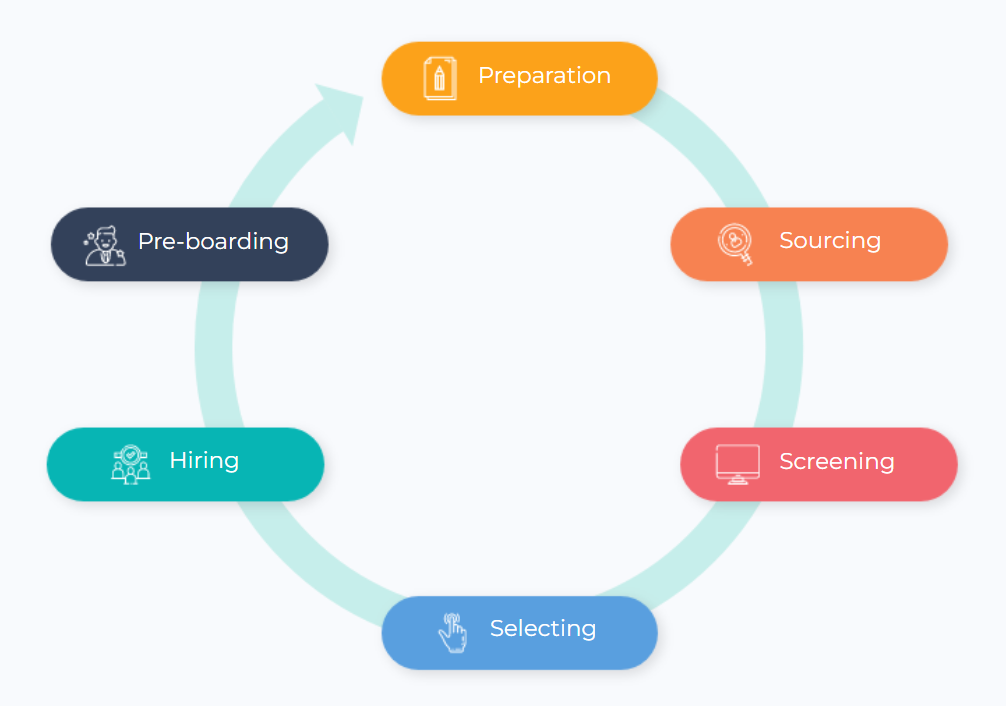
Preparation
Any organizational process requires rigorous homework and a lot of preparation to do before implementation. Likewise,
if you have ever witnessed the execution of recruitment procedure, there is considerable amount of planning and devising that goes behind it which includes:

- Identifying the needs Aright, so there must be a gamut of operations going on in your organization to keep it running smoothly. And, of course, even after technology adoption, these functions need human hands to yield the optimum output. Now, you need to perform some requirements gathering as to what qualities the candidates should possess to do the same and make sure it aligns with your company’s objective before you dive into the candidate search.
- Preparing a job description Based on the needs analysis, you must have landed on the right characteristics in a prospect to be eligible for the job, the expected competencies, the required roles & responsibilities, and the correct criteria to assess and hire them. This is what you write down on a paper/in your mail to send across as the JD.
- Creating a recruitment plan Now comes the tricky part. From top to bottom, you must make a stepwise strategy to execute the recruitment process. Planning mainly involves deciding on the hiring budget. From the spreading the word about the vacancy to the interviewing and onboarding processes, the costs and other resources required for each stage of recruitment must be forecasted and arranged accordingly.
- Finding recruitment sources and job portals This step depends on the connections you have built in the market so far. Searching for the right candidate for a particular kind of job becomes much easier if you find the right people at the right time and know the right platforms. Posting ads, parsing resumes, shortlisting prospects, and inviting them for a 1-on-1, everything becomes a piece of cake when you know the appropriate recruitment sources.
“If you wait until day one to engage a new hire, you’ve already fallen behind: 65% of employers reported hiring people who do not show up on their first day.” – 360 learning
Just as the new employees enter the organization, surprise them with a warm welcome and be ready to introduce them to the system without forgetting a thing! Use the free employee onboarding checklist to ensure an organized enrolment process of the newcomer.
What are the sources of Recruitment Management?
“Candidates are twice as likely to accept cold emails if they have interacted with your brand before.” – RecruiterBox
Recruitment sources are the online and offline mediums through which candidates are informed about job vacancies and the suitable ones are invited to undergo the recruitment process. Nowadays, there are various automated solutions for HR to perform this activity.
There are mainly 2 types of recruitment sources:
External Recruitment Sources
This way of hiring employees particularly includes seeking talent outside of the organization. External recruitment sources include spreading the word about vacant positions in the company through methods such as job portals, campus recruitments, walk-in interviews, employee exchange programs, job promotions and advertisements through various social media, print media, and other platforms. The external means of recruitment increases the chances of employing high quality candidates and that too for filling a wide variety of vacant positions.
- Job Boards: A website used by recruiters to advertise job vacancies from where job seekers can find opportunities.
- Social Media: Employer branding and recruitment marketing are collectively used to pitch candidates for hiring through social media platforms. LinkedIn is considered as the largest medium where professional networks can be built.
- Print Media: Employers can also publish ads in the newspapers and magazines to attract candidates for recruitment.
- Company Website: Providing the contact information like phone numbers and email addresses of HR professionals/employers is another way to hear from the eligible candidates.
- Referrals: Employees working with an organization can refer their friends, relatives, and acquaintances with suitable skill sets to apply for a job vacancy.
- Career Fairs: AKA job fair is a recruiting event organized at a particular position where employers & recruiters from different organizations come together and meet with potential employees for filling vacant positions in their respective companies.
- Direct Contact: This is the approach where either the candidates appear for walk-in interviews or any of the party (employer/applicant) directly calls up to enquire about the vacancies in the organization.
- On-Campus Placements: Through this means of recruitment, employers visit certain colleges and educational institutions to interview and select candidates.
- Placement Agencies/Third Party Recruiters: These are the consultancy firms that different organizations (employers) hire or partner with to coordinate with prospective candidates.
Internal Recruitment Sources
This mode of employee recruitment involves rearranging the existing permanent employee base of the company. It includes promoting the outperforming employees to a higher level and similarly demoting the underperformers to a lower level. Also, releasing internal job postings for employees to apply to and undergo an interview procedure just like external recruitment is a part of this. By the means of internal recruitment, the hidden talent inside the organization is revealed and employee growth, retention, and satisfaction is promoted by leaps & bounds.
- Temp-To-Hires: Some outperforming interns, trainees, or temporary employees are converted into permanent employees under certain terms & conditions.
- Internal Job Posting (IJP):Once in a while, organizations declare job vacancies within the organization to shuffle the interested, capable, and eligible employees from one department or location to another.
- Transfers: In this case, the employers transfer an employee from one location/branch of the organization to another due to promotion, performance or other reasons.
- Promotions/Service Extensions: Performance appraisals lead to promotions and change in designations of employees. Similarly, service extensions provide them more time to work with the organization. In both cases, a vacant position remains filled.
- Demotions: Similar to promotions, employees are often demoted under circumstances like underperformance or any kind of misconduct so as to acquire a lower position.
- Retirements: In case employers cannot find the right candidates to fill key managerial and CXO positions, then they prefer to call back and hire their own retired employees.
- Referrals: This is a common practice in external as well as internal recruitment. When we talk about the latter, only employees of the organization are referred by their colleagues for filling a vacant position and not from outside the organization.
51% of recruiters rank referrals as one of their top sources of hiring.” – Deloitte
What are the advantages of effective Recruitment Management?
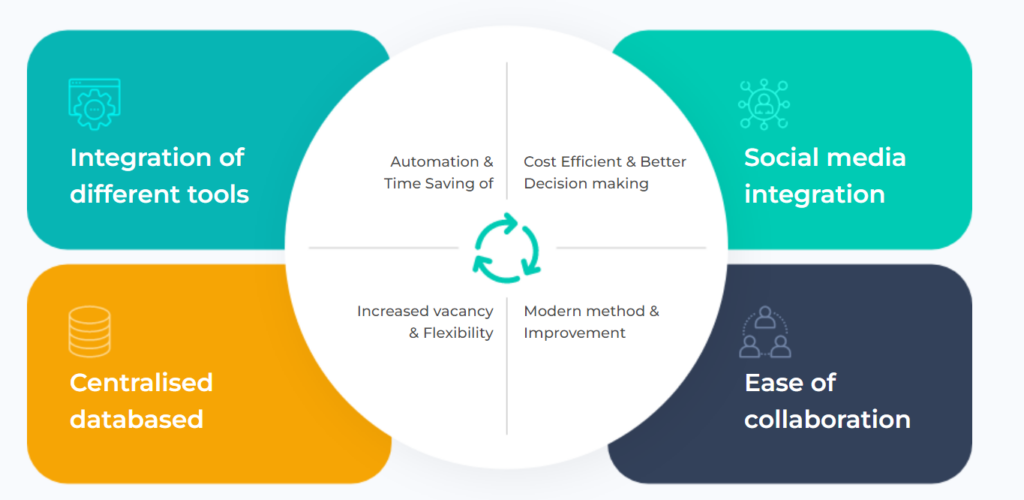
Using a top-notch Recruitment Management System, employers can reap benefits such as:
Top 3 loopholes most organization fall for when implementing an employee listening strategy:
- Integration of Different Tools: Due to the intervention of technology in traditional recruitment practices, various automation tools are seamlessly integrated with the system. Besides, the Inbox for HR feature makes each step of recruitment highly efficient as well as time & energy-saving. This is because HRs can now receive all their messages at one place and perform multiple recruitment-related tasks simultaneously without switching between too many screens.
- Integration of Social Media: The unification of social media and recruitment has cut various costs that were earlier incurred in manual sourcing and selection. Moreover, the candidate search has become simpler, faster, and more efficient.
- Centralized Database: Software used to manage recruitments has a centralized database that stores all the hiring-related information at a single location. In this way, recruiters don’t have to juggle through multiple systems and the vacancy closure rate and flexibility is increased.
- Ease of Collaboration: Using recruitment management systems is a modern method and therefore, brings a large scope of improvement in the area. Employers can easily collaborate with a third party recruiter or even directly approach the potential candidates now and shortlist the right match with more efficiency.
- Once the Recruitment Management process is streamlined, the whole organization experiences benefits including:
- Lower Hiring Costs: When every aspect of the process is pre-planned, specifically the budget, then the overall costs incurred on hiring are automatically controlled. A systematic recruitment management program results in economical operations and the incorporation of recruitment software boosts overall cost cutting and time-saving through quick & minimized tasks. Expenses incurred on advertising, connection building, equipment, travel, administration, and benefits do not burn a hole in the employer’s pockets anymore.
- Better quality of new hires: The efficiency of recruitment management software and the planned execution of the entire procedure helps the recruiter to reach high-quality candidates. A strong candidate search and sourcing coupled with precise screening leads to the selection of the perfect new hire. The recruits are likely to be more competent, productive, and loyal if chosen through a proper recruitment process.
- Increased employee understanding: With each minute detail being on the table before and at the time of recruitment, employees are able to understand and retain the company-related information. In this way, the chances of miscommunication minimize and the HR professionals/employers need not send frequent reminders, conduct heads-up, organize training or face breach of employment contract.
- Maximum productivity: Once the KRAs are clearly outlined & explained to the new hire and all the necessary resources are made available, it becomes simpler for them to achieve the targets within the stipulated time. As mentioned above, an appropriate recruitment process helps recruiters to reach high-quality candidates. So, productivity never becomes an issue, thereby enhancing the employees’ as well as the business’s performance. Besides, the recruitment management software becomes a cherry on the cake to support employee proficiency.
- Competitive Edge: Lastly, not only in terms of products & services, companies are also pitted against each other for the quality of employees. Companies following a proper recruitment management process always end up hiring competent, dedicated, and loyal employees, thereby sustaining top position. Hence, it helps them sustain an eminent position in the market among other contemporary organizations.
What are the objectives of Recruitment & Selection?
It is necessary to align recruitment objectives with the strategic objectives of the organization. For instance, if being a leader in customer service is a company’s strategic objective then while targeting for recruitment, this must be taken into account. The hiring managers should have an insight into the key recruitment strategies and at the same time, understand know-how of the business management.
There are pre-hire objectives like the time taken to fill a vacant position and the recruitment budget, and then there are post-hire objectives like initial performance of the recruit and his/her engagement & experience.

Let’s throw some light on both in detail:
Pre-hire Objectives
As soon as seats are vacated in an organization, all kinds of tactics start to develop around the recruitment of newbies who can fill the former employees’ shoes.
While planning for a recruitment campaign, some of the common pre-hire objectives to consider are:
While planning for a recruitment campaign, some of the common pre-hire objectives to consider are:
- Filling vacant positions: The primary purpose of setting up recruitment and selection campaigns is to find potential candidates for filling a new required position in the company or to search for a replacement for the employees who have resigned from the organization.
- Deciding deadline of hiring: Just like any other HR operation, recruitment is a process that is bound by a schedule and should be completed within the stipulated time. So, the next aim is to finalize the date by which the vacancy should be closed so that it doesn’t overlap with any other major event.
- Fixing cost-per-hire: Once the time frame and deadline of hiring is fixed, the budget parameters are taken into consideration. From posting the advertisements to onboarding every penny spent on the new joining is predicted beforehand to check if the expenses fit in the overall business budget.
- Establishing eligibility criteria: This objective is meant to determine the basic qualifications that every employee must hold and the conditions they must fulfill to be a part of the organization. Now, customization of the eligibility criteria as per the vacant position and department is done to fulfill the requirements of the position.
- Referrals: Employees working with an organization can refer their friends, relatives, and acquaintances with suitable skill sets to apply for a job vacancy.
- Career Fairs: AKA job fair is a recruiting event organized at a particular position where employers & recruiters from different organizations come together and meet with potential employees for filling vacant positions in their respective companies.
- Direct Contact: This is the approach where either the candidates appear for walk-in interviews or any of the party (employer/applicant) directly calls up to enquire about the vacancies in the organization.
Post-hire Objectives
As per a study on recruitment, parameters including the type of applicant, their previous work experience, and the competencies that they bring along should be focused over the hiring time, no. of applications, and budget factors.
Once the candidate becomes an employee, the main recruitment objectives to be kept in mind are:
- Reviewing the type of applicants: From the educational qualifications and previous work experiences to the skill sets and knowledge purview, the applicants are scrutinized to forecast their employment journey. So, once the candidates are shortlisted, their background is assessed to examine the type of applicants that are joining the organization.
- Assessing the initial performance: As soon as the applicants become the employees, their KPIs (Key Performance Indicators) are established. In the beginning, the initial show of recruits is analyzed to predict their growth. Performance goals are set to streamline further training, and orientation of the newbies. The employee targets are then aligned with the objectives of the company for an enhanced overall business performance.
- Analyzing the retention rate: Ultimately, this post-hire objective is devised to evaluate the number of employees who continue working with the company and ones who quit in the first few days/weeks. This data is utilized to assess the retention rate and work towards enhancing the same.
Two more supplementary points must be kept in mind while formulating the recruiting objectives. Primarily, there should be common grounds as to how the objectives will be measured – a) Quality of a new hire will be evaluated based on objective performance data b) based on the supervisor’s judgment or c) the customers’ ratings.
Moreover, there should be enough awareness of the particular labor market dynamics amongst the recruiters before they establish a recruitment campaign.
- Temp-To-Hires: Some outperforming interns, trainees, or temporary employees are converted into permanent employees under certain terms & conditions.
- Internal Job Posting (IJP):Once in a while, organizations declare job vacancies within the organization to shuffle the interested, capable, and eligible employees from one department or location to another.
- Transfers: In this case, the employers transfer an employee from one location/branch of the organization to another due to promotion, performance or other reasons.
- Promotions/Service Extensions: Performance appraisals lead to promotions and change in designations of employees. Similarly, service extensions provide them more time to work with the organization. In both cases, a vacant position remains filled.
- Demotions: Similar to promotions, employees are often demoted under circumstances like underperformance or any kind of misconduct so as to acquire a lower position.
- Retirements: In case employers cannot find the right candidates to fill key managerial and CXO positions, then they prefer to call back and hire their own retired employees.
- Referrals: This is a common practice in external as well as internal recruitment. When we talk about the latter, only employees of the organization are referred by their colleagues for filling a vacant position and not from outside the organization.
Pro Tip::
“Do not hire a man who does your work for money, but him who does it for the love of it.”
How To Set-up Candidate Selection Criteria?
There are two standards basis which the candidates can be recruited and selected to work with an organization:
- Minimum Qualifications: The applicants are screened through a comparison of the qualifications that are minimally required to perform the job with their minimum qualifications. The position or job descriptions specify the minimum qualifications necessary for getting selected.
- Selection Criteria: After a set of candidates are shortlisted for the interview by meeting the minimum qualifications, they need to fulfil the selection criteria which sets them apart from all other applicants and determines them as the best-qualified candidate. Quantity, quality, and pertinence of academics, professional experience, knowledge base and other skills that each candidate possesses are main parameters focused through selection criteria. Moreover, it includes qualifications that are unique to the specific position and the particular department of the organization. The best-suited candidate is finally selected after the candidates are pitted against each other and these selection criteria are applied.
There are 6 predetermined selection criteria designed for filling a vacant position.
- The level of education completed, its quality, and relevance to the position
- Relevant skills developed from previous work experience and reliability
- Expertise and relevance in technology (if applicable)
- Necessary licenses, training, and certifications
- Written & oral communication and soft skills
- Position-specific demands or open fields
Each criterion for candidate selection is measured by applying different tools including Application, Curriculum Vitae, Cover Letter, References, Interview, Work Sample, and Writing Sample.
How To Develop a Recruiting Strategy?
64% of millennials would rather make less at a job they love than make more at a job they find boring – Paycar
After you have established the purpose or objective of organizing the recruitment campaigns, it is necessary to formulate a plan of action to progress smoothly. This POA is called recruitment strategizing to fill job openings. There are some parameters that the recruiters need set as they develop their recruitment strategy such as:
- Deciding the type of target candidates
- Finding out how to reach target candidates
- Finalizing commencement of the recruitment campaign
- Drafting the recruitment message to be communicated
- Determining the nature of site visits
Now is the time to ensure that you proceed in the right direction and choose the right candidate for your organisation. And how will you do that? Not only by matching the eligibility criteria but also by helping the company achieve its recruitment goals and support needs of stakeholders. You can break down your recruiting strategy into actionable tactics as follows:
- Analyze the best practices and templates: You can find a number of recruitment strategies and best practices on the web. Having a glance at other organizations’ way of doing things and relating it to what might be beneficial for your company is important. Having said that, it is also necessary to understand the uniqueness of your own brand and only consider the methods that are customized to meet your requirements and help you come closer to your personal business goals. Also, your employer brand needs to be kept in mind to ensure proper positioning of the recruiting effort.
- Evaluate existing business strategies: It is always advised to evaluate the existing organizational strategy before you start developing a new one for recruitment. It must include the business strategy, current recruiting strategy and other departmental techniques that are applicable. Several inputs from the workforce plan can also be incorporated.
- Incorporate modern technologies: Some SMEs still rely on manual processes of recruitment, but with the increment in volume of recruitment, implementing a top-notch software has become kind of a necessity. When we talk about an HRMS, it includes a recruitment module with basic functionality to automate the processes involved. You may also find and contact vendors with an expertise in developing Applicant Tracking Systems and enable advanced functionality to reduce the recruiting effort.
Following are examples of technologies to consider when developing your recruitment plan:
- Artificial Intelligence tools for enhanced management
- Applicant Tracking System to parse resumes Video
- Conferencing Software for virtual interviews
- Job Boards to expand the scope of candidate sourcing
- Onboarding Module to improve recruit’s experience
- Implement stakeholder feedback: When we speak of the recruitment strategy development process, it’s important to incorporate and solicit stakeholder feedback. In a recruiting strategy, stakeholders include the hiring managers, executives, employees and HR team members. Apart from these critical entities of the organization, do not forget to take suggestions and advice from the potential candidates and understand their needs from the hiring feedback that they share.
- Examine internal processes & policies: Just like introspection is important while trying to grow, the roots of an organization such as internal processes and policies need to be assessed as you prepare to welcome new candidates onboard. The organizational policies and practices give you an edge over others as you compete to hire the top talent. This is reflected in work flexibility, corporate benefits, leave policies, CSR, or professional development and can act as a selling point to the candidates. Considering this while drafting recruitment strategy can also become an opportunity to identify outdated policies that cause candidates to choose other employment offers and revamp them accordingly.
- Pin down candidates pitching techniques: It is of extreme importance to know how to attract the right employees and there are multiple ways to achieve the same. First of all, you need to curate a communication tactic and identify the ideal forums for every vacancy. Then creating an impactful social media campaign and evaluating the metrics to validate the success of your strategy is the next big thing that can make a difference. The first step is to post open positions on your company website which will provide candidates with a feel of the company culture and atmosphere. Other ways include external recruitment sources such as posting to job boards, organizing referral programs, contacting past employees, outsourcing to a third party, hosting internal business events, and manually searching for passive candidates.
- Separate employees and freelancers: As a recruiter, when you depend on the company’s strategies, it is also imperative to identify and manage employees and contingent workers separately. Hiring third-party agents is also an option to recruit contingent workers. Other considerations like deciding whether your organization will benefit from employees within the company or by hiring externally for filling future vacancies. You already recognize the work ethic and have evaluated the skills and abilities of internal candidates in their current role. But you may have to train them for taking them to the next level or on a new role outside their area of expertise. With external candidates, you get the skill set you need immediately. But the person may not fit in your organization. It may even disappoint the current employees who were waiting for opportunities to grow with your organization. So, it’s a tricky decision to make!
- Keep outsourcing as an option: Managing regular, day-to-day recruitment is easy when you have a talent acquisition team. But under special circumstances, there are many options for outsourcing your recruiting needs like partnering with another organization altogether. For instance, if you wish to recruit a group of employees with the same skill sets for a one-time task, it would be economical to have a partner that specializes in talent with similar skill sets. You may later on decide to continue long-term partnerships or retain some of the recruitment in-house, as required.
- Delineate your brand persona: Presenting the brand in the right way makes a strong positive impact on the quantity and quality of qualified candidates that come your way. While formulating the overall marketing strategy, defining your organization’s brand and refining the brand persona can be used to your advantage in the recruitment process. Take note of how candidates, employees, and external entities perceive your organization by using reviewing platforms such as Glassdoor. Hire a team that can manage your online & offline reputation (ORMs). Ideally, the perception of your brand should align with your plan. If not, you can devise strategies to fill the gap.
How can you forget the financial aspect when it comes to building a strategy for your business growth and development? It is one of the most critical decisions to make while formulating the recruitment strategy as to how much money should be invested on the tasks and operations involved in hiring and onboarding a newbie in the organization.
Let’s have a quick glance at the steps that help to prepare the recruitment budget.
How To a Prepare Recruitment Budget?
No matter how strong your talent acquisition strategies are, without a solid budget, you will keep wondering how all the funds went down the drain. So, as an HR professional or a recruiter, don’t just prepare a budget to ask the employer for money. Rather, make it a mission to save some bucks on your company’s behalf! The recruitment budget must be created in such a way that each and every monetary aspect (direct/indirect or voluntary/involuntary) is taken into account.
Mentioned below are 7 steps to manage the recruitment budget and keep it cost-effective:
- Determine total no. of recruits and cost per hire using Payroll Software
- Evaluate recruitment marketing expenses
- Estimate learning & development budget
- Take note of all the fixed expenses
- Keep aside recruitment upgradation costs
- Consider all the unplanned and optional expenses
- Make a recruitment schedule and set a timelin
There is no one-size-fits-all answer to this question, as the budget for recruiting will vary depending on the size and type of organization. However, some tips on how to prepare a recruitment budget include:
- Do a “needs assessment” to determine what positions need to be filled and what kind of recruitment strategy you need to employ.
- Determine your budget to calculate how much money you need to allocate for recruiting.
- Set priorities to decide which positions are the most important to fill and which ones can wait.
- Track results to track how much you’re spending on recruiting and how well it’s working for necessary adjustments to your budget in the future.
What is the Difference Between Talent Acquisition and Recruitment?
“Talent Acquisition is more focused on the strategic side of tougher positions to fill.” – Founder and President, LocalWork.com
Talent Acquisition VS Recruitment
Broadly speaking, the difference between talent acquisition and recruitment can be understood based on the following parameters:
- Recruitment is a subset of Talent Acquisition
- Recruitment is linear, Talent Acquisition is an ongoing cycle
- Recruitment is limited to CV, Talent Acquisition looks beyond
- Recruitment finds employees, Talent Acquisition finds niche specialists
- Recruitment fills immediate requirements, Talent Acquisition focuses long-term bonds
To understand the two concepts in detail and be able to draw a line between them, let’s walk through the main elements of distinction in detail:
- Strategy Development and Planning: On one hand, when you set up a strong talent acquisition strategy, it requires a lot of planning. It involves an in-depth look at the nature of your business and an understanding of future organizational needs. On the other hand, recruitment is a predefined process that goes by the rule book. It’s not a forward-thinking approach like talent acquisition. The latter is a more detailed approach of getting employees aboard by looking through a wider lens that takes note of both local & global labor markets. Recruitment is simply a step-by-step procedure which can be conceived as a part of talent acquisition.
- Workforce Division: It takes comprehension of the different work segments within a company, along with the different positions within those segments to manage talent acquisition. When you decide to acquire talent, you must have an insight of your company’s internal operations and also understand the skills, experiences, and competencies that each position requires for the business to grow. If we talk about recruitment, the deets of each section of the workforce is not necessary to grasp as the overall process remains the same.
- Analytics and Metrics: Since recruitment is a part of talent acquisition, you need to collect and analyze relevant information so as to continuously enhance the recruiting process and make better hiring decisions. Formulating a talent acquisition strategy is incomplete without implementing key metrics to track and analyze the candidates, thereby ultimately improving the quality of hire.
- Employer Branding: It is a fact that attracting customers is important for a business to grow. But like never before, employers are now paying more heed to attracting talent and rather improve the quality of services that they provide. Branding is an important part of talent recruitment as it sends out a clear message about the organization and its culture to the potential candidates. Employer branding encompasses creating and promoting a positive image, company culture and spreading the word about quality products and services to maintain a good reputation. You can always attract top candidates by giving them a peek and feel of what it’s like to work with your company. With recruitment, you may skip this step altogether.
- Talent Sourcing and Management: Recruitment management is all about posting ads about the company and the vacant positions to be filled by prospective applicants. Whereas, when it comes to talent acquisition, you need to constantly research and recognize the different platforms where you can source candidates. After establishing contact with potential candidates, you also have to maintain and build those contracts into long-term relationships. Unlike recruitment, most of the candidates here do not fill positions right away but at a later stage down the line.
How To Perform Recruitment Analytics?
In order to explore every aspect of the business, incorporate it into the recruitment process, turn data into actionable insights, and make better & faster decisions, powerful recruitment analytics is extremely necessary. Unlike previous times, the recruiters focus more on analytics than simply conducting reporting of a process. Reporting explains what happened in the process and how to compare it with the past findings. However, to take the next big leap, analytics plays a major role in predicting what is likely to happen, prescribes what should be done, and guides what to do next.
As you plan on performing the recruitment analytics, ask yourselves and get to an answer for the following questions:
- What is the reach of recruitment sources/channels?
- What is the quality of candidates hired?
- What is the cost per hire?
- How is the applicant’s expectation VS experience graph?
After you have found the answers to the aforementioned questions, all there is left to analyze are the following factors, moving from one column to the second, and ultimately being able to reach the third column parameters. This will not only turn you into a better decision maker but also reap humongous benefits for your business through proper recruitment management and analytics. The factors include:
- Recruitment Speed
- Recruitment Sources
- Applicant Diversity
- Candidate Conversion
- Candidate Satisfaction
- Costs Saved
- Amount Leveraged
- Candidate Performance
- Candidate Experience
- Candidate Engagemen
- Abandonment
- Messaging
- Mobility
- Disposition Speed
- Candidate Retention
Now, there are various ways to get hands on the recruitment data for performing process analytics. Some of them include:
Recruitment Analytics Data Sources
There are several means from which HR professionals or recruiters can gather information and data points to perform recruitment analytics such as:
- Telemetric Data
- Demographic Data
- Candidate Surveys
- Employee Work History
What is Recruitment Metrics?
The standard set of measurements that are used to track hiring success and optimize the process along the way is known as Recruitment Metrics.
There are several recruitment metrics that an employer needs to consider for predicting the hiring outcomes and taking necessary improvement steps such as:
- Recruitment Marketing Metrics: To measure the results and effectiveness of your recruitment marketing strategy.
- Hiring Velocity Metrics: To measure the duration and speed of the hiring process.
- Hiring Expenses Metrics: To measure the cost incurred on the hiring process.
- Hiring Quality Metrics: To measure the quality of the candidates you hire.
- Referral Metrics: To measure the effectiveness of your employee referral programs.
These are nothing but the key to evaluating the performance of the recruitment process of an organization. Deciding measurable recruitment goals and precise information to track your key performance is extremely important. It specifies where you stand amongst your contemporaries, specifically when you’re trying to make your recruits the new game-changers.
Some areas of considerations while defining the recruitment metrics include:
- Time frame of hiring
- Cost-per-hire
- Yield ratio for each recruitment method
- New recruit retention rate
- New recruit performance level
- Hiring manager’s satisfaction with the recruitment process
- Candidate’s feedback on the recruitment process
Before Moving On, Ask yourselves:
- Is the candidate familiar with the organization/the job?
- Is the candidate attracted to the organizational culture?
- Is the candidate having fewer/less likely job options?










 Secures Top Spot in
