


Q1. Darwinbox vs greytHR India, Which One Is Actually Right for a Growing Indian Company in 2026?
If you landed here, you are probably sitting with a shortlist, a spreadsheet, and a deadline. Last quarter, a payroll manager at a 740-person logistics firm in Pune told me she had been comparing Darwinbox and greytHR for eleven weeks. She still could not decide, because the greytHR demo felt too small and the Darwinbox demo felt too heavy. That gap between “too small” and “too heavy” is the real 2026 HR software conversation, and most buyers are stuck inside it.
greytHR is the honest pick for India-focused, payroll-first SMBs under 500 employees, where EPF, ESI, Professional Tax, and payslips are the daily job. Darwinbox is the honest pick for 1,000-plus-employee, talent-led enterprises that need performance, OKRs, and multi-country payroll. Between those two, there is a messy middle (roughly 500 to 2,000 employees) where both platforms quietly break.
The three buyer realities you are probably in
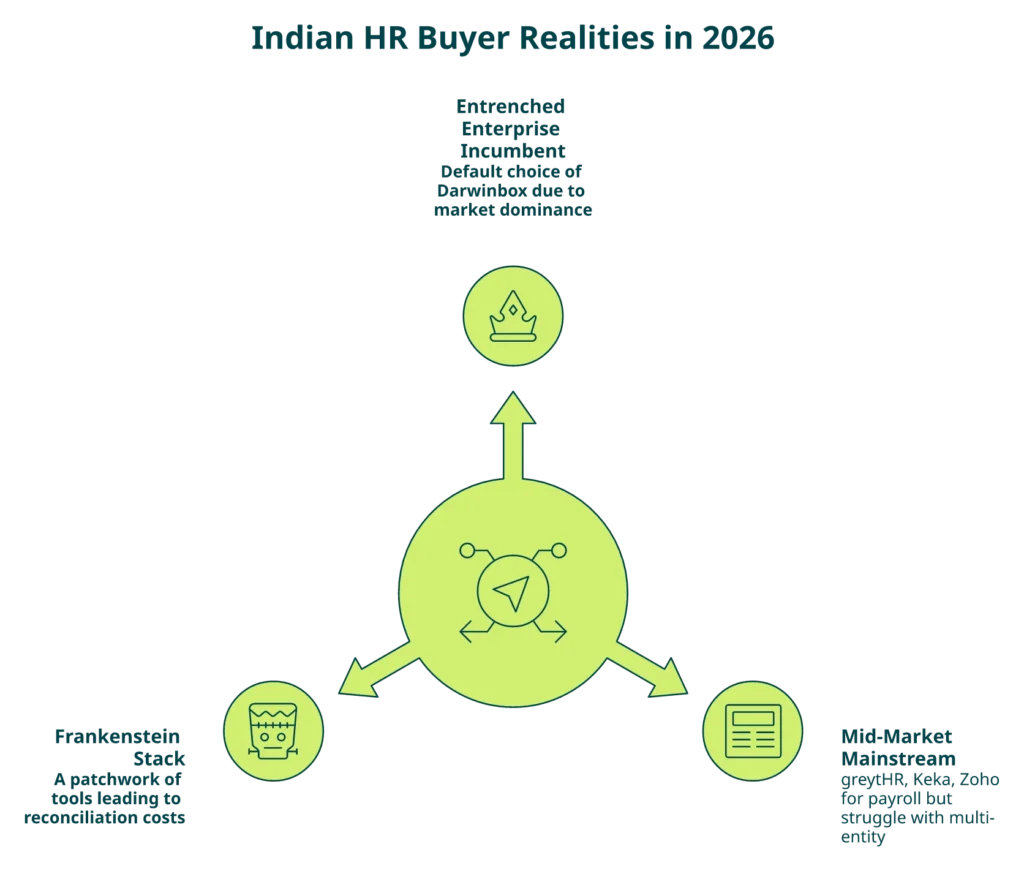
Indian HR leaders rarely arrive on a comparison page in a vacuum. In my experience of building HROne and talking to 2,000-plus HR teams, you are usually inside one of three realities.
- ⭐ The Entrenched Enterprise Incumbent, you already have Darwinbox in the RFP because everyone has Darwinbox in the RFP, and nobody wants to be the person who picked the “non-unicorn.”
- ⭐ The Mid-Market Mainstream, greytHR, Keka, or Zoho People are good enough for payroll, but they start wobbling the moment you add a second legal entity or a performance cycle.
- ⭐ The Frankenstein Stack, a payroll vendor, a biometric portal, a separate ATS, Excel for performance, and WhatsApp for everything else. It looks cheap until someone asks the CHRO how long it takes to close a confirmation letter.
Snapshot verdict, grounded in a real go-live
Here is the verdict in one bulleted view, then a named customer to anchor it.
- ✅ Under 500 employees, India-only, payroll-first, shortlist greytHR.
- ✅ 1,000 to 5,000 employees, multi-country, talent-heavy, shortlist Darwinbox.
- ✅ 500 to 2,000 employees, India-first, running a Frankenstein stack, this is the messy middle, and it is where HROne displaces both. MR DIY India went live on HROne in 30 days after signing, and compressed its payroll cycle from 10 days to 5 to 6 days in the first quarter post go-live.
I might be wrong on the edges here, but the pattern repeats across retail, BFSI, and manufacturing. The wrong platform is almost never a product problem. It is a fit problem.
Q2. What Does Each Platform Actually Sell, Payroll-First HRMS vs Enterprise Unified HCM?
Half the bad HRMS decisions I see start with a category mistake. greytHR and Darwinbox are not two flavours of the same thing. They are two different categories answering two different questions, and pretending otherwise is how buyers end up paying enterprise prices for SMB problems.
Payroll-first HRMS, explained in plain English
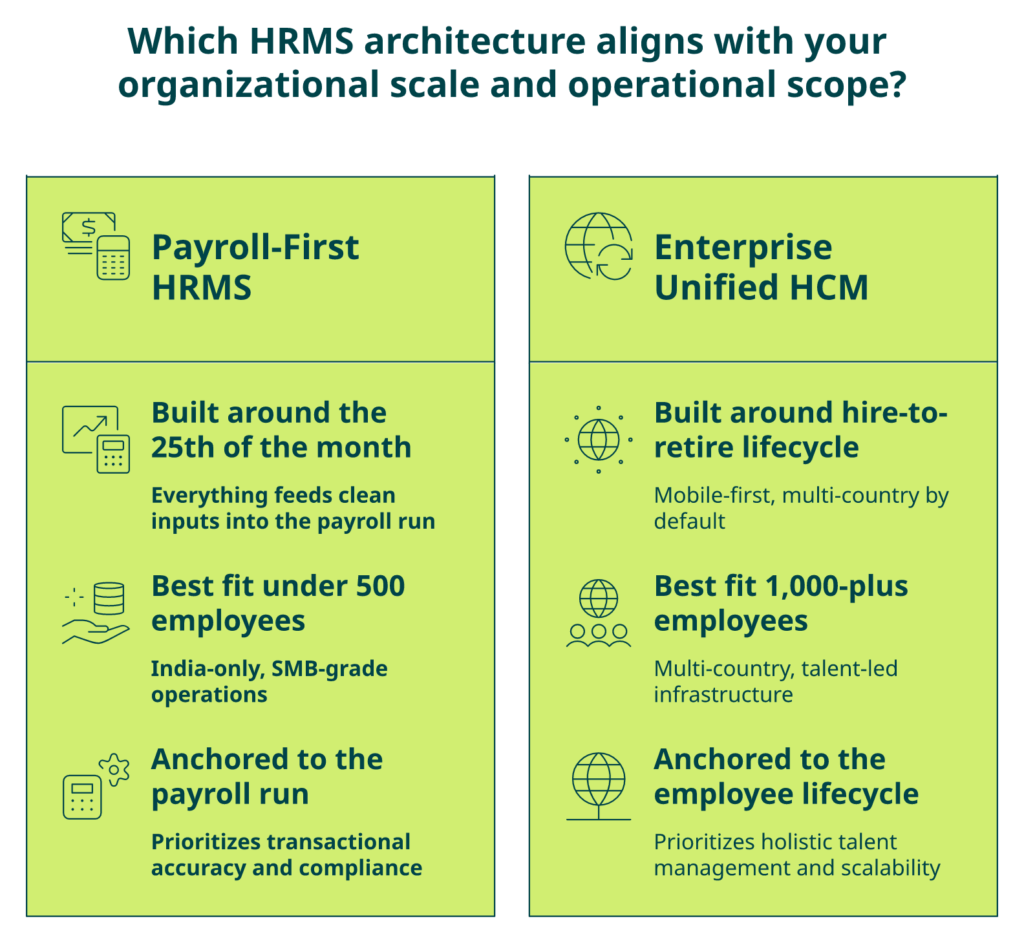
A payroll-first HRMS is built around the payroll run. Everything else, leave, attendance, self-service, and letters, exists to feed clean inputs into payroll on the 25th of the month. greytHR fits this definition cleanly. It serves 20,000-plus customers, mostly Indian SMBs under 500 employees, with ISO 27001:2013 certification and a strong EPF, ESI, and Professional Tax backbone.
The concept is simple: if your pain is “payroll is late and the FnF settlement is wrong,” greytHR solves the pain. The application question is narrower: does the same engine handle a multi-legal-entity retail chain running shifts across nine states? Usually not, and the reviews on G2 admit it openly.
Enterprise unified HCM, explained in plain English
An enterprise unified HCM is built around the employee lifecycle, not the payslip. It tries to give you one system for hire, develop, pay, perform, and exit, usually with a mobile-first posture and a multi-country footprint. Darwinbox fits this definition, which is why it shows up in almost every 1,000-plus-employee RFP in India. For a deeper head-to-head, see our HROne vs Darwinbox comparison.
The concept here is breadth. The application question is whether your 650-person company actually uses that breadth in year one, or just pays for it.
Side-by-side category DNA
| Dimension | greytHR | Darwinbox |
|---|---|---|
| Category | Payroll-first HRMS | Enterprise unified HCM |
| Founded | 1994 (Greytip Software) | 2015 |
| ICP headcount | Under 500 (SMB) | 1,000 to 10,000-plus |
| Module breadth | Core HR, Payroll, Leave, Attendance, and light Performance | Core HR, Payroll, Performance, OKRs, Recruitment, LMS, and Engagement |
| Pricing model | Published INR tiers, per-additional-employee rates | Custom quote, multi-year lock-in common |
| Mobile posture | Functional, often lags the web app | Mobile-first, modern UX |
| Multi-country | India plus Middle East | 116-plus countries |
Where each category quietly cracks
greytHR cracks when you need workflows beyond payroll. A verified G2 reviewer put it bluntly:
“GreytHR is not much good at customizing based on our requirements. For our case, from implementation onwards, there were issues with leave balance and all. Many times we were manually correcting the leave balance of employees.”
— Verified User in IT, greytHR G2 Verified Review
Darwinbox cracks on daily productivity and time-to-value. One G2 reviewer described the experience after a bad implementation:
“Bad implementation experience, bad UI UX, configurations getting broken in production on its own due to product deployments, terrible customer service. Basically everything.”
— Verified User in Computer Software, Darwinbox G2 Verified Review
Neither quote is the whole story. Both platforms have happy customers. But the cracks are real, and they sit exactly at the category edges. Working with 2,000-plus HR teams, what I have felt is that category confusion costs more than any module comparison ever will.
Q3. Darwinbox vs greytHR Pricing in India 2026, What Do You Actually Pay Over Three Years?
💰 Here is the answer capsule, because pricing is where most comparison articles go fuzzy. For a 500-employee Indian company, greytHR typically lands between ₹18 to ₹35 lakh across 3 years all-in, and Darwinbox between ₹45 lakh to ₹1.1 crore, depending on modules, implementation, and add-ons. The sticker price is not the number you should be anchoring on. You can sanity check your own numbers against our HROne pricing page.
greytHR published tiers and the add-on maths
greytHR publishes its India pricing, which is rare and appreciated. As of early 2026, the tiers run roughly like this: Starter is free for up to 25 employees, Essential at around ₹3,495 per month for 50 users plus ₹30 per additional employee, Growth at ₹7,495 per month for 50 users plus ₹60 per additional employee, and Enterprise at ₹10,995 per month for 50 users plus ₹100 per additional employee.
The trap is the per-additional-employee curve. At 500 employees on the Growth tier, you are already paying roughly ₹34,500 per month just for licence, before implementation, support add-ons, or the Performance module.
Darwinbox pricing, decoded
Darwinbox does not publish India pricing. Public sources and buyer conversations suggest a PEPM range of ₹300 to ₹600 depending on modules and headcount, one-time implementation fees of ₹5 to ₹25 lakh, and multi-year lock-ins where subscription billing typically starts on day one of purchase, not go-live. For transparency context, read why transparency in HR software pricing matters.
That last point is the one most buyers miss. If implementation takes 12 weeks and you signed in January, you are paying for March, April, May, and half of June before anyone in your company logs in.
3-year TCO at three headcount bands
Indicative ranges, based on public pricing data and buyer-reported quotes. Treat them as directional, not contractual.
| Headcount | greytHR 3-year TCO (INR) | Darwinbox 3-year TCO (INR) |
|---|---|---|
| 500 | ₹18 lakh to ₹35 lakh | ₹45 lakh to ₹1.1 crore |
| 1,500 | ₹55 lakh to ₹95 lakh | ₹1.4 crore to ₹3 crore |
| 3,000 | ₹1.1 crore to ₹1.9 crore | ₹2.9 crore to ₹5.8 crore |
Numbers include licence, implementation, migration, support, and one or two add-on modules. They do not include your own internal project cost, which is usually 20 to 30 percent on top. Run your own math on the HROne ROI Calculator before you sign anything.
💸 Where the hidden add-ons live
On the Darwinbox side, the quote you sign is rarely the cheque you write. Module add-ons (Performance, Recruitment, LMS, and Engagement), integration fees, and per-country extensions add up fast. A G2 reviewer noted:
“Implementing and maintaining comprehensive HR software can be costly, especially for small and medium-sized businesses with limited budgets.”
— Shefali J., Darwinbox G2 Verified Review
On the greytHR side, the hidden cost is not in the bill. It is in the workflow work you end up doing manually because the configuration runs out. A verified reviewer said it directly:
“We had to go in rounds and spend so many man hours to configure our payroll and later found so many gaps for which we are running in rounds to get it fixed.”
— Verified User in IT, greytHR G2 Verified Review
The HROne counter, said plainly
What my experience of shipping HROne tells me is that TCO is really a billing-model fight, not a sticker-price fight. We bill PEPM, we start the subscription meter after you go-live, and we do not lock you in beyond a 2-month notice. MR DIY India went live in 30 days, which means their meter started in month two, not month five. We also built India’s first inbuilt ROI Dashboard, so the CHRO can walk into a board review and show rupees saved, not slide decks.
See what you would actually pay
Calculate your 3-year TCO against greytHR and Darwinbox in 60 seconds, with no sales call attached.
Open the HROne Pricing Calculator →Q4. Which Platform Handles Indian Statutory Compliance More Honestly, A Compliance-as-Code Audit Rubric for EPF, ESI, PT, LWF, Code on Wages, and POSH?
Every Indian HRMS brochure says “100 percent compliance.” Very few define what the 100 percent covers. In my experience auditing vendor claims with customers in BFSI and manufacturing, the gap between the brochure and the configuration sheet is where audit penalties live. For a grounded primer, see our guide on statutory compliance in payroll.
What “100 percent compliance” actually hides
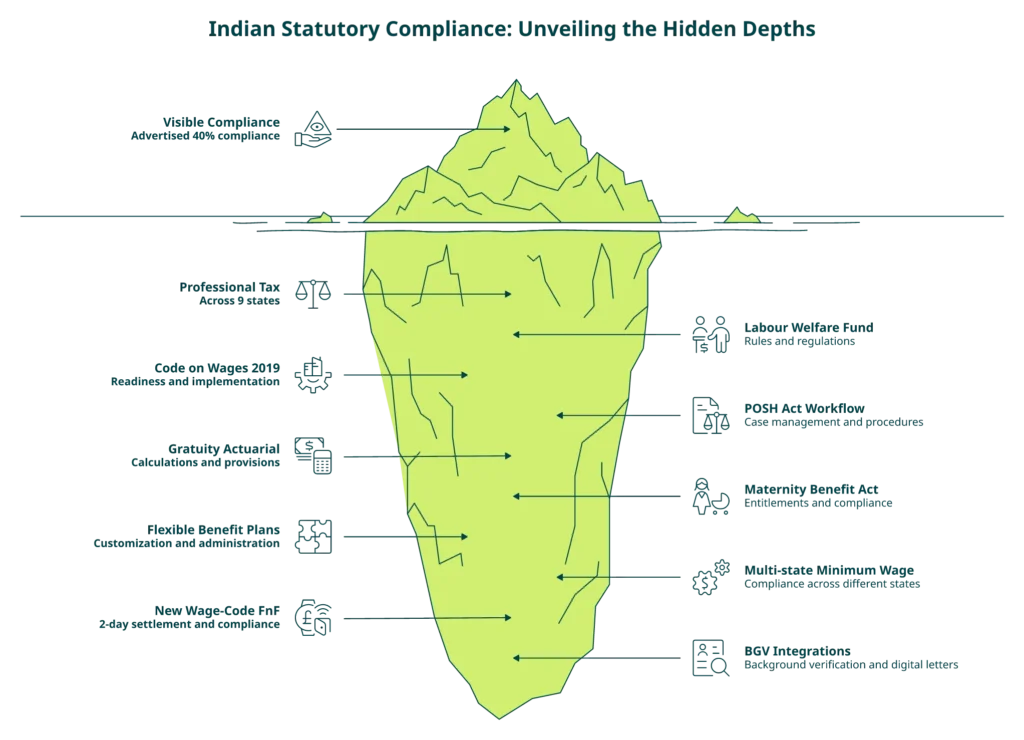
The Indian statutory stack is not one thing. It is at least ten overlapping regimes, and each one has state-level variations. Any honest audit has to look at Professional Tax across 9 states (each with its own slab and return cycle), Labour Welfare Fund rules, Code on Wages 2019 readiness, POSH Act case workflows, gratuity actuarial calculations, Maternity Benefit Act entitlements, Flexible Benefit Plans, multi-state minimum wage, the new wage-code two-day FnF settlement rule, and BGV integrations. For state-wise depth, bookmark the state-wise Professional Tax slab rates reference.
A vendor that covers EPF, ESI, and TDS is not at 100 percent. They are at about 40 percent of what a 2,000-person Indian company needs on a Monday morning.
greytHR’s compliance strengths and honest limits
greytHR has a legitimate payroll-compliance backbone for Indian SMBs. It is ISO 27001:2013 certified, handles EPF, ESI, Professional Tax, and TDS for most states, and supports payslip, Form 16, and statutory return generation out of the box.
Where it wobbles is in the depth of configuration and in nuance. G2 reviewers flag TDS filing gaps, missing challan visibility, and rigid tax-optimization workflows. For a 150-person IT services firm, that is liveable. For a 1,200-person hospital network, it is not.
Darwinbox’s multi-country strength and India nuance
Darwinbox’s compliance story is breadth. It supports payroll in 116-plus countries and is the stronger pick for Indian enterprises with a GCC or SEA footprint. Within India, though, deep statutory configuration often leans on custom build or partner support, which shows up as longer implementation timelines and configuration drift after product deployments.
The buyer question is not “does Darwinbox do Indian compliance.” It does. The question is “does the speed of change in my factory’s shift-differential rule match the speed at which Darwinbox’s implementation partner can configure it.” That answer varies by deployment. For context on manufacturing-grade compliance needs, read how HRMS resolves HR challenges in manufacturing.
The compliance-as-code rubric (paste-ready for your RFP)
This is the scorecard I wish every RFP had. Score each vendor 0 to 3 per row, where 0 is “needs custom work,” 1 is “partial,” 2 is “configurable on the front-end,” and 3 is “pre-built and audited.” Add HROne as your benchmark row because we built the India DNA in from day one. Our payroll software and core HCM modules anchor this rubric.
| Statutory dimension | HROne | Darwinbox | greytHR |
|---|---|---|---|
| EPF, ESI, TDS, and Professional Tax across 9 states | Pre-built, front-end configurable | Configurable, partner-led | Pre-built |
| Labour Welfare Fund rules | Pre-built | Configurable | Partial |
| Code on Wages 2019 readiness | Pre-built | Configurable | Partial |
| POSH Act case workflow | Pre-built | Configurable | Partial |
| Gratuity actuarial | Pre-built | Configurable | Partial |
| Maternity Benefit Act | Pre-built | Pre-built | Pre-built |
| FBP declaration and flexibility | Pre-built | Pre-built | Partial |
| Multi-state minimum wage | Pre-built | Configurable | Partial |
| New wage-code 2-day FnF settlement | Pre-built | Configurable | Partial |
| BGV and digital letter acknowledgments | Pre-built via Marketplace | Configurable | Limited |
A named proof point, not a tagline
When a G2 reviewer described greytHR as having an “under-trained team handling tickets you raise,” the pain was not the tax engine, it was that nobody inside the vendor could unblock a compliance edge case in time for payroll cut-off. That is the real risk.
HROne’s deep India DNA shows up where it matters: Asia Healthcare Holdings runs 20 pan-India units on a single HROne instance, with multi-legal-entity configuration handled on the front-end by HR users, not by developers raising tickets. Paperless digital letter acknowledgments give you a defensible audit trail that stands up in a labour inspection.
I might be wrong on the individual vendor scores, and your auditor should verify them against your specific state mix. But the rubric is the right question to ask.
Q5. How Do Talent, Payroll, and AI Modules Compare, Feature Parity Matrix Across 8 Modules?
The fastest way to waste twelve weeks is to buy on a ticked feature sheet. A CHRO at a 900-person BFSI client in Mumbai once showed me a 47-row evaluation matrix where her chosen vendor had 44 green ticks. Eleven months post go-live, three of those ticks were still “in configuration,” and two were quietly marked “partner-led.” Green ticks are easy. Green ticks that survive an April payroll run with retrospective CTC revisions are not. For a grounded read on buyer risk, see our guide on HRIS buyer pitfalls.
Across the eight modules most Indian mid-market buyers actually use, greytHR is strong on Core HR and Payroll, partial on Performance and Recruitment, and thin on LMS and Analytics depth. Darwinbox is broad across all eight, but daily-productivity UX and time-to-value drag. HROne sits deep across the “bread-and-butter” bundle (Core HR, Workforce, Time Office, and Payroll) that 98 percent of Indian customers run together.
What “parity” actually means in a payroll cycle
A ✅ in Core HR means you can add a new location, a new legal entity, or a new department on the front-end without a support ticket, on a Monday afternoon, before Tuesday’s onboarding batch. A ⚠️ means you can configure it, but you will raise a ticket and wait. A ❌ means you will wait, pay, and then wait again. Judge every cell below by that test, not by the checkbox.
The 8-module parity matrix
| Module | HROne | Darwinbox | greytHR |
|---|---|---|---|
| Core HR and OU structure | ✅ Front-end configurable, multi-entity on one instance | ✅ Broad, partner-led for deep config | ✅ Solid for single-entity SMB |
| Payroll and Statutory | ✅ Auto-scheduler, group payout validations, zero salary delays | ✅ 116 countries, India configurable | ✅ India-deep, SMB-grade |
| Leave and Attendance | ✅ Offline attendance, geo-fence auto-sync | ✅ Mobile-first | ⚠️ Mobile lags web |
| Performance and OKRs | ✅ 15-day appraisal cycles with auto bell curves | ✅ Deep | ❌ Light |
| Recruitment and ATS | ✅ AI resume relevancy stacking | ✅ Full ATS | ❌ Missing or bolt-on |
| LMS | ✅ Marketplace integration | ⚠️ Partner-led | ❌ Missing |
| Analytics and HR Ops heat map | ✅ India’s first inbuilt ROI Dashboard | ⚠️ Reports, no ROI view | ❌ Limited reporting |
| Employee Experience | ✅ Super Inbox, 110 tasks closed in 3 clicks | ⚠️ Multi-tab navigation | ⚠️ Outdated UI noted by users |
⭐ A pre-RFP test protocol you can run on Monday
Stop trusting the demo. Try these five scenarios live in each vendor’s sandbox before you sign anything.
- Add a new legal entity with its own Professional Tax slab on the front-end, time it in minutes.
- Run a CTC revision for 50 employees mid-cycle, with arrears, and export the payroll register.
- Raise a mobile leave request from a phone with airplane mode on for two minutes, then watch it sync.
- Parse 100 resumes into a shortlist where the top 20 have to match a JD you wrote that morning.
- Pull an HR Ops dashboard showing which of your hire-to-retire processes missed SLA last month.
If a vendor cannot demo all five without a follow-up call, your RFP has your answer.
❌ The AI layer, said plainly
AI in HR is not a chatbot on the homepage. It is the difference between a recruiter reading 200 CVs and 20. Darwinbox offers conversational HR and assistants that work well at large-enterprise scale. greytHR’s AI footprint is lighter and more payroll-adjacent. HROne’s One AI Suite stacks relevant CVs on top, parses expense receipts so finance stops doing manual entry, generates JDs and interview questions, and runs an AI Employee Agent for policy queries. Explore our HROne AI and Employee AI Agent capabilities for context.
One honest HROne user described the practical result:
“Sometimes i also used its OneAI system to apply leaves, That is what i have seen first time in a HR application system.”
— Ayush G., HROne G2 – Verified Review
💸 The Frankenstein-stack cost, in plain rupees
Neither Darwinbox nor greytHR removes the quiet cost of a five-tool stack for most 500 to 2,000-person firms. A typical stack looks like payroll vendor at ₹60 per employee per month, biometric portal at ₹25, standalone ATS at ₹40, expense tool at ₹30, and engagement at ₹20, totalling ₹175 PEPM before integrations and reconciliation labour. Working with 2,000-plus HR teams, what I have felt is that the five-tool stack is rarely cheaper than a unified platform once month-end reconciliation hours are priced in. Our Inbox for HR is designed for exactly this consolidation.
A verified Darwinbox user hinted at why integrations stay painful:
“Integration issues Sync with other systems can be inconsistent. User interface Navigation could be more intuitive in some areas.”
— Saksham A., Darwinbox G2 Verified Review
A verified greytHR user flagged the rigidity cost:
“GreytHR is not much good at customizing based on our requirements. For our case, from implementation onwards, there were issues with leave balance and all.”
— Verified User in IT, greytHR G2 Verified Review
The real win is not more modules. It is modules that trigger each other without a ticket, and a Monday morning where nothing rolls to Tuesday.
Q6. Implementation, Migration, and Adoption, How Long Does Each Really Take, and What Does the Migration Checklist Look Like?
⏰ The silent killer of HRMS decisions is not the product. It is the day the invoice starts billing. In most enterprise contracts, the meter starts on day one of purchase. Peace of mind, however, starts only on go-live. That gap is where the change-management fatigue lives, and where most CHROs quietly lose the room internally. For a structured rollout pattern, see our onboarding process approach.
The long-implementation psychology
A Darwinbox-style enterprise rollout typically runs 8 to 16 weeks across Core HR, Payroll, L&A, and Performance, with more if multi-country is in scope. greytHR’s SMB rollout usually lands in 2 to 6 weeks because the scope is narrower. The trade-off is obvious: shorter rollout, thinner scope. The bill, in both cases, often arrives before the login does.
SCR case: a 740-person retail buyer
Situation. A retail client with 740 employees signed a legacy enterprise HCM in January. Complication. By June, payroll was still parallel-running on greytHR and the new platform, because shift rules for 60-plus store formats never got mapped. Resolution. The CFO asked for a re-baseline, and the answer involved a third implementation partner and another six-figure invoice.
✅ The 12-step migration checklist (paste-ready)
Use this whether you are moving greytHR to Darwinbox, Darwinbox to HROne, or either to anything else. Score each step Red, Amber, or Green weekly. Pair it with our payroll audit checklist for sign-off rigour.
- Data audit and master data mapping (employee, OU, cost-centre, and location).
- Policy catalogue extraction (leave, attendance, FBP, and CTC components).
- Statutory continuity plan (EPF, ESI, PT, TDS, and LWF returns across cut-over month).
- Payroll register validation against last three months.
- Parallel-run for two payroll cycles, not one.
- Leave and attendance reconciliation with biometric source.
- Letter and document migration to new employee record.
- RBAC (role-based access control) and SSO provisioning.
- Integrations cutover (Tally, ERP, BGV, and Slack).
- Employee and manager training, with a written FAQ, not just videos.
- A 30-day hypercare window with a single point of contact.
- Post-go-live audit against the 12-step checklist itself.
⭐ The MR DIY India story, in one paragraph
MR DIY India went live on HROne in 30 days, not 90. Their payroll cycle compressed from 10 days to 5 to 6 days inside the first quarter. The trigger was simple: prior-HR onboarding consultants (not generic PMs) ran the rollout, subscription metered only after go-live, and the 9.8 NPS SPOC picked up the phone during hypercare.
One HROne customer summarised the experience:
“The initial setup of HROne was surprisingly straightforward, much lighter than expected for a full HRMS… The InboxforHR is a game-changer, centralizing every HR task into one simple inbox, cutting down administrative time by 60-70%.”
— Waldon S., HROne G2 – Verified Review
On the other side, a greytHR user flagged the migration reality:
“We had to go in rounds and spend so many man hours to configure our payroll and later found so many gaps for which we are running in rounds to get it fixed.”
— Verified User in IT, greytHR G2 Verified Review
I might be wrong on exact weeks for your scope, but the checklist is the part that generalises. Treat it as a living artefact, not a one-time tick-sheet.
Q7. What Do G2, PeerSpot Mindshare, and NPS Say About Support and Adoption?
⭐ If adoption is low, the answer is rarely more training. It is usually bad navigation dressed up as “user enablement.” The 2026 review data backs this up cleanly. Platforms that score high on Ease of Setup and Quality of Support also score high on Overall Satisfaction. The correlation is not subtle. For the broader landscape view, see our top 10 HR software in India roundup.
The adoption-as-design thesis
HR teams do not “not adopt.” They stop adopting when the third click to close a leave request fails. Every dropped task becomes an email, every email becomes a WhatsApp, and that is how a six-figure HRMS quietly degrades into a glorified payslip portal.
G2 and satisfaction ratings snapshot
Ratings as observed on G2 in 2025-2026. These are directional and change monthly, so always re-check before a procurement meeting. Our why HROne page tracks the latest third-party recognition.
| Dimension | HROne | greytHR | Darwinbox |
|---|---|---|---|
| Quality of Support | 9.6 / 10 | 8.7 / 10 | 8.4 / 10 |
| Ease of Setup | 9.5 / 10 | 8.7 / 10 | 7.8 / 10 |
| Overall Satisfaction (Global rank) | #8 Best HR Software Worldwide | #42 | Enterprise bucket |
| Core HR Ease of Use rank | #3 | #29 | Lower mid |
| Customer NPS (reported) | 9.8 | Not published | Not published |
The support chasm, in users’ own words
A verified greytHR reviewer put the support problem bluntly:
“Extremely poor customer support. They have an under-trained team handling tickets you raise, I should say their response is so illogical or poorly thought sometimes that it cracks us up.”
— Verified User in IT, greytHR G2 Verified Review
A Darwinbox reviewer flagged a different but related failure:
“Bad implementation experience, bad UI UX, configurations getting broken in production on its own due to product deployments, terrible customer service.”
— Verified User in Computer Software, Darwinbox G2 Verified Review
An HROne customer described the opposite experience:
“The support team is always ready to help us with any issues, ensuring smooth operations. Their onboarding process was thorough, with helpful training sessions for the whole team.”
— Rishiraj R., HROne G2 – Verified Review
PeerSpot mindshare, in context
On PeerSpot’s Cloud HCM category, Darwinbox holds roughly 2.8 percent mindshare and greytHR about 0.6 percent, reflecting Darwinbox’s enterprise-RFP dominance and greytHR’s SMB footprint. Mindshare is not quality. It is volume of mention. Use it to understand who you will be defending the decision against, not which one is the right answer for you.
What my experience of shipping HROne tells me is that the review gap and the mindshare gap are different conversations. Win the review gap first, and mindshare follows.
Q8. Darwinbox vs greytHR for Mid-Market Manufacturing, BFSI, and ITeS, Which Handles Shift, Geo-Fence, and Multi-Legal-Entity?
Generic HRMS demos never survive a plant-floor shift roster. I once sat in a demo where a beautifully themed dashboard failed the moment the HR head asked, “Can I configure a 6-day week with a rotating off-day for fifty-two locations, each with its own state minimum wage?” The silence that followed is the real comparison. Our manufacturing HR page addresses these realities directly.
The vertical-fit problem
Mid-market Indian buyers in Manufacturing, BFSI, and ITeS rarely fail on payroll. They fail on the layers underneath: shift planning, geo-tagged attendance for field reps, contract-workforce compliance, multi-legal-entity OU (organisational unit) structures, and FBP (Flexible Benefit Plan) declarations that change mid-year because of a CTC revision. For the compliance angle, see our ITeS compliance HRMS guide.
greytHR for single-entity SMB manufacturing
greytHR holds reasonably well for sub-500-employee single-entity plants. Payroll, statutory, and basic leave work as advertised. It starts wobbling when configuration meets exception, rotating shifts, location-specific PT slabs, and custom overtime formulas. Users on G2 report rigidity and manual workarounds.
“Lag while login and logging out. No flexible customization. Automatic log out while marking attained error in infecting the location. Some features are only available in a desktop mode, not in mobile application.”
— Arjun T., greytHR G2 Verified Review
Darwinbox for 1,000-plus-employee multi-entity enterprises
Darwinbox’s breadth is a legitimate answer for 1,000-plus headcount with multi-country and multi-entity needs. The trade-off shows up as front-end ticket dependency, where minor policy changes route through partner or support teams.
“Transitioning from the old system to Darwinbox is quite difficult. User interface of Darwinbox is very outdated. Darwinbox Support team is not supportive.”
— Ankush B., Darwinbox G2 Verified Review
⭐ Vertical-fit table
| Vertical need | HROne | Darwinbox | greytHR |
|---|---|---|---|
| Shift planning, rotating off-days | ✅ Native | ✅ Configurable | ⚠️ Rigid |
| Geo-fenced mobile attendance, offline sync | ✅ Offline-first | ✅ Mobile-first | ⚠️ Mobile gaps |
| Contract-workforce compliance | ✅ Pre-built | ✅ Configurable | ⚠️ Partial |
| Multi-legal-entity OU on one instance | ✅ No entity cap, front-end config | ⚠️ Partner-led config | ❌ Limited |
| FBP, CTC revision, and new wage-code FnF | ✅ Pre-built | ✅ Configurable | ⚠️ Partial |
The HROne proof, in a named customer
Asia Healthcare Holdings runs 20 pan-India units on a single HROne instance with multi-legal-entity configuration, all handled by HR users on the front-end policy engine instead of developers raising tickets. The 127 pre-built hire-to-retire workflows cover pre-boarding, onboarding, confirmation, transfer, promotion, and exit clearance, so HR stops chasing managers across email threads. For field-workforce specifics, see our attendance management module.
A verified HROne customer in field-heavy operations described the daily reality:
“GPS-based login and logout with pinpoint accuracy. It helps me track my on-field employees status, like where they are currently, to resolve customer service issues.”
— Krunal S., HROne G2 – Verified Review
Working with 1,500-plus brands, what I have felt is that vertical fit is the RFP question most buyers ask last and regret first. Ask it on week one, not week nine.
Built for your plant, branch, or delivery floor
See how HROne runs shift, geo-fence, and multi-entity compliance for 1,500-plus Indian brands.
Explore HROne for Manufacturing →Q9. When Should You Switch from greytHR to Darwinbox, or Skip Both? (The Messy Middle Thesis)
Most Indian HR tech advice treats migration as a staircase. Outgrow greytHR, climb to Darwinbox. Outgrow Darwinbox, climb to SAP. I think the staircase is wrong for most 500 to 2,000-employee Indian companies, and the wrong climb is the single most expensive decision a CHRO makes in year three. For a head-to-head at the incumbent level, see our HROne vs greytHR comparison.
The contrarian claim, stated plainly
Most buyers who upgrade from greytHR to Darwinbox at the 500-employee mark over-pay for breadth they will not use in year one. The modules that actually move the needle (Core HR, Workforce, Time Office, and Payroll) are the same modules 98 percent of Indian mid-market customers use daily. Breadth is not wrong. Buying it a year early is. Our core HCM and payroll software modules are built around that exact daily-use bundle.
⭐ The honest switch triggers
There are specific moments when a migration from greytHR earns its pain. Use this list, not the vendor’s growth chart.
- You have crossed 500 employees and have real performance or OKR ambitions that greytHR’s light module cannot support. See our performance management module for context.
- You are paying employees in three or more countries and need a unified payroll engine, not three vendors stitched together.
- You have two or more legal entities in India and need OU (organisational unit) structures on one instance, not a shared services workaround.
- Your CTC revision and FBP (Flexible Benefit Plan) declarations change more than twice a year, and your current platform cannot handle mid-cycle changes without support tickets.
If none of those four triggers apply, the migration is usually premature.
❌ The skip-both scenario
There is a third path that most comparison articles never name. For many 500 to 2,000-employee Indian firms, the right answer is neither greytHR nor Darwinbox. It is a platform built around daily productivity, where every pending task surfaces in one place, 127 pre-built hire-to-retire workflows define who does what by when, and the subscription meter starts only after go-live. Our Inbox for HR was built for exactly this.
That is the architectural thesis behind HROne’s Super Inbox and the reason Asia Healthcare Holdings and MR DIY India run on a single instance without developer tickets. Breadth without daily productivity is a more expensive Excel. Productivity without breadth is a ceiling. The combination is the skip-both argument.
⚠️ What I am still unsure about, and the vendor-bias beat
I will be honest about the limits of my own argument. I run HROne, so my view is not neutral. I might be wrong here for a 1,800-person multi-geography tech company that needs deep OKR tooling on day one. Darwinbox may well be the right pick for that buyer, and I would rather say so than pretend otherwise.
Two things I think HROne is still iterating on: deeper AI-command interfaces inside the mobile app (some users have flagged this directly), and performance-module first-time guidance for new admins. Both are on our roadmap. Neither should stop a 900-person Indian buyer from evaluating us against greytHR and Darwinbox on the same rubric. Read why HROne if you want the full picture.
The question is not “which vendor has the prettiest demo.” It is “which vendor lets your HR team close 110 tasks before Friday without chasing anyone.” Answer that honestly, and the switch decision writes itself.
Q10. Which HRMS Should a 2026 Indian Buyer Shortlist by Headcount Band, and What Should the RFP Actually Ask?
⏰ Most RFPs I see are structured around features. The good ones are structured around billing, support, and change. A payroll manager evaluating four vendors in eleven weeks does not need a 400-line feature sheet. She needs the 12 questions that separate the vendor that ships from the vendor that stalls. For a buyer-checklist primer, see how to choose the best HRIS HRMS software.
Shortlist shapes by headcount band
Here is the 2026 shortlist I would hand a friend over coffee, based on what actually works for Indian mid-market and enterprise buyers. HROne is listed first because it holds across every band. If you want the broader market scan, read our top 10 HR software in India roundup.
| Headcount | Shortlist (first pick, then alternates) |
|---|---|
| 0 to 250 | HROne, and greytHR |
| 250 to 1,000 | HROne, Keka, and greytHR |
| 1,000 to 5,000 | HROne, and Darwinbox |
| 5,000-plus | HROne Enterprise, Darwinbox, and SAP SuccessFactors |
✅ The 12-question RFP checklist (paste-ready)
Drop these into your RFP verbatim. Score each vendor 0 to 3 per question. Anyone scoring below 24 out of 36 is not ready for your scale. Pair the exercise with the ROI calculator and the salary calculator to sanity-check the commercial side.
- When does the subscription meter start: day one of purchase, or go-live date?
- What is the 3-year TCO for my headcount, including implementation, migration, and all module add-ons?
- How many state-level Professional Tax slabs and Labour Welfare Fund rules are pre-built?
- Can I configure multi-legal-entity OU structures on one instance, with no entity cap?
- What is the documented go-live timeline for a customer of my size and industry, with named references?
- What is the contractual support SLA, published NPS, and escalation matrix?
- Which AI capabilities are production-ready today (not roadmap): resume relevancy, receipt parsing, and employee agent? See HROne AI for a working example.
- What is the data-migration plan, including two payroll parallel runs and statutory continuity?
- Is there an inbuilt ROI or HR Ops dashboard I can show my board in month three?
- What is the lock-in period, and what is the exit-data export format?
- Who runs my implementation: prior-HR consultants, or technical project managers?
- Can my HR team change a leave policy without raising a developer ticket?
⭐ The closing line, and the invitation
There is a phrase I keep coming back to: Darwinbox manages the hierarchy, greytHR manages the cheque, and HROne manages the day. It is not a marketing line. It is a description of the architectural difference between three honest categories. Pick the one that matches how your HR team actually wants Monday morning to feel.
What my experience of shipping HROne tells me is that the best HR decisions are made in a 30-minute conversation, not a 90-day RFP scramble. If you are in the messy middle, I would rather hear your story than pitch you a deck. Start with our contact page when you are ready.
Skip the 90-day RFP scramble
Talk to the HROne team about your messy middle, no demo script, just a 30-minute conversation with someone who has built HR teams before.
Start the Conversation →What I’m Thinking About Next
What I think we will see in the next two years is a split in the Indian HRMS market that nobody is pricing in yet. The enterprise-HCM category (Darwinbox and SAP) will keep getting wider but slower. The payroll-first category (greytHR) will keep getting cheaper but flatter. The interesting layer is the middle, where productivity beats breadth and architecture beats branding.
I am sitting with a harder question. If an HR team can close 110 tasks in three clicks from one screen, does the module count still matter? My current thinking is that it stops mattering around 2027, when AI-assisted HR workflows make “breadth” something you assemble, not something you buy. I might be wrong. If you are in the messy middle, I would love to hear what you are testing next.
References
Official Docs / Indian Statutes
Ministry of Labour and Employment, Government of India, “Code on Wages, 2019,” Notification, August 2019.
EPFO, “Circulars and employer guidance notes, 2024-2026,” Published: 2024-2026.
Ministry of Women and Child Development, Government of India, “Sexual Harassment of Women at Workplace (Prevention, Prohibition and Redressal) Act, 2013,” Notification, 2013.
Datasets
G2. “Darwinbox G2 reviews collection, 2021-2025,” 2021-2025.
G2. “greytHR G2 reviews collection, 2021-2025,” 2021-2025.
G2. “HROne G2 reviews collection, 2025-2026,” 2025-2026.
G2. “Darwinbox G2 reviews and product pages, 2021-2025,” 2021-2025.
G2. “greytHR G2 reviews collection, 2021-2025,” 2021-2025.
G2. “HROne G2 reviews collection, 2025-2026,” 2025-2026.
Blogs
HROne. “HROne Context Document, internal product and positioning dossier.” Published: 2026.
TrustRadius. “Darwinbox vs greytHR comparison page, 2018-2026.” Published: 2018-2026.
HROne. “HROne Context Document, internal product and positioning dossier.” Published: 2026.
TrustRadius. “Darwinbox vs greytHR comparison page.” Published: 2018-2026.
Author. “Field interview, retail HR operator conversation.” Published: 2026.
PeerSpot. “DarwinBox vs greytHR comparison.” Published: 2024.















 Secures Top Spot in
