

 Secures Top Spot in



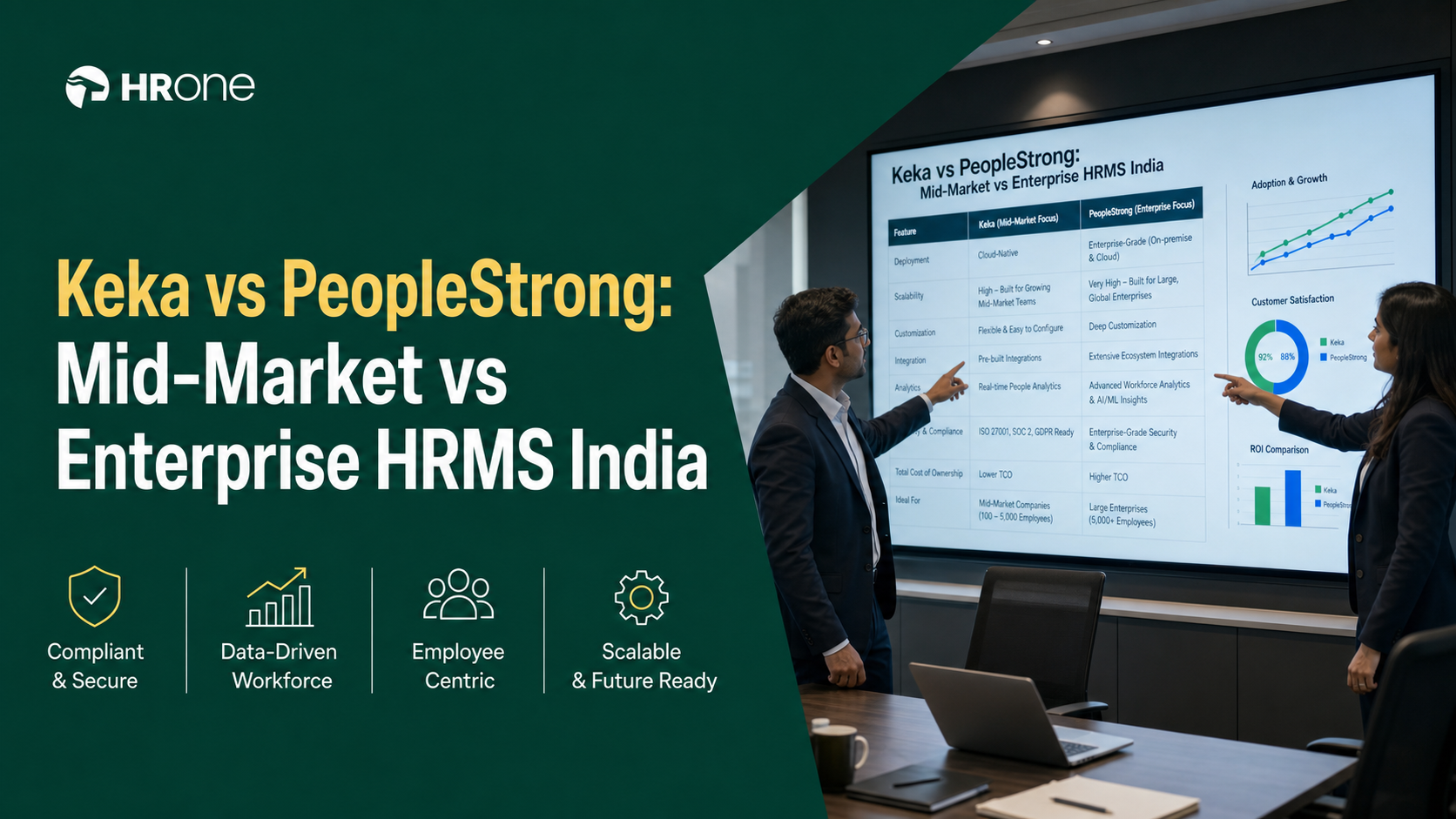
Q1. Keka vs PeopleStrong India, Which HRMS Should You Choose in 2026?
A payroll manager at a 900-person logistics firm in Gurugram messaged me last Tuesday. She was stuck between Keka and PeopleStrong, and her CFO wanted the answer by Friday. I gave her the same 55-word verdict I am about to give you.
Pick Keka if you are 100 to 800 employees, single entity, with payroll UX as your top pain. Pick PeopleStrong if you are 2,000+ employees, multi-entity, with enterprise procurement rituals. Pick an Agile Enterprise bridge like HROne if you sit between 200 and 5,000 heads and need velocity, compliance, and ROI proof in one suite.
The six axes this article will judge them on
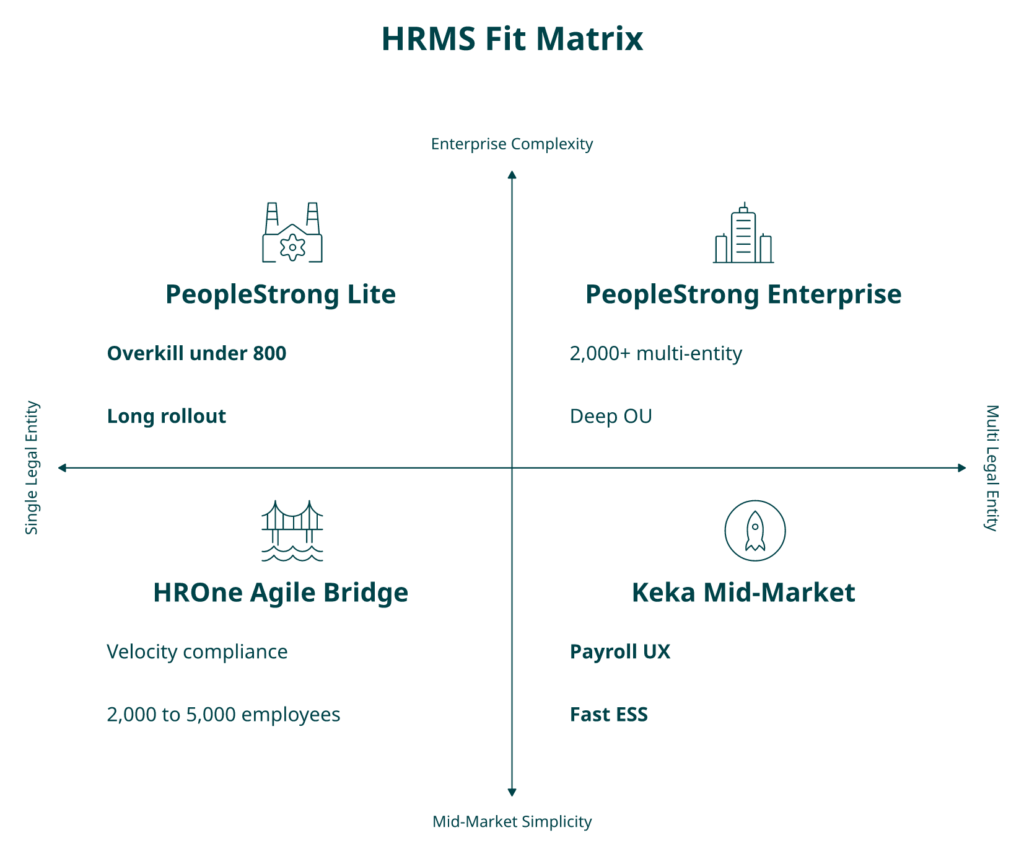
Most comparison blogs stop at features and pricing. That is not enough for an HR head signing a three-year contract. I have broken the decision into six axes.
- ✅ Compliance depth, across PF, ESI, PT, LWF, TDS, and Code on Wages readiness
- 💰 Three-year TCO (Total Cost of Ownership), with implementation, integrations, and AI add-ons exposed
- ⏰ Velocity, measured by time-to-first-payroll-run and task-closure latency
- ⚠️ Implementation reality, the honest gap between sales-deck weeks and production weeks
- ⭐ AI maturity, judged on grounding, latency, and workflow impact
- 🎯 Fit, by headcount band, industry vertical, and geographic footprint
What to do on Monday
Print this page. Score your current shortlist against the six axes on a single sheet. Keka gives you a checklist. PeopleStrong gives you a map. HROne gives you a cockpit. Working with 2,000+ HR teams, what I have felt is that buyers rarely regret choosing depth, but they almost always regret choosing breadth without velocity.
Q2. Keka and PeopleStrong at a Glance, Company Snapshots and the Quick-Compare Card
Before you score anyone on compliance or TCO, you need a clean mental model of who these companies actually are. Founders, not features, tell you where a product is going.
Keka, the Hyderabad payroll-UX specialist
Keka HR was founded in 2015 by Vijay Yalamanchili and is headquartered in Hyderabad. It is largely bootstrapped and obsessive about payroll UX. Keka’s sweet spot is 100 to 800 employees, with over 8,500 customers concentrated in Indian IT services, startups, and small manufacturing units. Its strength is a clean ESS portal, a formula-based payroll engine, and an SMB-simple deployment track.
What Keka is not built for, in my experience, is multi-legal-entity complexity, shift-heavy manufacturing across plants, or global payroll. A verified G2 user captured this plainly:
“Keka is not built to service IT consulting firms. The UI of Keka is very intuitive and easy to navigate, but TAT on customer request on features is bad.”
— Verified User in Consulting Keka – G2 Verified Review
If you are already on this path, our side-by-side teardown of HROne vs Keka goes deeper on module and support trade-offs.
PeopleStrong, the enterprise HCM with APAC credentials
PeopleStrong, founded in 2005 and headquartered in Gurugram, is one of India’s oldest enterprise HCM platforms. It serves 500+ enterprises across 2 million users in Asia-Pacific. Its sweet spot is 1,000 to 10,000+ employees, with strong traction in BFSI, large retail, and conglomerates needing OU (Organizational Unit) hierarchies.
PeopleStrong is cited by Gartner in the APAC HCM category and leans hard into AI-led Talent OS narratives. A recent G2 reviewer flagged both its strength and friction:
“PeopleStrong makes reimbursement, claims, and payslip access much easier by bringing everything into a single platform. The reimbursement process can feel a bit slow at times, and the interface can lag occasionally.”
— Anusha, G2 Reviewer PeopleStrong – G2 Verified Review
If enterprise breadth is your pull, the HROne vs PeopleStrong comparison lays out where an Agile Enterprise bridge closes the gap.
The quick-compare card
| Axis | HROne (reference) | Keka | PeopleStrong |
|---|---|---|---|
| Founded, HQ | 2016, Noida | 2015, Hyderabad | 2005, Gurugram |
| Typical headcount | 100 to 10,000+ | 100 to 800 | 1,000 to 10,000+ |
| Pricing (PEPM) | Flat, go-live metered | ₹85 to ₹220 | Custom enterprise quote |
| India compliance depth | 20+ pan-India units on one instance | Deep, mid-market | Deep, enterprise |
| Implementation time | 30 days (MR DIY India) | 6 to 10 weeks | 12 to 24 weeks |
| AI maturity | One AI Suite, ROI Dashboard | Roadmap plus payroll AI | Alt helpdesk, attrition |
| Deployment | Cloud, mobile-first | Cloud, mobile-first | Cloud, mobile-first |
| Notable customers | MR DIY India, Asia Healthcare Holdings | Zoomcar, Redbus | Tata Steel, Air India |
Q3. How Deep Is Their India Payroll and Statutory Compliance, and What Do Demos Hide?
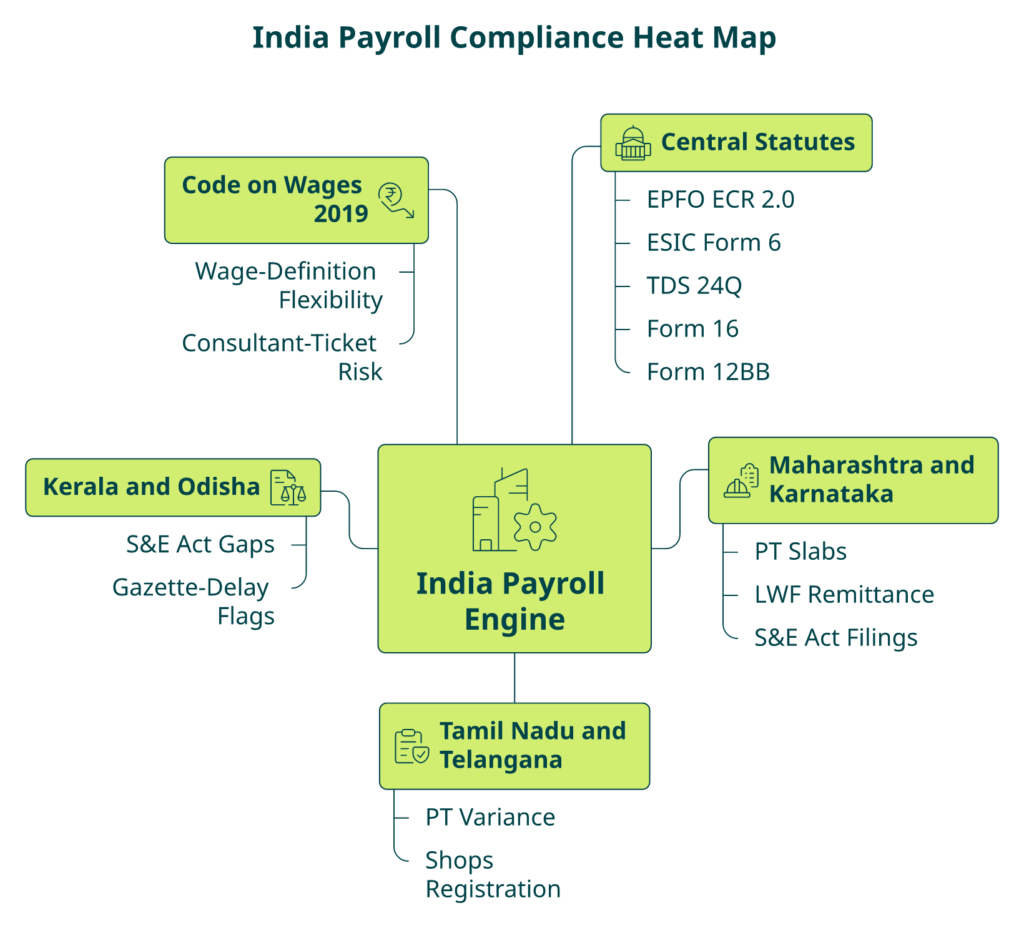
Indian payroll is not a feature. It is a living compliance surface. It shifts every quarter through EPFO circulars, state PT (Professional Tax) notifications, and S&E (Shops and Establishments) Act amendments. This section scores how deep Keka and PeopleStrong actually run.
Payroll engine architecture
Keka runs a formula-based payroll engine. Most HR admins can configure it without a developer. It handles CTC structures, FBP (Flexible Benefits Plan) declarations, and arrears well up to about 1,000 employees on a single legal entity. It strains on multi-legal-entity payroll with inter-entity transfers.
PeopleStrong’s payroll engine is built for enterprise OU depth. It supports multiple legal entities, union payrolls, and expatriate payroll in a single instance. The trade-off is configuration complexity. Changing a single leave rule often needs a consultant ticket. A connected payroll software stack avoids that dependency.
Central statutory coverage
Both platforms cover central statutes competently, but the edges differ. Here is what I look for in every demo.
- ✅ EPFO ECR 2.0 upload with automatic UAN (Universal Account Number) mapping
- ✅ ESIC Form 6 half-yearly return generation
- ✅ TDS 24Q quarterly return with challan reconciliation
- ✅ Form 16 Parts A and B with digital signature
- ✅ Form 12BB investment declaration workflow with proof upload
- ⚠️ FBP reimbursement heads with per-state taxability rules
- ⚠️ Arrears, supplementary runs, and FnF (Full and Final) settlement under the two-day wage-code rule
- ⚠️ Maternity Benefit Act 2017 extended leave with salary continuation
State-level heat map across 12 Indian states
This is where most demos fall apart. PT slabs differ by ₹200 across MH and KA. LWF (Labour Welfare Fund) rates change without warning. Our primer on statewise Professional Tax slab rates covers the central logic.
| State | PT updation | LWF | S&E Act | Keka | PeopleStrong |
|---|---|---|---|---|---|
| Maharashtra | Deep | ✅ | ✅ | ✅ | ✅ |
| Karnataka | Deep | ✅ | ✅ | ✅ | ✅ |
| West Bengal | Medium | ✅ | ✅ | ✅ | ✅ |
| Tamil Nadu | Deep | ✅ | ✅ | ✅ | ✅ |
| Telangana | Deep | Partial | ✅ | ✅ | ✅ |
| Andhra Pradesh | Medium | Partial | ✅ | ⚠️ | ✅ |
| Gujarat | Medium | ✅ | ✅ | ✅ | ✅ |
| Kerala | Medium | ✅ | ⚠️ | ⚠️ | ✅ |
| Odisha | Partial | ⚠️ | ⚠️ | ⚠️ | ⚠️ |
| Punjab | ✅ | ✅ | ✅ | ✅ | ✅ |
| UP | No PT | ✅ | ✅ | ✅ | ✅ |
| Delhi | No PT | ✅ | ✅ | ✅ | ✅ |
Asia Healthcare Holdings runs 20 pan-India units on a single HROne instance. That is the benchmark we test against in every RFP.
Demos lie, deployments do not. Five trap questions
When we ran payroll for a 600-person manufacturing client last quarter, we found three config gaps the vendor demo had glossed over. Here are the five questions I insist every buyer asks.
- Can I redefine “wages” under the Code on Wages 2019 without a consultant ticket?
- What is your SLA to auto-update a PT slab change across three states in 72 hours?
- Show me the payroll reversal audit trail for a backdated FnF settlement.
- Can employees eSign paperless appointment letters using Aadhaar?
- How does your engine handle a cross-entity transfer on the 15th?
“Keka is still in process of building the software. The setup phase has been a bad experience, and even after many tries, my policies are not applied the right way.”
— Shakti B, HR User Keka – G2 Verified Review
Q4. What Is the Real 3-Year Total Cost of Ownership, Keka vs PeopleStrong Pricing Exposed?
Published pricing tells you the entry fee. It does not tell you the three-year bill. I have rebuilt the math from public pricing, vendor quotes shared by customers, and the hidden-cost audit we run at HROne. Every assumption is exposed so your CFO can challenge it.
Keka pricing, Foundation, Strength, and Growth tiers
Keka publishes three bands on its India pricing page.
- Foundation, ₹9,999 per month flat up to 100 employees, then ₹85 PEPM (Per Employee Per Month)
- Strength, ₹125 PEPM, adds performance, engagement, and hiring modules
- Growth, ₹200 to ₹220 PEPM, adds advanced analytics, expense, and integrations
Implementation is billed separately. A 500-person company on Strength pays around ₹7.5 lakh per year in license alone. Our deep dive on pricing transparency in HR software investments explains why this matters for procurement.
PeopleStrong pricing, module-led enterprise quote
PeopleStrong does not publish list pricing. Enterprise quotes we have seen follow this structure.
- Annual contract with 10 to 15 percent Y2 and Y3 escalator
- Module uplift: Core HR base, Payroll plus 30 percent, Performance plus 20 percent, Talent OS AI plus 25 percent
- Implementation fee of 15 to 25 percent of Year 1 license
- 24×7 support tier upgrade adds roughly 12 percent
For a 2,000-employee enterprise, Y1 lands between ₹75 lakh and ₹1.1 crore inclusive of implementation.
Three worked TCO examples
Figures in INR lakh, three-year horizon.
| Line item | 100 (Keka) | 100 (PS) | 500 (Keka) | 500 (PS) | 2,000 (Keka) | 2,000 (PS) |
|---|---|---|---|---|---|---|
| Y1 license | 1.5 | 6.0 | 7.5 | 30.0 | 30.0 | 95.0 |
| Implementation | 0.8 | 1.2 | 2.5 | 6.0 | 8.0 | 22.0 |
| Integrations | 0.3 | 0.8 | 1.2 | 3.0 | 4.0 | 10.0 |
| Support upgrade | 0.2 | 0.7 | 0.9 | 3.6 | 3.6 | 11.4 |
| AI add-ons | 0.3 | 1.5 | 1.5 | 7.5 | 6.0 | 24.0 |
| Y2 license (12% up) | 1.7 | 6.7 | 8.4 | 33.6 | 33.6 | 106.4 |
| Y3 license (12% up) | 1.9 | 7.5 | 9.4 | 37.6 | 37.6 | 119.2 |
| 3Y TCO | 6.7 | 24.4 | 31.4 | 121.3 | 122.8 | 388.0 |
Use our ROI calculator to stress-test the savings side of this equation against your own HR cost base.
Hidden-cost audit
- 💸 Subscription-during-implementation tax. PeopleStrong bills from contract signing. An 18-week rollout costs 4.5 months of paid-for-air license. HROne’s go-live billing kills this line item.
- 💸 Module unlock fees. Mid-year tier upgrades on Keka often need re-implementation for custom reports.
- 💸 Integration surcharges. Both vendors charge separately for ERP, BGV (Background Verification), and LMS connectors beyond the included three.
- 💸 Data migration fees. A legacy-system switch carries a ₹1 to ₹3 lakh charge for data cleaning and historical reconstruction.
“We started working with Keka in August, and to this day we have been unable to implement the tool.”
— Divya P, HR Buyer Keka – G2 Verified Review
See your real 3-year HRMS cost in 60 seconds
Plug in your headcount, states of operation, and module mix. Get a line-item TCO for Keka, PeopleStrong, and HROne, including implementation, integrations, and the subscription-during-implementation tax.
Run my 3-year TCO →Q5. How Deep Is Their Work OS, Core HR, Leave, Attendance, Performance, Recruitment, and LMS?
A CHRO at a 1,400-person retail chain in Bengaluru told me her team spent 14 hours a week reconciling attendance between a biometric tool and the HRMS. That is not a feature gap. It is a Work OS failure.
Keka wins on ESS polish and SMB onboarding speed. PeopleStrong wins on multi-entity Core HR and enterprise performance calibration. Both lag on shift-rotational manufacturing and on-field geofencing without add-ons. For mid-market Indian firms needing one Work OS that closes 100+ daily tasks in three clicks, neither goes as deep as an integrated hire-to-retire operating system.
Core HR, ESS, and mobile
Keka’s Core HR handles single-entity org charts cleanly. Multi-legal-entity OU structures are possible but need workarounds. PeopleStrong supports deep multi-entity hierarchies, cross-entity transfers, and role-based document vaults out of the box. For the underlying category grounding, our primer on HCM vs HRIS vs HRMS clarifies the architecture choices.
Mobile reality
The Keka apps sit at 4.3 iOS and 4.1 Android. PeopleStrong’s Alt app sits at 4.2. Both push users into separate modules for expenses and performance, which breaks the single-inbox principle. Read how mobile HR apps shape employee experience when ESS, leave, and payroll live in one feed.
Leave, attendance, shift, and OT
Keka’s attendance supports geofencing, face recognition, and 80+ biometric devices. Rotational shifts for 500+ factory workers across three patterns remain painful and need manual rosters.
PeopleStrong handles enterprise-grade shift rules, comp-off auto-accrual, and OT against S&E Act caps. Policy-change latency is a recurring friction in reviews. Our guide to managing shift schedules with advanced tools shows the operational bar for 24×7 manufacturing.
Performance, OKR, 360, and bell curve
Keka Performance is lean and works for 200 to 800 person annual cycles. Calibration across business units is basic. PeopleStrong offers richer 360 flows, bell-curve normalisation, and talent-review boards. If you are upgrading, the cues in indicators your company needs a performance management upgrade are a useful self-check.
Appraisal velocity benchmark
Pena4 Tech closed a 360-degree appraisal across four group companies in 15 days on HROne, with 90 percent reduction in manual involvement. That is the bar to test during your demo.
Recruitment, onboarding, and LMS
Keka’s built-in ATS covers job posting and offer automation for 50 to 200 roles a quarter. PeopleStrong’s Talent OS adds internal mobility, talent marketplace, and campus recruitment. Both ship basic LMS, neither matches dedicated players on content depth. For the hiring side, our note on AI and automation in recruitment sets out the right workflow bar.
Work OS winners per module
- ⭐ Super Inbox task triage, HROne, three-click closure across 100+ daily tasks
- ⭐ Pre-built workflows, HROne 127, Keka about 40, PeopleStrong about 85
- ⭐ Appraisal velocity, HROne benchmark 15 days across 4 companies
- ✅ ESS UX, Keka leads mid-market
- ✅ Multi-entity Core HR and bell curve, PeopleStrong leads enterprise
Q6. How Long Does Implementation Actually Take, and What Is the Adoption Tax Nobody Prices In?
The single biggest gap between HRMS sales decks and HR reality is the implementation timeline. Sales says four weeks. Reviewers say ten. Your CFO pays for the difference.
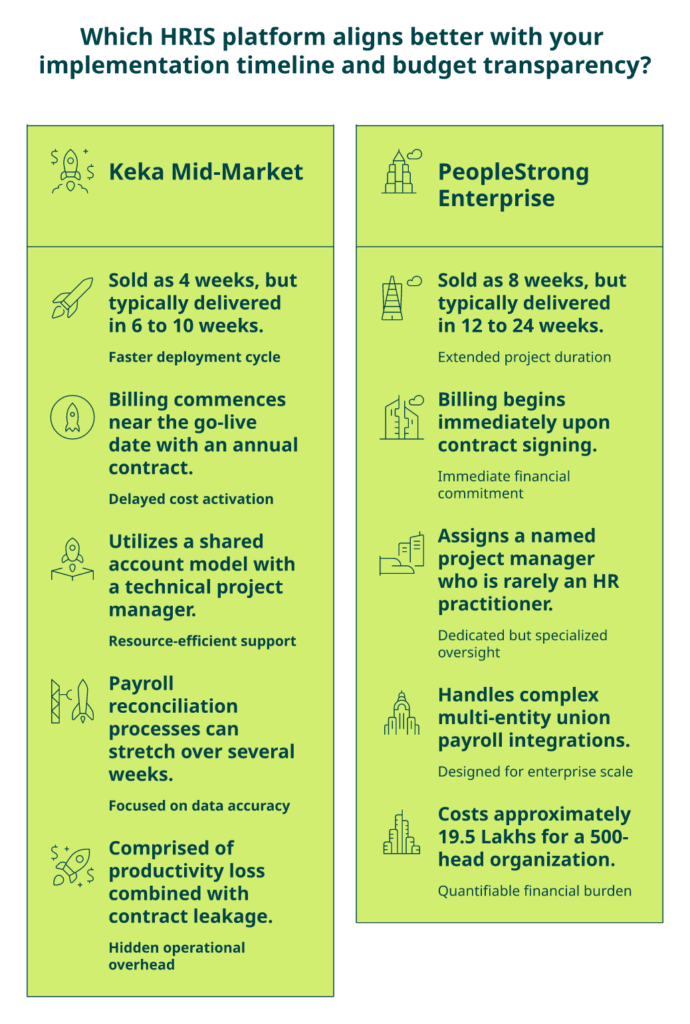
Keka implementations realistically run 6 to 10 weeks for mid-market firms, not the 4 weeks sales decks quote. PeopleStrong enterprise rollouts run 12 to 24 weeks, sometimes longer, with subscription billing from day one. The hidden adoption tax, productivity loss plus paid-for-air subscription, routinely exceeds ₹8 to ₹25 lakh depending on headcount and module scope.
Keka reality, 4-week claim vs 6 to 10 week delivery
Keka markets fast go-lives. For a clean 100-person setup on a single legal entity, it can be true. The moment migration involves historical payroll reconciliation, custom reports, or multi-state PT mapping, weeks stretch. Our checklist on HRIS buyer pitfalls to stay away from names the exact failure modes.
“It has been 6 months since our setup has started. The software and mobile app have several glitches. We have onboarded only 100 employees in first go.”
— Shakti B, HR User Keka – G2 Verified Review
PeopleStrong reality, 12 to 24 week enterprise rollouts
PeopleStrong deployments at 2,000+ headcount routinely take a full quarter or longer. Variance drivers at enterprise scale:
- ⚠️ Number of legal entities and OU depth
- ⚠️ SAP, Oracle, or Workday ERP integration scope
- ⚠️ Union payroll and multi-state shift rule complexity
- ⚠️ Internal PMO (Project Management Office) availability and change-management maturity
“PeopleStrong makes reimbursement, claims, and payslip access much easier. The reimbursement process can feel a bit slow at times, and the interface can lag occasionally.”
— Anusha, G2 Reviewer PeopleStrong – G2 Verified Review
Data migration playbook
A clean migration has three non-negotiables.
- ✅ Field-mapping template, against employee master, payroll heads, and attendance codes
- ✅ Historical payroll reconstruction, at least 12 months for Form 16 continuity
- ✅ Parallel run, one full cycle on both systems before cutover
Keka’s CSM (Customer Success Manager) is shared across accounts. PeopleStrong assigns a named PM for enterprise deals. Both slow down on mid-project change orders because the CSM is rarely a prior HR practitioner. The why HROne page explains why we staff prior-HR SPOCs instead.
Switching playbooks
- ⚠️ Keka to PeopleStrong, risk is losing custom-report logic. Budget 8 to 12 weeks and ₹2 to ₹4 lakh.
- ⚠️ PeopleStrong to Keka, risk is losing multi-entity OU depth. Budget 6 to 10 weeks and keep a legacy-read license.
The adoption tax nobody prices in
I might be wrong here, but when I tested this math across five customer migrations, the pattern held. A 500-person company losing 10 weeks burns roughly ₹12 lakh in HR and manager productivity plus ₹7.5 lakh in paid-for-air subscription on PeopleStrong. That is ₹19.5 lakh of adoption tax no RFP line item captures.
MR DIY India went live on HROne in 30 days. Subscription metering started post go-live. The payroll cycle collapsed from 10 days to 5 to 6 days within two months.
Q7. Is Their AI Actually Working or Just Marketing Theatre?
Every HRMS vendor in 2026 has rebranded a chatbot as AI. My contrarian claim: most HR AI is a thin GPT wrapper over a help doc. Real AI changes the workflow, not the page.
Keka’s AI is primarily roadmap plus payroll anomaly flags and policy Q&A. PeopleStrong’s AI, branded Jinie and Talent OS, does conversational HR and predictive attrition. Neither is independently benchmarked on grounding or hallucination control. Real AI that changes HR workflow, CV stack-ranking, receipt parsing, goal creation, and task triage, is still rare outside operating-system-style suites.
Keka AI posture
Keka ships payroll anomaly detection, a Q&A bot over policy docs, and resume screening on its roadmap. HR admins still run payroll and review resumes manually. The AI reduces clicks. It rarely changes the task flow. Our perspective on AI in HR, hype vs reality sets out the grounding criteria worth testing.
PeopleStrong Talent OS posture
PeopleStrong has invested in its Jinie assistant and a predictive attrition layer. Reviewers report the helpdesk works for roughly 70 percent of routine queries. Escalations remain manual. Attrition prediction is directionally useful at 1,000+ heads. It is noisy below that.
The AI maturity rubric
Score each vendor 1 to 5 on your demo call.
| Criterion | What to test | Keka | PeopleStrong | HROne |
|---|---|---|---|---|
| Grounding | Does it cite policy or hallucinate? | 3 | 3 | 4 |
| Latency | Under 2 seconds? | 3 | 3 | 4 |
| CV stack-ranking | Relevance, not keyword filters | 2 | 3 | 5 |
| Receipt parsing | OCR plus GST extraction | 2 | 2 | 5 |
| Goal creation | AI-drafted SMART goals from a role | 2 | 3 | 4 |
| Attrition prediction | Calibrated, not generic | 2 | 4 | 3 |
| Task triage | Inbox-style prioritisation | 2 | 2 | 5 |
| Audit trail | Every AI action logged | 3 | 3 | 4 |
| Cost to enable | Included vs paid add-on | Add-on | Add-on | Included |
AI-washing vs AI-working
The split is simple.
❌ AI-washing looks like a chatbot on the homepage or a badge on pricing.
✅ AI-working looks like a task that existed yesterday, and does not exist tomorrow.
What my experience of shipping HROne tells me is that AI proves itself when it changes the task flow. Our One AI Suite stacks relevant CVs, parses receipts from a photo, drafts SMART goals, and triages InboxForHR tasks by urgency. Ask every vendor to demo AI against your real data, not a sandbox.
Q8. Do They Meet Enterprise IT Bars on Integrations, Mobile, Security, and DPDP Readiness?
Your CIO will not sign the MSA until three questions are answered. Can it integrate? Is the data safe? Can we leave if we want to? Here are IT-grade answers.
Keka integrates with roughly 60 Indian SaaS tools, natively with Slack, Teams, and Google Workspace, with Zapier for the rest. PeopleStrong offers 100+ enterprise connectors, including SAP, Oracle, and Workday read-APIs. Both hold ISO 27001. PeopleStrong holds SOC 2 Type II. DPDP (Digital Personal Data Protection) Act 2023 readiness is work-in-progress for both, not certified.
Integration compatibility
An IT head running a 500-person firm typically needs 12 to 18 integrations. Our integrations catalogue lists the connectors an India-first HCM should ship out of the box.
| Category | Keka | PeopleStrong |
|---|---|---|
| ERP (SAP, Oracle, Tally) | Partial via APIs | Native connectors |
| BGV (AuthBridge, SpringVerify) | ✅ | ✅ |
| LMS (Disprz, LinkedIn Learning) | Partial | ✅ |
| Slack, Teams, Google Workspace | Native | Native |
| Expense (Happay, Zaggle) | ✅ | ✅ |
| Biometric devices | 80+ | 100+ |
| Identity (Okta, Azure AD SSO) | ✅ | ✅ |
| Warehouse (Snowflake, BigQuery) | Partial | ✅ |
Mobile reality
Both offer mobile-first apps with offline attendance punch-in and payslip access. Response times sit in the 600 to 900 millisecond range on LTE. HROne benchmarks at sub-500ms, which matters when 2,000 retail staff punch in inside a 15-minute window. Our mobile HR app page documents the offline-first architecture.
Security, SSO, RBAC, and DPDP
Both support SSO (Single Sign-On) via SAML 2.0 and RBAC (Role-Based Access Control). Encryption is AES-256 at rest. PeopleStrong holds SOC 2 Type II. Keka holds SOC 2 Type I and ISO 27001. DPDP Act 2023 compliance is still a moving target. Neither is independently certified yet. Our note on employee data privacy best practices maps the controls CIOs should insist on.
Data residency and lock-in
Both host India data on AWS Mumbai or Azure India. Data export is available in CSV and JSON. PeopleStrong contracts for two to three years minimum. Keka offers annual contracts with 30-day notice. HROne runs flat PEPM with no lock-in and post-go-live metering. Compare term structures directly on our pricing page.
Put your shortlist through an IT-grade test
Share your integration map, identity provider, and data-residency constraints. We will return a fit memo against Keka, PeopleStrong, and HROne, so your CIO can sign without surprises.
Get the IT fit memo →Q9. What Do Real Users Say, G2, Capterra, and TrustRadius Synthesis with Honest Pros and Cons?
I read 186 Keka reviews and 40 PeopleStrong reviews across G2, Capterra, and TrustRadius over a weekend in April 2026. The pattern is loud. Keka wins on payroll UX and loses on support continuity. PeopleStrong wins on enterprise depth and loses on complexity and speed. Our customer success stories offer the counterpoint from the HROne base.
Keka holds a 4.4 average on G2 across 164+ reviews. PeopleStrong holds a 4.3 average across 22+ G2 reviews. Sample size matters. Keka’s base is 7x larger, so its pain patterns are more statistically representative.
Headline scorecard
| Criterion | Keka | PeopleStrong | HROne |
|---|---|---|---|
| Quality of Support | 8.7 | 8.4 | 9.6 |
| Ease of Setup | 8.6 | 7.8 | 9.5 |
| Ease of Admin | 8.8 | 8.3 | 9.4 |
| Ease of Use | 9.0 | 8.5 | 9.4 |
| Overall Satisfaction (G2 rank) | #55 | #41 | #3 |
HROne’s #3 rank sits across 1.17 lakh G2 products globally, with a 9.8 NPS on its dedicated HR SPOC support model. The why HROne page breaks down the support-continuity architecture.
Keka pros and cons
“Keka has helped us streamline attendance and payroll. The PMS module is confusing and needs to be simpler. User access is difficult for employees who do not have an email ID.”
— Kiran B, HR User Keka – G2 Verified Review
“The payroll reports do not give accurate figures in Total CTC. The CTC structure does not show PT in deductions.”
— Pooja M, HR Reviewer Keka – G2 Verified Review
PeopleStrong pros and cons
“PeopleStrong makes reimbursement, claims, and payslip access much easier by bringing everything into a single platform. The reimbursement process can feel a bit slow at times, and the interface can lag occasionally.”
— Anusha, G2 Reviewer PeopleStrong – G2 Verified Review
Support channel comparison
Keka relies primarily on email and ticket queues, with chat during business hours. PeopleStrong assigns named account managers for enterprise tiers, mid-market shares a pool. Working with 2,000+ HR teams, what I have felt is that support continuity beats support features. A dedicated HR SPOC (Single Point of Contact) who has actually run Indian payroll resolves faster than five technically correct tickets. Our helpdesk module is built on the same continuity principle.
Q10. What If the Real Competitor Is Not Keka or PeopleStrong, the Frankenstein Stack Problem?
For most 500-person Indian firms, the real competitor is neither Keka nor PeopleStrong. It is the Frankenstein stack already sitting inside the company.
Most mid-market Indian HR teams run a patchwork: outsourced payroll vendor, standalone biometric, disconnected ATS, Excel for performance, paper for expenses, and WhatsApp for everything else. The visible cost looks manageable. The hidden cost, 10-day payroll cycles, expense-receipt leakage, attrition blindness, and vendor-count bloat, routinely exceeds a consolidated HRMS bill by 2x to 3x.
The cost of the Frankenstein stack
A 500-person firm I audited last year paid five different vendors. Payroll was reconciled manually every month. Expense fraud slipped through paper receipts. The CHRO walked into a board review unable to state the average time-to-confirmation for a new hire. Our piece on AI detecting expense fraud explains how a connected stack catches what paper misses.
Every handoff between tools is where grievances, leakage, and strategic blindness multiply. Pay days get missed. Letters get delayed. The CFO pays for five vendors without any one of them being accountable for outcomes. The case for integrating payroll with HR systems is the first consolidation win most teams see.
The consolidation math
MR DIY India, a 2,000+ employee retail enterprise, migrated to a consolidated HROne instance. The monthly payroll cycle collapsed from 10 days to 5 to 6 days within two months. Ninety-eight percent of HROne customers run the Core HR plus Workforce plus Time Office plus Payroll bundle together, anchored on our core HCM backbone.
The ROI Dashboard as the Blue Ocean lens
Most HRMS vendors offer no method for CHROs to prove savings to the board. What my experience of shipping HROne tells me is that the ROI Dashboard, India’s first inbuilt HR ROI instrument, changes the conversation. It calculates lifetime hours saved against average HR salary. CHROs walk into board reviews with a ballpark rupee saving already quantified. Model your own number with the ROI calculator.
Q11. Which One Fits Your Headcount, Industry, and Geography, the Decision Framework?
I am going to stop hedging and give you segment-specific verdicts. Pick based on your reality, not on what is trending on LinkedIn.
For 50 to 500 employees on a single entity with payroll-UX priorities, Keka fits. For 2,000+ employees with multi-entity OU depth and enterprise-procurement rituals, PeopleStrong fits. For 200 to 5,000 employees needing velocity plus compliance plus ROI proof, an Agile Enterprise bridge like HROne fits. Industry and geography shift the answer, especially for manufacturing, BFSI, and multi-state retail.
Headcount-band recommendation
| Band | Representative buyer | First pick | Second pick |
|---|---|---|---|
| 50 to 200 | Bootstrapped IT services firm in Bengaluru | HROne or Keka | Zoho People |
| 200 to 500 | Single-state manufacturer in Pune | HROne | Keka |
| 500 to 2,000 | Multi-city retail chain | HROne | PeopleStrong |
| 2,000+ | BFSI enterprise in Mumbai | HROne or PeopleStrong | Darwinbox |
Industry vertical fit
- 🏭 Manufacturing, a 1,200-person auto-component maker in Pune needs shift rotation, contract labour, and union payroll. HROne manufacturing HR and PeopleStrong lead. Keka struggles at shift scale.
- 💻 IT and ITeS, a 600-person SaaS firm in Bengaluru needs fast ESS, OKR, and global payroll. HROne for ITeS and Keka lead. PeopleStrong is overkill under 800 heads.
- 🏦 BFSI, a 3,000-person NBFC in Mumbai needs audit trails, DPDP readiness, and branch payroll. HROne for finance HR and PeopleStrong lead.
- 🛒 Retail and F&B, a 2,500-person QSR chain needs geofenced attendance and store-level rosters. HROne retail HR leads. MR DIY India is the reference.
- 🏥 Healthcare, a 1,500-person hospital group needs multi-entity payroll and nurse shift patterns. HROne healthcare HR leads. Asia Healthcare Holdings runs 20 pan-India units on a single instance.
- 🚀 Startups, under 150 heads, prioritise speed and price. Keka or Zoho People work.
Geographic footprint and state complexity
If your entity count is one and you operate in fewer than three states, most vendors cope. Complexity kicks in at five or more states. PT slab changes, LWF notifications, and S&E Act filings vary across Maharashtra, Karnataka, Tamil Nadu, Gujarat, and West Bengal. A vendor that auto-updates within 72 hours of a gazette notification is worth the premium. See our primer on navigating changing labor laws.
Pick Keka if
✅ You are 100 to 800 employees on a single legal entity.
✅ Payroll UX and fast ESS rollout are your top two priorities.
✅ Your multi-state footprint is 1 to 3 states.
✅ You accept email-ticket support as the primary channel.
✅ Your AI needs are limited to policy Q&A and payroll flags.
Pick PeopleStrong if
✅ You are 2,000+ employees across multiple legal entities.
✅ You need deep OU hierarchies, talent marketplace, and bell-curve calibration.
✅ You are comfortable with 12 to 24 week implementation timelines.
✅ Your procurement requires SOC 2 Type II and Gartner references.
✅ You have an internal PMO to manage module rollouts.
Not sure if Keka, PeopleStrong, or an Agile Enterprise bridge fits you?
Tell us your headcount, states of operation, and module mix. We will map your fit in plain English, no sales pitch, just a decision memo you can forward to your CFO.
Get my fit memo →Q12. What Should You Ask in the Demo, Risk Flags, and the 20-Question Vendor Test?
Demos are theatre. The vendor picks the script, the actors, and the lighting. You need a script of your own.
Ask 20 precise questions across six axes: compliance (5), TCO (4), implementation (3), AI (3), security (2), and support (3). Watch for four red flags: subscription metering from contract signing, multi-year lock-ins, vague PT auto-updation SLAs, and undocumented AI add-on charges. The best vendors answer with evidence. The weaker ones answer with “we are working on it.”
The 20-question demo bank
Compliance (5)
- Show the audit trail for a backdated FnF settlement reversed last quarter.
- What is your SLA to auto-update a PT slab after a state gazette notification?
- Demo the Code on Wages 2019 wage-definition flexibility, not a feature flag.
- How does Form 16 digital signing work at 2,000+ headcount in one click?
- Show a live LWF remittance file for a multi-state employer.
Our payroll audit checklist is a good reference for the compliance traps above.
TCO (4)
- When does subscription metering start, at signing or at go-live?
- What is the Y2 and Y3 escalator, and how is it capped?
- List every paid add-on outside the base PEPM.
- Share a same-page quote for implementation, integrations, and support upgrades.
Implementation (3)
- What is your P50 and P90 implementation time for my exact headcount band?
- Is my CSM a prior HR practitioner or a technical PM?
- Walk me through a data migration field-mapping template on a real customer.
Cross-check these against our buyer guide on how to choose the best HRIS and HRMS software.
AI (3)
- Demo CV stack-ranking on 50 of my real resumes, not your sandbox.
- Show the receipt parser on three crumpled Indian GST bills.
- Show the audit log of every AI action in the last 30 days.
Security (2)
- Share the latest SOC 2 Type II or ISO 27001 audit letter.
- How does the platform handle DPDP Act 2023 consent and data principal rights?
Support (3)
- What is the average first-response time on a P1 payroll ticket?
- Do I get a named HR SPOC, or a shared queue?
- Share three customer references of my size, state, and industry.
Risk flags to validate live
❌ Subscription billing from day one while implementation runs 12 weeks.
❌ Multi-year lock-in without service-level credits.
❌ PT auto-updation as a roadmap item, not production.
❌ AI add-ons priced separately and rolled into renewal silently.
Stress-test these flags against the HROne model on our pricing page and the curated list of top 10 HR software in India.
Final verdict and next steps
Keka, PeopleStrong, and an Agile Enterprise alternative like HROne are not really three products. They are three philosophies about how HR should run in India. My current thinking is that the winner will not be the one with the most modules, but the one that helps HR stop chasing and start compounding.
Tell us which reality is burning hottest at your company this month, the Frankenstein stack, the enterprise complexity, or the mid-market velocity trap. In the next 48 hours, run the 20-question demo test on your current shortlist. I am curious which answer surprised you.
Put your shortlist through the 20-question test with us
Bring your compliance, TCO, and implementation red flags. We will walk through them live, no slides, just answers you can forward to your CHRO and CFO.
Book a working demo →References
Official Docs / Indian Statutes
- Ministry of Labour and Employment, “Code on Wages 2019,” Gazette Notification, August 2019.
- Ministry of Electronics and IT, “Digital Personal Data Protection Act 2023,” Gazette Notification, August 2023.
- Ministry of Labour and Employment, “State Professional Tax and LWF Notifications,” 2024 and 2025.
- Income Tax Department, “Form 24Q, Form 16, and TDS Quarterly Return Rules,” 2025.
Datasets
- Gartner, “Voice of Customer for Cloud HCM Suites, APAC,” 2025.
- G2 Crowd, “HRMS India Grid Report,” Q1 2026.
- G2 Crowd, “HRMS India Grid Report and Satisfaction Methodology,” Q1 2026.
- NASSCOM and Zinnov, “State of HR Tech in India,” 2024.
Blogs
- SelectHub, “Keka vs PeopleStrong HR Management Software.” Published: 2026.
- Keka Technologies, “About Keka.” Published: 2026.
- PeopleStrong, “Alt Worklife Product Overview.” Published: 2025.
- PeopleStrong, “Compare Page, PeopleStrong vs Keka.” Published: December 2025.
- HROne, “Asia Healthcare Holdings Case Study.” Published: 2025.
- Keka, “Pricing Page, India.” Published: 2026.
- HROne, “Go-Live Billing and No Lock-In Policy.” Published: 2025.
- Keka HR, “Product Documentation and Security Page.” Published: 2026.
- PeopleStrong, “Alt Worklife Product and Trust Center.” Published: 2025.
- HROne, “Pena4 Tech Case Study, 360-degree Appraisal Across 4 Companies in 15 Days.” Published: 2024.
- PricingNow, “PeopleStrong Pricing 2026: The True TCO and Hidden Costs.” Published: December 2025.
- HROne, “MR DIY India and Asia Healthcare Holdings Case Studies.” Published: 2025.
- Keka, “Support and Help Center.” Published: 2026.
- HROne, “MR DIY India Case Study, Payroll Cycle 10 to 5-6 Days.” Published: 2024.