


Q1. Why Is “Which Is the Best HRMS?” the Wrong Question for Scaling Indian Companies in 2026?
The best HRMS for a 200-person SaaS startup in Bengaluru is almost never the best HRMS for a 2,000-person manufacturing group spread across five states. Outgrowing your HR software is not a feature-gap moment. It is the day your current system stops absorbing the complexity of your business, and your HR team starts absorbing it instead, in spreadsheets and WhatsApp groups and late-night payroll reconciliations.
The question you are actually asking
I have spent the last decade building an HRMS in India, and I still get this question every week. “Karan, which is the best HRMS?” My honest answer is that it is the wrong question. A better one is, “At what point does my current HRMS stop compounding my HR team’s time and start taxing it?” That is the outgrowing moment, and it is operational, not theoretical.
Who this guide is actually written for
This guide is written for a specific reader. You are a CHRO, a People Ops head, or a founder running HR for a company with 500 to 5,000 employees. You are probably in your late twenties to mid forties. You are already using Keka, Darwinbox, or greytHR. You are not shopping. You are diagnosing.
You have the scars of an implementation that took longer than promised. You have a support ticket open right now that nobody owns. You are being asked by your CFO for a single rupee number on what HR tech saves the business, and you do not have it. If that sounds familiar, our CHRO solutions page maps to exactly this reader.
Why “best HRMS” fails buyers who already own one
Buyers do not arrive on a comparison page as blank slates. They arrive carrying scars. Ranking lists that tell a 2,000-person conglomerate to “consider Keka” or a 150-person SaaS startup to “consider Workday” are noise. What helps is pattern recognition, which is why most serious readers start with a how to choose HRIS HRMS software framework before comparing brands.
The bouquet vs the garden
Most HR leaders buy a bouquet of modules. Leave, attendance, payroll, a bit of performance. It looks beautiful on day one. Then a second legal entity shows up, or a manufacturing unit with shift rosters, or a new state with a different Professional Tax slab, and the bouquet wilts. A garden, by contrast, keeps growing because the soil underneath (the workflow engine, the operating unit structure, the data model) is built for complexity.
Outgrowing happens when you realise your bouquet cannot become a garden without ripping the roots out.
Keka, Darwinbox, and greytHR in one honest paragraph
Let me be fair to all three, because this article is not a hit piece.
- ✅ Keka is a well-designed SMB product with a clean UI and a strong brand among sub-500-employee firms. It wins organic search and onboards quickly when your setup is simple.
- ✅ Darwinbox is the enterprise name that shows up in every 1,000-plus-employee RFP in India, backed by a unicorn valuation and genuine module breadth, with Gartner recognising it as the only India-origin Challenger in the 2025 Cloud HCM Magic Quadrant.
- ✅ greytHR is arguably the most reliable SMB payroll engine in India, with deep statutory coverage and a generous free plan that has earned it a loyal base below 300 employees.
Each of them is the right answer for some company, on some day, at some size. Each of them also has a ceiling. The rest of this article maps those ceilings honestly.
The open loop I want you to hold
⏰ Here is the question I want you to sit with while reading the next ten sections. If your current HRMS is hitting a ceiling, you have exactly three exits. You can tier up within your current vendor’s higher SKU. You can migrate up to a Workday-class global HCM. Or you can go composable, unbundling into best-of-breed tools stitched by APIs.
Which one fits your business is not a matter of taste. It is a function of four variables (entity count, geography, analytics maturity, and your board’s tolerance for CAPEX), and I will walk you through a 30-minute diagnostic by Q6. Stay with me.
Q2. When Does a Company Actually Outgrow Its HRMS, and What Are the Structural Thresholds in India?
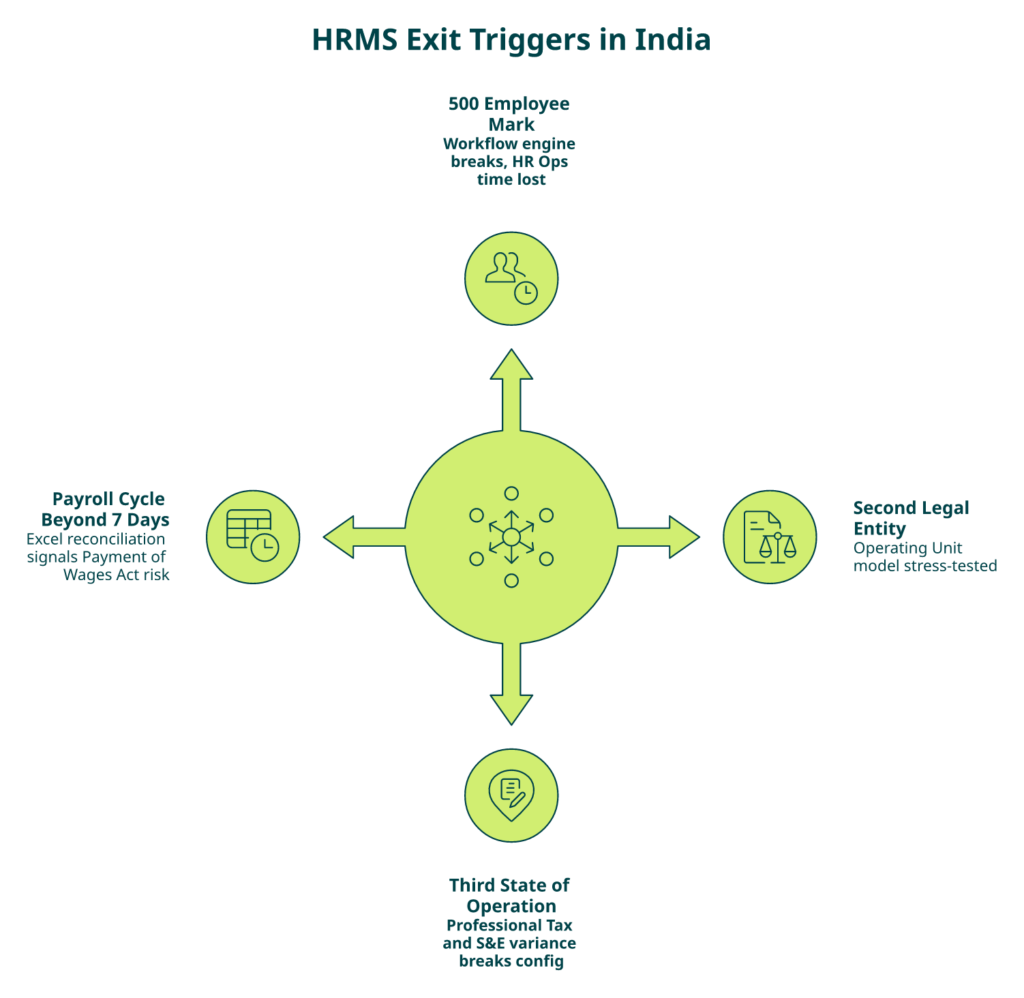
Companies in India outgrow their HRMS at four structural thresholds, not one. The 500-employee mark, the addition of a second legal entity, the third state of operation, and a payroll cycle that stretches past seven days. Each threshold is a statutory trigger as much as an operational one, which is why the break shows up so predictably.
The four thresholds that actually matter
Working with more than 1,500 customer brands, the pattern is remarkably consistent. The complaint is rarely “we need more features”. It is always “our current system cannot absorb this specific new reality”.
Threshold 1: The 500-employee mark
At around 500 employees, your HR operating model changes. You cross from a team that can manually shepherd every exception into a team that needs workflow automation to survive. A 2023 KPMG India benchmark found mid-market firms lose around 30% of HR Ops time to manual payroll rectification, and that number spikes sharply past the 500-headcount band. Below 500, surface UX wins. Above 500, workflow depth wins, which is where a mature core HCM starts paying for itself.
Threshold 2: The second legal entity
The day your group adds a second legal entity is the day your HRMS’ operating-unit (OU) model gets stress-tested. Operating unit, in plain terms, is how the software models multiple legal entities, cost centres, and business units under one parent. Most SMB-tier HRMS products can handle one entity elegantly and two entities awkwardly. By the third, you are configuring payroll structures by duplication, which is where compliance risk leaks in.
Threshold 3: The third state of operation
Indian labour law is a federated mess, and I mean that with affection. Every state has its own Professional Tax slab, Shops and Establishments rules, and minimum-wage notifications. The Code on Wages 2019 consolidated central law but did not eliminate state variance. At two states, you can manage with exceptions. At three or more, you need a statutory compliance payroll engine that knows which rule applies to which employee automatically.
Threshold 4: Payroll cycle over seven days
This is the operational tell. If your payroll team is working more than seven business days per cycle, something in your stack is leaking time. MR DIY India’s payroll cycle dropped from 10 days to 5 to 6 days after consolidation, and that is the benchmark I hold in my head. A 10-day cycle means you are rebuilding payroll in Excel every month, even if you would not call it that.
⚠️ The Indian statutory scale-break map
The break points are not arbitrary. They map directly onto statutes that most analyst decks skip past.
| Threshold | Typical vendor break-point | Statutory trigger |
|---|---|---|
| 500 HC | SMB-tier workflow engine maxes out | EPFO audit frequency rises |
| 2nd legal entity | OU model forces duplicate configs | Code on Wages 2019 multi-entity payroll |
| 3rd state | PT, S&E, minimum-wage variance breaks config | State S&E Acts and PT notifications |
| Payroll >7 days | Manual reconciliation in Excel | Delayed salary triggers Section 5 of Payment of Wages Act |
| Contract labour mix | No CLRA register automation | Contract Labour (R&A) Act 1970 audit trail |
| POSH complaints rising | No confidential audit trail | POSH Act 2013 annual return requirement |
If you are at two of these thresholds, stop adding workarounds. Schedule a 30-minute audit with your payroll lead and map which statutes your current HRMS configures automatically versus which ones your team handles in Excel. That gap is your real ceiling, and it will not fix itself.
Q3. Where Does Keka Ceiling Out, on Workflow Rigidity, Analytics Depth, and Global Payroll Gaps?
Keka ceilings out when a company crosses roughly 500 employees, adds a second legal entity, or starts needing same-day support. Its surface UX stays pleasant. The workflow engine, the analytics depth, and the email-only support SLA are what start to crack, and the cracks tend to show up in the same order every time. A head-to-head view sits on our HROne vs Keka page for readers who want the full matrix.
Where Keka genuinely shines
Let me start with the honest bit. Keka is a well-designed SMB product. The dashboard is clean. The mobile app is responsive. For a 150-person services firm running one legal entity in one state, Keka onboards fast and runs well.
G2 ranks it respectably on Easiest-to-Use Core HR, and most of the negative reviews are not about the UI at all. They are about what happens when you try to scale past the sweet spot.
The protagonist: a 400-person fintech HR Ops lead
Picture Priya. She runs HR Ops at a 400-person fintech in Pune. She picked Keka two years ago because the dashboard looked modern and her CFO liked the pricing. For eighteen months, things were fine.
Then the company opened a second entity in Bengaluru for a regulated lending arm. Then they added a Mumbai sales office. Then a senior payroll escalation sat in an email thread for four working days because support does not operate on a dedicated-SPOC model. That is the SCR arc in a sentence. Situation, complication, resolution.
What Priya tells us
“I have been a Keka user since 2021, and the service is decreasing day by day. The other day I was trying to configure menstrual leave only for Bangalore location and needed some help, the chat was not at all helpful. Most of the times folks behind the chat window is not fully aware of the functionality. TAT on customer request on features is bad. Keka is not built to service IT consulting firms.”
— Verified User in Consulting Keka – G2 Verified Review
This is not an outlier. It is a pattern.
The three complications that predict a Keka exit
❌ Complication 1: Workflow rigidity at the second entity
Keka’s workflow engine handles single-entity companies elegantly. The moment you need entity-specific leave policies, OU-level approval matrices, or state-specific statutory rules, configuration gets fragile. Reviewers report policies “not applied the right way” even after six months of setup, which is precisely where a robust leave management engine earns its keep.
“Customisation required as per company policy finding difficult to incorporate. The Leave request cannot be cancelled by a user after applying. Custom field and filter option is not available in custom report.”
— Prem K., HR Keka – G2 Verified Review
❌ Complication 2: Analytics and workforce-planning depth
At 500+ employees, CHROs start needing real workforce planning. Attrition heatmaps by function, cost-to-hire by source, span-of-control diagnostics. Keka’s reporting is serviceable for basic HR MIS, but workforce-planning depth is thin. CFO-ready analytics typically requires export to Excel or Power BI.
❌ Complication 3: Global payroll gaps
The moment you hire a single employee in the UAE, Singapore, or the US, Keka’s India-centric payroll engine becomes a problem. There is no native multi-country payroll. You end up bolting on a Deel or a Remote, and now you are running two HR systems.
❌ Complication 4: Email-only support SLA
This is the one that surprises buyers. Support resolution often runs through shared email threads rather than a named SPOC. For a 200-person firm, this is tolerable. For a 600-person firm where one payroll error affects 600 paycheques, it is not.
“We started working with Keka HRMS in August, and to this day, we have been unable to implement the tool in our company due to their consistently delayed responses and poor coordination between their internal teams.”
— Divya P. Keka – G2 Verified Review
📊 The Keka ceiling map
| HC band | Module | Break-point signal |
|---|---|---|
| <300 | All modules | Works well for single entity, single state |
| 300 to 500 | Workflows, support | Email-thread support starts slipping SLAs |
| 500 to 1,000 | OU, analytics | Multi-entity config gets brittle |
| 1,000+ | Global payroll, WFP | Requires bolt-ons or replacement |
The resolution
The diagnostic question is not “is Keka bad”. It is not. The question is, “does my escalation model survive 600 employees and a second state?” If the answer is no, you are not outgrowing Keka because of features. You are outgrowing it because your operating reality has moved past what a Keka-sized support and workflow engine was built for.
In our experience of migrating mid-market firms off Keka, the switching trigger is almost always the support ticket that sat for four days during a payroll week, not the feature gap. The feature gap is the excuse. The SLA miss is the reason.
Q4. Why Do Enterprises Outgrow Darwinbox Despite Its Unicorn Halo, on Implementation Weight, HCM Parity Gaps, and Cost Creep?
Darwinbox is the safest-feeling choice for Indian enterprise HR buyers, and that is precisely why so many 2,000-plus-employee firms outgrow it faster than they expected. The thesis is simple. Darwinbox sells breadth of modules. It charges from day one while implementation drags for months. And at 2,000+ headcount with a global footprint, the module depth starts to feel like it was built for APAC mid-market, not global enterprise. The side-by-side view lives on our HROne vs Darwinbox page.
Pillar 1: Implementation weight and customisation debt
Darwinbox’s module breadth is real. So is the configuration overhead that comes with it. Implementations routinely stretch across multiple quarters, and during those quarters, the subscription meter is already running.
The operational tell is navigation fatigue. HR Ops teams bounce across multiple tabs and email threads to close a single confirmation letter, a leave approval, or an exit clearance. Reviewers describe this pattern consistently, and the cost is not theoretical. It is 110 daily touchpoints per HR Ops user, multiplied across the team, which is why a single HR inbox changes the operating model.
“Bad implementation experience, bad UI UX, configurations getting broken in production on its own due to product deployments, terrible customer service. Basically everything. The solution was supposed to act as a full fledged HRMS for us. We are ending up doing most of the products manually and all the data is messed up.”
— Verified User in Computer Software Darwinbox – G2 Verified Review
Pillar 2: HCM parity gaps vs Workday and SuccessFactors
For a 2,000-plus-employee Indian enterprise with real global ambition, the board eventually asks for Gartner-validated enterprise HCM. Gartner’s 2025 Magic Quadrant for Cloud HCM places Darwinbox as a Challenger, which is a genuine achievement and the only India-origin vendor at that level. Leaders, though, remain Workday, Oracle HCM, SAP SuccessFactors, ADP, and UKG.
The parity gaps that show up in side-by-side evaluations are workforce planning depth, talent intelligence, global payroll country coverage, and learning experience. These are not flaws. They are scope gaps that become material when your HR strategy shifts from “run HR well in India” to “run HR well across fifteen countries”.
💰 Pillar 3: Cost creep at 2,000+ headcount
Here is the economic pattern we see. Darwinbox enters at a reasonable PEPM (per-employee per-month) rate. Then modules get added. Then a custom implementation partner gets involved. Then a multi-year lock-in gets signed. By year three, the fully-loaded cost at 2,000+ headcount often rivals a tier-one global HCM, without the analyst validation to show the board. Readers pressure-testing this math usually land on our ROI calculator before the next renewal.
G2 data is instructive. Darwinbox’s setup-satisfaction score sits around 7.8, against HROne’s 9.5 on the same dimension. For context, MR DIY India went live on HROne in 30 days, while a comparable enterprise implementation on Darwinbox often runs a quarter or more. The full story is on the MRDIY case study page.
“Implementing and maintaining comprehensive HR software can be costly, especially for small and medium-sized businesses with limited budgets. It relies on internet networks and connectivity. If there are internet connection issues or the server experiences downtime, it can disrupt HR operations.”
— Shefali J. Darwinbox – G2 Verified Review
“Transitioning from the old system to Darwinbox is quite difficult. User interface of Darwinbox is very outdated. Darwinbox Support team is not supportive.”
— Ankush B. Darwinbox – G2 Verified Review
📊 The Darwinbox ceiling map
| HC band | Where it shines | Where it ceilings |
|---|---|---|
| 500 to 1,500 | Module breadth, brand trust | Implementation time, day-one billing |
| 1,500 to 2,500 | APAC-wide coverage | Navigation fatigue, 110-task multi-tab |
| 2,500+ | India reputation |
Q5. Where Does greytHR’s SMB Payroll Strength Become a Scaling Constraint, on UX, Performance/OKR, and Analytics Gaps?
greytHR is one of India’s most reliable SMB payroll engines below 300 employees, and it starts stalling at three predictable points when you scale. The mobile employee experience feels dated, the performance and OKR modules are thin, and analytics plus integration depth does not keep pace with multi-entity complexity. Configuration stays rigid exactly where your business is getting flexible. The full contrast sits on our HROne vs greytHR page.
Problem: the Monday that made me write this
A payroll lead at a 450-person auto-components firm in Coimbatore told me last month that her team spends three full days every cycle “correcting what the system should have done”. Leave balances get reset by hand. State-specific Professional Tax slabs get overridden in Excel. Attendance exceptions from the night shift in Unit 3 get re-imported manually.
She is not using greytHR wrong. She has outgrown what it was designed for.
Agitate: where rigidity starts leaking compliance risk
❌ UX and mobile ESS that your 22-year-olds roll their eyes at
ESS (Employee Self Service) is the mobile portal employees use for payslips, leave, and attendance. Scaling firms tell me the same thing. The web version works fine. The mobile app lags, logs out, and does not match the web feature-set, which pushes every request back to the HR inbox. A robust mobile HR app with full web parity is what scaling firms eventually need.
“The app is not as user-friendly as advertised, with frequent glitches and slow load times that disrupt workflow. The mobile app lacks key functionality compared to the web version, limiting its effectiveness for remote employees.”
— Shreeya V. greytHR – G2 Verified Review
❌ Performance, OKR, and talent modules that stop at appraisal
Past 300 employees, you need real goal cascade, OKR tracking, and 9-box talent reviews. OKR stands for Objectives and Key Results, a goal-setting framework that cascades CEO priorities down to individual contributors. greytHR’s performance module handles basic appraisal. The cascade, the 9-box, and the calibration engine are where scaling firms bolt on Lattice or 15Five, and that bolt-on is where your data fragmentation begins. A mature performance management engine is what closes this gap natively.
⚠️ Where rigidity quietly becomes a statutory risk
Manual leave corrections and Excel-driven payroll exceptions are not just efficiency problems. Under the Code on Wages 2019, employers carry direct liability for accurate wage computation and timely disbursement. Every manual override is an audit exception waiting to happen.
“GreytHR is not much good at customizing based on our requirements. From implementation onwards, there were issues with leave balance and all. Many times we were manually correcting the leave balance of employees. We cannot properly implement our company policies due to the limitations of greytHR.”
— Verified User in Information Technology and Services greytHR – G2 Verified Review
Solve: the scaling matrix I use with CHROs
G2’s global lists place HROne around #8 and greytHR around #42, and the gap is real in the dimensions that matter above 300 HC. Here is the matrix I walk scaling CHROs through.
📊 greytHR vs the scaling reality
| Dimension | greytHR strength | Scaling ceiling |
|---|---|---|
| UX and mobile ESS | Web ESS acceptable | Mobile parity gaps, dated UI |
| Performance and OKR | Basic appraisal | No cascade, thin 9-box |
| Analytics | Standard MIS reports | No workforce-planning depth |
| Integrations | Core finance connectors | Limited ATS, LMS, and SSO maturity |
| FBP (Flexi Benefit Plan) | Adequate declarations | Rigid at multi-entity CTC revisions |
| POSH audit trail | Basic grievance log | No confidential evidentiary chain |
✅ What I have learned from the migrations
In our experience of migrating mid-market firms off greytHR, the switching trigger is almost never a feature shortfall. It is the manual-override count in a single payroll cycle. The day your payroll lead tells you she corrected 40 leave balances by hand, your compliance risk is already priced in.
We built HROne around 127 pre-built hire-to-retire workflows precisely because rigid configuration is the single biggest source of statutory leakage I have seen in the Indian mid-market. Asia Healthcare Holdings runs 20 pan-India units on a single HROne instance with multi-legal-entity configuration, which is the kind of complexity greytHR’s design struggles to absorb.
What to do on Monday
Ask your payroll lead one question. “How many manual leave or CTC corrections did you make last cycle?” That number is your migration business case, stated in a language the CFO understands.
Q6. What Does the Outgrowing Signals Scorecard Look Like, on 25 Diagnostic Questions Across 10 Categories?
The outgrowing scorecard is a 30-minute self-audit with 25 diagnostic questions spread across 10 signal categories. You answer each question yes or no, count your “fail” signals, and map the total to one of four paths. Stay, Tier Up, Migrate, or Composable. It is designed to give a busy CHRO a defensible answer before a board meeting, not after. If you want a numerical companion, our ROI calculator sits alongside this scorecard.
How to run the scorecard in 30 minutes
Block 30 minutes. Pull up your last three payroll cycles, your open support tickets, and your last HR MIS report. Walk through the 10 categories below with your payroll lead and an IT stakeholder. Score one point for every question where the answer is “no” or “we handle this manually”.
This is not a perfect instrument. It is a decision scaffold backed by primary sources, and it is better than the gut-feel switching most teams default to. A structured how to choose HRIS HRMS software framework sits underneath the scoring logic.
The 10 signal categories, with the questions that matter
1. Headcount and entity complexity
- Do we operate in more than one legal entity today?
- Will we cross 500 employees in the next 12 months?
- Do we have a plan for a third state of operation?
2. Payroll complexity
- Does payroll close in under 7 working days every month?
- Do we handle multi-state Professional Tax automatically?
- Are FBP (Flexi Benefit Plan) and CTC revisions configured without manual overrides?
3. Performance and OKR maturity
- Do we run goal cascades from CEO to IC without Excel?
- Does our appraisal cycle close in under 20 days end-to-end?
4. Analytics and workforce planning
- Can we pull attrition by function, tenure, and manager in under 10 minutes?
- Do we have a board-ready workforce plan with cost-to-hire by source?
5. Integration architecture
- Is HRIS connected to finance, ATS, LMS, and SSO through supported APIs?
- Does onboarding data flow into payroll without manual re-entry?
6. Compliance and audit readiness
- Is our POSH audit trail confidential and evidentiary?
- Do we have a contract-labour register compliant with CLRA 1970?
7. Employee experience and mobile ESS
- Does mobile ESS cover every task the web portal offers?
- Is offline attendance supported for manufacturing or field teams?
8. Customisation debt
- Can we change a leave policy without a developer ticket?
- Are custom reports built by HR, not by IT?
9. Support SLA and escalation
- Do we have a named SPOC with a phone number?
- Is average resolution under 24 hours for P1 issues?
10. Total cost of ownership trajectory
- Is our fully-loaded PEPM (Per Employee Per Month) cost predictable for the next 3 years?
- Does our vendor bill from day one or after go-live? Our pricing page shows how subscription-after-go-live actually looks on paper.
⏰ Scoring bands
Count your total “fail” signals across all 25 questions.
| Score | Band | Recommended path |
|---|---|---|
| 0 to 7 | Green | Stay and optimise within current vendor |
| 8 to 14 | Amber | Tier Up within current vendor or sister SKU |
| 15 to 20 | Red | Migrate to a Workday-class or India-first HCM |
| 21 to 25 | Rebuild | Go composable, unbundle best-of-breed |
What the research says about these thresholds
A 2023 KPMG India benchmark found mid-market firms at 500-plus headcount lose around 30% of HR Ops time to manual reconciliation, which maps almost exactly to the Amber band. Gartner’s 2025 Magic Quadrant for Cloud HCM is the anchor for the Red-band migration conversation, since analyst validation becomes a board-level question at that scale.
What to do on Monday
Print this scorecard. Fill it in with your payroll lead before Friday. The point is not the number. The point is the two or three categories where you scored worst, because those are the conversations your next vendor shortlist has to solve.
Q7. Why Do HR Teams Regret Their HRMS Purchase, on the Four-Bucket Regret Taxonomy From G2 Patterns?
The regret you can feel before you can name it
HRMS buyer regret in India is not one feeling. It is four, and they show up in a predictable order. Support debt, implementation drag, analytics gap, and billing misalignment. I have lived through two of these myself as a founder watching customers migrate in, and the pattern is remarkable in how consistently it plays out. Readers who want the checklist view should also look at HRIS buyer pitfalls.
The quiet methodology note
I read roughly 50 verified G2 reviews across Keka, Darwinbox, greytHR, Zoho People, and BambooHR, weighted toward reviews from the last 24 months. I coded each “dislike” field against four buckets, and a single review could land in more than one. This is qualitative pattern work, not a probability study, and I am aware dissatisfied users post more often. Take it as a diagnostic lens, not a verdict.
The four regret buckets, in the order they usually hit
🎫 Bucket 1: Support debt
This is the slow one. Email-only tickets, junior reps who do not understand your functional context, and escalations that vanish into a shared inbox. It starts as a minor annoyance and becomes the reason you switch.
“I have been Keka user since 2021, and the service is decreasing day by day. Most of the times folks behind the chat window is not fully aware of the functionality. TAT on customer request on features is bad.”
— Verified User in Consulting Keka – G2 Verified Review
⏳ Bucket 2: Implementation drag
Setup stretches past committed timelines. Policies do not configure correctly. You discover mid-go-live that a leave type you explained twice was never built.
“Bad implementation experience, bad UI UX, configurations getting broken in production on its own due to product deployments, terrible customer service. The solution was supposed to act as a full fledged HRMS for us. We are ending up doing most of the products manually.”
— Verified User in Computer Software Darwinbox – G2 Verified Review
📉 Bucket 3: Analytics gap
Your CFO asks for attrition by function and tenure before a board review. The system can export raw data. It cannot answer the question. You end up in Excel at 11 PM on Tuesday.
“The system acts as per its own whims and gives error reports. We have to spend time manually to find errors. Not one month has passed where we have not raised ticket. Employee experience has gone for a toss.”
— Maheshkumar J. greytHR – G2 Verified Review
💸 Bucket 4: Billing misalignment
Subscription meter started on day one, even though implementation ran six months. Annual price hikes arrive with a short letter. Multi-year lock-in comes up at renewal, not at purchase. The case for HR software pricing transparency lives right here.
“Biggest issue is how much they have increased prices and continue to do so. They know that switching HRMS is painful. Every year is either a large price increase or our plan being sunsetted with the only option being to switch to a more expensive plan.”
— Josh A. BambooHR – G2 Verified Review
📋 The regret taxonomy, side by side
| Bucket | Representative vendor pattern | How it shows up in HR | 12-month switch probability |
|---|---|---|---|
| Support debt | Email-thread-only SLAs | 4-day ticket during payroll week | Medium |
| Implementation drag | Multi-quarter setup | Policies live but broken | Medium |
| Analytics gap | Thin workforce planning | Board deck built in Excel | Low to medium |
| Billing misalignment | Day-one billing, annual hikes | CFO question HR cannot answer | High |
What the pattern actually means
Working with more than 2,000 HR teams, what I have felt is that billing misalignment is the quietest predictor of a 12-month switch. Buyers tolerate implementation drag if they trust the partner. They tolerate analytics gaps if there is a roadmap. They rarely tolerate paying a live subscription for a product that is not yet live, because that failure mode reframes the relationship from partnership to vendor.
This is exactly why we built HROne’s subscription-after-go-live model. The meter starts when you are live, not when you sign.
What to do on Monday
Sit with your last HRMS renewal contract for 15 minutes. Mark every clause where the meter started before value did. That list is your regret taxonomy, in one page.
Q8. Should You Tier Up, Migrate to Workday-Class HCM, or Go Composable, on the Three-Path Decision Tree?
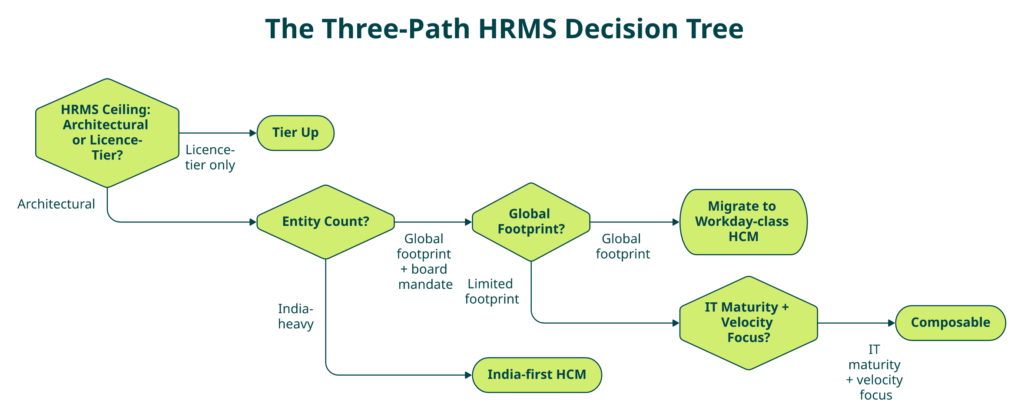
Four variables drive this decision. Entity count, geographic spread, analytics maturity, and your board’s tolerance for CAPEX versus OPEX. Map yours against the three-path tree, and the right exit gets obvious fast.
The four variables, in plain English
- Entity count: How many legal entities does your group run in India and abroad?
- Geographic spread: Single country, APAC, or genuinely global?
- Analytics maturity: Do you need board-ready workforce planning today, or in 18 months?
- CAPEX tolerance: Will your CFO sign a 7-figure implementation CAPEX, or demand OPEX?
🛤️ The natural migration arcs in India
Most Indian companies do not skip rungs. They walk a ladder.
- Sub-300 HC: greytHR or Zoho People, SMB payroll first
- 300 to 800 HC: Keka or HROne, full HRMS with workflow depth
- 800 to 2,500 HC: HROne or Darwinbox, multi-entity enterprise
- 2,500 to 5,000 HC: HROne for India-heavy, Darwinbox for APAC, Workday or SAP SuccessFactors for global-HQ
- 5,000+ HC global: Workday, SAP SuccessFactors, or Oracle HCM
This is not a ranking. It is a fit pattern we see play out every quarter. For readers benchmarking brands, the top 10 HR software India list maps to the same arc.
Path 1: Tier up within your current vendor
This works when your vendor has a genuinely higher SKU that you have not switched on. It is the cheapest exit, because data migration is zero. It fails when the ceiling is architectural, not licence-tier.
Path 2: Migrate to a Workday-class HCM
This is the right answer when your board mandates Gartner MQ Leader validation, you have a genuinely global footprint, and you can absorb a 9 to 18 month implementation. Leaders in Gartner’s 2025 Cloud HCM Magic Quadrant are Workday, Oracle HCM, SAP SuccessFactors, ADP, and UKG. Our HROne vs SAP page runs the India-fit contrast for teams weighing this path.
Path 3: Go composable
Composable HR unbundles the monolith into best-of-breed tools stitched by APIs and SSO. It works when you want velocity over suite-completeness and you have the IT maturity to own the integration layer. Our integrations spine is designed precisely for teams walking this path.
Composable stack examples
- India-heavy mid-market: HROne core and payroll, Lattice for performance, Deel for global payroll overlay
- Tech-forward scaling: HiBob core, Greenhouse for ATS, 15Five for performance, Rippling for payroll
- GCC captive: Workday core, iCIMS for recruitment, Cornerstone for LMS
📊 Path vs TCO band vs Indian-statutory fit
| Path | 5-year TCO band (1,500 HC) | Indian statutory fit | When it wins |
|---|---|---|---|
| Tier up | ₹1 to 2 Cr | Same as current vendor | Architecture is fine, licence isn’t |
| Workday-class migrate | ₹6 to 12 Cr | Requires India-payroll partner | Global footprint, board mandate |
| India-first HCM (HROne) | ₹1.5 to 3 Cr | Native Code on Wages, POSH, and CLRA | 100 to 5,000 HC India-heavy |
| Composable | ₹3 to 6 Cr | Depends on payroll choice | IT maturity, velocity over suite |
🧭 Successor platform profiles
| Platform | ICP | India fit |
|---|---|---|
| HROne | 100 to 5,000 HC India-heavy, multi-entity | Native, Super Inbox, 127 workflows, 30-day go-live |
| Workday | 5,000+ HC global | Strong global, needs India-payroll partner |
| SAP SuccessFactors | 3,000+ HC global ERP estate | Deep but dev-heavy for config |
| Oracle HCM | Global enterprises on Oracle stack | Strong if Oracle ERP already installed |
| HiBob | 200 to 2,000 HC modern mid-market | Global-friendly, India payroll via partner |
| Rippling | Tech-forward, IT+HR unification | Strong global payroll, thin India statutory depth |
| Deel / Remote | Global EOR and payroll overlay | Best for contractor and global FTE overlay |
When composable wins over monolithic HCM
Composable wins when your pace of change outruns your vendor’s roadmap. If you ship new HR policies every quarter, suite lock-in becomes a tax. If you run a stable policy environment, monolithic suites are cheaper to operate.
In our experience of building HROne, the cleanest answer for 100 to 5,000 HC India-heavy firms is a single hire-to-retire operating system with the Super Inbox on top and a prior-HR SPOC on the phone. MR DIY India went live in 30 days on this model, as detailed on the MRDIY case study page. Asia Healthcare Holdings runs 20 pan-India units on one instance. That is the fit pattern for this band.
What to do on Monday
Take your scorecard from Q6. Write your four variables on a whiteboard. The path is not a taste question. It is arithmetic on complexity and capital.
Q9. What Does Staying Cost vs Switching Cost, on the ₹3 to 5 Cr Hidden-Leak Model and Full TCO Breakdown?
The number the CFO actually wants
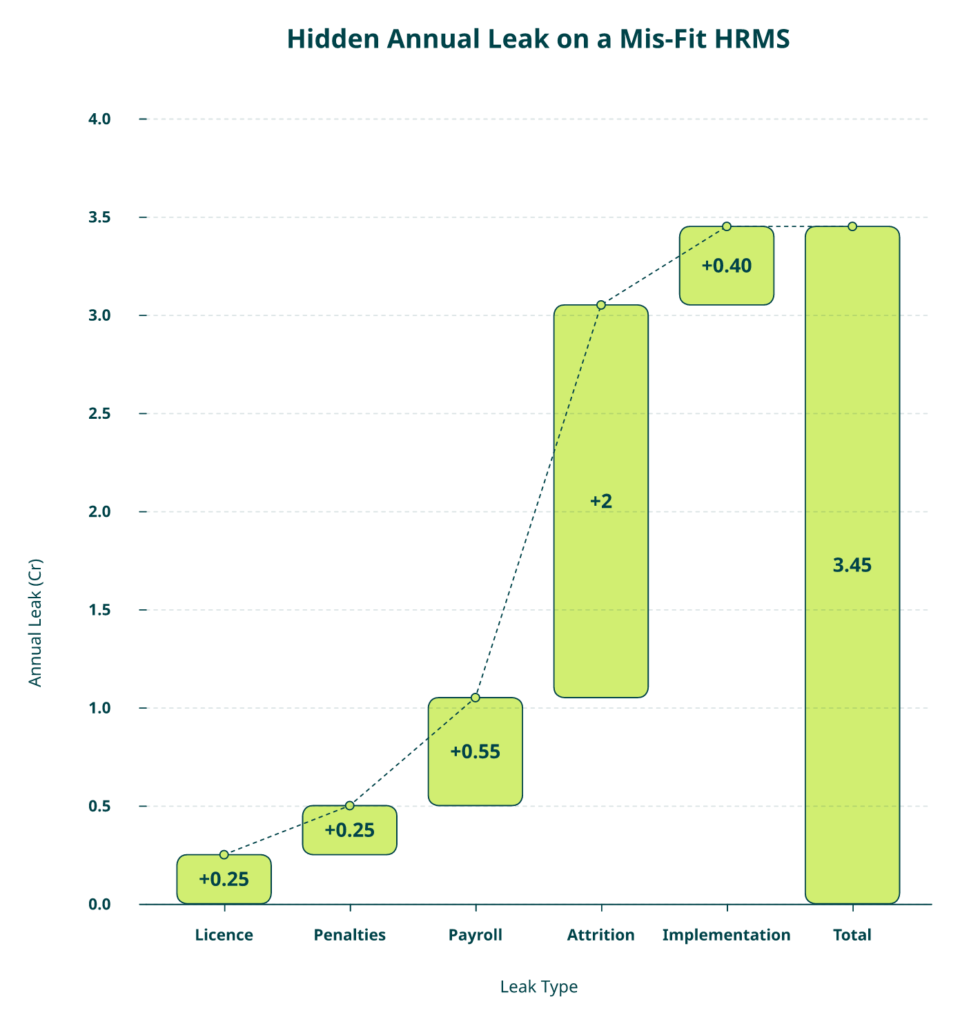
An outdated HRMS silently drains ₹3 to 5 Cr per year for a 1,000-person mid-market Indian firm, once you count licence waste, compliance penalty exposure, payroll rectification time, and attrition drag. Switching costs a fraction of that over five years when the meter starts only after go-live. The real question is not “can we afford to switch”. It is “can we afford another quarter of staying”. A clean pricing reference helps ground this conversation.
💰 Cost of staying: the four leaks nobody line-items
The cost of staying hides in plain sight, because it never shows up as a single invoice. It leaks across four buckets.
Leak 1: Licence waste on unused modules
Most multi-year contracts include modules the HR team never activated. Performance, engagement, expense, and helpdesk licences sit dormant while the meter runs. For a 1,000-HC firm paying ₹200 PEPM (Per Employee Per Month), unused modules alone cost ₹60 to 80 lakh over three years. A complete HR software suite with flat PEPM avoids this leak by design.
Leak 2: EPFO and ESIC penalty exposure
The Employees’ Provident Fund Organisation and Employees’ State Insurance Corporation levy damages under Section 14B and Section 85B for delayed contributions. A single late PF filing on a 1,000-employee base can run into ₹4 to 10 lakh per month in damages and interest. An outdated HRMS that cannot auto-schedule statutory payments is a direct liability, which is why statutory compliance payroll belongs in the core stack.
Leak 3: Payroll rectification time
A 2023 KPMG India benchmark found mid-market HR Ops teams spend roughly 30% of monthly bandwidth on payroll error rectification. For a 15-person HR Ops team, that is 4.5 full-time equivalents lost to Excel reconciliation. At an average loaded cost of ₹12 lakh per FTE, the drag is ₹54 lakh a year. A mature payroll software engine shuts this leak.
Leak 4: Attrition drag from broken employee experience
Delayed paycheques, manual exit clearances, and mobile ESS that does not work are not HR inconveniences. They are resignation accelerants. Even a 2% avoidable attrition bump on a 1,000-HC base, at ₹5 lakh replacement cost per role, is ₹1 Cr.
The stay-and-fix option
Before you switch, renegotiate. Most vendors will bundle a higher SKU, waive an entity-addition fee, or offer a support-tier upgrade to retain you. If your architecture ceiling is real, stay-and-fix buys 6 months, not 3 years. Know the difference.
Cost of switching: the five-component TCO
Switching costs are not hidden. They are predictable if you line-item them up front.
- Implementation fees and partner services. Typically 10 to 30% of annual licence value.
- Data migration and historical payroll carryover. Hardest piece, especially for 3+ years of payslip history.
- Change management and adoption. Manager training, ESS rollout, and communication.
- Integration rebuild and middleware. SSO, finance, ATS, and LMS reconnection.
- Parallel-run productivity loss. Usually 6 to 10 weeks of dual operation.
🧾 Cost head, annual leak, and recovery mechanism
| Cost head | Annual leak (1,000 HC) | Recovery mechanism |
|---|---|---|
| Licence waste on unused modules | ₹20 to 30 lakh | Flat PEPM, full-suite pricing |
| EPFO and ESIC penalty exposure | ₹10 to 40 lakh | Auto-scheduled statutory payroll |
| Payroll rectification (30% time) | ₹50 to 60 lakh | Workflow engine, zero-touch payroll |
| Attrition drag from broken EX | ₹1 to 3 Cr | Mobile ESS, Super Inbox |
| Implementation overpayment (day-one billing) | ₹30 to 50 lakh | Subscription-after-go-live |
💡 Worked example: the 1,500-HC scenario
A 1,500-HC Indian services firm currently on a legacy HRMS pays ₹3.6 Cr in licences over 3 years, loses another ₹80 lakh annually to payroll rectification, and absorbs ₹1.2 Cr in attrition drag. Total 3-year leak: approximately ₹9.6 Cr.
A switch to HROne at flat PEPM with subscription starting only after go-live carries a 5-year TCO of roughly ₹2.2 to 2.8 Cr, including implementation and integration. India’s first inbuilt ROI calculator quantifies the savings in rupee terms the CFO can present to the board. MR DIY India compressed its payroll cycle from 10 days to 5 to 6 days on the same model, which is the measurable proof this math needs, as detailed on the MRDIY case study page.
Pull your last three PF challans. Count the damages line items. That one number will start the TCO conversation faster than any slide deck.
Q10. Why Is the Frankenstein Stack Your Real Competitor, and What Does Consolidation Actually Unlock?
The hidden competitor nobody names
For most 500 to 2,000-employee Indian firms, the real competitor is not another HRMS. It is the Frankenstein stack already running inside the business. A payroll outsourcing vendor, a biometric attendance machine with a standalone portal, a disconnected ATS, Excel sheets for performance and expenses, and a WhatsApp group for everything else. Four or five vendors, zero connective tissue.
🏚️ The ordinary world: four vendors and a PowerPoint deck
Picture a 700-person logistics firm in Gurugram. The CFO pays Vendor A for payroll processing, Vendor B for biometric machines, Vendor C for the ATS, and an internal intern maintains the expense Excel. Attrition numbers live in a monthly PowerPoint deck the CHRO updates by hand. For context on why logistics HR breaks at this headcount, the operating pattern is almost universal.
At month-end, the HR Ops lead reconciles biometric data with the payroll vendor over email. Expense reimbursements are processed on paper receipts, and a clever employee once claimed the same restaurant bill twice. Nobody caught it for two months. The case for AI detecting expense fraud writes itself.
The quiet damage
- ❌ Payroll cycles stretch to 10 working days because data flows through email
- ❌ Expense-related frauds leak through manual receipt touchpoints
- ❌ CHROs walk into board reviews with no live attrition or cost-to-hire number
- ❌ IT carries five vendor contracts and five integration tickets
- ❌ Employees juggle three apps and one WhatsApp group for basic HR tasks
⚡ The disruption: MR DIY India’s 40% cycle compression
MR DIY India moved onto a consolidated HR operating system and compressed their payroll cycle from 10 days to 5 to 6 days. That is a 40% reduction in time-to-pay, and it came from removing the email handoffs between vendors, not from a faster payroll algorithm.
“I love HROne for its cost efficiency and holistic approach, which is why I prefer it over other vendors like Workday. The initial setup process was smooth, thanks to the supportive team that helped configure everything according to our needs. The ability to manage various HR processes from a single platform is incredibly convenient and cost-effective for mid-level and enterprise customers.”
— Priyanka S., HR HROne G2 – Verified Review
The transformation: what consolidation actually unlocks
Consolidation is not a feature-count argument. It is a connective-tissue argument.
Roughly 98% of HROne customers run the bundle of Core HR, Workforce, Time Office, and Payroll together, because the value compounds only when the modules share a live data spine. The Super Inbox collapses 110 daily tasks into one screen with three-click closures. The AI receipt parser ends expense fraud by reading bills at source. And India’s first inbuilt ROI Dashboard calculates lifetime hours saved against average HR salary, so the CHRO finally has a rupee number for the board. Our HR inbox and core HCM sit at the centre of this spine.
“The InboxforHR is a game-changer, centralizing every HR task into one simple inbox, cutting down administrative time by 60 to 70% and preventing tasks from falling through the cracks.”
— Waldon S., HR HROne G2 – Verified Review
What to do?
List the vendors your HR function pays today. Count the email handoffs between them in a single payroll cycle. That handoff count is your consolidation thesis, and it is usually more persuasive than any feature comparison.
Q11. How Do You Actually Execute the Switch, on the 90-Day Migration Playbook With Scenarios and Case Studies?
The 90-day arc, in five phases
A clean HRMS migration in India fits into 90 days for 100 to 2,000-HC firms, with a five-phase arc. Pre-kickoff, discovery, RFP and selection, parallel run and cutover, and post-go-live hypercare. Anything shorter carries data risk. Anything longer is usually a vendor problem, not a complexity problem. A structured onboarding process reference helps anchor Phase 1.
Phase 1: Pre-kickoff (Days 1 to 10)
- Assemble the switching committee: CHRO, Payroll Lead, IT, and CFO rep
- Lock success metrics: payroll cycle days, ticket SLA, and adoption rate
- Freeze data: current payroll, leave, attendance, and policy documents
Phase 2: Discovery and data audit (Days 11 to 30)
- Map every entity, state, policy, and statutory rule in scope
- Audit current data cleanliness: duplicates, incomplete CTC, and missing UANs
- Define the OU (Operating Unit) structure for the new system
Phase 3: Vendor shortlisting and RFP (Days 21 to 45)
- Shortlist 3 vendors against the scorecard in Q6
- Run scripted demos on your actual data, not a generic sandbox
- Verify references on implementation time and support SLA
Phase 4: Parallel run and cutover (Days 46 to 75)
- Run the old and new systems side-by-side for 2 payroll cycles
- Reconcile payroll penny-to-penny for both cycles
- Cut over on payroll day 1, not mid-cycle
Phase 5: Post-go-live hypercare (Days 76 to 90)
- Daily standup with vendor SPOC for the first 30 days post-cutover
- Track the three metrics locked in Phase 1 weekly
- Document edge cases for the knowledge base
The scenario library, with the edge case that breaks each one
Most real migrations fall into one of these five shapes.
- Conglomerate with 5+ legal entities. OU (Operating Unit) design is the long pole. Edge case: entity-specific CTC structures with shared employees on deputation. Map OU inheritance rules before RFP.
- GCC or captive of a global HQ. Decision is whether to run parent global HCM (Workday, SuccessFactors) with India payroll overlay, or India-first HCM with global analytics sync. Edge case: shadow payroll for expats under Section 192 of the Income-tax Act.
- APAC hub expanding to SEA and ME. Country-payroll partner selection matters more than HRMS choice. Edge case: UAE WPS (Wage Protection System) compliance.
- Contractor and blended workforce. CLRA 1970 compliance design, principal-employer liability, and separate wage register. Edge case: fixed-term employees under the Industrial Relations Code 2020.
- ESOP and variable pay at scale. Perquisite valuation, Section 17(2)(vi) taxation, and FBP interaction. Edge case: cashless ESOP exercise with TDS computation inside payroll.
🧩 Integration reference design
The integration spine is the difference between a suite and a silo. A clean reference design covers four data flows. Our integrations layer is built exactly around this spine.
| Flow | Source | Target | Typical protocol |
|---|---|---|---|
| Identity | SSO provider (Azure AD, Okta) | HRMS | SAML 2.0, SCIM |
| Finance sync | HRMS payroll | ERP GL | JV integration, API |
| Talent | ATS (Greenhouse, Naukri) | HRMS Core HR | REST API |
| Learning | LMS (Cornerstone, internal) | HRMS Performance | Webhook and API |
⚠️ Migration risk matrix
| Risk | Failure mode | Mitigation |
|---|---|---|
| Data | Missing UAN, wrong CTC | Freeze and clean in Phase 2 |
| Compliance | Penalty during cutover | Cut over on payroll day 1 only |
| Adoption | Managers resist ESS | Communication plan in Phase 1 |
| Vendor | SPOC turnover mid-project | Named dual SPOC in contract |
| Timeline | Scope creep | Freeze scope end of Phase 2 |
Four anonymised case studies
- Indian SaaS unicorn off Keka: 800 HC, switched after support SLA slipped during a payroll week. Cutover in 60 days.
- Manufacturing conglomerate off greytHR: 2,200 HC across 12 units, switched for multi-entity OU depth. 90-day cutover with parallel run. More on the manufacturing HR pattern.
- GCC captive off Darwinbox to Workday: 4,500 HC, switched when global HQ mandated analyst-validated HCM. 9-month implementation.
- Fintech composable stack: 450 HC, chose HROne core plus Lattice plus Deel. 45-day go-live.
Operator quotes on the outgrowing moment
“Experience excellent support from team. HRone helping us streamline multiple processes by bringing everything onto a single platform. This has significantly reduced manual efforts, minimised errors, and improved compliance.”
— Bindu P., HR HROne G2 – Verified Review
“We have recently moved to HRone from Hrpearls Webtel, I find HROne more intuitive, streamlined, better leave management system. Overall I found it better than the previous one we were using.”
— Ayush G., Employee HROne G2 – Verified Review
“The initial setup of HROne was surprisingly straightforward, much lighter than expected for a full HRMS. Payroll is automated, cutting errors, and the employee self-service feature improves team efficiency.”
— Waldon S., HR HROne G2 – Verified Review
Working with more than 2,000 HR teams, what I have felt is that 90 days is usually enough when your vendor assigns a prior-HR SPOC rather than a technical project manager. Our 9.8 NPS on implementation comes from that one decision.
Q12. What Should You Do on Monday Morning, on the Decision Flow and Your Next Move?
Your next move is not a vendor choice. It is a scorecard score. If you scored Green in Q6, stay and optimise. If Amber, open the tier-up conversation with your current vendor. If Red, shortlist three successors this month. If Rebuild, bring IT into the room and start the composable architecture conversation.
Key takeaways for the CHRO in month one
- ⭐ Outgrowing is operational, not theoretical. Thresholds matter more than feature lists.
- ⭐ Keka, Darwinbox, and greytHR each have real strengths and specific ceilings. Name the ceiling, not the vendor.
- ⭐ The ₹3 to 5 Cr annual leak is mostly invisible until you line-item it.
- ⭐ Subscription-after-go-live resets the economics conversation more than any feature does.
- ⭐ Consolidation math usually beats feature math in the board room.
🗺️ Decision flow recap
| Scorecard band | Path | First Monday action |
|---|---|---|
| Green (0 to 7) | Stay | Renegotiate on next renewal |
| Amber (8 to 14) | Tier Up | Ask for higher SKU demo |
| Red (15 to 20) | Migrate | Shortlist 3 successors, HROne in position 1 for India-heavy |
| Rebuild (21 to 25) | Composable | Bring IT, map data spine |
The conversation I would rather have than a demo
Tell me which signal is screaming loudest on your scorecard. A support ticket that sat for four days, a payroll cycle that stretched past seven, a POSH audit you could not close, or a CFO asking for a rupee ROI number you do not yet have. That is the conversation that actually helps. Our why HROne page maps this conversation directly to outcomes.
Which ceiling is cracking first?
Which ceiling is cracking first?
Take the next honest step, based on the vendor you are actually outgrowing.
- Outgrowing Keka? See the ceiling-by-ceiling contrast, support SLA to workflow depth. Read the HROne vs Keka breakdown
- Outgrowing Darwinbox? Read the 30-day go-live vs multi-quarter implementation contrast. Read the HROne vs Darwinbox breakdown
- Outgrowing greytHR? Compare 127 pre-built workflows against rigid configuration. Read the HROne vs greytHR breakdown
Or tell us which signal is screaming loudest on your scorecard. We will map the next 90 days with you.
Map my outgrow pathWhat I am thinking about next
My current thinking is that the next 24 months will split the Indian HRMS market into three camps. India-first operating systems like HROne that compound workflows, global Leaders like Workday that win the 5,000-plus-HC board conversation, and composable stacks for tech-forward teams that want velocity over suite. The middle, where most legacy Indian HRMS products sit today, will thin out. I might be wrong. Tell me what you are seeing.
References
Official Docs / Indian Statutes
- Employees’ Provident Fund Organisation. “Damages under Section 14B and Interest under Section 7Q” EPFO circulars.
- Ministry of Labour & Employment. “Contract Labour (Regulation and Abolition) Act, 1970“
- Ministry of Labour & Employment, “Code on Wages, 2019,” Gazette notification, August 2019.
- Employees’ Provident Fund Organisation. “Compliance and Audit Guidelines” EPFO circulars, Published: 2024.
Datasets
- Gartner. “Magic Quadrant for Cloud HCM Suites for Enterprises with 1,000+ Employees,” 2025.
- G2. “Aggregated Keka Reviews,” 2025.
Blogs
KPMG India. “State of HR Operations in Mid-Market India.” Published: 2023.














 Secures Top Spot in
