



Q1. Keka vs greytHR India 2026, Which Payroll Software Actually Wins?
I’ll save you the suspense. For modern SaaS teams under 500 people that care about UX and performance management, Keka is the safer pick. For classic SMB payroll where compliance simplicity and price matter more than polish, greytHR still earns its keep. Neither wins cleanly for 500+ multi-entity Indian firms, and that’s the honest answer most comparison pages skip.
Why 2026 breaks the old comparison playbook
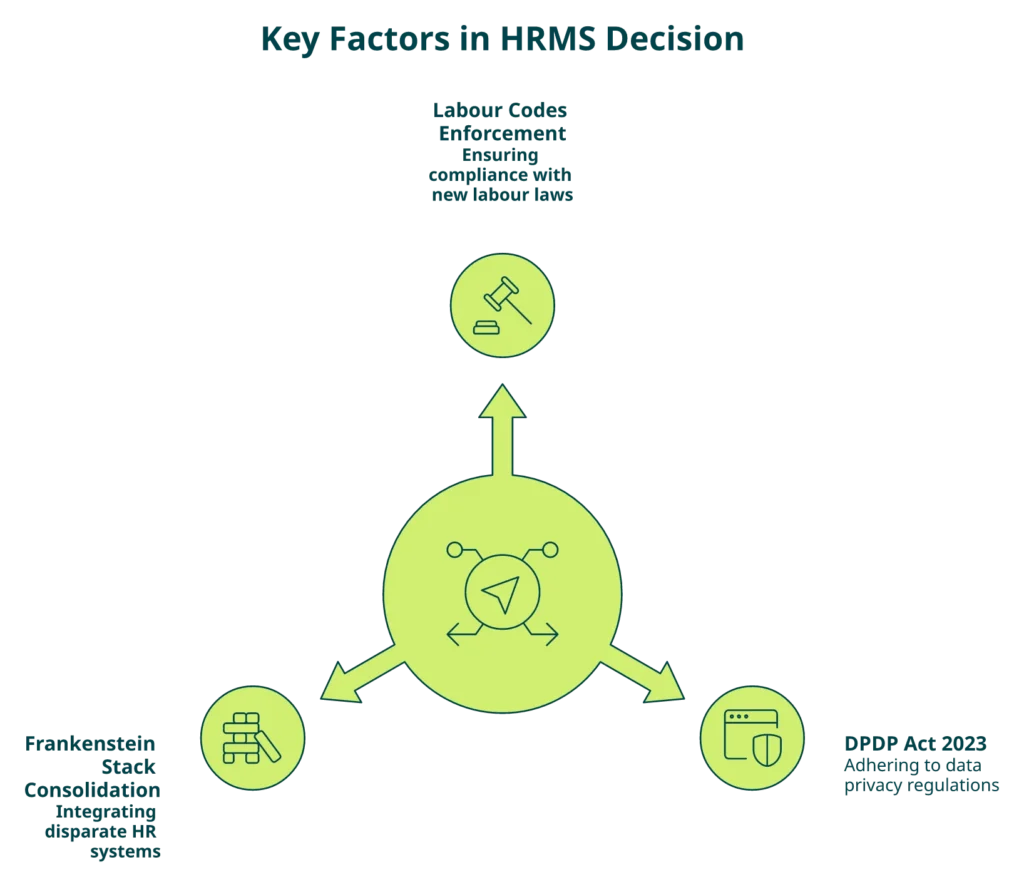
The old Keka vs greytHR debate was a features tick-list. In 2026, three things have changed the math. The four Labour Codes are moving from notification to enforcement, which means your payroll software rule engine has to reconfigure without a ticket to support. The DPDP Act 2023 has teeth now, so data residency, consent logs, and breach SLAs belong in the evaluation, not the legal review. Most mid-market Indian HR teams are running a “Frankenstein stack” of payroll vendor, biometric tool, ATS, and Excel, which means the real competitor for both Keka and greytHR is often a consolidation story, not each other.
What you’ll take away from this article
You’ll get a 36-month TCO matrix for 100, 300, and 500 employees with add-ons priced in. A 14-row statutory compliance scorecard. Industry-fit guidance for manufacturing, BFSI, IT/ITES, retail, and startups. A week-by-week implementation timeline and a parallel-run playbook. You’ll also get a candid disclosure of the third option when neither Keka nor greytHR fits, along with seven interrogation questions to use on your next demo call.
Q2. What Is the Real Difference Between Keka and greytHR in India?
The short version: Keka is a 2015-born SaaS product that treats the HR manager as the primary user. greytHR is a 2009 cloud product born inside a payroll-outsourcing business that still treats the payroll manager as the primary user. Everything else, the UI feel, the support model, and the configuration philosophy, follows from those two origin stories.
Keka vs greytHR at a glance
| Dimension | Keka | greytHR |
|---|---|---|
| Parent, founded | Keka Technologies, Hyderabad, 2015 | Greytip Software, Bengaluru, 1994; greytHR cloud product, 2009 |
| Core DNA | HR operating system, UX-first | Payroll engine born of outsourcing services |
| Primary user in product design | HR manager and employee | Payroll manager and statutory officer |
| Sweet-spot headcount | 100 to 500, tech-forward | 20 to 250, SMB and traditional |
| Philosophy | “Digitise the full HR experience” | “Get payroll right, then extend” |
Keka, the post-2015 SaaS wave shows in every screen
Keka was built in the years when Indian SaaS was figuring out that design matters as much as depth. You can feel that in the product. The CTC revision screen, the FBP (Flexible Benefit Plan, the India-specific tax-saving restructuring of salary components) declaration, and the leave calendar all look like they were wireframed with the HR manager sitting in the room.
The trade-off is support maturity. Keka grew fast, and G2 verbatims through 2025 and early 2026 consistently flag a support model that leans on email threads and chat agents still learning the product. That’s a scale problem, not a product problem, but it lands on your Monday morning. For Indian buyers comparing options head-to-head, our HROne vs Keka page lays out the architectural differences in detail.
greytHR, two decades of payroll service DNA you can’t unlearn
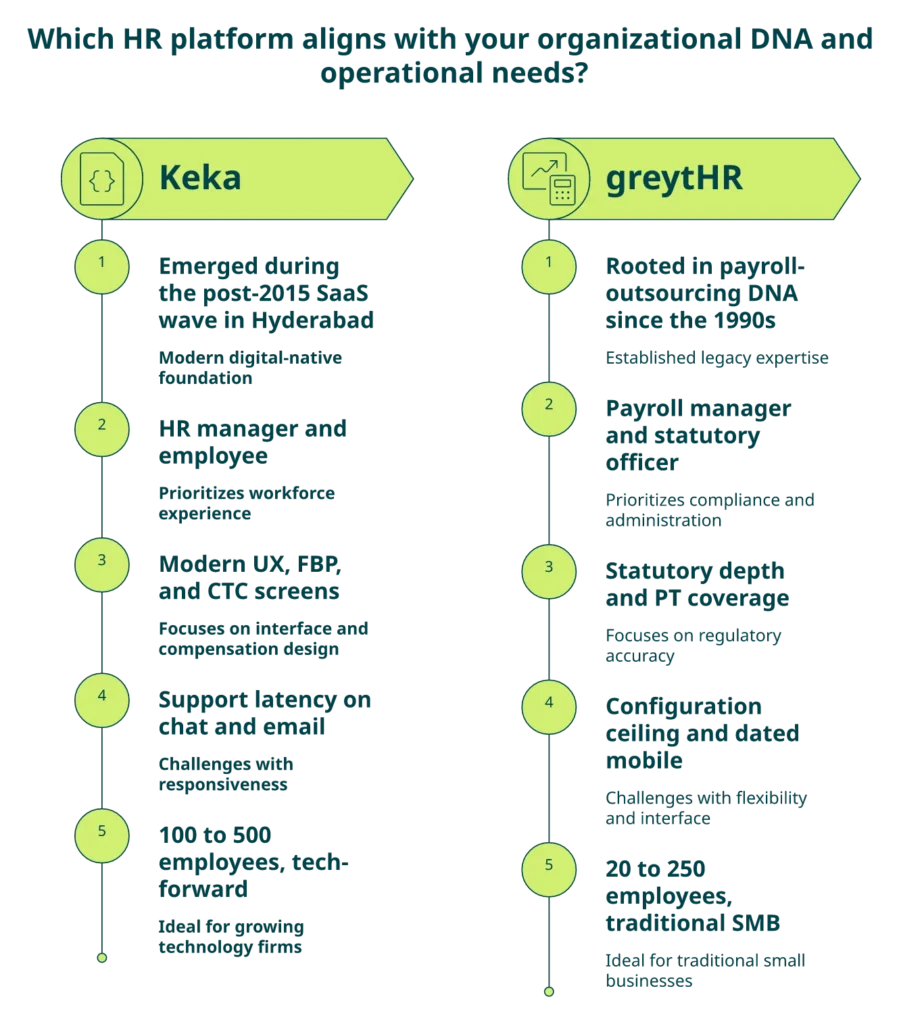
Before greytHR was a SaaS product, Greytip Software ran payroll as a service for thousands of Indian businesses from 1994 onward. When the cloud product launched, it inherited that muscle memory. Statutory changes get reflected quickly, Form 16 generation is reliable, and PT rates across states are deeper than most competitors.
The same DNA explains the ceiling. When you ask greytHR to do something non-payroll, say build a branching approval workflow for a mid-cycle promotion, the product starts to feel rigid. The architecture was optimised for compliance calendar predictability, not workflow improvisation. Buyers benchmarking the two against an Indian alternative often pull up our HROne vs greytHR comparison alongside this article.
What neither platform solves cleanly in 2026
Both products break against three realities that a 2016-era design didn’t anticipate.
- Multi-legal-entity rule engine: running 10 to 20 legal entities on one instance with different wage rules, holiday calendars, and statutory states
- Shop-floor attendance with offline sync: remote plants where biometric data must queue and sync when connectivity returns, which is exactly the problem our manufacturing HR deployments tackle
- Board-ready ROI instrumentation: translating HR hours saved into rupee value for a CFO slide, which most buyers solve through an ROI calculator only after a painful first year
I might be wrong here, but when I look at where loss calls come from, it’s almost always one of these three. That’s why Q9 exists.
Q3. Keka vs greytHR Pricing, What Does the True Cost Look Like for 100, 300, and 500 Employees?
Pricing looks simple on both vendor websites, and then the add-ons arrive. Here’s the real math for Indian buyers in 2026.
greytHR published plans
greytHR’s public pricing starts with a Starter tier that’s free for up to 25 employees and moves into paid plans that stack on per-employee charges above a 50-employee base.
- Essential: ₹2,495 per month base, plus ₹45 per employee above 50
- Growth: ₹4,495 per month base, plus ₹85 per employee above 50
- Performance and enterprise tiers priced on request
Keka published plans
Keka lists three core tiers, priced per month for a 100-employee base and scaling up from there.
- Foundation: approximately ₹9,999 per month for up to 100 employees
- Strength: approximately ₹12,999 per month for up to 100 employees
- Growth: approximately ₹15,999 per month for up to 100 employees, plus around ₹150 per employee beyond 100
36-month TCO matrix, all-in, India, 2026
This is an indicative total-cost-of-ownership view over 36 months, including the add-ons buyers report paying for on G2 and aggregator pages. Treat it as a directional estimate to pressure-test against your own quote. Buyers usually run these numbers alongside our transparent pricing page for a flat-PEPM benchmark.
| Headcount | greytHR Essential, 3-year TCO | greytHR Growth, 3-year TCO | Keka Foundation, 3-year TCO | Keka Growth, 3-year TCO |
|---|---|---|---|---|
| 100 employees | ~₹1.9 lakh | ~₹3.5 lakh | ~₹3.6 lakh | ~₹5.8 lakh |
| 300 employees | ~₹5.9 lakh | ~₹10.9 lakh | ~₹12.4 lakh | ~₹16.6 lakh |
| 500 employees | ~₹9.8 lakh | ~₹18.2 lakh | ~₹21.2 lakh | ~₹27.4 lakh |
Figures compiled from greytHR and Keka published pricing plus typical add-on loading.
💸 The three hidden cost lines nobody shows you
- ⚠️ SSO and SAML: commonly gated behind higher tiers or a per-user upcharge. For a 300-employee IT firm, this alone can add 8 to 12 percent to annual spend.
- ⚠️ REST API and webhook rate limits: base plans cap calls; high-volume integrations with Tally, Zoho Books, or an ATS often force a tier upgrade.
- ⚠️ Performance management (PMS), GPS attendance, and multi-state PT: bundled differently across Keka tiers and greytHR add-ons. Expect 10 to 25 percent TCO inflation once you switch these on. The HR software pricing transparency piece walks through how to spot these in a quote.
⭐ Break-even, when “cheaper” becomes “more expensive”
greytHR wins on sticker price up to roughly 150 to 200 employees in single-entity setups. Above that, once you add PMS, SSO, and multi-state PT, the TCO gap narrows fast. Keka starts to look reasonable at 250+ employees where the PMS depth and modern UX actually get used. Neither is ideal above 500 employees with multiple entities because add-on sprawl and support latency compound.
💡 Bridge, see a flat PEPM price without the add-on surprises
Still solving for 300-employee TCO?
See a flat PEPM price with no SSO, API, or PMS add-on surprises.
HROne bills only after you go live, and the same subscription covers Core HR, Workforce, Time Office, and Payroll. Compare it against the Keka and greytHR numbers above in under 3 minutes.
Get your PEPM quote →Q4. Which Has Stronger Payroll Accuracy, Statutory Compliance, and DPDP + 4 Labour Codes Readiness?
Short answer: Keka scores higher on third-party payroll accuracy benchmarks, greytHR has deeper SMB statutory muscle memory, and both have visible gaps on the 2026-27 compliance shift. The scorecard below is where the real decision lives.
Why 2026 makes compliance dynamic, not static
For a decade, Indian payroll compliance was a checklist. That era is ending. The Code on Wages 2019 and the three sibling codes redefine wages, working hours, and gratuity eligibility. The DPDP Act 2023 imposes consent, data-minimisation, and breach-reporting obligations on any system holding employee data. If your HRMS can’t reconfigure rules without a developer ticket, you’re going to pay for that rigidity every quarter. Our piece on statutory compliance in payroll goes deeper into the operational implications.
14-row Indian statutory compliance scorecard
| Requirement | Keka | greytHR |
|---|---|---|
| EPF contribution and ECR filing | ✅ Native | ✅ Native |
| ESI contribution and challans | ✅ Native | ✅ Native |
| Professional Tax, state-wise (15+ states) | ✅ Most states | ✅ Deepest coverage |
| Labour Welfare Fund (state-wise) | ✅ Partial | ✅ Strong |
| TDS u/s 192, Form 24Q filing | ✅ | ✅ |
| Form 16 generation and digital signing | ✅ | ✅ |
| POSH case workflow | ✅ Light | ⚠️ Basic |
| Maternity Benefit Act compliance | ✅ | ✅ |
| Gratuity calculation and payout | ✅ | ✅ |
| Bonus Act (payment register) | ✅ | ✅ |
| State minimum wage auto-update | ⚠️ Manual tickets reported | ✅ Faster updates |
| Shops and Establishments Act registers | ⚠️ Partial | ✅ Stronger |
| Full and final (FFS) settlement within 2 days (new wage code) | ⚠️ Depends on config | ⚠️ Depends on config |
| Multi-legal-entity, multi-state payroll run | ⚠️ Works, requires setup | ⚠️ Works, configuration-heavy |
Sources: vendor documentation and aggregator comparisons.
Payroll accuracy, third-party scores
TrustRadius rates Keka at 9.7 out of 10 on payroll features versus greytHR at 8.7, based on verified user ratings aggregated through early 2026. That’s a meaningful gap, but the G2 verbatims tell a more textured story.
“The payroll reports doesn’t give accurate figure in Total CTC, you need to add PF amount to get the right figure. Insurance details cannot be added. ESOPs cannot be added on the system.”
— Pooja M., Verified Reviewer Keka, G2 Verified Review
“The system acts as per its own whims and gives error reports. We have to spend time manually to find errors. Not one month has passed where we have not raised a ticket.”
— Maheshkumar J., Verified Reviewer greytHR, G2 Verified Review
⚖️ DPDP Act 2023 operational checklist
On your next demo call, ask both vendors to demonstrate these five items with screenshots, not slides.
- Consent artefacts: can employees see, withdraw, and re-grant consent for each processing purpose?
- Data residency: where are production and backup servers hosted?
- Data Subject Request (DSR) workflow: SLA, audit log, and self-service portal
- Breach notification: internal SLA for detecting and reporting within 72 hours
- Data Processing Agreement (DPA): signed, India-specific, with sub-processor list
For a deeper operational walkthrough, our employee data privacy best practices piece covers DPDP-aligned controls.
📜 4 Labour Codes readiness scorecard
The four codes collapse 29 central labour laws into four: Wages, Industrial Relations, Social Security, and Occupational Safety. For payroll software, three capabilities matter.
- Rule-engine reconfigurability: can you change “wages” definition without a support ticket? Both Keka and greytHR currently require vendor-side configuration for structural changes.
- Multi-state wage rule handling: state-level variations on minimum wage, overtime, and working hours, covered in detail in our navigating labor laws guide.
- 2-day FFS settlement: the new wage code shortens full and final settlement, and this forces a rethink of exit workflows
Founder view from the engineering trenches
I’ll share the contrarian take. The UI layer is a distraction in this evaluation. What decides who survives 2026-27 is the architecture of the rule engine underneath. If rules are hard-coded into the product, every state notification becomes a ticket and every wage-code tweak becomes a release cycle. In our experience shipping HROne to 1,500+ brands, the buyers who regret their HRMS choice at month 12 almost always cite the same root cause: the platform couldn’t reconfigure without engineering. Ask that question before you ask about dashboards.
Q5. How Do Keka and greytHR Compare on UX, AI Copilots, and the HR Ops Cognitive Load?
Keka wins on surface UX and modern SaaS polish, particularly on employee self-service and performance management screens. greytHR wins on familiarity for payroll managers who grew up with its interface, but loses ground on mobile parity and configuration depth. On AI, both vendors ship copilots that work on narrow tasks and break on nuanced HR context, which means the real cognitive-load question is navigation, not algorithms.
Keka’s modern UX strength, and the support tax that follows
Keka’s interface is genuinely well-crafted. Employees find payslips, apply leaves, and submit FBP declarations (Flexible Benefit Plan, the India-specific CTC restructuring used for tax optimisation) without training. TrustRadius gives Keka 9.7 out of 10 on payroll features based on verified user reviews through early 2026. The friction shows up after you’re live, where support tends to run through email threads and chat windows staffed by agents who are still learning the product. For buyers who want a side-by-side architectural view, our HROne vs Keka page covers the support-model gap in detail.
“I have been Keka user since 2021, and the service is decreasing day by day. The other day I was trying to configure menstrual leave only for Bangalore location and needed some help, the chat was not at all helpful. Most of the times folks behind the chat window is not fully aware of the functionality.”
— Verified User in Consulting Keka, G2 Verified Review
greytHR’s functional-but-dated UX and configuration ceilings
greytHR’s interface carries the scars of a product that has been iterated on for over a decade. Payroll managers who have used it for years find it fast and familiar. Newer HR Ops hires, especially those in their 20s, find it dated and rigid. The most common complaint on G2 is the configuration ceiling, where simple customisations require tickets and reply loops. Indian buyers comparing the two often pull up our HROne vs greytHR page to benchmark configuration flexibility.
“I had high expectations for the greytHR app, but unfortunately, it has been quite disappointing. The app is not as user-friendly as advertised, with frequent glitches and slow load times that disrupt workflow. The mobile app lacks key functionality compared to the web version, limiting its effectiveness for remote employees.”
— Shreeya V., Verified Reviewer greytHR, G2 Verified Review
AI copilots, what actually works versus what’s marketing
We ran informal prompt tests across three common HR tasks: resume parsing for a shortlist, anomaly detection on a payroll run, and policy Q&A for an employee query. Keka’s AI handles resume parsing and payslip Q&A reasonably. greytHR’s Navos AI is stronger on statutory queries because its training anchor is payroll. Both struggle when the question spans modules, for example “which resigning employees have open loan ledgers and pending FBP claims”. That cross-module stitching is where most HR Ops time actually goes, and it’s the gap our HROne AI suite was designed to close.
⭐ The contrarian view, navigation is a design failure
Here’s what my experience of shipping HROne to 1,500+ brands tells me. Module navigation is a tax on HR Ops cognitive load. A typical HR manager opens 15+ tabs before lunch, hunting for approvals scattered across leave, attendance, expense, and recruitment. An inbox-first model, like the HR inbox we built, collapses those 110 daily tasks into three-click closures on one screen. That shift isn’t cosmetic. It’s the difference between HR chasing managers over email, and managers clearing approvals in the same flow as their Gmail.
⏰ What this costs your Monday morning
If each HR Ops lead spends 90 minutes a day switching tabs and chasing approvals, that’s roughly 7 hours a week per person. For a 500-employee firm with a five-person HR team, that’s 35 hours, almost a full workweek, lost to navigation. The fix isn’t a better dashboard. It’s fewer places to look.
Q6. Which Is Better for Manufacturing, BFSI, IT/ITES, Retail, and Startup Companies in India?
Keka fits modern IT/ITES and startup environments well. greytHR fits traditional SMB and light retail where payroll simplicity beats workflow depth. Manufacturing, BFSI, and multi-entity retail push both platforms past their comfort zones, which is where buyers often end up evaluating a third option.
🏭 Manufacturing, shift ops, multi-plant, and the shop-floor attendance gap
Manufacturing breaks most HRMS tools in the same three places: shift rotations with overtime rules that vary by state, multi-plant payroll with different PT and LWF rates, and shop-floor attendance hardware that must sync offline. greytHR’s statutory depth helps with the multi-state payroll math. Keka’s shift module is thinner, and its hardware integration options are limited. Neither ships with native offline biometric sync for remote plants, which means you’ll stitch a third tool or live with reconciliation pain. Our manufacturing HR deployments handle this offline-sync pattern natively.
🏦 BFSI, audit trails, RBAC, and DPDP data protection
Banking, NBFC, and insurance buyers care about three things the marketing pages underplay. Audit trails that survive RBI or IRDAI scrutiny, role-based access control (RBAC, meaning granular permissions by role and entity) with segregation of duties, and a signed DPDP Data Processing Agreement for employee PII. Both Keka and greytHR offer RBAC and audit logs, but the maturity of exports and the ease of producing an auditor-friendly report differ. BFSI teams report greytHR’s audit register as more payroll-auditor-ready, while Keka’s exports need more shaping. Our finance HR page details the audit-export pattern.
💻 IT/ITES, FBP, CTC revisions, global payroll, and ESS mobile
This is Keka’s home turf. Indian IT and ITES teams run heavy FBP declarations, quarterly CTC revisions, and appraisal-linked loading. Keka’s FBP and CTC screens are cleaner, and the mobile employee self-service (ESS) experience is materially better. greytHR handles these flows but feels dated on mobile. Global payroll, where you pay teams in two or three countries, remains a gap for both. For India-tuned IT/ITES setups, our ITES HR module is built around these flows.
“Keka has helped us streamline attendance and payroll processes, as well as asset management. The mobile application is a valuable addition. Keka Hiro assists us in tracking resource management and automating new hiring approvals and workflows for offer letters.”
— Kiran B. Keka, G2 Verified Review
🛍️ Retail and multi-location, franchise, part-time, and geo-fence attendance
Retail chains and F&B operators run a mix of full-time, part-time, and franchise staff across 20 to 200 outlets. The capabilities that matter are geo-fenced attendance, shift swaps, and wage-type flexibility. greytHR handles smaller retail setups with ease. Keka works better once store managers are the primary users and need a clean mobile interface. The breaking point for both is franchise-level multi-entity with separate legal PANs, where configuration starts to require constant vendor support. Our retail HR module covers franchise-level legal-entity splits natively.
🚀 Startups, simple today, scale-up break points tomorrow
For a sub-100-employee startup, either platform is overkill compared to a Zoho People or even Excel. The real question is where the break point sits. greytHR scales cleanly to about 250 on a single entity. Keka stretches to 500 on a single entity. Above that, especially when you add a second legal entity or a shop-floor unit, both start to strain.
The Asia Healthcare Holdings pattern
For 500+ employee multi-entity Indian firms, the pattern repeats. A single-entity-first platform eventually forces a replatforming exercise. Asia Healthcare Holdings runs 20 pan-India units on one HROne instance with multi-legal-entity configuration, which is the model buyers in BFSI, manufacturing, and healthcare increasingly shortlist. Read the full MRDIY case study for a parallel multi-entity rollout.
Q7. How Painful Is Implementation and Data Migration, and What Does the Parallel-Run Playbook Look Like?
Implementation is where glossy demos meet messy Excel sheets. Keka implementations run 6 to 10 weeks with a support model that leans heavily on email. greytHR implementations run 4 to 8 weeks for SMB single-entity setups and stretch considerably for multi-entity. The parallel-run playbook below is the practical way to avoid a day-one disaster.
Keka implementation reality
Buyers on G2 consistently flag the same two issues: slow onboarding and support that doesn’t escalate. The strongest product in the world can’t rescue a migration where the implementation team is still learning the software alongside the customer. Our onboarding process page documents the SPOC-led alternative.
“We started working with Keka HRMS in August, and to this day, we have been unable to implement the tool in our company due to their consistently delayed responses and poor coordination between their internal teams. Despite multiple follow-ups, the lack of proper support and communication from Keka has made the entire process frustrating and ineffective.”
— Divya P. Keka, G2 Verified Review
greytHR implementation speed and the multi-entity ceiling
For a single-entity SMB with clean payroll history, greytHR typically runs live in 4 to 6 weeks. The ceiling appears when you add a second legal entity, a new state, or a wage structure that deviates from defaults.
“We had to go in rounds and spend so many man hours to configure our payroll and later found so many gaps for which we are running in rounds to get it fixed.”
— Verified User in IT Services greytHR, G2 Verified Review
Week-by-week implementation timeline
| Phase | Week | Activities |
|---|---|---|
| Kickoff | Week 0 | SOW sign-off, data request list, and SPOC assignment |
| Discovery | Week 1 to 2 | Policy inventory, wage structures, leave rules, and state coverage |
| Configuration | Week 3 to 4 | Tenant setup, CTC structures, PT and LWF rates, and approval workflows |
| Data migration | Week 4 to 5 | Masters, YTD earnings, loan ledgers, leave balances, and Form 16 history |
| UAT | Week 6 | Sandbox payroll simulation, variance review, and sign-off |
| Parallel run | Week 7 | Shadow payroll alongside legacy system |
| Go-live | Week 8 | First live payroll, cutover, and statutory filings |
⚠️ Five migration failure points, where payroll breaks quietly
- Legacy CTC structures with non-standard heads that don’t map to new wage-code definitions
- LOP (Loss of Pay) history missing, which corrupts leave encashment and gratuity math, covered in our leave encashment glossary
- Loan ledgers with inconsistent amortisation schedules and interest flags
- FBP declarations partially completed, which breaks tax computation
- Form 16 continuity across vendors, which triggers employee queries at tax season
The 8-step shadow-payroll parallel-run playbook
- Pick a month with representative variance (bonus cycle, joiners, and leavers).
- Freeze masters on the legacy system at month-start cut-off.
- Run both systems with identical inputs end-to-end.
- Compare gross, deductions, net, TDS, and statutory outputs line by line.
- Flag variances above 1 rupee per employee, investigate, and document the rule gap.
- Fix configuration, do not patch with adjustments.
- Repeat the full cycle for a second month before cutover.
- Archive both runs as your audit trail for the quarter.
For a deeper procedural reference, see our hassle-free payroll processing steps guide.
✅ Why “subscription starts after go-live” should be a contract clause
Most HRMS contracts start billing from the day you sign, even if implementation takes three months. You end up paying for air. Writing a clause that meters subscription only after successful go-live flips the vendor’s incentive toward finishing quickly. We built HROne’s commercial model around this principle precisely because customers asked for it on loss calls.
Q8. Which Integrates Better With Tally, Zoho Books, MS Teams, Slack, and Your Existing Stack?
Integrations are where HRMS ROI quietly leaks. Keka has the more open REST API and deeper ATS-to-HR connectors. greytHR has better out-of-the-box Tally and biometric coverage. Both have fine print around rate limits and webhook retries that Indian mid-market buyers usually discover at the first month-end crunch, which is the wrong time to discover anything. Our integrations page lists the connectors we ship by default.
The Tally example every Indian CFO should pressure-test
Here’s the scenario a CFO at a 400-person firm lives through. Payroll runs on the 25th. The payroll JV (journal voucher, the consolidated accounting entry for salary, deductions, and employer contributions) needs to post to Tally before month-end books close on the 5th. If the HRMS-to-Tally sync fails silently, a finance junior spends three working days re-keying entries.
- Keka pushes a clean Tally-compatible export and supports custom JV templates via its REST API.
- greytHR ships a native Tally connector with pre-mapped ledgers, which works faster for standard chart-of-accounts setups.
- Both require manual re-mapping when you add a new cost centre mid-quarter.
Ask each vendor to demo a live JV push with a sample of 300 employees, not a PDF of capability. Our integrating payroll with attendance piece walks through similar pressure-tests.
🔌 12-row integration matrix
| Integration | Keka | greytHR |
|---|---|---|
| Tally (payroll JV) | ✅ Custom JV via API | ✅ Pre-mapped connector |
| Zoho Books | ✅ Connector | ✅ Connector |
| QuickBooks, SAP, or Oracle NetSuite | ✅ REST API, custom build | ⚠️ Export-based |
| Slack | ✅ Native app | ⚠️ Limited |
| MS Teams | ✅ Native app | ✅ Native app |
| SSO (SAML 2.0, OAuth) | ✅ Higher tier upcharge | ✅ Higher tier upcharge |
| Biometric hardware (Matrix, ESSL, Realtime) | ✅ Mainstream brands | ✅ Broader shop-floor coverage |
| BGV vendors (AuthBridge, IDfy, SpringVerify) | ✅ Select partners | ⚠️ Limited |
| LMS (Docebo, Disprz, Darwinbox Learn) | ✅ Native and connectors | ⚠️ Via API |
| ATS | ✅ Keka Hire native | ⚠️ External ATS only |
| Expense (Fyle, Happay) | ✅ Keka native and connectors | ⚠️ Partial |
| Open REST API and webhooks | ✅ Open documentation | ✅ Webhook-heavy model |
Compiled from vendor documentation and aggregator comparisons.
⚠️ The API rate-limit trap, made concrete
Ask both vendors the same two questions and write down the numbers.
- What is the API calls-per-minute limit on my plan, and what triggers a tier upgrade?
- If a webhook fails, how many automatic retries happen, and over what window before the event is dropped?
A payroll manager at a 600-person Pune IT firm once told me her Tally sync silently dropped 18 journal entries across a Friday evening payroll run because her webhook retry window was 15 minutes and their Tally server was down for 45 minutes. The vendor was “technically within SLA”. She still had to re-enter 18 lines by hand on Monday.
Marketplace depth for 500+ employee firms
At 500 employees and above, the integrations that matter broaden to ERP connectors (SAP, Oracle NetSuite), BGV vendors (AuthBridge, IDfy, SpringVerify), and LMS platforms (Docebo, Disprz). Keka’s marketplace is broader on ATS and performance tooling. greytHR’s is deeper on statutory filing connectors and biometric hardware. Neither covers the full enterprise pattern without custom work, which is exactly where the Frankenstein stack starts to grow back. Our HROne vs Darwinbox page covers enterprise-tier integration depth in detail.
✅ Three concrete integration demands for your next demo
- Demo a live payroll JV push to Tally with a 300-employee sample.
- Show the API usage dashboard and the exact tier where rate limits upgrade.
- List every integration that requires a paid add-on, in writing.
Q9. When Should You Pick Neither Keka nor greytHR, and Why HROne Often Becomes the Third Option?
I’ll be upfront. I run HROne, so of course I think HROne deserves a seat at this evaluation. The honest framing is this: there are specific 2026 buyer realities where Keka and greytHR structurally under-serve, and if you’re sitting in one of those realities, you owe yourself a look at a third option before you sign.
How we earned a seat at this comparison
HROne ranks #3 for overall customer satisfaction out of roughly 1.17 lakh software products on G2, and #8 on the Best HR Software Worldwide list. Our implementation SPOC model runs at a 9.8 NPS on post-go-live surveys, and we currently support 1,500+ brands across IT, manufacturing, healthcare, and retail. That’s the evidence base, not a sales pitch. The full product surface is laid out on our HR software page.
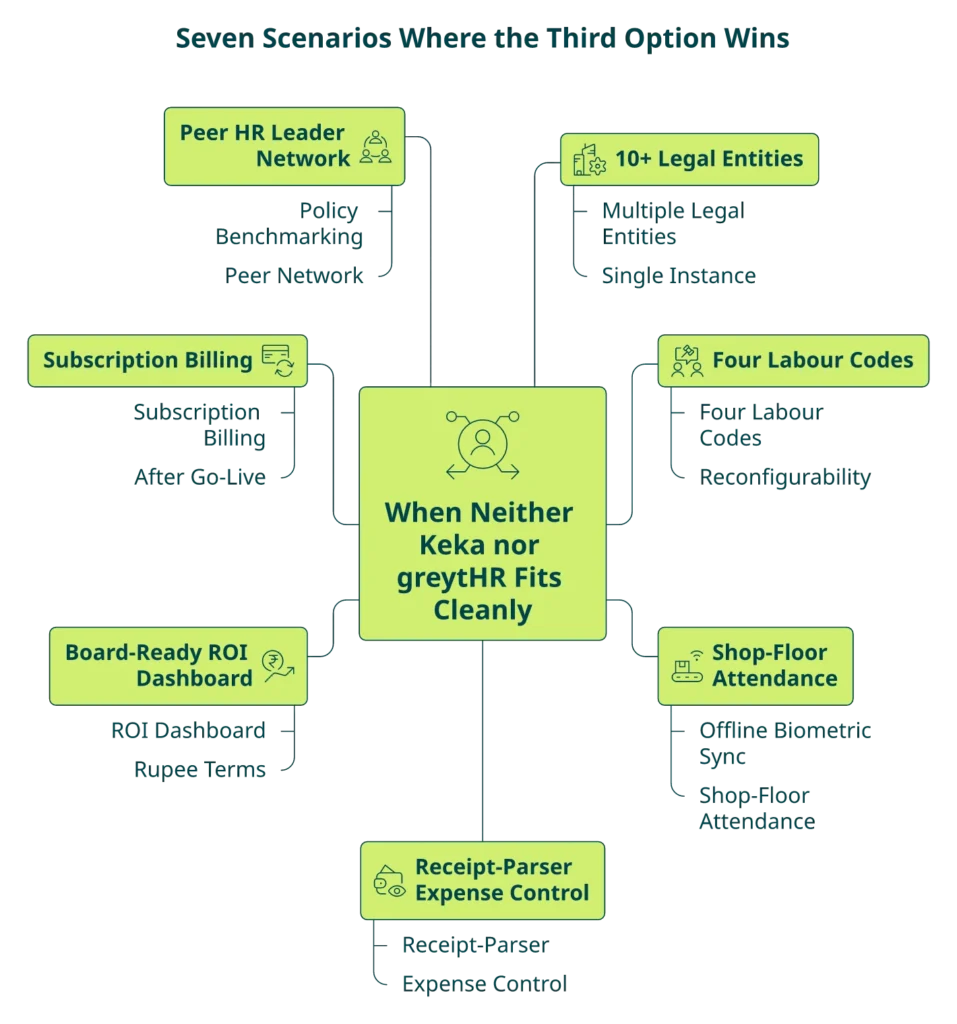
🚩 Seven scenarios where neither Keka nor greytHR fits cleanly
Ranked by how often they show up in our loss calls:
- HROne customers running 10+ legal entities on one instance, like Asia Healthcare Holdings running 20 pan-India units
- 4 Labour Codes reconfigurability without engineering tickets, which rules out platforms that hard-code wage definitions
- Shop-floor attendance with offline biometric sync across manufacturing plants, the pattern our Propel attendance system was designed for
- Receipt-parser-driven expense control where finance can’t keep chasing paper receipts, covered by our expense and reimbursement module
- Board-ready ROI dashboard that shows lifetime hours saved in rupee terms, which buyers usually validate with our ROI calculator
- Go-live-based billing so you stop paying for air during setup
- A peer HR leader network like HR Commune to swap policies and playbooks
“Manage your data” versus “manage your day”
Keka and greytHR help HR teams manage data. An HR manager opening 15 tabs to process one confirmation letter isn’t a data problem, it’s a daily workflow problem. The HR inbox collapses those scattered approvals into one Gmail-style screen where tasks close in three clicks. MR DIY India consolidated their stack onto HROne and cut their payroll cycle from 10 days to 5 to 6 days, not by adding features, but by removing handoffs. The full story is in the MRDIY case study.
G2 rankings that matter for setup and support
| Ranking dimension | HROne | Keka | greytHR |
|---|---|---|---|
| Overall satisfaction (G2) | #3 | #55 | mid-tier |
| Ease of Setup (G2) | #3 | #16 | mid-tier |
| Best HR Software Worldwide | #8 | outside top 40 | #42 |
Data compiled from HROne G2 rankings and published G2 category reports.
“The InboxforHR is a game-changer, centralizing every HR task into one simple inbox, cutting down administrative time by 60-70% and preventing tasks from falling through the cracks. The initial setup of HROne was surprisingly straightforward, much lighter than expected for a full HRMS.”
— Waldon S. HROne G2, Verified Review
The bouquet versus the garden
A founder I respect once told me HR software is a bouquet. Keka and greytHR hand you the flowers: payroll, attendance, and a decent ESS. HROne tries to hand you the garden: hire-to-retire workflows, a receipt-parser, an ROI dashboard, HRV Studio for low-code custom apps, and an SPOC who spent years in HR before joining our delivery team. The “last switch” promise isn’t a slogan, it’s a commercial model with no lock-in and subscription starting only after go-live.
The third option we didn’t want to mention
If neither Keka nor greytHR fits your multi-entity 2026 reality, see HROne on your own screen.
127 pre-built workflows, Super Inbox, One AI Suite, and a 9.8 NPS SPOC. Subscription starts after go-live, with no lock-in and no air-billing.
Book a 30-minute HROne walkthrough →Q10. What Does the 90-Day Post-Implementation Regret Audit Reveal About Keka and greytHR Buyers?
Every HRMS looks great in a demo. The truth arrives around day 90, when the honeymoon ends and the workflow gaps become visible. We run a structured 90-day audit with every switching customer, and the patterns are consistent enough to be useful for buyers still evaluating.
The 90-day audit methodology
We ask 12 questions across five dimensions: payroll variance, support resolution time, workflow adoption rate, mobile parity with desktop, and manager-level task closure rate. The conversations are anonymised and aggregated across 1,500+ deployments, which lets us see the regret patterns that don’t show up in G2 star ratings. For a deeper view of what to look for, our HRIS buyer pitfalls piece complements this audit.
😓 Five most common regrets from Keka buyers at day 90
- Support latency: email threads that loop back without resolution
- PMS upsell surprise: performance management gated behind higher tiers, which is why we bundle performance management in the core subscription
- Multi-entity gaps: struggles when a second legal entity or state is added
- Mobile parity: key admin actions remain desktop-only, a gap our mobile HR app closes
- API rate limits: integrations hit ceilings at month-end load
“We started working with Keka HRMS in August, and to this day, we have been unable to implement the tool in our company due to their consistently delayed responses and poor coordination between their internal teams.”
— Divya P. Keka, G2 Verified Review
😓 Five most common regrets from greytHR buyers at day 90
- Configuration ceiling: simple customisations require tickets
- Workflow rigidity: approval chains that can’t branch on conditions
- UI fatigue: dated screens that HR Ops in their 20s resist
- AI gap: Navos AI is capable on payroll, thin elsewhere, in contrast to our broader HROne AI suite
- Multi-entity breakage: adding a state or entity triggers re-configuration
“We had to go in rounds and spend so many man hours to configure our payroll and later found so many gaps for which we are running in rounds to get it fixed.”
— Verified User in IT Services greytHR, G2 Verified Review
The two regrets HROne customers report, because no platform is perfect
I’d be lying if I said HROne customers never push back. The two consistent asks at day 90 are:
- Onboarding curve for first-time users: power modules like payroll and performance benefit from more hand-holding, which is why our onboarding process assigns a prior-HR SPOC
- Deeper customisation on edge cases: some requests go into a product backlog rather than a same-day fix
“While HROne does a great job overall, one thing I don’t like is that it can sometimes feel a bit overwhelming for new users. Certain features take time to understand, and without enough guided support, the learning curve can feel quite steep.”
— Nijanthan R. HROne G2, Verified Review
What to measure on your own day 90
Set a calendar reminder for 90 days after go-live and score these five numbers:
- ⏰ Average support ticket resolution time, in hours
- 💸 Payroll variance per employee versus the legacy system
- ✅ Percentage of managers closing tasks within the HRMS, not email
- 📱 Mobile-to-desktop feature parity, as a ratio
- 📊 Adoption rate of ESS across employees
If any of these are off, you caught it early. Most buyers discover these numbers 18 months in, when switching is painful.
Q11. The 2026 Decision Blueprint: Seven Interrogation Questions and Five Contract Clauses Before You Sign
If you take one artefact home from this article, let it be this section. It’s the blueprint I wish every buyer had on their next sales call.
The 2026 decision tree
- Under 100 employees, single entity, SMB payroll priority, greytHR is the pragmatic pick. Side-by-side detail lives on our HROne vs greytHR page.
- 100 to 500 employees, tech-forward, performance and UX matter, Keka works. Our HROne vs Keka page covers the architectural contrast.
- 100 to 5,000 employees, multi-entity, shop-floor or BFSI compliance, ROI accountability to board, HROne is worth a serious look.
- 5,000+ employees, global payroll, multi-country, add SAP SuccessFactors or Darwinbox to the shortlist. Comparison details on the HROne vs SAP page.
Three-column take-home comparison
| Dimension | HROne | Keka | greytHR |
|---|---|---|---|
| Core DNA | Hire-to-retire HR OS | Modern HR SaaS | Payroll-first SMB |
| Sweet-spot headcount | 100 to 5,000 | 100 to 500 | 20 to 250 |
| Multi-entity | ✅ Native, 20+ units live | ⚠️ Requires setup | ⚠️ Config-heavy |
| Inbox-style workflow | ✅ Super Inbox | ❌ Module nav | ❌ Module nav |
| AI suite | ✅ Resume, receipt, and agent | ✅ Keka AI | ✅ Navos AI (payroll) |
| ROI dashboard | ✅ India’s first inbuilt | ❌ | ❌ |
| Go-live-based billing | ✅ | ❌ | ❌ |
| Implementation SPOC | ✅ Prior-HR, 9.8 NPS | ⚠️ Email threads | ⚠️ Standard |
| G2 overall satisfaction | #3 | #55 | mid-tier |
| Best suited for | Mid-market multi-entity | Tech-forward SMB | Traditional SMB |
Compiled from vendor rankings and G2 data.
❓ Seven interrogation questions to ask any HRMS sales rep
- Can your rule engine reconfigure wage definitions under the new Labour Codes without a code release?
- Does subscription billing start on contract date or after successful go-live? See our transparent pricing page for the go-live model.
- Can you share a signed DPDP Data Processing Agreement specific to India?
- What’s your SLA for implementing a new state’s PT and LWF rates?
- On exit, how do I export every record, including LOP history and Form 16 continuity?
- What’s the API rate limit per minute on my proposed plan, and what does an upgrade cost?
- How does pricing change when I add a second legal entity or 50 more employees?
✅ Five contract clauses to demand before signing
Go-live-based billing: subscription meters only after successful first live payroll.
Data portability: full export in open formats, on demand, within 7 days.
Labour Codes SLA: commitment to configure new code rules within 30 days of notification.
DPDP DPA: signed agreement with India-specific sub-processor list.
Exit clause: no auto-renewal, 60-day notice, and no lock-in penalty.
🗓️ What to do Monday morning
Open your current shortlist. Send these seven questions to each vendor over email. Give them five working days. The speed, specificity, and confidence of their answers will tell you more than any demo. If you’d like a structured starting point, our how to choose HRIS HRMS software guide walks through the full evaluation rubric.
References
Official Docs / Indian Statutes
- Ministry of Labour and Employment, “Code on Wages, 2019,” Gazette of India notification, 8 August 2019.
- Ministry of Electronics and Information Technology, “Digital Personal Data Protection Act, 2023,” Gazette of India, 11 August 2023.
- Employees’ Provident Fund Organisation, “Electronic Challan cum Return (ECR) specifications.”
- Employees’ State Insurance Corporation, “Contribution and challan filing.”
















 Secures Top Spot in
