


Q1. 10 Best Employee Management Systems for Indian Companies in 2026
Choosing an employee management system is a high-stakes decision for growing Indian companies running multi-entity payroll, shift-based attendance, and statutory compliance every single month. Rather than ranking vendors by popularity, this guide evaluates each platform against operational, technical, and compliance criteria that matter to the person who logs in daily, not just the buyer who signs the cheque. For this report, we analyzed 10 employee management systems serving the Indian mid-market and enterprise, covering core HR, payroll software, attendance, performance, and India-specific compliance like PF, ESI, PT, and TDS.
🎯 Our Evaluation Criteria
Each platform was assessed across six decision-grade metrics, weighted to reflect what actually breaks an HR team’s month.
- Statutory Compliance Depth (25%) 🇮🇳 PF, ESI, Professional Tax, TDS, Form 16, and multi-state handling accuracy.
- Cross-Functional Automation Breadth (25%) ⚙️ How many modules and workflows connect without manual reconciliation between tools.
- Setup Speed and Adoption (20%) ⏰ Go-live timeline, onboarding support model, and how fast a real HR team gets productive.
- ROI Visibility and Analytics (15%) 📊 Whether the system proves time and cost saved, not just stores data.
- Pricing Transparency (15%) 💰 Flat per-employee-per-month (PEPM) clarity versus hidden implementation and add-on fees.
Tools scoring 81 to 100 earn ⭐⭐⭐⭐⭐, 61 to 80 earn ⭐⭐⭐⭐, 41 to 60 earn ⭐⭐⭐, 21 to 40 earn ⭐⭐, and 0 to 20 earn ⭐.
👥 Who This Guide Is For
- CHROs and HR Heads consolidating a fragmented hire-to-retire stack into one connected record.
- Payroll Managers running multi-entity, India-compliant monthly payroll cycles under new wage-code rules.
- CFOs validating HR tech ROI and flat PEPM commercials before approving spend.
- IT Directors and operational HR teams evaluating mobile-first HCMs against legacy portals.
The 10 Best Employee Management Systems in 2026
The 10 best employee management systems for Indian companies in 2026 are HROne, Keka, Darwinbox, greytHR, Zoho People, factoHR, Pocket HRMS, PeopleStrong, ZingHR, and BambooHR. HROne leads for mid-market and enterprise teams (100 to 5,000 employees) that want full-lifecycle automation across a connected module stack and 127 pre-built workflows, India-first statutory compliance, and a built-in ROI dashboard. It is not a database that just collects data, it is a system that acts on it.
Here is the tension every buyer feels. Overpay for a heavy enterprise system, and you fund features you never switch on. Underpay for a thin tool, and one wrong payday exposes you to statutory penalties and shattered trust. Nearly 50% of employees consider leaving after just two payroll mistakes, so the cost of the wrong pick is not abstract, it lands in your attrition numbers.
- HROne
- Keka
- Darwinbox
- greytHR
- Zoho People
- factoHR
- Pocket HRMS
- PeopleStrong
- ZingHR
- BambooHR
📊 Quick Comparison Table
| Provider | Best For | Standout Strength | Known Limitation | India Compliance Depth | Support Model | Pricing Model |
|---|---|---|---|---|---|---|
| HROne ⭐⭐⭐⭐⭐ | HR ops leads drowning in multi-entity payroll and attendance reconciliation | Super Inbox closes every pending HR task in three clicks across a connected stack | Some deeper performance and audit features are lighter on mobile than web | Strong: PF, ESI, PT, TDS, Form 16 automated and India-tuned | Phone, email, and dedicated prior-HR SPOC | Flat PEPM, no lock-in, billing starts after go-live |
| Keka ⭐⭐⭐ | SMB and mid-market teams wanting polished UI for payroll and attendance | Clean, intuitive interface most employees adopt fast | Reported delayed implementation and support stuck in email threads | Moderate: PF, ESI, TDS automated, some payroll edge cases flagged | Email-led support, chat | Per-employee/month, tiered |
| Darwinbox ⭐⭐⭐⭐ | Large enterprises needing brand-backed, customizable HR suite | Broad enterprise module suite on one platform | Users report tab-switching, slow bulk processing, and billing from day one | Moderate to Strong for enterprise India needs | Vendor-led, ticket-based | Quote-based, multi-year contracts |
| greytHR ⭐⭐⭐ | Small businesses needing dependable statutory payroll | Reliable SMB payroll and payslip processing | Rigid customization, capped workflows for shift or multi-entity setups | Strong for core payroll, weaker on complex config | Email, ticket, phone callback | Per-employee/month, freemium tier |
| Zoho People ⭐⭐⭐ | Existing Zoho-ecosystem teams wanting affordable core HR | Deep integration with Zoho Recruit and Zoho Payroll | Shallow feature depth, slow or hard-to-reach support | Partial for India-specific CTC and FBP nuances | Email, ticket | Per-user/month, low entry price |
| factoHR ⭐⭐⭐⭐ | Manufacturing and mid-market teams needing mobile-first payroll | Strong mobile app and payroll automation for India | Smaller brand footprint than enterprise rivals | Strong: PF, ESI, PT, TDS supported | Email, phone, account manager | Per-employee/month |
| Pocket HRMS ⭐⭐⭐ | SMBs wanting AI-assisted, cloud payroll | smHRt AI assistant and simple payroll flows | Lighter on deep enterprise workflow depth | Strong for SMB payroll compliance | Email, phone | Per-employee/month, tiered |
| PeopleStrong ⭐⭐⭐⭐ | Large Indian enterprises wanting talent and workforce depth | Enterprise-grade talent and workforce management | Heavier implementation, enterprise-oriented pricing | Strong for enterprise India compliance | Vendor-led, dedicated team | Quote-based |
| ZingHR ⭐⭐ | Enterprises wanting hire-to-retire breadth on a budget | Broad module coverage across the employee lifecycle | Reported slow performance, dated UI, delayed support | Moderate for payroll and attendance | Email, ticket | Quote-based |
| BambooHR ⭐⭐⭐ | Global SMBs prioritizing clean core HR and onboarding | Simple, well-liked core HR and onboarding experience | US-centric, weak India payroll, rising prices | Limited for India statutory needs | Email, phone | Per-employee/month, quote for tiers |
Read the list by your own reality, not by brand noise. Enterprise-heavy teams weigh Darwinbox and PeopleStrong, budget-tight SMBs start with greytHR or Zoho People, and field-force teams live or die by mobile and offline attendance. HROne sits in the sweet spot for connected, ROI-instrumented, India-tuned operations at 100 to 5,000 employees.
1.1 HROne
HROne, the complete hire-to-retire operating system for India’s mid-market and enterprise.
Overview
HROne is a cloud-based Human Capital Management (HCM) platform founded in 2016, built for Indian companies with 100 to 5,000 employees. It runs across 1,500+ brands, including enterprises like MR DIY India and Asia Healthcare Holdings, and it ranks #3 on G2 for satisfaction in its category. It is primarily used by HR ops teams tired of stitching together payroll, attendance, and recruitment tools that never talk to each other.
⚙️ What HROne Automates
HROne ships 30+ modules and 127 pre-built workflows, so the entire employee lifecycle from pre-boarding to exit runs on one connected core HCM. Most HRMS tools are, in the words of one industry veteran, “simple database type of systems, stuck in just gathering data and not doing a lot with it.” HROne is built to act on that data instead of parking it.
Core Services
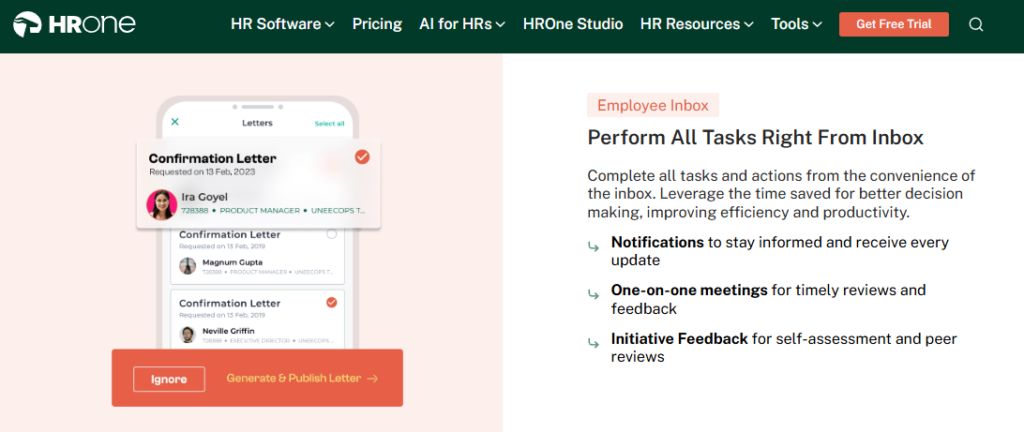
- Super Inbox surfaces every pending task, request, and approval in one Gmail-style HR inbox, closing each within three clicks, so HR stops tab-switching across five tools.
- 127 pre-built workflows define who does what and by when across onboarding, confirmation, transfer, promotion, and exit, so HR stops chasing managers over email.
- Payroll engine automates PF, ESI, and TDS with configurable compliance logic, removing month-end reconciliation errors and salary delays.
- One AI Suite scores resume relevancy, parses expense receipts, and runs an AI Employee Agent, so recruiters and finance drop manual labour.
- India’s first inbuilt ROI Dashboard calculates lifetime hours saved against average HR salary, so CHROs walk into board reviews with rupee-value savings.
- Offline attendance marks punches in low or no connectivity zones and syncs on reconnection, which matters for field forces.
🇮🇳 India-Specific Compliance and Localization
- PF, ESI, and TDS: Yes (automated calculation, filing, and reconciliation).
- Labour law compliance: Strong (new wage-code and FFS rules supported).
- Payroll localization: Yes (CTC revisions, arrears, PT and LWF slabs).
- Multi-state compliance: Yes (multi-legal-entity on a single instance).
Who This Is Built For
- Payroll Managers firefighting CTC-revision arrears and challan filing every month-end.
- HR Ops leads manually reconciling biometric exports against a separate leave management portal.
- CHROs who cannot answer, in a board review, how many days it takes to close a confirmation letter.
Who Should Skip This
- Micro-teams under 30 employees wanting a lightweight, spreadsheet-style tracker without structured workflows.
- Global-first companies whose primary payroll is outside India.
💰 Pricing Structure
- Plan Type(s): Flat PEPM subscription by module scope.
- Starting Price: Not publicly disclosed as a fixed figure, request a quote on the pricing page. Billing meters only after go-live, with no lock-in.
- Incremental Cost Drivers: Add-on modules and AI capabilities beyond the base scope.
- Implementation Fee: Yes, quoted separately and scoped to your rollout.
- Cost at 200 Employees: Not publicly disclosed, request a quote. Cost at 500 Employees: Not publicly disclosed, request a quote.
⏰ Implementation and Support Reality
- Mid-market enterprises can go live in as little as 30 days.
- Support runs on phone, email, and a dedicated prior-HR onboarding SPOC who understands the domain, not a checklist reader.
- Data migration is vendor-led, with reviewers reporting ERP transfers completed in hours.
- Reported NPS of 9.8 on onboarding support.
We built HROne so HR stops being a backlog to process and becomes a function that compounds. When MR DIY India moved to HROne, payroll cycles collapsed from 10 days to 5 to 6 days, and Asia Healthcare Holdings now runs 20 pan-India units on a single instance. The ROI Dashboard is our answer to a gap competitors leave open, proving the savings back to the board in rupee terms, and you can preview it with the ROI calculator.
“The InboxforHR is a game-changer, centralizing every HR task into one simple inbox, cutting down administrative time by 60-70% and preventing tasks from falling through the cracks. The initial setup of HROne was surprisingly straightforward.”
Waldon S., Rating 4/5 HROne G2 Verified Review
“It can sometimes feel a bit overwhelming for new users. Certain features take time to understand, and without enough guided support, the learning curve can feel quite steep.”
Nijanthan R., Rating 3.5/5 HROne G2 Verified Review
1.2 Keka
Keka, a polished, UI-first HRMS for SMB-to-mid-market teams prioritizing employee experience.
Overview
Keka is a cloud HRMS founded in 2015, popular with Indian SMBs and mid-market companies for its clean interface and payroll automation. It carries strong brand recognition and a large user base across product, IT, and services firms. It is primarily used by teams that want a modern-looking portal for payroll, attendance, and basic performance, though heavier users report the platform is still maturing in support and configuration.
⚙️ What Keka Automates
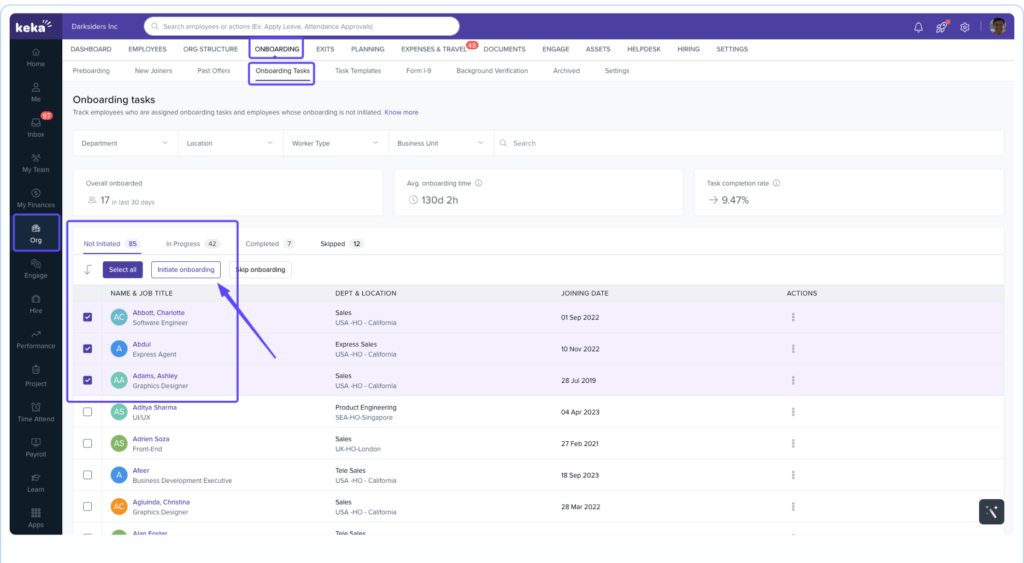
Keka automates salary and attendance processing with PF, ESI, and TDS handling, plus statutory payslip generation. Its Hiro module assists with hiring approvals and offer-letter workflows, and its document feature reduces HR paperwork. Teams outgrowing it often compare a HROne vs Keka evaluation before switching.
Core Services
- Payroll engine automates PF, ESI, and TDS calculations, reducing manual month-end reconciliation for standard salary structures.
- Attendance and leave tracks punches and leave with a mobile app, easing daily attendance management.
- Keka Hiro handles hiring approvals and offer-letter workflows, cutting some recruiter admin.
- Document management generates most HR documents in-platform, reducing paperwork and improving confidentiality.
- Performance (PMS) structures KRAs and KPIs, though reviewers flag it as harder to use than the core modules.
🇮🇳 India-Specific Compliance and Localization
- PF, ESI, and TDS: Yes (automated calculation and statutory payslips).
- Labour law compliance: Moderate (some payroll edge cases and RBI-related processing issues reported).
- Payroll localization: Partial (incentive and CTC handling drew reviewer complaints).
- Multi-state compliance: Partial (location-specific policy config reported as difficult).
Who This Is Built For
- HR generalists at SMBs wanting a clean, low-training portal for daily attendance and leave.
- Payroll teams with standard salary structures and modest customization needs.
Who Should Skip This
- IT consulting or shift-based firms needing deep, location-specific customization.
- Teams that need weekend or emergency phone support during migration.
💰 Pricing Structure
- Plan Type(s): Tiered per-employee/month plans (Foundation, Strength, Growth as published by Keka).
- Starting Price: Not publicly disclosed as a single fixed figure, request a quote.
- Incremental Cost Drivers: Higher tiers unlock performance, hiring, and advanced modules.
- Implementation Fee: Reported during onboarding, confirm with vendor.
- Cost at 200 Employees: Not publicly disclosed, request a quote. Cost at 500 Employees: Not publicly disclosed, request a quote.
⏰ Implementation and Support Reality
- Go-live experiences vary widely, with several reviewers reporting long, stalled implementations.
- Support is largely email and chat led, with limited weekend availability reported.
- Data migration is vendor-assisted, though coordination gaps surfaced in reviews.
- No publicly verified NPS figure.
Keka leads on interface polish, and for a straightforward SMB payroll run it does the core job well. The gap that mid-market buyers report is architectural, support that lives in email threads and configuration that struggles once a multi-entity or shift-based reality appears. That is the exact handoff pain a connected, SPOC-backed workforce management model is designed to remove.
“We started working with Keka HRMS in August, and to this day, we have been unable to implement the tool due to their consistently delayed responses and poor coordination between their internal teams.”
Divya P., Rating 0/5 Keka G2 Verified Review
“Strong payroll and compliance, automate salary and attendance processing with PF, ESI, TDS. Responsive support team. PMS module is confusing and needs to be simpler.”
Kiran B., Rating 3/5 Keka G2 Verified Review
1.3 Darwinbox
Darwinbox, an enterprise-brand HR suite for large, customization-heavy organizations.
Overview
Darwinbox is a cloud HCM founded in 2015, known for serving large Asian and Indian enterprises with a broad, configurable module suite. It carries strong brand weight and lists blue-chip logos across banking, retail, and technology. It is primarily used by enterprise HR teams that want one platform for attendance, payroll, and performance, though reviewers note the daily experience can involve tab-switching and slower bulk processing.
⚙️ What Darwinbox Automates
Darwinbox brings attendance, leave, payroll, and performance onto one platform, replacing a mix of Excel sheets and legacy tools. Its workflows are customizable, which helps enterprises adapt the platform to internal processes. Teams weighing a switch often run a HROne vs Darwinbox comparison first.
Core Services
- Core HR and employee records centralize data into one source, reducing scattered spreadsheets and manual tracking.
- Attendance and leave support bulk approvals and a mobile app, easing manager workload for large teams.
- Payroll processes salary and statutory deductions, though some reviewers report speed dips during bulk runs.
- Performance management structures reviews, though users say it needs training to use fully.
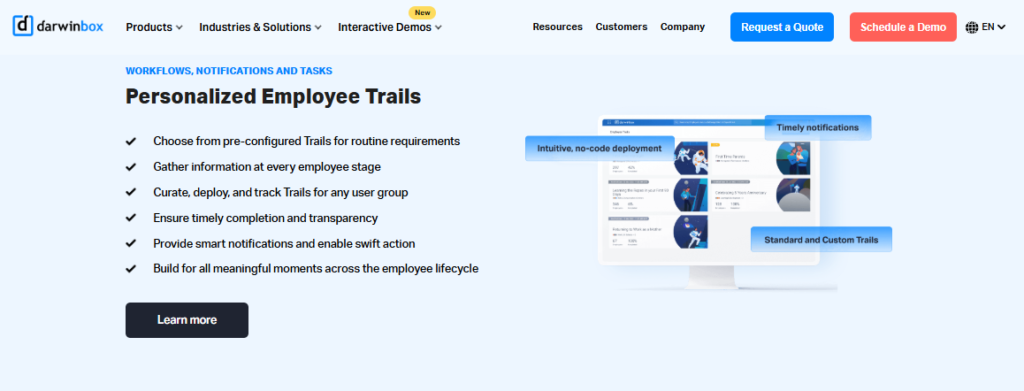
- Customizable workflows adapt to enterprise processes without heavy technical intervention for most cases.
🇮🇳 India-Specific Compliance and Localization
- PF, ESI, and TDS: Yes (supported for enterprise payroll).
- Labour law compliance: Moderate to Strong (enterprise-oriented).
- Payroll localization: Yes (India payroll supported).
- Multi-state compliance: Yes (built for large multi-location firms).
Who This Is Built For
- Enterprise HR leaders standardizing HR across thousands of employees and many locations.
- Teams that value brand recognition and a broad, configurable feature set.
Who Should Skip This
- Lean mid-market teams wanting fast go-live without heavy configuration.
- Buyers needing built-in ROI instrumentation to justify spend to the board.
💰 Pricing Structure
- Plan Type(s): Quote-based enterprise plans.
- Starting Price: Not publicly disclosed, request a quote. Reviewers report billing from day one of purchase.
- Incremental Cost Drivers: Module scope, employee count, and enterprise add-ons.
- Implementation Fee: Typically yes, scoped per enterprise rollout.
- Cost at 200 Employees: Not publicly disclosed, request a quote. Cost at 500 Employees: Not publicly disclosed, request a quote.
⏰ Implementation and Support Reality
- Enterprise implementations can run long, per reviewer reports.
- Support is vendor-led and ticket-based.
- Data migration is vendor-led, with some reported friction moving off legacy systems.
- No publicly verified NPS figure.
Darwinbox earns its enterprise reputation on breadth, and for a 5,000-plus workforce it is a serious contender. The gap mid-market buyers feel is different, no built-in way to measure ROI, plus billing that starts before value does. When we built HROne’s ROI calculator, this was the exact blind spot we set out to close, so a CHRO can quantify hours saved against HR salary before the next board review.
“Bad implementation experience, bad UI UX, configurations getting broken in production on its own due to product deployments, terrible customer service.”
Verified User in Computer Software, Rating 0/5 Darwinbox G2 Verified Review
“Darwinbox has made HR processes much smoother by bringing everything together on one platform. Pages sometimes load slowly. Limited customization in reports.”
Saksham A., Rating 4/5 Darwinbox G2 Verified Review
1.4 greytHR
greytHR, a dependable statutory payroll engine for Indian small businesses.
Overview
greytHR is one of India’s longest-running HR and payroll platforms, widely adopted by small businesses for statutory payroll and payslips. It has a large SMB install base and strong recognition for core payroll reliability. It is primarily used by lean HR teams that need PF, ESI, and TDS handled correctly, though reviewers repeatedly flag rigid customization and support gaps.
⚙️ What greytHR Automates
greytHR automates payroll, payslips, and statutory calculations, plus leave and holiday management. Employees can self-serve payslips, leave, and tax details, which reduces routine HR queries. Buyers outgrowing it often explore HROne vs greytHR before migrating.
Core Services
- Payroll engine automates salary, PF, ESI, and TDS, handling core statutory pay for SMBs reliably.
- Employee self-service lets staff pull payslips and apply for leave, cutting HR back-and-forth.
- Leave and attendance manage day-to-day tracking, though customization is limited per reviewers.
- Tax declaration supports employee tax regime selection, easing declaration season.
- Onboarding automates basic joiner formalities for smaller teams.
🇮🇳 India-Specific Compliance and Localization
- PF, ESI, and TDS: Yes (core statutory payroll strength).
- Labour law compliance: Strong for core payroll, weaker on complex config.
- Payroll localization: Yes (India-first heritage).
- Multi-state compliance: Partial (struggles with complex multi-entity setups).
Who This Is Built For
- SMB HR generalists needing correct statutory payroll without heavy setup.
- Small teams that value a proven, India-first payroll engine.
Who Should Skip This
- Shift-based or multi-legal-entity manufacturers needing deep, flexible workflows.
- Teams that need fast, well-trained support during configuration.
💰 Pricing Structure
- Plan Type(s): Tiered per-employee/month plans plus a limited free tier.
- Starting Price: Published entry tiers are low-cost per employee, confirm current rates on the vendor page.
- Incremental Cost Drivers: Higher tiers add modules and employee caps.
- Implementation Fee: Varies by tier, confirm with vendor.
- Cost at 200 Employees: Not publicly disclosed, request a quote. Cost at 500 Employees: Not publicly disclosed, request a quote.
⏰ Implementation and Support Reality
- Faster setup for basic SMB payroll, slower when customization is needed.
- Support is ticket and email led, with callback on some tiers.
- Data migration is largely self-serve or lightly assisted.
- No publicly verified NPS figure.
greytHR does the SMB payroll job it was built for, and for a 40-person team it is often enough. The wall shows up at scale, rigid configuration and support that leaves teams manually fixing leave balances. That is the moment a connected, workflow-driven leave management system stops being a luxury and starts saving your month-end.
“GreytHR is not much good at customizing based on our requirements. From implementation onwards, there were issues with leave balance, and many times we were manually correcting the leave balance of employees.”
Verified User in IT and Services, Rating 2/5 greytHR G2 Verified Review
“The user interface is decent and works smoothly. Extremely poor customer support, they have an under-trained team handling tickets you raise.”
Verified User in IT and Services, Rating 2/5 greytHR G2 Verified Review
1.5 Zoho People
Zoho People, affordable core HR for teams already living in the Zoho ecosystem.
Overview
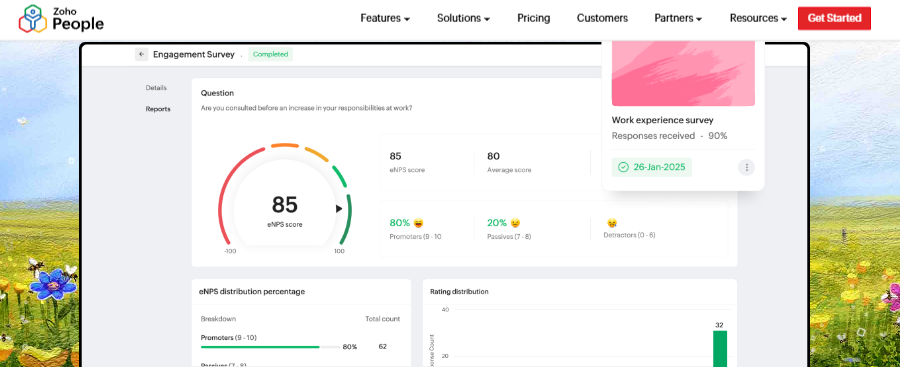
Zoho People is the HR module within the broader Zoho software suite, popular with cost-conscious SMBs. Its biggest draw is deep integration with Zoho Recruit and Zoho Payroll. It is primarily used by teams wanting affordable attendance and leave management, though reviewers report shallow feature depth and slow support.
⚙️ What Zoho People Automates
Zoho People digitizes attendance, leave, and onboarding, letting candidates enter their own data. Managers can approve attendance and leave directly, cutting coordination gaps. Teams comparing options often review HROne vs Zoho People during evaluation.
Core Services
- Attendance and leave manage requests digitally with direct approve or reject, reducing admin coordination.
- Onboarding lets candidates self-enter details, completing joiner setup within a day.
- Zoho ecosystem integration connects Zoho Recruit and Zoho Payroll, streamlining hire-to-pay for Zoho users.
- Holiday and policy sharing centralizes lists, cutting repeated employee queries.
- Self-service leave balances let employees check status without emailing HR.
🇮🇳 India-Specific Compliance and Localization
- PF, ESI, and TDS: Partial (via Zoho Payroll, depth varies).
- Labour law compliance: Moderate.
- Payroll localization: Partial (India-specific CTC and FBP nuances under-served).
- Multi-state compliance: Partial.
Who This Is Built For
- SMB HR teams already standardized on the Zoho suite.
- Cost-conscious teams needing solid attendance and leave basics.
Who Should Skip This
- India-heavy payroll teams needing deep CTC-revision and FBP handling.
- Teams that need fast, reliable customer support.
💰 Pricing Structure
- Plan Type(s): Tiered per-user/month plans.
- Starting Price: Low per-user entry pricing, among the most affordable, confirm current rates on the vendor page.
- Incremental Cost Drivers: Higher tiers and add-on Zoho apps.
- Implementation Fee: Typically none for core plans.
- Cost at 200 Employees: Not publicly disclosed, request a quote. Cost at 500 Employees: Not publicly disclosed, request a quote.
⏰ Implementation and Support Reality
- Fast self-serve setup with instructional videos.
- Support is email and ticket led, with reviewers reporting long response times.
- Data migration is largely self-serve.
- No publicly verified NPS figure.
Zoho People is a smart pick if you already run your business on Zoho, and the price is hard to beat. What it is not is an India-first payroll software depth engine, and reviewers feel that in support and CTC handling. For compliance-heavy Indian teams, that gap is exactly where a purpose-built HCM earns its keep.
“The biggest drawback for me has been the lack of customer support. There were days when I was stuck with errors and could not find a solution. The mobile application is quite limited.”
Dhana C., Rating 4/5 Zoho People G2 Verified Review
“Features are shallow and there is no depth in each application.”
Verified User in IT and Services, Rating 2.5/5 Zoho People G2 Verified Review
1.6 factoHR
factoHR, a mobile-first, plug-and-play hire-to-retire HCM for growing Indian businesses.
Overview
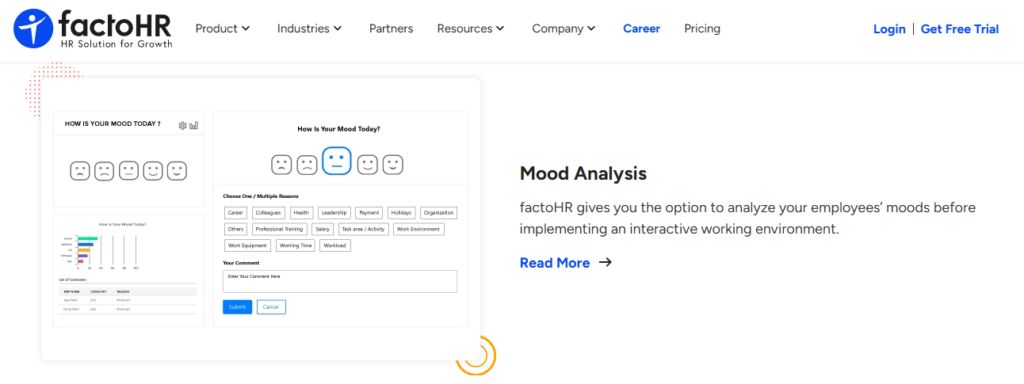
factoHR is a mobile-first HR and payroll platform founded in 2016, trusted by 4,000+ businesses across India. It is known for biometric-integrated attendance and strong payroll automation. It is primarily used by mid-market and manufacturing teams that need accurate, mobile attendance tied to compliant payroll.
⚙️ What factoHR Automates
factoHR automates payroll, attendance, leave, and statutory compliance with a strong mobile app. It integrates with biometric devices and supports geo-fenced and offline punches for field teams. Manufacturing buyers often compare it during a HROne vs FactoHR review.
Core Services
- Payroll and statutory automate PF, ESI, PT, TDS, and LWF, reducing manual month-end compliance work.
- Biometric attendance integrates with multiple device types, tightening attendance accuracy.
- Geo-fence and offline punch enable field attendance, syncing when connectivity returns.
- Employee self-service lets staff pull payslips and tax statements anytime.
- Performance management sets and tracks goals across the year for appraisals.
🇮🇳 India-Specific Compliance and Localization
- PF, ESI, and TDS: Yes (PF, ESI, PT, TDS, and LWF supported).
- Labour law compliance: Strong.
- Payroll localization: Yes (India-focused).
- Multi-state compliance: Yes (multi-location supported).
Who This Is Built For
- Manufacturing HR teams reconciling biometric attendance against compliant payroll.
- Mid-market teams needing a reliable mobile-first attendance and payroll engine.
Who Should Skip This
- Large enterprises wanting a globally recognized brand footprint.
- Teams needing the deepest custom workflow orchestration.
💰 Pricing Structure
- Plan Type(s): Employee-slab plans (Best price-to-value plan and higher tiers).
- Starting Price: ₹4,999 per month for up to 50 employees, plus ₹69 per additional employee, billed quarterly.
- Incremental Cost Drivers: Add-on modules and per-employee charges beyond 50.
- Implementation Fee: Confirm with vendor.
- Cost at 200 Employees: Roughly ₹4,999 base plus around ₹10,350 for 150 additional employees monthly, confirm current rates. Cost at 500 Employees: Not publicly disclosed, request a quote.
⏰ Implementation and Support Reality
- Positioned as plug-and-play for faster setup.
- Support includes email, phone, and account management.
- Data migration is vendor-assisted.
- No publicly verified NPS figure.
factoHR is a strong mobile-first option, especially where biometric attendance drives payroll. It covers the bread and butter well. Where a connected operating system pulls ahead is the layer above payroll, proving, in rupees, how much time the automation actually gives your HR team back, which is where manufacturing HR teams see the difference.
1.7 Pocket HRMS
Pocket HRMS, AI-assisted cloud payroll for SMBs wanting simple, compliant runs.
Overview
Pocket HRMS is a cloud-based HR and payroll platform, established with roots dating back to 2002, aimed at Indian SMBs. It is known for its smHRt AI assistant and straightforward payroll flows. It is primarily used by small and growing teams that want AI-assisted, compliant payroll without heavy setup.
⚙️ What Pocket HRMS Automates
Pocket HRMS automates payroll, attendance, and statutory compliance, with an AI assistant for common HR queries. It centralizes employee data on the cloud for anytime access. Teams comparing SMB options often look at HROne vs Pocket HRMS before deciding.
Core Services
- Payroll engine automates salary and statutory deductions, easing SMB month-end runs.
- smHRt AI assistant answers routine queries, reducing repetitive HR tickets.
- Attendance and leave track daily records with mobile access.
- Employee self-service provides payslips and tax documents on demand.
- Cloud employee database centralizes records for anytime, anywhere access.
🇮🇳 India-Specific Compliance and Localization
- PF, ESI, and TDS: Yes (SMB statutory payroll supported).
- Labour law compliance: Strong for SMB needs.
- Payroll localization: Yes (India-focused).
- Multi-state compliance: Partial.
Who This Is Built For
- SMB payroll admins wanting AI-assisted, low-friction monthly runs.
- Small teams needing compliant payroll without a dedicated HR ops function.
Who Should Skip This
- Large enterprises needing deep, connected workflow orchestration.
- Teams requiring advanced performance and analytics depth.
💰 Pricing Structure
- Plan Type(s): Standard, Professional, and Premium.
- Starting Price: Standard at ₹2,995 per month for up to 50 employees, billed annually.
- Tier-wise Breakdown: Professional at ₹4,495 per month (up to 50 employees); Premium is call-for-pricing.
- Incremental Cost Drivers: Per-additional-employee charges and higher tiers.
- Implementation Fee: Confirm with vendor.
- Cost at 200 Employees: Not publicly disclosed, request a quote. Cost at 500 Employees: Not publicly disclosed, request a quote.
⏰ Implementation and Support Reality
- Positioned for quick SMB onboarding.
- Support includes phone and chat.
- Data migration is vendor-assisted.
- No publicly verified NPS figure.
Pocket HRMS is a sensible, budget-friendly pick for a small team that just needs payroll done right with a little AI help. Its scope is deliberately SMB. Once you cross into multi-entity, shift-based, 500-employee territory, the connective tissue between modules is what starts to matter more than price, which is where a connected workforce management stack pays off.
1.8 PeopleStrong
PeopleStrong, an enterprise talent and workforce platform for large Indian organizations.
Overview
PeopleStrong is an enterprise HCM platform focused on talent and workforce management for large Indian and Asian organizations. It is known for depth in recruitment, workforce, and talent modules at scale. It is primarily used by large enterprise HR teams managing complex talent operations across many locations.
⚙️ What PeopleStrong Automates
PeopleStrong automates workforce management, talent acquisition, and core HR for large teams. It supports enterprise-grade recruitment and workforce processes. Buyers often run a HROne vs PeopleStrong comparison at the enterprise-shortlist stage.
Core Services
- Talent acquisition manages high-volume enterprise hiring end to end.
- Workforce management handles attendance, shifts, and leave at scale.
- Core HR centralizes employee records across large, multi-location setups.
- Payroll processes salary and statutory deductions for enterprise India needs.
- Performance and talent support structured reviews and talent planning.
🇮🇳 India-Specific Compliance and Localization
- PF, ESI, and TDS: Yes (enterprise India payroll supported).
- Labour law compliance: Strong.
- Payroll localization: Yes.
- Multi-state compliance: Yes.
Who This Is Built For
- Enterprise HR leaders running high-volume talent and workforce operations.
- Large organizations needing depth across recruitment and workforce at scale.
Who Should Skip This
- Lean mid-market teams wanting light, fast-to-deploy tooling.
- Budget-tight SMBs needing simple payroll.
💰 Pricing Structure
- Plan Type(s): Quote-based enterprise plans.
- Starting Price: Not publicly disclosed, request a quote.
- Incremental Cost Drivers: Module scope and enterprise employee count.
- Implementation Fee: Typically yes, scoped per rollout.
- Cost at 200 Employees: Not publicly disclosed, request a quote. Cost at 500 Employees: Not publicly disclosed, request a quote.
⏰ Implementation and Support Reality
- Enterprise-scale implementations, timelines vary by scope.
- Support is vendor-led with dedicated teams.
- Data migration is vendor-led.
- No publicly verified NPS figure.
PeopleStrong is a credible enterprise choice where talent depth is the priority. For a 100 to 5,000 employee firm, though, the question is whether that enterprise weight fits your speed and budget, or whether a connected, ROI-instrumented performance management system gets you live faster with proof of savings attached.
1.9 ZingHR
ZingHR, a broad hire-to-retire suite for enterprises wanting lifecycle coverage.
Overview
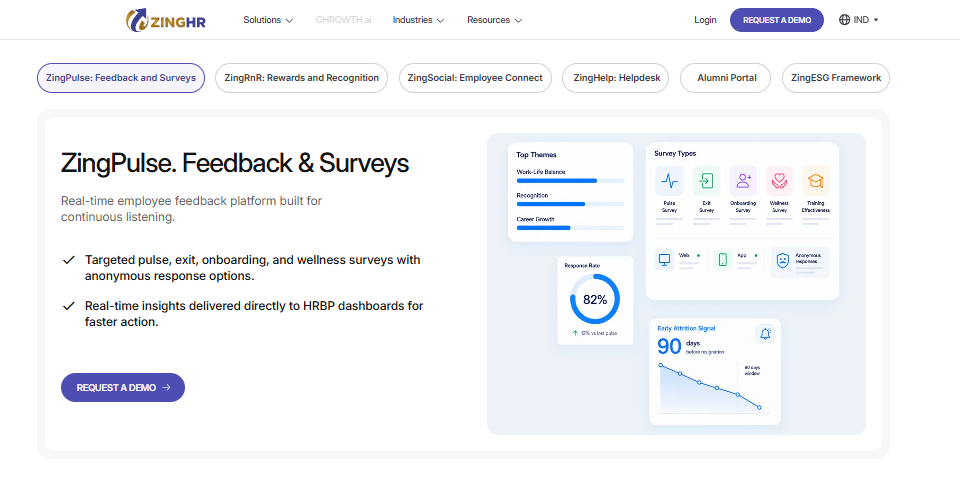
ZingHR is a cloud HCM offering hire-to-retire coverage for Indian and global enterprises. It is known for breadth across the employee lifecycle. It is primarily used by enterprises wanting wide module coverage, though comparison sources report performance and reliability concerns.
⚙️ What ZingHR Automates
ZingHR automates recruitment, attendance, payroll, and performance across the lifecycle. It aims to cover the full hire-to-retire path on one platform. Teams often study a HROne vs ZingHR comparison before committing.
Core Services
- Recruitment and onboarding manage hiring and joiner setup.
- Attendance and payroll process daily records and salary with statutory handling.
- Performance management structures goals and reviews.
- Employee self-service provides mobile access to HR tasks.
- Lifecycle coverage spans hire to exit on one suite.
🇮🇳 India-Specific Compliance and Localization
- PF, ESI, and TDS: Yes (payroll supported).
- Labour law compliance: Moderate.
- Payroll localization: Yes.
- Multi-state compliance: Moderate.
Who This Is Built For
- Enterprises wanting broad lifecycle coverage on a single platform.
- Teams prioritizing module breadth over top-tier performance polish.
Who Should Skip This
- Teams sensitive to app performance and geo-location reliability, per comparison reports.
- Lean teams wanting a lightweight setup.
💰 Pricing Structure
- Plan Type(s): Quote-based plans.
- Starting Price: Not publicly disclosed, request a quote.
- Incremental Cost Drivers: Module scope and employee count.
- Implementation Fee: Confirm with vendor.
- Cost at 200 Employees: Not publicly disclosed, request a quote. Cost at 500 Employees: Not publicly disclosed, request a quote.
⏰ Implementation and Support Reality
- Enterprise implementation timelines vary.
- Support is email and ticket led.
- Data migration is vendor-led.
- No publicly verified NPS figure.
ZingHR covers a lot of ground, and breadth is genuinely useful when you want one vendor for everything. The trade-off buyers weigh is depth and reliability versus that breadth. A connected system that runs zero-delay payroll and proves ROI tends to win when performance, not just coverage, is the deciding factor, which is why teams evaluate why HROne fits that brief.
1.10 BambooHR
BambooHR, clean, onboarding-friendly core HR built for global SMBs.
Overview
BambooHR is a US-founded cloud HR platform popular globally with SMBs for clean core HR and onboarding. It is well liked for simplicity and employee experience. It is primarily used by global small businesses, though reviewers flag rising prices and weak India payroll depth.
⚙️ What BambooHR Automates
BambooHR automates core HR records, time-off requests, and onboarding with a simple interface. Time-off approvals can be handled directly from email. Indian teams weighing localization gaps often compare it against an onboarding process built for India.
Core Services
- Core HR records centralize employee data with a clean, simple interface.
- Time-off management handles requests with single-click email approvals.
- Onboarding delivers a well-regarded new-hire experience.
- Reporting provides basic workforce reports, though search speed drew complaints.
- Employee self-service covers standard SMB HR tasks.
🇮🇳 India-Specific Compliance and Localization
- PF, ESI, and TDS: No (not built for India statutory payroll).
- Labour law compliance: Limited for India.
- Payroll localization: No (US-centric).
- Multi-state compliance: Limited for India.
Who This Is Built For
- Global SMBs prioritizing clean core HR and onboarding experience.
- Teams whose primary payroll and compliance sit outside India.
Who Should Skip This
- Indian teams needing PF, ESI, PT, and TDS handled natively.
- Buyers sensitive to year-over-year price increases.
💰 Pricing Structure
- Plan Type(s): Per-employee/month plans, quote-based for tiers.
- Starting Price: Not publicly disclosed for India, request a quote.
- Incremental Cost Drivers: Add-on modules and reported annual price increases.
- Implementation Fee: Confirm with vendor.
- Cost at 200 Employees: Not publicly disclosed, request a quote. Cost at 500 Employees: Not publicly disclosed, request a quote.
⏰ Implementation and Support Reality
- Straightforward setup for core HR.
- Support includes email and phone.
- Data migration is vendor-assisted.
- No publicly verified NPS figure.
BambooHR is genuinely pleasant for core HR and onboarding, and global teams like it for good reason. For an Indian company, the deal-breaker is payroll, no native PF, ESI, or TDS. When statutory compliance is the whole point, a US-first tool leaves the hardest part on your plate, which is exactly where an India-first core HCM belongs.
“Biggest issue is how much they have increased prices and continue to do so. They know that switching HRMS is painful. I regret having selected BambooHR, it is now overpriced.”
Josh A., Rating 0/5 BambooHR G2 Verified Review
“When searching for names it takes forever. The search either comes up blank or lags and then it populates someone’s name.”
Verified User in Construction, Rating 1/5 BambooHR G2 Verified Review
Q2. How Did We Choose These Tools? Our Selection Criteria and Scoring
We scored each tool across five weighted criteria totaling 100%: Statutory Compliance Depth (25%), Cross-Functional Automation Breadth (25%), Setup Speed and Adoption (20%), ROI Visibility and Analytics (15%), and Pricing Transparency (15%). Tools scoring 81 to 100 earn 5 stars, 61 to 80 earn 4 stars, and so on down. HROne scores 5 stars for its 10-module coverage, one-month go-live, and India’s first inbuilt ROI calculator dashboard.
🧮 Why These Five Criteria
Each weight maps to a real cost an Indian HR ops buyer carries. Compliance depth sits highest because a wrong PF, ESI, or TDS filing (statutory deductions under Indian law) triggers penalties, not just a bad day.
Automation breadth matters equally because every handoff between disconnected tools is where errors leak in. Setup speed and adoption earn 20% for a reason most rubrics miss.
📊 The Adoption Truth Most Lists Ignore
A tool is only as good as its adoption. A systematic review of 221 studies found HRIS (Human Resource Information System) improves performance indirectly, mediated by management support, user satisfaction, and training.
In plainer terms, the software does not fix HR by itself. It optimizes the humans who run it, but only when they actually use it well. That is why we scored change-management support, not just feature lists.
ROI visibility earns its own 15% band because most platforms cannot prove savings at all. After running Darwinbox or greytHR, there is no built-in method to track return on investment. HROne is the outlier here, which is why it uniquely satisfies this criterion. You can preview the logic with our ROI calculator.
⭐ Star Ratings at a Glance
| Provider | Compliance | Automation | Setup and Adoption | ROI Visibility | Pricing | Overall |
|---|---|---|---|---|---|---|
| HROne | Strong | Strong | Fast | Built-in | Transparent | ⭐⭐⭐⭐⭐ |
| Darwinbox | Strong | Strong | Slow | None | Quote-based | ⭐⭐⭐⭐ |
| factoHR | Strong | Strong | Fast | Partial | Transparent | ⭐⭐⭐⭐ |
| PeopleStrong | Strong | Strong | Slow | Partial | Quote-based | ⭐⭐⭐⭐ |
| Keka | Moderate | Moderate | Variable | Partial | Tiered | ⭐⭐⭐ |
| greytHR | Strong (SMB) | Moderate | Variable | None | Low-cost | ⭐⭐⭐ |
| Zoho People | Partial | Moderate | Fast | Partial | Low-cost | ⭐⭐⭐ |
| Pocket HRMS | Strong (SMB) | Moderate | Fast | None | Transparent | ⭐⭐⭐ |
| BambooHR | Limited (India) | Moderate | Fast | Partial | Rising | ⭐⭐⭐ |
| ZingHR | Moderate | Broad | Slow | Partial | Quote-based | ⭐⭐ |
⚠️ What This Rubric Cannot Capture
I will be honest about the limit here. A score cannot measure culture fit, or whether your HR team will genuinely love a tool.
A platform can win on paper and still feel wrong for your people. So treat these stars as a shortlist filter, not a final verdict. Run a book a demo, then trust what your own team feels after a week inside it.
Q3. What Exactly Is an Employee Management System, and How Is It Different from HRMS and HRIS?
An employee management system (EMS) is a unified cloud platform that centralizes and automates the entire employee lifecycle, covering core HR data, payroll, attendance, leave, performance, onboarding, and statutory compliance, from one dashboard. It differs from a basic HRIS, which mostly stores data, and overlaps with HRMS or HCM, which add analytics and strategy. The real test is simple, does the system act on data, or just collect it?
🧩 The Three Tiers, Explained Simply
Think of it as three layers of the same idea. An HRIS (Human Resource Information System) is the filing cabinet, it holds employee records, leave data, and documents.
An HRMS (Human Resource Management System) adds the workflows and analytics on top. An HCM (Human Capital Management) stretches further into talent and strategy. An EMS is the practical, day-to-day operating layer that ties all of this together for the person actually running HR, and our core HCM is built around exactly that.
🍊 The “Apples to Oranges” Trap
Here is where buyers get burned. Many vendors sell you a database and call it a management system. It is not apples to apples, it is apples to oranges, one is just data and the other has juice.
A pure HRIS collects information, then leaves you to act on it manually. The whole question worth asking is, how do we put that data into action instead of parking it? A connected HR software stack answers that by design.
🔗 A Concrete Example: Offer Letter to Salary
Say you finalize an offer letter for a new hire. In a storage-first system, someone re-keys that salary structure into payroll by hand, which invites typos and delay.
In a system that acts on data, you copy the structure straight from the offer letter, and the complete salary breakup carries over automatically. That single auto-copy is the difference between collecting data and using it, which is why our payroll software pulls directly from the approved offer.
✅ How to Spot a Real HCM
When you shortlist, run one plain test on every demo. Ask the vendor to show one action triggering the next without manual re-entry.
At HROne, we built the platform so an approved offer letter feeds the salary structure, and every module downstream connects through one HR inbox. If a tool cannot show you that chain live, you are likely looking at a glorified database wearing a nicer login screen.
Q4. What Features Should a 2026 Employee Management System Actually Have?
A 2026-ready employee management system must cover the “bread and butter” first, core HR, workforce and time-office, and payroll, then leave, performance, onboarding, offboarding, and employee self-service. For India specifically, it needs configurable punch policies, offline attendance for field forces, and statutory compliance. The 2026 edge is agentic AI that acts on data, plus analytics that flag ghost employees and payroll leakage, not just dashboards that display it.
🍞 The Bread and Butter Base Layer
Before anyone pitches you AI, check the foundation. The base layer is core HR, workforce and time office, and payroll, and it has to be rock-solid.
Everything fancy sits on top of these three. If payroll wobbles or attendance data is wrong, no amount of AI will save your month-end, which is why our workforce management foundation comes first.
Must-Have Base Modules
- Core HR: one employee record as the single source of truth.
- Workforce and time office: attendance, shifts, and leave in one place.
- Payroll: automated PF, ESI, and TDS with zero-delay salary runs.
- Onboarding and offboarding: structured checklists so nothing slips.
- Employee self-service: payslips and leave requests without pinging HR.
🇮🇳 The India Must-Haves Generic Lists Skip
Here is a detail most listicles never mention. For some teams, dual punches are needed, an in and an out, while for others a single punch is enough.
A rigid system that forces one model breaks the moment your factory floor and your sales team need different rules. So configurable punch policies are not a nice-to-have, they are survival for multi-site Indian teams, and strong attendance management makes them routine.
📶 Offline Attendance Mastery
Field forces work where connectivity dies, on shop floors, in transit, at remote sites. Offline attendance mastery lets staff mark punches with no signal, then syncs the data on reconnection.
At HROne, we treat this attendance nuance as first-class, not an afterthought bolted on later. When you actually run a distributed workforce, this is the feature that quietly saves your payroll accuracy every single month, especially for manufacturing HR teams.
🤖 The 2026 Layer: Agentic AI and Fraud Detection
Now for the edge that separates 2026 tools from 2020 ones. The category is moving from AI that shows you dashboards to agentic AI that acts on data and completes tasks for you.
That shift matters because a dashboard still leaves the work on your plate. An agent that drafts a JD, scores resumes, or parses receipts actually removes the labour, which is the whole point of HROne AI.
🔍 Catching Ghost Employees
The second 2026 must-have is fraud and leakage detection. A ghost employee (a fake worker kept on payroll to siphon salary) is a real, documented risk in large workforces.
Strong analytics should flag ghost employees, duplicate bank accounts, and expense anomalies before money leaves the building. My current thinking is that in the next two years, this moves from a premium add-on to a baseline expectation. If a 2026 tool only displays leakage instead of catching it, it is already behind.
Q5. How Does an Employee Management System Handle Indian Statutory Compliance and Biometric Data?
A compliant Indian EMS must automate PF (Provident Fund via EPFO), ESI (Employee State Insurance via ESIC), state-wise Professional Tax, and TDS (Tax Deducted at Source) with Form 16 and Form 24Q, plus wage rules under the Code on Wages, 2019. In 2026, it must also handle DPDP Act 2023 consent for biometric and selfie attendance data. The stakes are real, manual PF and TDS work burns 40 to 60 hours a month, and one payroll error erodes employee trust.
🧾 The Shadow Workload Nobody Budgets For
Here is the moment I hear most from payroll managers. Every month, teams spend at least a week, with two or three people, just fetching and cleaning attendance data.
That is a hidden salary cost buried inside your compliance calendar. And the fear underneath it is worse than the hours, one wrong filing invites statutory penalties, not a polite reminder. A connected payroll software removes that scramble.
💸 Why One Mistake Costs More Than Money
Payroll errors do not just cost fines, they cost faith. Nearly 50% of employees consider leaving after just two payroll mistakes.
So compliance is not a back-office chore, it is a retention lever. When someone’s PF or TDS is wrong twice, trust breaks quietly, and the resignation follows later.
📊 India Compliance Coverage Matrix
| Statutory Need | HROne | greytHR | Zoho People | BambooHR |
|---|---|---|---|---|
| PF (EPFO) | Yes | Yes | Partial | No |
| ESI (ESIC) | Yes | Yes | Partial | No |
| Professional Tax (state-wise) | Yes | Yes | Partial | No |
| TDS, Form 16, Form 24Q | Yes | Yes | Partial | No |
| Code on Wages readiness | Yes | Partial | Partial | No |
| DPDP consent for biometrics | Yes | Partial | Partial | Limited |
🔒 The DPDP Gap Most Buyers Miss
Here is the governance blind spot. Biometric and selfie attendance count as personal data under the DPDP Act, 2023, so you need explicit employee consent to collect and store it. Most attendance tools capture the fingerprint or selfie, but never manage the consent, notice, or retention behind it.
At HROne, we built consent-managed attendance management directly into the flow, so that one-week manual chase becomes automated, auditable compliance. That is the difference between collecting biometric data and being able to defend how you collected it.
Q6. What Does It Cost, and How Fast Can You Go Live? Pricing, ROI, and Implementation
Employee management systems in India typically cost ₹30 to ₹300 per employee per month, but the sticker price hides implementation fees and the risk of buying a system that cannot deliver. The smarter lens is ROI, cost and time saved. Some Indian teams go live on a full HCM in about one month, and mid-year payroll migration is far less risky than vendors claim if you ask the right questions upfront.
💰 The Real Price Behind the Price
PEPM (per employee per month) is the standard Indian pricing model. The published rate is rarely the full story, though.
The two hidden costs are implementation fees, sometimes equal to three months of subscription, and the bigger risk of buying software that never delivers. A cheap tool that fails is the most expensive tool you can buy, so review transparent pricing before you commit.
📉 The Middle Market Lockout
Here is a frustration I hear often from 100 to 5,000 employee firms. The best-known global platforms often only sell seriously to businesses with 3,000-plus employees.
That leaves a huge, capable middle market underserved, or forced to overpay for enterprise bloat. My view is that this lockout is the single biggest reason Indian mid-market HR teams end up with the wrong tool, which is why a purpose-built HR software for the mid-market matters.
📊 Pricing Bands, Then the ROI Reframe
| Tier | Typical PEPM | What You Get |
|---|---|---|
| Entry / SMB | ₹30 to ₹80 | Core HR, attendance, basic payroll |
| Full-featured India | ₹80 to ₹200 | Payroll, compliance, performance, mobile |
| Enterprise | ₹200 to ₹300+ | Multi-entity, advanced analytics, custom |
Now flip the lens from cost to return. A payroll cycle that took almost 10 days can drop to a single click, freeing a full week of two or three people every month. That reclaimed time, valued against HR salaries, is the real return, and it is exactly what HROne’s inbuilt ROI calculator quantifies for the board.
⏰ The Mid-Year Migration Myth
Let me challenge a myth vendors love. Many will tell you switching payroll providers mid-year is too complicated.
That is largely a scare tactic. One pharma-adjacent enterprise went live on a full HCM in about one month after signing, mid-year and all. The honest caveat, deeper integrations, like L&D (Learning and Development) partners, can take longer, so scope those separately, and our integrations make that scoping clearer.
“I love HROne for its cost efficiency and holistic approach, which is why I prefer it over other vendors like Workday. The initial setup process was smooth, thanks to the supportive team.”
Priyanka S., Rating 5/5 HROne G2 Verified Review
“The initial setup of HROne was surprisingly straightforward, much lighter than expected for a full HRMS.”
Waldon S., Rating 4/5 HROne G2 Verified Review
What I am sitting with now is a question for you, if you priced your team’s month-end hours honestly, would your current tool still look cheap?
Q7. Which Employee Management System Is Right for Your Team?
Pick by workforce reality, not brand hype. Mid-market and enterprise teams (100 to 5,000 employees) wanting full-lifecycle automation and ROI visibility fit HROne best; large global enterprises may lean to Darwinbox or SAP SuccessFactors; budget-tight micro-SMEs often start with greytHR or Zoho People; field-heavy teams need offline attendance above all. The wrong fit costs you an implementation and a painful re-switch.
🎯 Match the Tool to Your Reality
There is no single best tool, only the best fit for your workforce shape. A 60-person factory in Coimbatore and a 400-person software firm have almost nothing in common at month-end.
So stop reading listicles ranked for someone else’s company. Start from your own compliance load, workforce mix, and budget instead, and a flexible workforce management foundation adapts to whichever shape you are.
🗺️ Scenario-Based Picks
| Your Reality | Best Fit | When to Skip It |
|---|---|---|
| Mid-market, full lifecycle, ROI proof | HROne | If you are under 30 employees |
| Large global enterprise | Darwinbox, SAP SuccessFactors | If you need fast, cheap go-live |
| Budget-tight micro-SME | greytHR, Zoho People | If you need deep workflows |
| Field or deskless workforce | factoHR, HROne | If attendance is desk-only |
| AI-assisted SMB payroll | Pocket HRMS | If you need enterprise depth |
⚠️ The Real Cost of a Wrong Fit
Here is the pain nobody prices in. I have seen teams go through three system changes in under four years, each one a fresh migration, retraining, and morale hit.
That churn is the true cost of choosing on hype. The goal is a Star Solution that covers all areas of HR tactics, so you stop being a data-entry clerk and start doing strategy, which is the case our why HROne page makes in detail.
“It centralizes core HR tasks, attendance, leave, and payroll coordination, and helps speed up approval turnaround times. We’ve cut down on manual tracking and reduced errors compared with using spreadsheets.”
Rahul C., Rating 5/5 HROne G2 Verified Review
“Great UI, but I have been a Keka user since 2021, and the service is decreasing day by day. Keka is not built to service IT consulting firms.”
Verified User in Consulting, Rating 2.5/5 Keka G2 Verified Review
So here is my honest ask before you shortlist anything, tell me your workforce shape, your state spread, and your biggest month-end headache, and I will tell you whether HROne is even the right conversation for you. You can also start that conversation on our contact us page.














 Secures Top Spot in
