



Q1. What Are the 10 Best HR Software Tools for Staffing Agencies & Contract Workforce in India in 2026?
HROne ranks first for Indian staffing agencies and contract workforces in 2026 because Core HR with multi-legal-entity setup, Time Office, and payroll software ship inside its ₹4,950 per month Basic tier. The ten evaluated: 1) HROne 2) StaffingGo 3) BiOKnox 4) Ceipal 5) Zoho Recruit 6) Keka 7) greytHR 8) Bullhorn 9) Eilisys Ascent 10) Recruiterflow.
Choosing software for staffing and contract workforce operations is a high-stakes call, because a single missed contractor wage cycle lands on the principal employer under Section 21 of the CLRA. For this guide, ten platforms were evaluated against operational, statutory, and commercial criteria rather than popularity. The primary reader is the person inside the system daily: the HR ops lead reconciling biometric exports, and the payroll manager closing multi-entity runs. The shadow readers on the buying committee are the CHRO, the CFO signing the PEPM commercial, and the IT Director assessing mobile-first architecture against a legacy portal.
Our Evaluation Criteria
Each platform was assessed across seven criteria weighted toward contract workforce reality, not generic feature counts.
- Contract Labour Compliance Depth ✅
Coverage of CLRA registers XIII to XXIV, Form I and Form V records, contractor-wise EPF Section 8A and ESI files, and state-wise PT and LWF - Recruit-to-Payroll Continuity ⭐
Whether sourcing, attendance, and payroll write to one database, or need month-end reconciliation between three systems - High-Volume Onboarding Throughput ⏰
Bulk join handling, resume parsing with relevancy scoring, and salary structures flowing from offer letter to payroll without CSV work - Shift and Site Attendance 📍
Auto shift rotation, geo-fencing, selfie punch, offline capture, and real-time biometric sync for deployed workers, the core of HRMS capability for field and blue-collar teams - Multi-Entity Client Isolation 🔒
Number of legal entities per instance, per-entity charges, and role-based access rights filtered to entity and business unit - Pricing Transparency 💰
Published INR figures, per-entity surcharges, implementation fees, lock-in terms, and when billing actually starts - Implementation and Support Model ⚠️
Go-live timeline, whether support runs on phone plus a named SPOC or only email threads, and migration ownership
Who This Guide Is For
- CHROs and HR Heads consolidating a staffing stack where recruitment, attendance, and payroll sit in three disconnected tools
- Payroll Managers running monthly cycles across multiple client legal entities with different PF, ESI, PT, and LWF rules, where multi-state payroll compliance becomes the deciding factor
- HR Ops leads chasing 500 weekly contract joins for bank details, biometric enrolment, and mismatched PAN records
- CFOs validating flat PEPM commercials and refusing to pay licence fees during a six-week implementation
- IT Directors assessing mobile-first attendance capture for site-deployed workers against a legacy biometric portal
The Ranked List 📋
- HROne
- StaffingGo
- BiOKnox
- Ceipal
- Zoho Recruit
- Keka
- greytHR
- Bullhorn
- Eilisys Ascent
- Recruiterflow
| Provider | Best For | Standout Strength | Known Limitation | Contract Workforce Fit | Support Model | Pricing Model |
|---|---|---|---|---|---|---|
| HROne ⭐⭐⭐⭐⭐ | HR ops leads reconciling multi-entity payroll across several client accounts | Multi-legal-entity Core HR, Time Office, and Payroll ship in the entry tier, with 127 hire-to-retire workflows | New users find the feature surface heavy without guided onboarding | Strong: geo-fencing, selfie and offline attendance, real-time biometric sync | Phone plus email plus dedicated prior-HR SPOC | Flat band plus per-user, billed after go-live, no lock-in |
| StaffingGo ⭐⭐⭐⭐ | Agency owners billing per active consultant across client deployments | Staffing ERP, CLMS, and HRMS in one product built only for manpower agencies | Thin independent review footprint compared with global ATS platforms | Strong: CLMS module with contractor compliance | Vendor-led, demo-gated | Per active consultant per month, from ₹60 |
| BiOKnox ⭐⭐⭐⭐ | Principal employers tracking contract workmen across multiple sites | Combined HRMS and CLMS covering vendor management and biometric attendance at site scale | Positioned for site-based workmen, lighter on white-collar lifecycle | Strong: CLMS-first architecture | Vendor-led implementation | Not publicly disclosed, request a quote |
| Ceipal ⭐⭐⭐⭐ | Recruiters running high-volume IT bench and contract placements | AI sourcing and VMS integration depth, rated 4.6 of 5 across 1,261 Capterra reviews | No India statutory payroll layer, so PF and ESI stay in a second system | Partial: placement side only | Email plus chat | Per-user per month, quote-based |
| Zoho Recruit ⭐⭐⭐ | Small agencies already standardised on the Zoho suite | Low entry cost with native links into the wider Zoho stack | Recruitment-only scope, so payroll and statutory registers sit in separate products | Partial: sourcing and pipeline | Email plus ticket | Per-user per month, published tiers |
| Keka ⭐⭐⭐ | Mid-market HR teams wanting a polished self-service portal | Clean employee experience and strong SME brand recall | No publicly documented CLRA register or Form V module | Limited: permanent workforce first | Email-led | Per-employee per month, tiered |
| greytHR ⭐⭐⭐ | SMB payroll managers filing routine PF, ESI, and TDS | Deep, long-standing India payroll and compliance library | Reviewers report TDS revision gaps and an interface that “looks like an outdated legacy system” | Limited: statutory payroll, thin on contract deployment | Email plus ticket | Per-employee per month, tiered |
| Bullhorn ⭐⭐⭐⭐ | Global staffing firms with mature contract-to-cash operations | Enterprise ATS and CRM depth with timesheet-to-invoice workflow | Quote-based enterprise contracts with no published India statutory layer | Partial: agency-side operations | Account-managed | Quote-based enterprise |
| Eilisys Ascent ⭐⭐⭐ | Enterprise HR teams governing contractor records and site visibility | Contract workforce management covering contractor records, attendance, compliance, and billing | Narrow scope, no recruitment engine | Strong: contractor compliance and billing | Vendor-led | Not publicly disclosed, request a quote |
| Recruiterflow ⭐⭐⭐ | Boutique agencies focused on outreach and pipeline velocity | Recruiting automation and sequencing built for small teams | USD pricing from roughly $99 per user per month, no India payroll | Limited: sourcing only | Email plus chat | Per-user per month, published in USD |
1.1 HROne, the Hire-to-Retire Operating System for Multi-Entity Staffing Operations
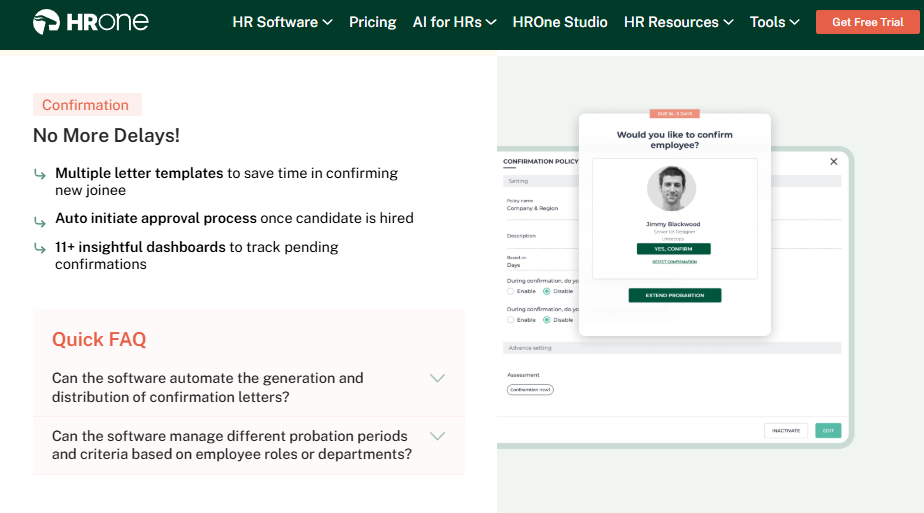
HROne ⭐⭐⭐⭐⭐ | India-first, mobile-native HCM built for 100 to 5,000 employee organisations running several legal entities.
🏢 Overview
HROne is a cloud HCM founded in 2016 under Uneecops Workplace Solutions, covering 127 hire-to-retire workflows on one platform. It is live with 1,500-plus brands and holds a 4.8 of 5 G2 rating across 2,074-plus verified reviews, ranked number one in India for customer satisfaction in G2’s 2026 awards.
Staffing teams reach for it when attendance, payroll, and recruitment currently live in three systems that do not talk. That reconciliation tax is the pain it removes.
⚙️ Core Services
- Core HR with multi-legal-entity setup creates separate client entities and organisation units inside one instance, so each client account carries its own policy set without a second subscription. This is the architecture examined in detail on HR software for multi-entity companies in India.
- Time Office syncs biometric punches in real time and supports geo-fencing, selfie attendance, and offline capture, which removes manual muster-roll entry for site-deployed workers.
- Payroll engine automates PF, ESI, TDS, and professional tax with configurable compliance logic, cutting month-end reconciliation errors on arrear and CTC-revision cycles.
- Super Inbox surfaces every pending task, request, and approval on one Gmail-style screen and closes them in three clicks, replacing tab-switching across five tools. The mechanic is documented on the HR inbox page.
- One AI Suite stacks the highest-relevance CVs on top with a scored reason, and parses expense receipts, so recruiters and finance stop doing manual sorting.
- Workforce module runs confirmation, transfer, separation, and digital letter acknowledgement, which is where contract renewals and exits usually leak.
- ROI Dashboard calculates lifetime hours saved against average HR salary, giving the CHRO a rupee figure to take into a board review.
🇮🇳 India-Specific Compliance & Localization
- PF / ESI / TDS support: Yes (automated calculation plus challan file generation)
- Labour law compliance: Strong (statutory registers, PT and LWF, wage-code aligned FFS)
- Payroll localization (India-specific): Yes (CTC revisions, arrears, FBP declarations)
- Multi-state compliance handling: Yes (state-wise rules per legal entity in one instance)
A reviewer running Indian payroll put the compliance point plainly, and it maps to what the module is built to do.
“Proper calculation of PF and ESI was a pain area for us before, but now with the HROne automated calculation process, results are up to the mark and following Indian tax compliances properly.”
– Ajay K., 5/5 HROne G2 – Verified Review
👥 Who This Is Built For
- Payroll Manager firefighting CTC-revision arrears across four client entities every month-end
- HR Ops lead manually reconciling biometric exports against a separate leave management portal for site-deployed contract staff
- CHRO who cannot answer, in a board review, how many days a confirmation letter takes to close
❌ Who Should Skip This
- Teams under roughly 50 employees, since the entry tier bills a flat band for 50 users regardless of actual headcount
- Agencies wanting only a sourcing and outreach tool, with payroll deliberately kept outside the system
The honest counterweight comes from a three-star reviewer, and it is worth reading before you sign.
“It can sometimes feel a bit overwhelming for new users. Certain features take time to understand, and without enough guided support, the learning curve can feel quite steep.”
– Nijanthan R., 3/5 HROne G2 – Verified Review
💰 Pricing Structure
- Plan Type(s): Basic, Professional, Enterprise, as published on the pricing page
- Starting Price: ₹4,950 per month covering 50 users, billed monthly, 50-user minimum
- Tier-wise Breakdown:
- Basic, ₹4,950 per month for 50 users, then ₹99 per additional user. Includes Core HR with multi-legal-entity, Time Office, Payroll, mobile app, reports, and dashboards.
- Professional, ₹6,500 per month for 50 users, then ₹130 per additional user. Adds Workforce (confirmation, transfer, separation) and digital letter acknowledgement.
- Enterprise, custom quote for 50-plus teams. Adds Recruitment, Performance, Engagement, Expense, Asset, and Helpdesk.
- Incremental Cost Drivers: Additional users beyond the 50-user band, and module upgrades between tiers. There is no charge for maintaining multiple legal entities in one instance.
- Implementation Fee: Not publicly disclosed, request a quote. Subscription meters only after go-live, with no lock-in.
- Cost at 200 Employees: ₹19,800 per month on Basic, ₹26,000 per month on Professional | Cost at 500 Employees: ₹49,500 per month on Basic, ₹65,000 per month on Professional
🛠️ Implementation & Support Reality
- Go-live in as little as 30 days for mid-market rollouts, driven by 127 pre-built workflows rather than custom build, a sequence broken down in the HRMS implementation timeline for India
- Support runs on phone plus email plus a dedicated onboarding SPOC who has previously worked in HR, not a technical project manager
- Data migration is vendor-led, with the delivery consultant configuring policies during the setup phase
- Reported 9.8 NPS on the dedicated SPOC support model
🎯 Karan’s Take
Working with 2,000-plus HR teams, what I have felt is that agencies buy the wrong thing first. HROne deliberately does not sell a standalone recruitment product, because the ROI only lands when leave, attendance, and payroll sit on the same base. I might be reading this too strongly, but every fragmented staffing stack I have seen ends the same way. Someone re-keys data at month-end, and nobody trusts the analytics that come out.
1.2 StaffingGo, the Agency-Only ERP With Contract Labour Compliance Welded In
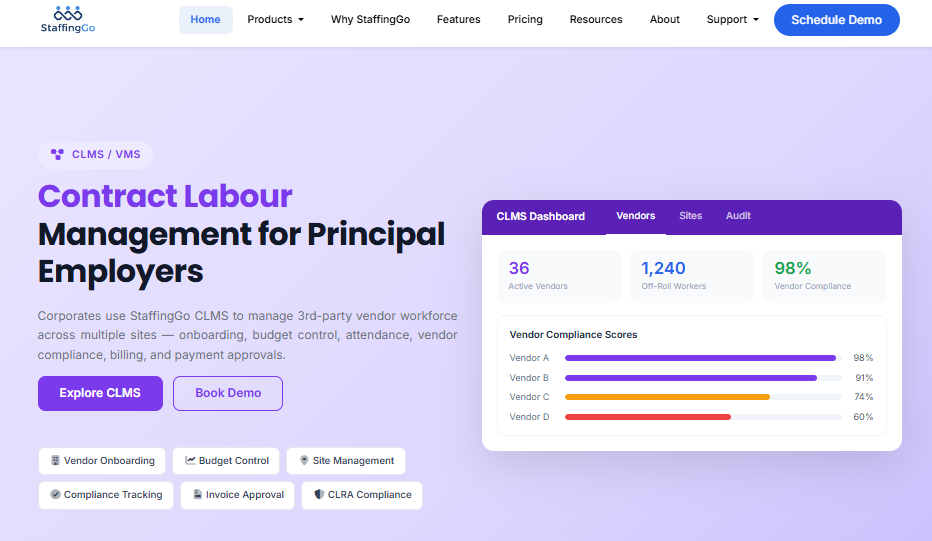
StaffingGo ⭐⭐⭐⭐ | Staffing ERP, CLMS, and HRMS built exclusively for Indian manpower and recruitment agencies.
🏢 Overview
StaffingGo positions itself as an ERP built only for staffing and manpower agencies in India, bundling client management, payroll, compliance, and billing. Unlike a general HRMS, its commercial model bills per active consultant, which matches how agency revenue actually behaves. Agencies reach for it when placement, deployment, and contractor compliance are three separate spreadsheets.
Its independent review footprint is thinner than the global ATS platforms, so reference checks matter more here.
⚙️ Core Services
- Staffing ERP links client management, requisitions, and deployment records, so a placement and its billing line stay attached instead of drifting apart.
- CLMS module manages contractor records and contract labour compliance, which is the register-keeping work most agency ATS tools push back onto HR.
- Payroll processes consultant salaries with statutory deductions, removing the separate outsourced-vendor handoff each month, a trade-off examined in payroll software versus outsourcing in India.
- Compliance tracking maintains statutory obligations across deployments, reducing the audit scramble when a principal employer asks for records.
- Billing and invoicing converts approved timesheets into client invoices, closing the gap where margin leaks between hours worked and hours billed.
🇮🇳 India-Specific Compliance & Localization
- PF / ESI / TDS support: Yes (statutory deductions inside agency payroll)
- Labour law compliance: Strong (CLMS built for contract labour obligations)
- Payroll localization (India-specific): Yes (built for the Indian staffing market)
- Multi-state compliance handling: Yes (multi-client, multi-location deployment model)
👥 Who This Is Built For
- Agency owner tracking margin per consultant across 40 client accounts in Excel
- Compliance coordinator assembling contractor registers by hand before a principal employer audit, the exact workload that statutory compliance software is meant to absorb
❌ Who Should Skip This
- Principal employers who need a full permanent-workforce HCM, since the product is built for the agency side
- Teams that want a large public review corpus to reference-check before signing
💰 Pricing Structure
- Plan Type(s): IT staffing, general staffing, and HRMS tiers, priced separately
- Starting Price: From ₹60 per consultant per month for IT staffing, billed on active headcount only
- Tier-wise Breakdown:
- IT staffing, from ₹60 per consultant per month, with bulk discounts above 500 consultants.
- General staffing, from ₹75 per consultant per month with volume discounts applied.
- HRMS tiers, ₹150 and ₹210 per employee per month.
- Incremental Cost Drivers: Final pricing depends on headcount and modules selected. Inactive records do not count toward billing.
- Implementation Fee: Not publicly disclosed, request a quote.
- Cost at 200 Employees: roughly ₹12,000 per month at the ₹60 IT staffing rate | Cost at 500 Employees: roughly ₹30,000 per month, before bulk discount
🛠️ Implementation & Support Reality
- Go-live timeline is not publicly published, so ask for two client references at your headcount
- Support and onboarding are vendor-led through a demo-gated process
- Data migration is vendor-led, with consultant records as the primary import
- No publicly reported NPS or CSAT figure
HROne sits at position one on this list for one structural reason. Core HR with multi-legal-entity configuration, Time Office, and Payroll all ship inside the ₹4,950 Basic tier, so an agency adds client entities without adding subscriptions. Billing starts at go-live, not at signature, and the savings can be modelled on the ROI calculator before a single rupee is committed.
1.3 BiOKnox, Combined HRMS and CLMS for Site-Based Contract Workmen
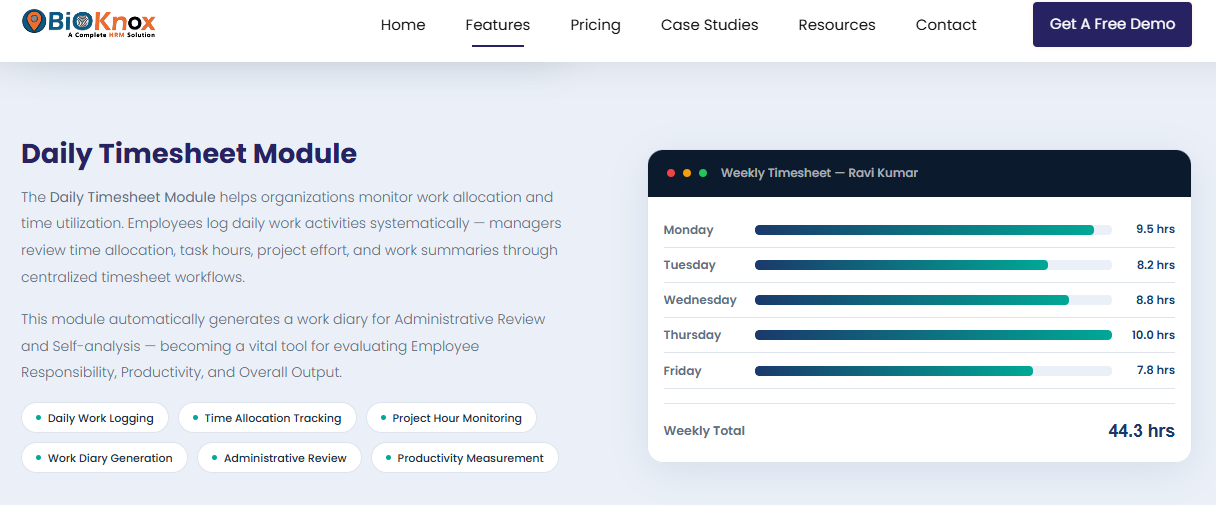
BiOKnox ⭐⭐⭐⭐ | Contract Labour Management System built for principal employers running multiple project sites.
🏢 Overview
BiOKnox positions itself as India’s combined HRMS and CLMS platform, automating attendance, payroll, leave, and contract labour for over 1 lakh workmen. It publicly names L&T and Tata Projects among 250-plus sites using the system. Teams reach for it when contractor registers, vendor records, and biometric logs sit in three different places before an audit.
It is a principal-employer tool first, not an agency placement engine.
⚙️ Core Services
- Vendor management onboards contractors with document validity tracking, so expired licences surface before an inspector finds them.
- Workman KYC and biometric enrolment captures identity and face or finger data at the gate, removing paper muster rolls at site level, which is the same problem solved by modern attendance management systems.
- Contract labour payroll processes wages contractor-wise with PF, ESI, PT, and LWF deductions, cutting manual wage-sheet preparation.
- Statutory compliance engine maintains CLRA registers and returns, which is the exact evidence a Section 21 wage dispute demands.
- Site-wise visibility reports headcount and attendance per location, so a project manager stops calling supervisors for daily numbers.
🇮🇳 India-Specific Compliance & Localization
- PF / ESI / TDS support: Yes (contractor-wise statutory deductions)
- Labour law compliance: Strong (CLRA registers and returns as core scope)
- Payroll localization (India-specific): Yes (built for Indian contract labour)
- Multi-state compliance handling: Yes (multi-site, multi-state deployments)
👥 Who This Is Built For
- Compliance coordinator assembling contractor registers by hand before a principal employer audit
- Project HR lead reconciling gate biometric logs against contractor wage sheets every month, a workload that manufacturing HR teams carry across every plant
❌ Who Should Skip This
- Staffing agencies needing sourcing, candidate pipelines, and client billing on the agency side
- White-collar HR teams wanting performance, engagement, and appraisal workflows
💰 Pricing Structure
- Plan Type(s): Not publicly published as named tiers
- Starting Price: Not publicly disclosed, request a quote
- Tier-wise Breakdown: Not publicly disclosed, request a quote
- Incremental Cost Drivers: Ask specifically about per-site and per-contractor charges
- Implementation Fee: Not publicly disclosed, request a quote
- Cost at 200 Employees: Not publicly disclosed | Cost at 500 Employees: Not publicly disclosed
🛠️ Implementation & Support Reality
- Go-live timeline is not published, so ask for a reference at your site count
- Support and onboarding run vendor-led through a demo process
- Data migration is vendor-led, with contractor and workman masters as the first import
- No publicly reported NPS or CSAT figure
1.4 Ceipal, AI Sourcing Depth for High-Volume Contract Placements
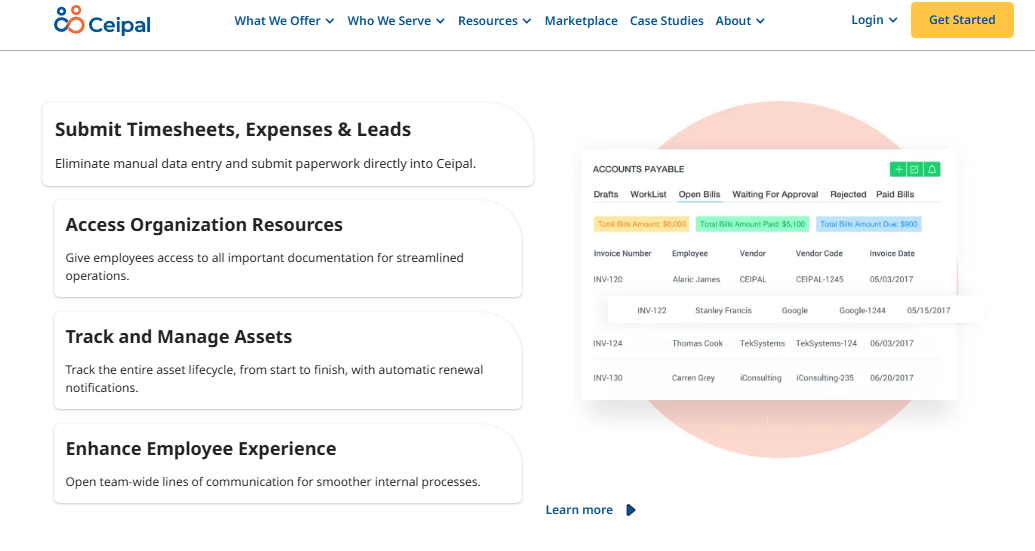
Ceipal ⭐⭐⭐⭐ | Staffing-first ATS and CRM for recruiters filling IT bench and contract roles at volume.
🏢 Overview
Ceipal provides an integrated applicant tracking system and candidate relationship management platform built for staffing and recruiting firms. On Capterra’s India staffing directory, it carries a 4.6 out of 5 rating across 1,261 reviews, one of the largest review bases in the category. Recruiters use it when requisition volume outpaces manual screening.
Its strength sits on the placement side, not the statutory payroll side.
⚙️ Core Services
- ATS with AI matching ranks and shortlists applicants automatically, cutting the manual screening hours on high-requisition roles, the same principle behind current AI recruiting software.
- Recruitment CRM tracks client and candidate relationships in one record, so business development stops living in inboxes.
- VMS integration ingests requisitions from vendor management systems, removing repeat data entry for enterprise client portals.
- Workforce Management module handles timesheets and onboarding at $4 per user per month, converting approved hours into billing inputs.
- Advanced Automation Bundle layers sourcing and outreach automation on top of the core ATS.
🇮🇳 India-Specific Compliance & Localization
- PF / ESI / TDS support: No (no India statutory payroll engine)
- Labour law compliance: Limited (CLRA registers stay outside the system)
- Payroll localization (India-specific): No (US-headquartered, global product)
- Multi-state compliance handling: No (India PT and LWF need a second system)
👥 Who This Is Built For
- Recruiter screening 300 CVs a week for IT contract roles without an AI shortlist
- Bench sales lead tracking consultant availability across several client requisitions, a pattern common across ITES HR operations
❌ Who Should Skip This
- Payroll managers who need PF, ESI, and TDS handled inside the same platform
- Principal employers whose core need is contractor compliance, not sourcing
💰 Pricing Structure
- Plan Type(s): Ceipal ATS, Advanced Automation Bundle, Ceipal Workforce Management
- Starting Price: $24 per user per month for Ceipal ATS, with a five-person minimum
- Tier-wise Breakdown:
- Ceipal ATS, $24 per user per month, five-user minimum.
- Advanced Automation Bundle, $48 per user per month.
- Ceipal Workforce Management, $4 per user per month.
- Incremental Cost Drivers: Bundle upgrades and the five-seat floor on the entry tier
- Implementation Fee: Not publicly disclosed, request a quote
- Cost at 200 Employees: Billed per recruiter seat, not per placed worker, so five ATS seats run $120 per month | Cost at 500 Employees: Unchanged by worker headcount, seat count drives the bill
🛠️ Implementation & Support Reality
- Go-live timeline is not published for the India market
- Support runs on email plus chat, with account management on higher bundles
- Data migration is self-serve with vendor assistance on request
- No publicly reported NPS figure
1.5 Zoho Recruit, Low-Cost ATS for Agencies Already Inside the Zoho Suite
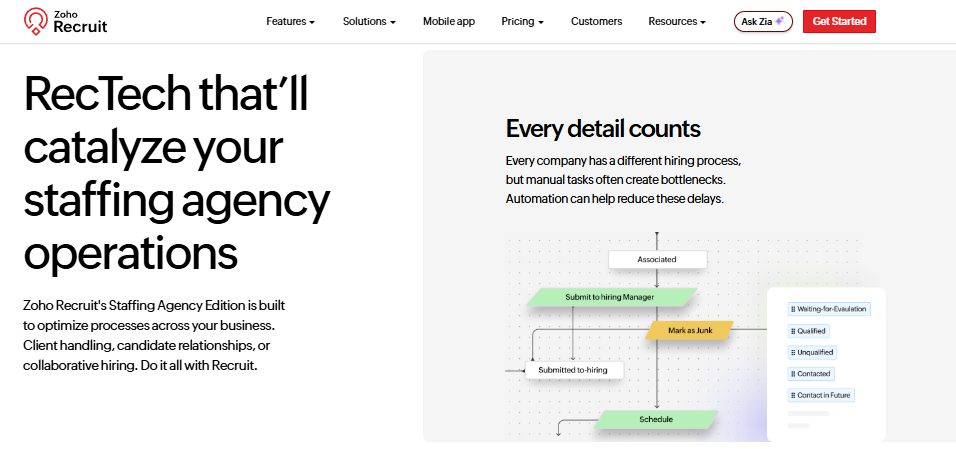
Zoho Recruit ⭐⭐⭐ | Budget applicant tracking with Naukri and LinkedIn integrations for small Indian agencies.
🏢 Overview
Zoho Recruit is the recruitment product inside the wider Zoho suite, sold per recruiter rather than per employee. Indian partner listings place Standard near ₹1,680 and Enterprise near ₹2,800 per recruiter per month on annual billing. It suits small agencies that already run Zoho CRM and want pipeline tracking without a new vendor relationship.
Payroll and statutory registers live in separate Zoho products.
⚙️ Core Services
- Resume parsing extracts candidate fields automatically, removing manual data entry on bulk CV uploads.
- Job board integrations post to Naukri, LinkedIn, and Indeed from one screen, cutting duplicate posting effort.
- Pipeline automation moves candidates through stages on trigger rules, so recruiters stop updating statuses by hand.
- Candidate scoring ranks applicants against role criteria to shorten the shortlist step.
- Vendor management and candidate portal open on the Enterprise tier for agency-side workflows.
🇮🇳 India-Specific Compliance & Localization
- PF / ESI / TDS support: No (payroll sits in a separate Zoho product)
- Labour law compliance: Limited (no CLRA register module)
- Payroll localization (India-specific): No (global product, India partner pricing)
- Multi-state compliance handling: No (not in scope for an ATS)
👥 Who This Is Built For
- Two-recruiter agency posting to Naukri manually and tracking candidates in a spreadsheet
- Ops lead already standardised on Zoho CRM who wants hiring in the same login
❌ Who Should Skip This
- Agencies needing contract labour compliance and statutory payroll in one platform, where a full recruitment management system tied to payroll matters more than seat price
- Teams deploying site-based workmen who need biometric attendance and muster rolls
💰 Pricing Structure
- Plan Type(s): Free, Standard, Professional, Enterprise
- Starting Price: Free for one recruiter, then about ₹1,250 to ₹1,680 per recruiter per month on annual billing
- Tier-wise Breakdown:
- Free, one recruiter, one active job, basic parsing.
- Standard, about ₹1,250 to ₹1,680 per recruiter per month, 10 active jobs, advanced parsing, and job board integrations.
- Professional, about ₹2,500 per recruiter per month on India listings.
- Enterprise, about ₹2,800 to ₹3,750 per recruiter per month, adds AI matching, vendor management, and API access.
- Incremental Cost Drivers: Monthly billing runs roughly 20% higher than annual, and 18% GST applies
- Implementation Fee: Partner implementation packages are charged as one-time setup fees, quoted separately
- Cost at 200 Employees: Billed per recruiter, so five recruiters on Standard run about ₹8,400 per month | Cost at 500 Employees: Unchanged by worker headcount, recruiter seats drive the bill
🛠️ Implementation & Support Reality
- Setup is largely self-serve, with partner-led packages available in India
- Support runs on email plus ticket, with priority tiers on higher plans
- Data migration is self-serve through CSV import
- No publicly reported NPS figure
1.6 Keka, a Polished Mid-Market HRMS With a Contract-Labour Gap
Keka ⭐⭐⭐ | Mid-market Indian HRMS with strong self-service and flat 100-employee pricing bands.
🏢 Overview
Keka is an Indian HRMS covering Core HR, leave, attendance, payroll, and performance, sold in flat bands for the first 100 employees. Foundation sits at ₹9,999 per month, Strength at ₹12,999, and Growth at ₹15,999. Mid-market HR teams pick it for employee experience and self-service adoption.
There is no publicly documented CLRA register or Form V module.
⚙️ Core Services
- Core HR and org structure holds a single employee record, replacing scattered joining files.
- Attendance and leave automates capture and approval, with self clock-in on higher tiers.
- Payroll automates PF, ESI, and TDS with statutory payslips, which reviewers rate as a strength.
- Performance and OKRs open on Strength, moving appraisals out of spreadsheets.
- Workflow automation and helpdesk arrive on Growth, routing employee queries instead of email chains.
🇮🇳 India-Specific Compliance & Localization
- PF / ESI / TDS support: Yes (automated statutory payroll and payslips)
- Labour law compliance: Moderate (statutory payroll yes, contract labour registers not documented)
- Payroll localization (India-specific): Yes (India-built HRMS)
- Multi-state compliance handling: Partial (multi-entity is treated as an add-on)
👥 Who This Is Built For
- HR generalist at a single-entity firm wanting employee self-service adoption without heavy training
- Payroll manager processing a permanent white-collar payroll under 500 heads
❌ Who Should Skip This
- Staffing agencies needing contractor registers, Form V records, and per-client entity isolation, which is where a HROne vs Keka comparison usually turns
- Teams under 25 employees, since a minimum floor applies before the flat band makes sense
Two reviewers give a fair picture, one on the payroll strength and one on the reporting gaps.
“Strong payroll and compliance automate salary and attendance processing with pf/esi tds. payslip statutory compliance. Responsive support team.”
– Kiran B., 3/5 Keka G2 – Verified Review
“The payroll reports doesn’t give accurate figure in Total CTC, you need to add PF amount to get the right figure.”
– Pooja M., 2/5 Keka G2 – Verified Review
💰 Pricing Structure
- Plan Type(s): Foundation, Strength, Growth
- Starting Price: ₹9,999 per month covering the first 100 employees, billed annually
- Tier-wise Breakdown:
- Foundation, ₹9,999 per month for 100 employees, then ₹90 per extra head. Core HR, leave, attendance, and basic payroll.
- Strength, ₹12,999 per month for 100 employees, then ₹120 per extra head. Adds performance, OKRs, and hiring.
- Growth, ₹15,999 per month for 100 employees, then ₹150 per extra head. Adds analytics, helpdesk, and expense.
- Incremental Cost Drivers: Multi-entity, deeper API, and LMS sit outside Growth as add-ons
- Implementation Fee: Yes, a setup fee applies, quoted separately
- Cost at 200 Employees: ₹18,999 per month on Foundation, effective ₹94 per employee at 250 heads | Cost at 500 Employees: ₹45,999 per month on Foundation, effective ₹92 per employee
🛠️ Implementation & Support Reality
- Reviewers report long setup phases, with one describing six months of unresolved policy configuration
- Support is email-led, and one reviewer reports escalation gaps during implementation
- Data migration is vendor-led during the setup phase
- No publicly reported NPS figure
1.7 greytHR, Deep SMB Payroll Compliance With a Thin Contract-Deployment Layer
greytHR ⭐⭐⭐ | Long-standing India payroll and compliance platform for SMB and lower mid-market teams.
🏢 Overview
greytHR is one of India’s most widely deployed HR and payroll platforms, with published pricing at ₹2,495 and ₹4,495 per month for the first 50 employees. A free Starter tier covers teams of 25 or fewer. Payroll managers choose it for statutory routine work, specifically PF, ESI, and TDS filing cycles.
Contract deployment and site attendance are not its centre of gravity.
⚙️ Core Services
- Payroll processing runs statutory calculations and payslips, removing spreadsheet formulas at month-end.
- Statutory compliance covers PF, ESI, PT, and TDS filing support, cutting the scramble before due dates, the ground covered in this PF, ESI, and TDS compliance guide for employers.
- Leave and attendance capture requests and approvals with employee self-service, reducing HR mailbox traffic.
- Employee self-service portal lets staff declare taxes and pick a tax regime themselves, which removes a manual collection round.
- Add-on modules cover performance management at extra cost, so the base plan stays payroll-centric.
🇮🇳 India-Specific Compliance & Localization
- PF / ESI / TDS support: Yes (long-established statutory payroll depth)
- Labour law compliance: Moderate (strong on payroll statutes, thin on CLRA deployment)
- Payroll localization (India-specific): Yes (India-first product)
- Multi-state compliance handling: Partial (multi-entity sits on the custom Premium quote)
👥 Who This Is Built For
- Payroll manager at a 120-person single-entity firm filing PF, ESI, and TDS monthly
- Finance lead who wants employees declaring their own taxes instead of emailing proofs
❌ Who Should Skip This
- Staffing agencies running shift-based deployments across several client legal entities, a scenario where a HROne vs greytHR evaluation gets decided on architecture
- Teams needing recruitment and contractor billing inside the same platform
A verified reviewer names the interface and configuration limits directly.
“The UI is not very appealing and looks like an outdated legacy system. If it has the ability to customize the UI it would be really great.”
– Naveen k., 2.5/5 greytHR G2 – Verified Review
💰 Pricing Structure
- Plan Type(s): Starter, Essential, Growth, Premium
- Starting Price: Free up to 25 employees, then ₹2,495 per month covering 50 employees
- Tier-wise Breakdown:
- Starter, free for 25 or fewer employees, Core HR and basic leave and attendance.
- Essential, ₹2,495 per month for 50 employees, then ₹45 per additional employee.
- Growth, ₹4,495 per month for 50 employees, then ₹85 per additional employee.
- Premium, custom quote, positioned for 500-plus and multi-entity setups.
- Incremental Cost Drivers: Performance management and other modules are priced as add-ons
- Implementation Fee: Not publicly disclosed, request a quote
- Cost at 200 Employees: ₹9,245 per month on Essential, ₹17,245 on Growth | Cost at 500 Employees: ₹22,745 per month on Essential, ₹42,745 on Growth
🛠️ Implementation & Support Reality
- Go-live is fast on the payroll-only scope, longer once attendance devices enter the picture
- Support runs on email plus ticket, with a self-service help centre
- Data migration is largely self-serve through templates
- No publicly reported NPS figure
1.8 Bullhorn, Enterprise Contract-to-Cash for Global Staffing Firms
Bullhorn ⭐⭐⭐⭐ | Enterprise ATS and recruitment CRM with timesheet-to-invoice depth for large agencies.
🏢 Overview
Bullhorn is a global staffing platform combining applicant tracking with a recruitment CRM, publishing Starter at $99 and Core at $165 per user per month. Larger tiers including Bullhorn One stay quote-only. Agencies with mature contract-to-cash operations use it to connect placement, timesheet, and invoice in one chain.
India statutory payroll is not part of the published scope.
⚙️ Core Services
- Applicant tracking with resume parsing builds candidate records automatically, removing manual profile creation.
- Recruitment CRM runs the sales pipeline alongside the candidate pipeline, so business development stops sitting in spreadsheets.
- Job posting and career portal publishes roles and captures applications directly into the ATS.
- Partner marketplace with 300-plus integrations connects payroll and back-office tools rather than shipping them natively, which is the opposite of native integrations inside one platform.
- AI search, match, and automation open on Pro, shortening sourcing cycles on high-volume desks.
🇮🇳 India-Specific Compliance & Localization
- PF / ESI / TDS support: No (handled by an integrated third-party payroll)
- Labour law compliance: Limited (no CLRA register module)
- Payroll localization (India-specific): No (global product, USD pricing)
- Multi-state compliance handling: No (India statutory work sits outside)
👥 Who This Is Built For
- Agency operations head connecting approved timesheets to client invoices without re-keying
- Recruitment director running several desks who needs pipeline and sales data in one system
❌ Who Should Skip This
- India-only agencies whose primary pain is PF, ESI, and contractor register compliance
- Small teams that cannot absorb USD per-seat pricing plus a separate payroll vendor
💰 Pricing Structure
- Plan Type(s): Starter, Core, Pro, Max, plus quote-only enterprise editions
- Starting Price: $99 per user per month on Starter
- Tier-wise Breakdown:
- Starter, $99 per user per month. ATS, resume parsing, client management, job posting, and free implementation.
- Core, $165 per user per month with a three-user minimum. Adds the partner marketplace, custom fields and workflows, and LinkedIn integrations.
- Pro and Max, quote-only. Add recruitment CRM, AI search and match, automation, analytics, and a dedicated account manager.
- Incremental Cost Drivers: Marketplace add-ons, AI modules, and multi-year contract terms
- Implementation Fee: Free implementation is published on Starter
- Cost at 200 Employees: Billed per recruiter seat, so three Core seats run $495 per month | Cost at 500 Employees: Unchanged by worker headcount, seat count drives the bill
🛠️ Implementation & Support Reality
- Implementation is included on Starter, and account-managed on higher tiers
- Support runs through expert support on entry plans and a dedicated account manager on Pro
- Data migration is vendor-led or partner-led depending on tier
- No publicly reported NPS figure
1.9 Eilisys Ascent, Contractor Governance for Enterprise Principal Employers
Eilisys Ascent ⭐⭐⭐ | Contract workforce management for enterprises tracking contractors, compliance, and billing.
🏢 Overview
Ascent Contract Workforce Management helps enterprises manage contract workers, contractor records, attendance, compliance, billing, and site visibility in one structured system. It is scoped for the principal employer side of the relationship rather than agency placement. Enterprises adopt it when contractor data lives across email, Excel, and vendor portals.
There is no recruitment engine in the published scope.
⚙️ Core Services
- Contractor records centralise contracts, licences, and validity dates, so lapses surface before an inspection.
- Attendance capture logs contract worker hours per site, replacing supervisor-maintained registers.
- Compliance tracking maintains statutory obligations across contractors, which is the evidence trail Section 21 disputes need, and the reason labour law compliance software exists as a category.
- Billing converts verified contractor attendance into payable amounts, closing the gap where invoice disputes start.
- Site visibility reports headcount and activity per location for project and plant managers.
🇮🇳 India-Specific Compliance & Localization
- PF / ESI / TDS support: Partial (contractor compliance focus, verify payroll scope)
- Labour law compliance: Strong (contract labour governance is the core product)
- Payroll localization (India-specific): Yes (built for Indian enterprise compliance)
- Multi-state compliance handling: Yes (multi-site enterprise deployments)
👥 Who This Is Built For
- Plant HR lead governing 30 contractors across three units with no single record
- Finance controller disputing contractor invoices against unverified attendance data
❌ Who Should Skip This
- Staffing agencies needing sourcing, candidate pipelines, and client relationship management
- Organisations wanting one platform for both permanent lifecycle and contract governance, which is the remit of a full core HCM
💰 Pricing Structure
- Plan Type(s): Not publicly published as named tiers
- Starting Price: Not publicly disclosed, request a quote
- Tier-wise Breakdown: Not publicly disclosed, request a quote
- Incremental Cost Drivers: Ask about per-site, per-contractor, and module charges
- Implementation Fee: Not publicly disclosed, request a quote
- Cost at 200 Employees: Not publicly disclosed | Cost at 500 Employees: Not publicly disclosed
🛠️ Implementation & Support Reality
- Go-live timeline is not published, so request a reference at your contractor count
- Support and onboarding are vendor-led
- Data migration is vendor-led, starting with contractor masters
- No publicly reported NPS figure
1.10 Recruiterflow, Outreach Automation for Boutique Recruiting Desks
Recruiterflow ⭐⭐⭐ | Agency ATS and CRM built around sequences and sourcing velocity for small teams.
🏢 Overview
Recruiterflow sells a single Platform Plan at $149 per user per month billed monthly, or $119 per user on an annual commitment. The plan covers ATS and CRM, multichannel sequences, automation, and API access, while AI agents sit on a custom-quoted plan. Boutique agencies use it when outreach volume, not compliance, is the bottleneck.
USD per-seat pricing is the main constraint for Indian agencies.
⚙️ Core Services
- ATS and CRM hold candidates, clients, and jobs in one record, removing duplicate pipeline tracking.
- Multichannel sequences automate email and outreach follow-ups, cutting manual chase work on passive candidates.
- Recruiting automation recipes trigger stage moves and tasks on rules, so nothing waits on a recruiter remembering.
- Chrome sourcing extension captures profiles in bulk from browser tabs into the ATS.
- Client portal and access controls share shortlists with clients without email attachments.
🇮🇳 India-Specific Compliance & Localization
- PF / ESI / TDS support: No (no payroll engine)
- Labour law compliance: Limited (no CLRA or statutory register scope)
- Payroll localization (India-specific): No (USD-priced global product)
- Multi-state compliance handling: No (out of scope for a sourcing ATS)
👥 Who This Is Built For
- Boutique agency founder running outreach sequences manually across two inboxes
- Recruiter who needs client-facing shortlists without emailing spreadsheets
❌ Who Should Skip This
- Agencies deploying contract or blue-collar workers who need attendance and statutory payroll
- Teams working to an INR budget where USD per-seat rates compound quickly, since published HR software pricing benchmarks land far lower in rupee terms
💰 Pricing Structure
- Plan Type(s): Platform Plan, plus a custom-quoted AIRA plan
- Starting Price: $149 per user per month billed monthly, $119 per user on annual commitment
- Tier-wise Breakdown:
- Platform Plan, $149 monthly or $119 annual per user. ATS and CRM, sequences, automation, Chrome sourcing, reports, and API access.
- AIRA Plan, custom quote. Adds AI recruiting agents and advanced matching.
- Incremental Cost Drivers: AI agents move you to the custom plan, and seat count drives total spend
- Implementation Fee: Not publicly disclosed, request a quote
- Cost at 200 Employees: Billed per recruiter seat, so three seats run $357 per month at the $119 annual rate | Cost at 500 Employees: Unchanged by worker headcount, seat count drives the bill
🛠️ Implementation & Support Reality
- Setup is largely self-serve, with onboarding support included
- Support runs on email plus chat
- Data migration is self-serve with import assistance
- Dedicated success manager appears on higher-tier arrangements
🎯 Sector-Wise Shortlist
| Sector reality | Shortlist first | Why |
|---|---|---|
| BPO and 24/7 continuous operations | HROne, BiOKnox | Auto shift rotation plus real-time biometric sync feeding payroll |
| IT and ITeS bench deployment | Ceipal, HROne | AI matching for bench sales, then statutory payroll on the same base |
| BFSI and multi-entity client accounts | HROne, greytHR Premium | Multi-legal-entity policy variation with state-wise statutory rules |
| Manufacturing and site-based contract labour | BiOKnox, Eilisys Ascent, HROne | CLRA registers, contractor billing, and gate-level attendance |
| Boutique agency, placement-led only | Recruiterflow, Zoho Recruit | Outreach velocity at low seat cost, payroll deliberately outside |
🎯 Karan’s Take
Working with 2,000-plus HR teams, what I have felt is that the seat-priced tools look cheapest on the quote and cost the most by March. HROne’s read is that the standard advice gets this backwards, because the real bill is the reconciliation hours, not the licence. I might be reading this too strongly. Still, every agency I have watched outgrow a sourcing-only ATS ended up paying for a second system within a year.
HROne closes this list at position one on one measurable point. Core HR with multi-legal-entity configuration, Time Office, and Payroll all ship inside the ₹4,950 Basic tier, so client entities are added without new subscriptions. Asia Healthcare Holdings runs 20 pan-India units on a single instance on that model.
Q2. How Did We Score and Rank These Platforms?
Each platform scored out of 100 across five weighted criteria: Contract Workforce Compliance Depth (30%), Unified Recruit-to-Payroll Architecture (25%), High-Volume Onboarding and Shift Automation (20%), Multi-Entity Client Isolation (15%), and Pricing Transparency and Support SLA (10%). Scores of 0 to 20 earn one star, 21 to 40 two, 41 to 60 three, 61 to 80 four, and 81 to 100 five.
⚖️ Why Compliance Carries the Heaviest Weight
Compliance depth takes 30% because the money risk is not shared. Under Section 21 of the CLRA, if a contractor short-pays wages, the principal employer pays in full and recovers it as a debt. Under the OSH Code, contractor fault is not a defence.
So a platform that tracks placements beautifully but cannot evidence wage disbursement leaves the biggest liability uncovered. That is a scoring decision, not a feature preference.
📏 What Each Criterion Actually Tested
- Contract Workforce Compliance Depth (30%): CLRA registers XIII to XXIV, Form I and Form V records, contractor-wise EPF Section 8A and ESI files, and state-wise PT and LWF, the ground covered by dedicated statutory compliance software.
- Unified Recruit-to-Payroll Architecture (25%): whether sourcing, attendance, and payroll write to one database or need manual month-end reconciliation.
- High-Volume Onboarding and Shift Automation (20%): bulk joins, resume parsing with relevancy scoring, auto shift rotation, and site attendance capture.
- Multi-Entity Client Isolation (15%): entities per instance, per-entity charges, and access rights filtered to entity and business unit.
- Pricing Transparency and Support SLA (10%): published INR or USD figures, when billing starts, and whether support runs on phone plus a named SPOC or only email.
📊 The Scores
| Platform | Compliance /30 | Architecture /25 | Onboarding /20 | Multi-entity /15 | Pricing and support /10 | Total | Stars |
|---|---|---|---|---|---|---|---|
| HROne | 27 | 23 | 18 | 15 | 9 | 92 | ⭐⭐⭐⭐⭐ |
| StaffingGo | 25 | 20 | 14 | 10 | 8 | 77 | ⭐⭐⭐⭐ |
| BiOKnox | 27 | 14 | 16 | 11 | 6 | 74 | ⭐⭐⭐⭐ |
| Bullhorn | 7 | 20 | 18 | 12 | 6 | 63 | ⭐⭐⭐⭐ |
| Ceipal | 10 | 17 | 17 | 11 | 7 | 62 | ⭐⭐⭐⭐ |
| Eilisys Ascent | 24 | 9 | 13 | 9 | 5 | 60 | ⭐⭐⭐ |
| Keka | 15 | 18 | 13 | 7 | 6 | 59 | ⭐⭐⭐ |
| greytHR | 18 | 16 | 11 | 7 | 7 | 59 | ⭐⭐⭐ |
| Zoho Recruit | 6 | 10 | 12 | 8 | 9 | 45 | ⭐⭐⭐ |
| Recruiterflow | 5 | 10 | 13 | 8 | 9 | 45 | ⭐⭐⭐ |
HROne measures the support criterion against a published 9.8 NPS on its dedicated SPOC model, and billing that meters only after go-live.
⚠️ Where This Rubric Could Be Wrong
Two vendors publish no pricing at all, so BiOKnox and Eilisys Ascent lost points on transparency rather than on capability. That may understate them. Reference-checking a live client at your headcount is the honest correction, and the HRMS evaluation checklist for India sets out how to run that check.
Review recency also matters more than star averages. Capterra shows CEIPAL at 4.6 out of 5 across 1,261 reviews, a base large enough to trust the pattern.
💬 What Buyers Report on Setup
The support and implementation weight came from reading complaint patterns, not vendor decks.
“The initial setup was straightforward and simple, and I didn’t require training to use it from the first day.”
– Prajwal B., 5/5 HROne G2 – Verified Review
“We started working with Keka HRMS in August, and to this day, we have been unable to implement the tool in our company due to their consistently delayed responses and poor coordination between their internal teams.”
– Divya p., 0/5 Keka G2 – Verified Review
🎯 Karan’s Take
Working with 2,000-plus HR teams, what I have felt is that the cheapest-per-seat tool wins the quote and loses the year. HROne’s read is that platforms surviving on budget-tier deals cut corners somewhere, and it usually shows in the compliance engine and support depth. I might be weighting support too heavily. Then again, nobody has ever thanked me for a cheap licence during a payroll crisis.
HROne scores 92 on this rubric. Unlimited legal entities at no extra charge, a 9.8 NPS dedicated SPOC, and billing that starts at go-live rather than signature carried the last three criteria, as set out on the pricing page.
Q3. ATS, HRMS or CLMS, Which Category Does Your Staffing Operation Actually Need?
An ATS places candidates. A CLMS manages contractor vendors, workman KYC, site attendance, and CLRA registers for a principal employer. An HRMS runs the employment lifecycle and payroll. Staffing agencies need an ATS welded to payroll. Principal employers need CLMS plus HRMS. Buying one in isolation is what creates the month-end reconciliation crisis.
🔤 Three Categories in Plain English
An ATS (Applicant Tracking System) is a pipeline tool. It holds candidates, jobs, and clients, and it stops when someone is placed.
A CLMS (Contract Labour Management System) starts where the ATS stops. It registers contractors, enrols workmen, captures site attendance, and keeps the statutory registers a labour inspector asks for.
🧭 Which One You Buy Depends on Which Side You Sit
| You are | Your primary pain | Category to buy | Fits from this list |
|---|---|---|---|
| Staffing agency, placement-led | Pipeline speed and outreach | ATS | Recruiterflow, Zoho Recruit |
| Staffing agency, contract-deployment-led | Placement plus wages plus billing | ATS welded to payroll | HROne, StaffingGo, Ceipal |
| Principal employer, site-based labour | Contractor registers and gate attendance | CLMS plus HRMS | BiOKnox, Eilisys Ascent, HROne |
| Enterprise agency, global contract-to-cash | Timesheet to invoice at scale | Enterprise ATS plus local payroll | Bullhorn plus an India payroll |
StaffingGo bundles contract-to-cash, CLMS, and HRMS in one product for agencies. BiOKnox runs the combined HRMS and CLMS model across 250-plus sites for principal employers.
🧨 What Buying One Slice Actually Costs
Here is the pattern I keep seeing. Attendance comes from a biometric portal, payroll from an outsourced vendor, and recruitment from a disconnected ATS. None of the three talk, so someone re-keys records every month-end.
The ops lead then chases people for updates. Nobody trusts the analytics that come out, because the inputs were assembled by hand, which is exactly the failure mode described in HR software versus Excel in India.
🩹 What Changes After Consolidation
HROne consolidated one customer’s three disconnected attendance, payroll, and recruitment sources onto a single instance covering 127 hire-to-retire workflows. Administrative occupancy sat at 150% before that. It came down by roughly 70%, and the team got that time back for placement strategy.
Academic work supports the segmentation point too. Duggan and colleagues argue that gig and contract work needs classification by variant, because HR obligations differ across them. Site-based CLRA labour is not the same buy as a deployed IT contractor.
🪂 Sequence Modules, Do Not Buy Them All
The Parachute Principle applies here. Turn on core database, time office, and payroll first, because that is where wage liability lives, and a full core HCM lets the rest wait.
Recruitment, performance, and expense can wait until placement volume justifies them. Paying for nine modules while using three is just a slower version of the same waste.
💬 What Buyers Say About Depth Versus Breadth
“Real time sync of biometric and mobile mark punch functionality available. Salary processing to last creation of bank Challan files is quick and systematic process with error free details.”
– Deepak K., 5/5 HROne G2 – Verified Review
“Features are shallow and there is no depth in each application.”
– Verified User in Information Technology and Services, 2.5/5 Zoho People G2 – Verified Review
🎯 Karan’s Take
I might be reading this too strongly, but the category question decides more than the vendor question. What surfaces in HROne’s deployments is that agencies almost always buy the sourcing tool first, then buy payroll twelve months later. Two implementations, two migrations, two contracts. Deciding the category properly on day one is the cheaper path.
HROne sits in the middle column of that decision table by design. Core HR with multi-legal-entity setup, Time Office, and Payroll ship together in the ₹4,950 Basic tier, so the recruitment software layer is added later without a second platform.
Q4. What Must Your HR Software Do to Stay CLRA and Code on Wages Compliant for Contract Workers?
Your system must generate CLRA Form I and Form V records, maintain registers XIII to XXIV contractor-wise, evidence wage disbursement under Section 21, hold EPF Section 8A and ESI files per contractor, and enforce the Code on Wages timeline. That means payment by the 7th of the following month, with full and final settlement within two working days.
📋 When the Rules Switch On
The CLRA (Contract Labour Regulation and Abolition Act, 1970) applies to a principal employer engaging 20 or more contract workmen. Registration happens through Form I, and the contractor needs a licence backed by your Form V.
State variation is the part software usually misses. Professional Tax and Labour Welfare Fund rules differ by state, so one national rule set will not hold, which is why multi-state payroll compliance is treated as its own discipline.
🔒 The Liability You Cannot Contract Away
Section 21 of the CLRA is the provision that matters most. If the contractor fails to pay wages, the principal employer pays the full amount and recovers it as a debt.
The Labour Codes did not soften this. Parallel, non-delegable obligations now sit on both the contractor and the principal employer, and contractor fault is not a defence, a shift that labour law compliance software now has to absorb.
💰 What the Code on Wages Changed
Three dates now drive your payroll calendar. Wages must be paid on or before the 7th of the following month, exclusions from the wage definition are capped at 50% of remuneration, and full and final settlement is due within two working days of exit.
The Ministry of Labour and Employment’s 2026 Compliance Handbook is the document to map your software against, obligation by obligation.
📊 The Statutory Coverage Scorecard
| Provision | What the software must do | Publicly covered by |
|---|---|---|
| CLRA s.7 and s.12 (Form I, Form V, licences) | Generate and store registration and licence records with validity alerts | BiOKnox, Eilisys Ascent, StaffingGo |
| CLRA registers XIII to XXIV | Maintain registers contractor-wise, exportable on demand | BiOKnox, Eilisys Ascent, StaffingGo |
| CLRA s.21 (wage verification) | Hold disbursement evidence before releasing contractor payment | BiOKnox, Eilisys Ascent, HROne |
| EPF s.8A and ESI (contractor-wise) | Separate social security files per contractor, not per site | HROne, StaffingGo, greytHR |
| Code on Wages (7th-of-month, 50% cap, 2-day FFS) | Payroll calendar locks plus automated FFS workflow | HROne, greytHR, Keka |
| PT and LWF (state-wise) | State rules configured per legal entity in one instance | HROne, greytHR |
| OSH Code s.23, s.24, s.55 (welfare, absolute liability) | Contractor welfare and compliance file inside the system | BiOKnox, Eilisys Ascent |
Ceipal, Bullhorn, Zoho Recruit, and Recruiterflow publish no India statutory layer, so these rows stay with a second system.
⚙️ Why Uniform Configuration Breaks Contract Payroll
Most HR systems do not fail because they are unfair. They fail because they are too uniform.
A contract workforce needs conditional rules, not one standard policy. Junior grades may need two-level approval through manager then HOD, while senior grades self-approve. Client A’s PF rule may differ from Client B’s, which is the case examined in HR software for multi-entity companies in India.
🛠️ Two Things to Do This Week
- Ask every shortlisted vendor to demo a Section 21 wage-verification trail live. Contractor invoice approval should block until prior-cycle disbursement proof is uploaded.
- Move the contractor-wise social security and welfare file out of email threads and into the system. Auditors ask for a record, not a mailbox.
HROne runs client-specific statutory policies through a front-end policy engine, so an agency configures separate PF, ESI, PT, and LWF rules per client entity without an IT ticket or a per-entity surcharge, all inside one payroll software instance.
🎯 Karan’s Take
Working with 2,000-plus HR teams, what I have felt is that compliance failures are almost never legal failures. They are data failures. HROne’s read is that the register is only as good as the attendance management feed behind it, and that feed is where most staffing operations quietly break. I could be wrong about the sequencing. Still, I have never seen a clean register sitting on top of a messy muster roll.
Q5. How Do You Run 500 Weekly Contract Joins, Rotational Shifts and Exits Without Manual Reconciliation?
Route every join through one chain: AI resume parsing with a relevancy score, offer letter, then automatic CTC assignment that copies the salary structure straight from the offer on joining. Set auto-rotation for morning, evening, and night shifts, with mobile or geo-fenced attendance feeding payroll. On exit, a structured resignation workflow proposes the last working day and fires clearance tasks before full and final settlement.
📥 The Five-Stage Join Flow
Build the chain once, then stop touching it.
- Parse and score. Bulk-upload CVs and let the system stack them by relevancy, so a recruiter reads six profiles instead of 300.
- Shortlist on score, not keywords. Real output looks like 97%, 95%, 94%, 88%, 87%, and 84%, with the reason attached to each figure.
- Issue the offer. The salary structure is built here, once.
- Auto-assign CTC on joining. The structure copies from the offer letter into the employee record. No CSV, no re-keying.
- Fire onboarding gates. Document upload, asset assignment, and IT access trigger from the same event.
HROne assigns CTC automatically post-joining by copying salary structures directly from the offer letter, which removes the manual salary-entry step entirely. The full sequence is documented on the onboarding process page.
⏰ Auto-Rotation for 24/7 Client Sites
Contract deployment rarely runs one shift. A single client site may need morning, evening, and night coverage, with different labour categories on each.
Set rotation rules per site and per category. Then let supervisors mark attendance from a mobile HR app, so hours land in payroll clean instead of arriving as a WhatsApp photo of a register.
⚠️ Do Not Buy Rostering as Innovation
Three patents already cover most of what vendors sell as advanced scheduling. Shift pools, kiosks, and automated attendance-violation polling appear in US8788308B1. Forecast-driven shift templating appears in US20210398040A9.
For BPO desks, test one specific thing: whether the system handles work items that cross interval boundaries, as described in US20110145032A1. If it cannot, your occupancy maths will be wrong, which is why workforce management depth matters more than the roster screen.
🔍 The Transparency Caveat Nobody Prices In
Peer-reviewed evidence says opaque allocation costs you something. A 2024 systematic review in the Journal of Organizational Behavior maps how algorithmic control, monitoring, rating, and matching shape worker outcomes.
A separate 2024 study of 687 gig workers found algorithmic management suppresses perceived autonomy, even when it raises engagement in other ways. So add worker-initiated shift swaps, and show people why they were allocated a shift.
🚪 The Exit Mirror
Offboarding fails more often than onboarding, because the last working day floats. Fix it with structure.
A resignation request should propose the last working day against the notice period, for example 90 days. It then triggers a clearance checklist across HR, IT, assets, and finance before the full and final settlement is compiled. That sequence is what keeps you inside the Code on Wages two-working-day settlement rule, and the asset management module carries the recovery leg of it.
💬 What Buyers Report on Joins and Attendance
“HROne has ease the process of new joiners onboarding and induction process, with onboarding checklist functionality, it is very easy to define department wise work and HR head can easily track the stage of completion in just one click.”
– Ajay K., 5/5 HROne G2 – Verified Review
“Zone cannot be added. No option to get complete in and out details.”
– Pooja M., 2/5 Keka G2 – Verified Review
🎯 Karan’s Take
I will not write “seamless onboarding” here, because it means nothing to a coordinator with 500 joins pending. What surfaces in HROne’s deployments is that deep navigation is the real tax, so tasks close inside a single Gmail-style inbox in three clicks. I might be overweighting screen design. Still, every ops lead I have watched abandon a system did it because the work took nine clicks.
HROne’s single-screen HR inbox workspace lets a coordinator approve a new join’s CTC request from the same inbox holding every other pending task, closing over 110 HR actions in three clicks. The offer-to-payroll bridge sits inside that same screen.
Q6. Can One Platform Isolate Client Entities and Still Scale With Your Contract Headcount?
Only if the platform supports unlimited legal entities in a single instance, with organisation-unit-level policy variation and role-based access filtered to entity, business unit, designation, level, and department. HROne applies no limit and no surcharge on entities inside one instance. Ask one more question before signing: does pricing hold when contract headcount triples?
💸 The Surcharge That Grows With Your Wins
Here is the trap. You sign at three client entities, then win seven more, and the licence line moves every time.
Some platforms treat multi-entity as an add-on rather than core architecture. Keka publishes multi-entity outside its Growth tier. greytHR routes multi-entity setups to a custom Premium quote, a split explained in HR software for multi-entity companies in India.
🔒 The Access Risk Nobody Audits
The second problem is quieter. A coordinator deployed at Client A should never see Client B’s payroll.
Get the setup right in three steps: define the role, assign the rights, then review. Rights should filter globally or down to a specific entity, business unit, designation, level, and department. Anything coarser is a discipline, not a control, as set out in this guide to HR software permissions.
📊 What to Ask Each Vendor
| Platform | Entities in one instance | Per-entity charge | Policy variation per entity |
|---|---|---|---|
| HROne | Unlimited | None | Yes, front-end OU configuration |
| StaffingGo | Multi-client by design | Ask, billed per active consultant | Yes, client-wise |
| BiOKnox | Multi-site | Not publicly disclosed | Yes, vendor and site-wise |
| Keka | Add-on beyond Growth | Yes, quoted separately | Limited |
| greytHR | Premium tier only | Custom quote | Limited |
| Ceipal, Bullhorn, Zoho Recruit, Recruiterflow | Per-seat products | Seat-based, not entity-based | India statutory rules sit outside |
Run the margin maths before the demo. At 40 client accounts, a per-entity fee stops being a line item and becomes a pricing decision.
📈 Now Stress-Test for Growth
Contract headcount does not grow gently. NITI Aayog recorded 6.8 million gig workers in 2019-20, and projects 23.5 million by 2029-30, roughly 6.7% of the non-farm workforce.
Formalisation is moving with it. Indian Staffing Federation members added 1.31 lakh new formal workers year on year in FY 2023-24. So price the platform at three times today’s headcount, not today’s, and read scaling HR processes from 100 to 1,000 employees before you commit.
✅ One KPI Worth Adding
Track UAN and ESIC generation turnaround per new contract worker. It is the cleanest single measure of whether your system is actually formalising people or just recording them.
HROne measures multi-entity readiness through live deployments like Asia Healthcare Holdings, which runs 20 pan-India units on a single instance with multi-legal-entity configuration. More of these are collected in the customer success stories library.
💬 What Buyers Report on Structure and Configuration
“HCM supports JV integration and GL code logic also. Delivery team has expertise, energetic and helpful during configuration phase.”
– Deepak K., 5/5 HROne G2 – Verified Review
“Ability to customize and modify the UI for the users. The UI is not very appealing and looks like an outdated legacy system.”
– Naveen k., 2.5/5 greytHR G2 – Verified Review
🎯 Karan’s Take
Every agency is its own special snowflake. One runs 12 clients with identical PF rules, another runs four clients with four different wage structures and three states.
HROne’s read is that architecture should bend to the client mix, not the reverse, which is why policy configuration sits on the front end rather than behind a developer ticket. I might be too confident about this. My honest test is simple: if changing a leave policy needs a support ticket, the architecture is not really multi-entity.
Q7. What Does It Cost, and What Should You Test Before You Sign?
India-built platforms start near ₹2,495 to ₹9,999 per month for a 50 to 100 employee band, agency tools bill from ₹60 per active consultant, and global recruitment platforms start around USD 99 to USD 149 per user. HROne bills flat with no lock-in and meters the subscription only after go-live. Test five things live before signing.
💰 What the Ten Actually Cost
| Platform | Starting price | Model |
|---|---|---|
| HROne | ₹4,950 per month for 50 users, then ₹99 per user | Flat band plus per-user, billed after go-live |
| greytHR | ₹2,495 per month for 50, then ₹45 per employee | Tiered per-employee |
| Keka | ₹9,999 per month for 100 employees, then ₹90 | Flat band plus per-employee |
| StaffingGo | From ₹60 per active consultant | Per active consultant |
| Zoho Recruit | Free tier, then about ₹1,250 to ₹1,680 per recruiter | Per recruiter |
| Ceipal | USD 24 per user, five-seat minimum | Per recruiter seat |
| Bullhorn | USD 99 Starter, USD 165 Core | Per recruiter seat |
| Recruiterflow | USD 119 annual, USD 149 monthly per user | Per recruiter seat |
| BiOKnox, Eilisys Ascent | Not publicly disclosed | Quote-based |
Per-seat and per-employee models diverge fast. At 500 contract workers, greytHR Essential lands near ₹22,745 and Keka Foundation near ₹45,999 per month. Benchmarks for the wider category sit in this payroll software price in India guide.
💸 The Costs That Are Not on the Pricing Page
Four lines usually appear after signature.
- Per-entity charges as you add client accounts.
- Implementation fees, quoted separately on several platforms.
- Billing from day one, even while implementation drags on.
- Support tiering, where phone access sits above your plan.
Demand three clauses in writing: flat pricing, no lock-in, and subscription starting only at go-live. Compare those terms against the published pricing before you negotiate.
🧭 Match Modules to Your Workforce Type
Do not buy the same stack for three different workforces.
- Site-based CLRA labour: Core HR, biometric or geo-fence attendance, contractor payroll, and CLRA registers.
- Deployed IT contractors: ATS with relevancy scoring, timesheets, client billing, and statutory payroll.
- App-based flexi staff: mobile attendance, auto shift rotation, rapid onboarding, and fast full and final settlement.
Academic work backs the split. Duggan and colleagues argue contract work variants carry different HR obligations, so one stack cannot serve all three. For field-deployed and blue-collar teams specifically, see HRMS for field employees and blue-collar workers.
✅ The Ten-Question Demo Script
Ask for these live, on their screen, not in a deck.
- Show a Section 21 wage-verification trail before contractor payment release.
- Generate a Form V record.
- Export CLRA registers XIII to XXIV contractor-wise.
- Assign CTC automatically from an offer letter.
- Route approvals conditionally by employee grade.
- Block Client A’s coordinator from Client B’s payroll.
- Run auto shift rotation across three shifts on one site.
- Close a resignation with a clearance checklist and full and final settlement inside two working days.
- Show state-wise PT and LWF rules per entity.
- Name the person who answers the phone during payroll week.
If any of these needs a custom build, price that build now. The wider version of this exercise sits in the HRMS evaluation checklist for India.
⚠️ The Honest “It Depends”
Custom module studios suit enterprise agencies with genuinely non-universal billing logic. They fail where ops teams are still only collecting data and not acting on it.
Nobody has found the end-all system yet. I have not, and I build one.
💬 What Buyers Report on Support and Setup
“Certain features take time to understand, and without enough guided support, the learning curve can feel quite steep.”
– Nijanthan R., 3/5 HROne G2 – Verified Review
“What is not ok is to assign people who are still themselves learning for setup of the software.”
– Shakti B., 0/5 Keka G2 – Verified Review
HROne bills flat with no lock-in, starts the subscription clock only after go-live, and assigns a prior-HR SPOC reachable by phone at a reported 9.8 NPS. MR DIY India cut payroll cycles from 10 days to 5 or 6 on that model.
🎯 Karan’s Take
My current thinking is that the next two years will move this decision away from licence price entirely. Once labour-code enforcement tightens, agencies will price software against penalty exposure instead of per-seat rates.
I could be early on that. If you are shortlisting right now, tell me which of the ten demo questions your current vendor cannot answer. That answer usually decides the deal before pricing does.

















 Secures Top Spot in
