



Q1. What Are the 10 Best HR Software Platforms for Small Companies and Small Businesses in 2026?
The 10 best HR software platforms for small companies in 2026 are HROne, Zoho People, Gusto, BambooHR, greytHR, Keka, PeopleStrong, Rippling, factoHR, and Zimyo. HROne leads this list on connected coverage, shipping 127 pre-built hire-to-retire workflows and a Super Inbox that closes daily tasks in three clicks, alongside a 4.8 rating across 2,120 verified G2 reviews.
Choosing HR software is a high-stakes call for a small company, because payroll errors and missed statutory filings carry real money and real liability. Rather than ranking vendors by popularity, this guide evaluates 10 platforms against operational, compliance, and commercial criteria that matter to teams between 20 and 500 employees. The primary reader here is the person inside the system every day, usually an HR ops lead or a payroll manager. The shadow readers are the CHRO signing off on process, the CFO approving spend, and the IT director asking about data ownership. Pricing bands run roughly ₹2,000 to ₹10,000 a month at Indian small-business scale, as our HR software pricing breakdown sets out in detail.
Our Evaluation Criteria
- Statutory Compliance Depth 🇮🇳
PF, ESI, TDS, professional tax, ECR generation, and readiness for the 50 percent wage rule under the new labour codes, as covered in our PF, ESI, and TDS compliance guide. - Time to Value ⏰
Published go-live timelines, benchmarked against G2 data showing 43 percent of core HR rollouts live inside four weeks. - Workflow Coverage 🔁
How many lifecycle steps run natively, from requisition to full and final settlement, without a second tool. - Pricing Transparency 💰
Published rate cards, minimum commitments, implementation fees, and whether billing starts before go-live. - Adoption and Usability 📱
Mobile capability, self-service depth, and whether employees without a work email can log in. - Support Model 🤝
Named specialist versus shared ticket queue, and escalation reality during payroll week. - Verified User Reviews ⭐
Balanced read of 2, 3, and 5 star reviews on G2, with limitations weighted as heavily as praise. - Scale Headroom 📈
Whether the platform survives the jump from 50 to 500 employees and multiple legal entities.
Who This Guide Is For
- HR ops leads reconciling biometric attendance exports against a separate leave portal every month.
- Payroll managers firefighting CTC revisions and arrears in the last 48 hours before payday.
- CHROs and HR heads consolidating a five-vendor stack into one employee record.
- CFOs testing whether HR tech spend produces a defensible rupee saving.
- IT directors comparing mobile-first cloud HCM against a legacy on-premise portal.
📊 The 10 platforms at a glance
| Provider | Best For | Standout Strength | Known Limitation | Avg. Go-Live | Support Model | Pricing Model |
|---|---|---|---|---|---|---|
| HROne ⭐⭐⭐⭐⭐ | HR ops leads drowning in multi-entity payroll and attendance reconciliation | 127 pre-built workflows plus a Super Inbox that closes tasks in three clicks | Structured workflows feel heavy for teams under 25 people | About 30 days | Phone, email, and a prior-HR onboarding SPOC | Flat band, ₹4,950 for 50 users, then ₹99 per user |
| Zoho People ⭐⭐⭐ | Cost-led teams already standardised on the Zoho suite | Lowest published entry price in the category at ₹48 per user monthly | “Features are shallow and there is no depth in each application” | 2 to 6 weeks | Email and chat, phone by tier | Per user monthly, 5-user minimum, GST extra |
| Gusto ⭐⭐⭐⭐ | US small teams wanting payroll, benefits, and HR in one clean flow | Simplest full-service US payroll and benefits experience | US-only payroll, no Indian statutory engine | Days to 2 weeks | Email, chat, phone on higher tiers | Base fee plus per employee monthly |
| BambooHR ⭐⭐⭐⭐ | Culture-first HR teams who need records and onboarding done well | Strong employee experience and reporting for sub-200 headcount | Payroll and India compliance need add-ons or partners | 2 to 8 weeks | Email and phone | Quote-based, per employee monthly |
| greytHR ⭐⭐⭐ | Indian SMB payroll managers running standard monthly cycles | Deep, long-standing Indian payroll and compliance for smaller teams | “TDS filing, revising of TDS is not possible” and an outdated UI | 2 to 5 weeks | Email and ticket, phone on higher plans | Per employee monthly, tiered |
| Keka ⭐⭐⭐ | Product-led teams prioritising interface polish | Clean UX with strong payroll and compliance automation | “It’s been 6 months since our setup has started” | 4 weeks to 6 months | Email and ticket-led | Per employee monthly, tiered |
| PeopleStrong ⭐⭐⭐ | Larger Indian mid-market teams with heavy talent needs | Broad Asia-Pacific enterprise HCM footprint | Over-scoped and heavy for a 50-person company | 8 to 16 weeks | Partner-delivered plus account team | Quote-based |
| Rippling ⭐⭐⭐⭐ | IT-plus-HR teams wanting device and app provisioning together | Unifies HR, IT, and finance workflows in one system | India payroll coverage is limited, pricing climbs with modules | 2 to 6 weeks | Email and chat, phone by plan | Per employee monthly, module-based |
| factoHR ⭐⭐⭐ | Manufacturing and field teams needing shift and attendance depth | Solid attendance, shift, and statutory handling for plant setups | Thinner performance and engagement depth | 3 to 6 weeks | Email, phone, and account manager | Quote-based, per employee monthly |
| Zimyo ⭐⭐⭐ | Cost-conscious SMB-to-mid-market crossovers | Modular pricing that lets you buy only core HR first | Reporting and configuration depth trail bigger suites | 2 to 6 weeks | Email and ticket | Per employee monthly, modular |
⚠️ How to read this table without getting burned
Star ratings compress a lot of nuance, so treat them as a shortlist filter and nothing more. A four-star tool that files your PF correctly beats a five-star tool that cannot.
The real signal sits in the limitation column. Every entry there comes from a documented operator complaint, not from a competitor’s marketing page.
My own bias, stated openly: I weight compliance and go-live time above interface polish. A pretty portal that misses an ECR deadline still costs you 12 percent annual interest plus damages, which is why a statutory compliance software layer is not optional at scale.
✅ The two-platform shortlist rule
Pick two platforms from this table, never five. Run both through one real payroll cycle with your own data, using our HRMS evaluation checklist as the scoring sheet.
The reader I keep meeting is not short of options. She is short of time, and she has been burned before, which is why the honest limitation matters more than the feature list.
1.1 HROne
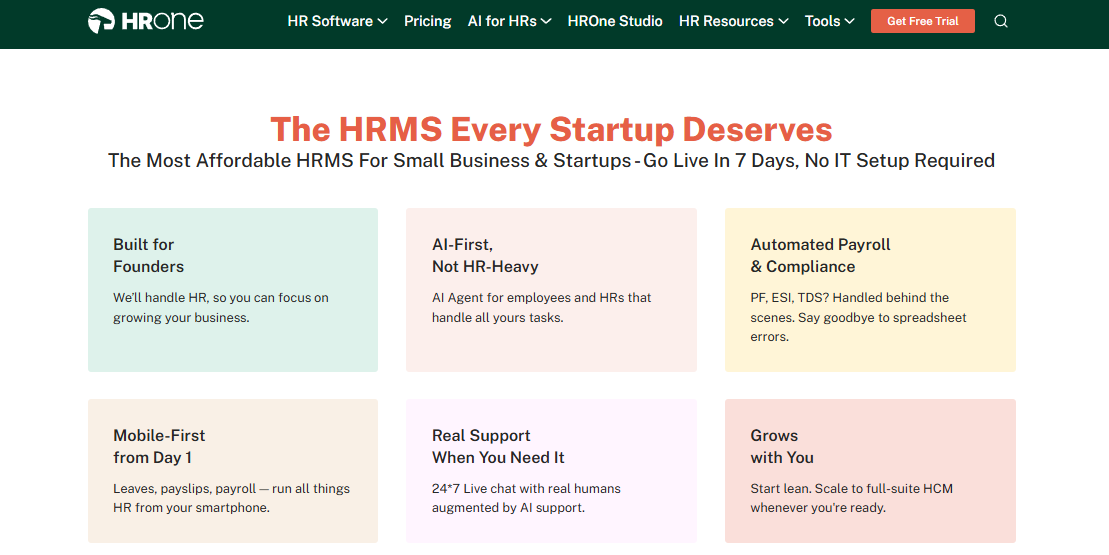
HROne – India-first mobile-native HCM that connects hire to retire in one inbox
🏢 Overview
HROne is a cloud HCM platform founded in 2016 and headquartered in Noida, built for Indian organisations running structured HR operations. It covers Core HR, Payroll, Attendance, Leave, Recruitment, Performance, Helpdesk, and Expenses in a single unified system. HROne holds a 4.8 rating across 2,120 verified G2 reviews and sits at number three out of 1.17 lakh products for customer satisfaction. It is used mostly by teams tired of reconciling biometric exports, spreadsheets, and an outsourced payroll vendor at month end.
🔧 Core Services
- Super Inbox routes every pending request, approval, and task into one Gmail-style queue, closing each item in three clicks, so HR stops chasing managers over email.
- 127 pre-built workflows define who does what and by when across onboarding, confirmation, transfer, promotion, and exit clearance, which removes handoff gaps between departments.
- Payroll engine automates EPF, ESI, TDS, and professional tax with an auto-scheduler and group payout validations, cutting month-end reconciliation errors. See the full payroll software module scope.
- Attendance and time office supports geo-fencing, selfie attendance, and offline marking on mobile, so field and plant staff stop submitting paper registers.
- One AI Suite scores resume relevancy, parses expense receipts, and runs an employee AI agent, which removes manual screening and claim data entry.
- Inbuilt ROI Dashboard calculates lifetime hours saved against average HR salary, giving the CHRO a rupee figure before a board review.
- HRV Studio lets HR build small custom apps for visitor or vendor management without raising a developer ticket.
🇮🇳 India-Specific Compliance and Localization
- PF / ESI / TDS support: Yes (automated computation, challan, and reconciliation)
- Labour law compliance: Strong (wage-code aligned CTC and FFS handling)
- Payroll localization: Yes (FBP declarations, arrears, professional tax by state)
- Multi-state compliance handling: Yes (multi-legal-entity on one instance)
👥 Who This Is Built For
- Payroll manager firefighting CTC-revision arrears across two or three legal entities every month.
- HR ops lead manually matching biometric attendance exports against a separate leave portal.
- CHRO who cannot answer how many days a confirmation letter currently takes to close.
❌ Who Should Skip This
- Teams under 25 people wanting lightweight, spreadsheet-like payroll without structured workflows.
- Companies with no India entity, since the compliance engine is the core value here.
💰 Pricing Structure
- Plan Types: Startup Launchpad, Basic, Professional
- Starting Price: ₹4,950 per month for 50 users on Basic, billed monthly, with a 50-user minimum
- Tier-wise Breakdown: Startup Launchpad at ₹2,900 for 25 users, then ₹75 per user, covering Core HR, Payroll, and Attendance. Basic at ₹4,950 for 50 users, then ₹99 per user, adding mobile app, dashboards, and PF/ESI/TDS/PT compliance. Professional at ₹6,500 for 50 users, then ₹130 per user, adding Workforce modules for confirmation, transfer, and separation. Current tiers are listed on the HROne pricing page.
- Incremental Cost Drivers: Per-user charges above the 50-user band, AI add-ons, Teams and WhatsApp bots, and module upgrades.
- Implementation Fee: Not publicly disclosed, request a quote. Subscription meters only after go-live, with no lock-in.
- Cost at 200 Employees: ₹19,800 per month on Basic | Cost at 500 Employees: ₹49,500 per month on Basic
⏰ Implementation and Support Reality
- Mid-market rollouts go live in as little as 30 days, which sits inside the four-week band that 43 percent of core HR buyers report. Our HRMS implementation timeline guide sets out the week-by-week plan.
- Support runs on phone, email, and a dedicated onboarding SPOC who has previously worked in HR, not a technical project manager.
- Data migration is vendor-led with a named owner through cutover.
- HROne reports a 9.8 NPS on that dedicated support model.
⭐ What Users Say
All-in-One HR Platform That Makes Daily Tasks Fast and Convenient.
– Verified User, Core HR HROne G2 – Verified Review, 4.5/5
HROne cut payroll cycles at MR DIY India from 10 days to five or six, and runs 20 pan-India units for Asia Healthcare Holdings on a single multi-entity instance, which is the kind of proof a CFO can actually check.
1.2 Zoho People
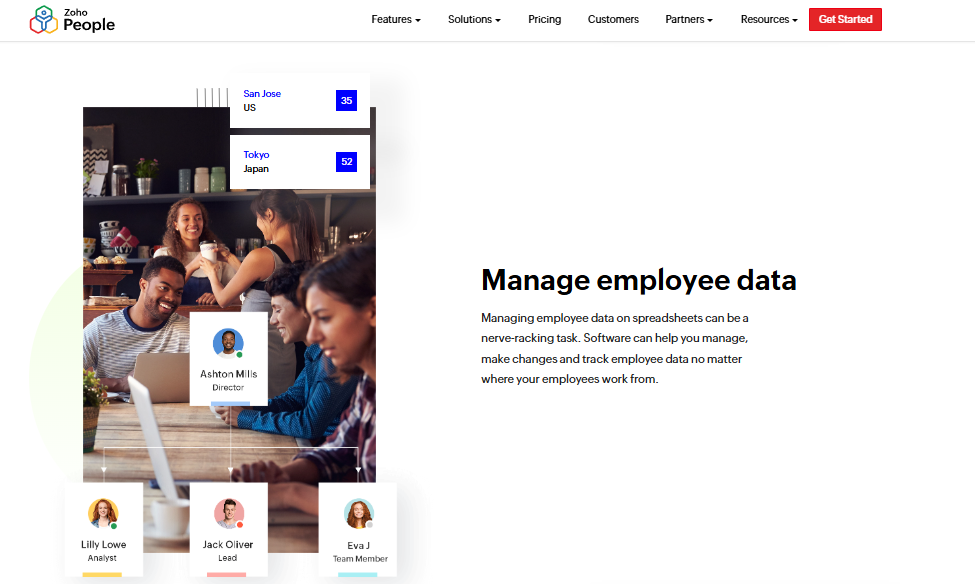
Zoho People – Lowest-cost HR record system for teams already living in Zoho
🏢 Overview
Zoho People is Zoho’s cloud HRMS, covering the employee database, leave, attendance, timesheets, onboarding, and performance. It is the cheapest credible entry point in this list, starting at ₹48 per user per month on annual billing in India. A free tier exists for up to three users, though it excludes attendance tracking. It is used most often by small teams that already run Zoho CRM or Books and want HR records in the same login.
🔧 Core Services
- Employee database and self-service centralises records and letters, which ends the shared-drive hunt for a signed offer letter.
- Leave and attendance handles policies, shifts, and rosters from the Professional tier, reducing manual leave-balance maths.
- Timesheets and project time tracks billable hours and syncs with Zoho Projects, so consulting teams stop rebuilding utilisation in Excel.
- Performance and OKRs arrive on Premium, covering appraisals, compensation, and engagement surveys.
- HR help desk and LMS sit on Enterprise, adding case management and training tracking.
- Zia AI assistant answers routine employee queries inside the Essential tier and up.
🇮🇳 India-Specific Compliance and Localization
- PF / ESI / TDS support: Partial (needs Zoho Payroll as a separate product)
- Labour law compliance: Moderate (statutory depth lives outside Zoho People)
- Payroll localization: Partial (India payroll is a distinct subscription)
- Multi-state compliance handling: Limited (thin on state-wise PT and multi-entity nuance)
👥 Who This Is Built For
- Founder-operator on the Zoho stack who wants leave and records off WhatsApp this week.
- HR generalist at a 20 to 60 person services firm tracking timesheets against client projects.
❌ Who Should Skip This
- Payroll managers needing PF, ESI, and TDS filed inside the same system as attendance.
- Multi-entity manufacturing teams needing deep shift and statutory configuration. A multi-entity HR software comparison shows where the gap opens.
💰 Pricing Structure
- Plan Types: Free, Essential HR, Professional, Premium, Enterprise
- Starting Price: ₹48 per user per month billed annually, GST extra, five-user minimum
- Tier-wise Breakdown: Essential HR ₹48, Professional ₹96, Premium ₹144, and Enterprise ₹192 per user monthly on annual billing. Monthly billing runs ₹60, ₹120, ₹180, and ₹240.
- Incremental Cost Drivers: Zoho Payroll as a separate subscription, People Plus bundle at roughly $10 per user for recruitment, and GST on every plan.
- Implementation Fee: Not publicly disclosed, request a quote.
- Cost at 200 Employees: ₹19,200 per month on Professional | Cost at 500 Employees: ₹48,000 per month on Professional
⏰ Implementation and Support Reality
- Self-serve setup means small teams can go live in two to six weeks without vendor involvement.
- Support is email and chat led, with phone access varying by plan.
- Data migration is self-serve through templates, which suits lean teams and frustrates complex ones.
- No published NPS or CSAT figure is available.
⭐ What Users Say
Easy to use, quick updates. Easy to add new tasks. Impossible to edit old entries (if you forgot to add something). Impossible to fix errors (like missing dates).
– John B., Zoho People G2 – Verified Review, 3/5
The breadth of applications and the price of it. Features are shallow and there is no depth in each application.
– Verified User in Information Technology and Services, Zoho People G2 – Verified Review, 2.5/5
HROne reads that shallow-depth complaint as the central trade-off of cheap HR software, and its own answer is depth in the four modules that carry an Indian payroll month: core HR, time office, workforce, and payroll on one instance.
Read More: Zoho People vs HROne
1.3 Gusto
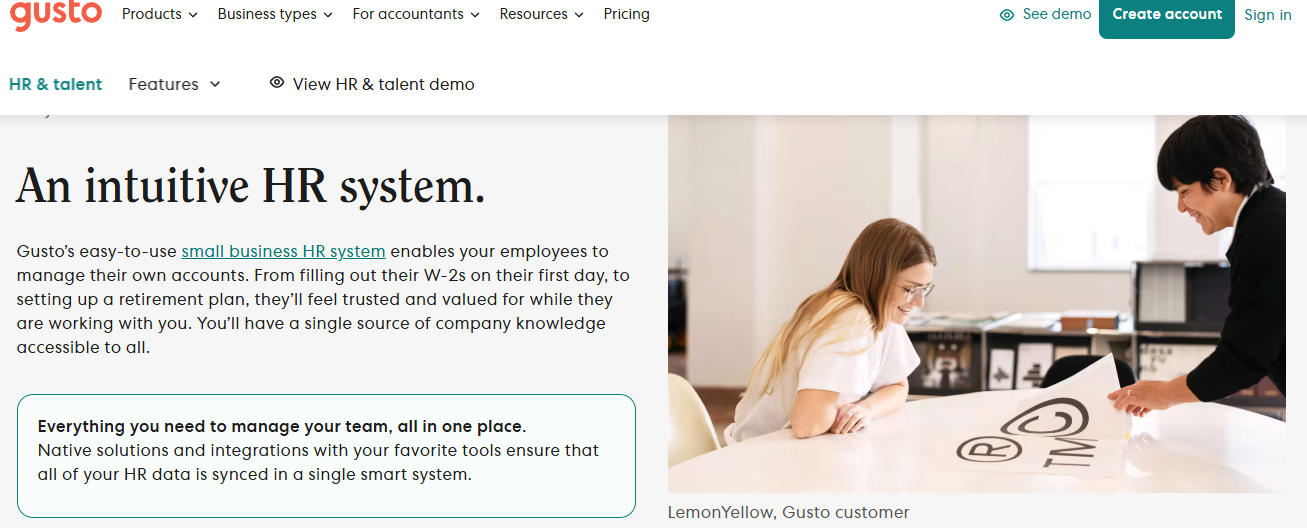
Gusto – Clean, full-service US payroll for small teams that hate paperwork
🏢 Overview
Gusto is a US payroll and HR platform built for small businesses that want payroll, benefits, and basic HR in one place. It is the most frequently recommended pick across independent small-business roundups for standard US teams. Gusto files federal, state, and local payroll taxes automatically, which is its core value. It is used most by owners who were doing payroll in a spreadsheet and got tired of tax notices.
🔧 Core Services
- Full-service payroll runs unlimited cycles and files federal, state, and local taxes automatically, removing manual tax deposits.
- Benefits administration connects health, dental, vision, and 401(k) in the same flow, so enrolments stop living in email.
- Time tracking and PTO arrives on the Plus plan, syncing hours straight into payroll and cutting timesheet re-entry.
- Onboarding issues offer letters, e-signatures, and I-9 collection, which removes the paper folder for new joiners.
- Multi-state payroll unlocks on Plus, handling employees across states without separate filings.
- Contractor payments run on a separate plan at $35 per month plus $6 per contractor.
🇮🇳 India-Specific Compliance and Localization
- PF / ESI / TDS support: No (US tax engine only)
- Labour law compliance: Limited (US federal and state focus)
- Payroll localization: No (no Indian salary structure or FBP handling)
- Multi-state compliance handling: Yes (US states, not Indian states)
👥 Who This Is Built For
- US founder-operator running payroll for 5 to 40 people without an HR hire.
- Office manager fixing payroll tax notices by hand every quarter.
❌ Who Should Skip This
- Any Indian entity needing PF, ESI, and TDS filed inside the same system. Indian statutory scope is set out in our multi-state payroll compliance guide.
- Teams needing structured lifecycle workflows for confirmation, transfer, or exit clearance.
💰 Pricing Structure
- Plan Types: Contractor Only, Simple, Plus, Premium
- Starting Price: $49 per month base plus $6 per employee, billed monthly, no minimum headcount
- Tier-wise Breakdown: Simple at $49 plus $6 per employee for single-state payroll. Plus at $80 plus $12 per employee, adding time tracking, PTO, and multi-state payroll. Premium at $180 plus $22 per employee, adding a dedicated advisor and HR experts. Contractor Only at $35 plus $6 per contractor.
- Incremental Cost Drivers: State registration fees, next-day pay, and R&D tax credit add-ons.
- Implementation Fee: No published implementation fee.
- Cost at 200 Employees: $1,249 per month on Simple | Cost at 500 Employees: $3,049 per month on Simple
⏰ Implementation and Support Reality
- Self-serve setup usually completes in days to two weeks for a single-state team.
- Support runs on email and chat, with phone access weighted to higher tiers.
- Data migration is self-serve through import templates.
- No publicly reported NPS figure.
1.4 BambooHR
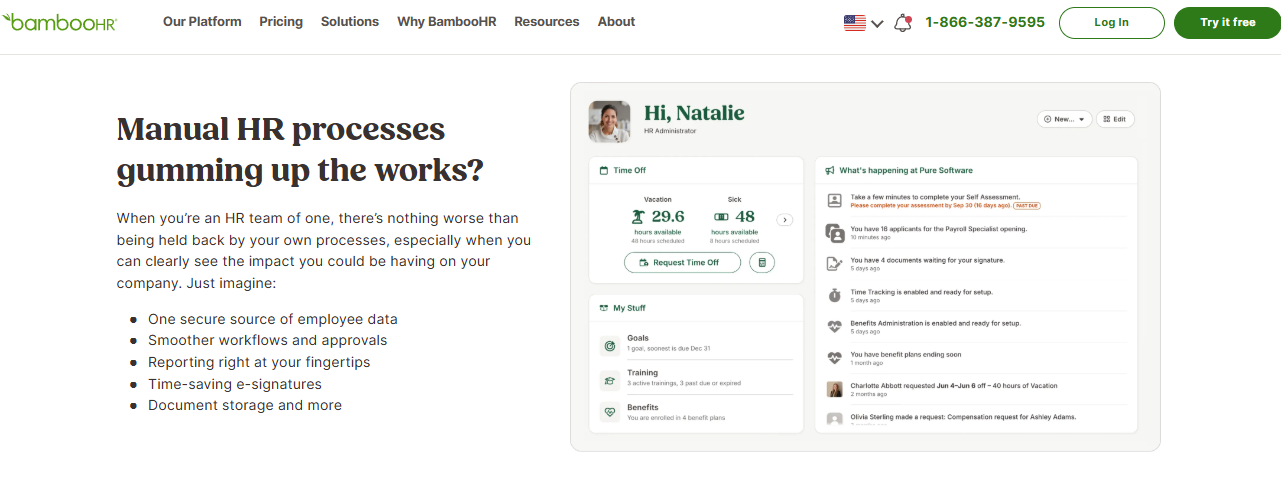
BambooHR – Employee records and onboarding done properly for sub-200 teams
🏢 Overview
BambooHR is an HR information system, meaning a central database for people records, built for small and mid-sized companies. It focuses on records, onboarding, time off, and reporting rather than deep payroll compliance. Independent roundups consistently list it among the top affordable options for small businesses. It is used most by HR generalists who inherited an offer-letter folder and no system.
🔧 Core Services
- Employee database centralises records, documents, and org charts, ending the shared-drive hunt for signed paperwork.
- Onboarding and offboarding runs task checklists and e-signatures, so new joiners stop chasing IT and HR separately. Indian teams can compare this against employee onboarding automation built for local documentation.
- Time off tracking automates accrual policies and approvals, removing manual leave-balance maths.
- Performance management handles review cycles and goals on the Pro tier and above.
- Reporting and analytics produces headcount and turnover reports without an Excel export.
- Payroll and benefits exist as US-only add-ons, not as a global compliance engine.
🇮🇳 India-Specific Compliance and Localization
- PF / ESI / TDS support: No (needs a separate Indian payroll vendor)
- Labour law compliance: Limited (built around US practice)
- Payroll localization: No (India payroll runs outside the platform)
- Multi-state compliance handling: No (no Indian PT or LWF logic)
👥 Who This Is Built For
- HR generalist at a 30 to 150 person team with no single source of employee data.
- People manager running review cycles in a spreadsheet and losing version control.
❌ Who Should Skip This
- Payroll managers needing statutory computation inside the same system as attendance.
- Cost-led Indian teams, since dollar-denominated PEPM lands well above local rates.
💰 Pricing Structure
- Plan Types: Core, Pro, Elite
- Starting Price: $10 per employee per month on Core, with a flat rate starting at $250 per month for teams of 25 or fewer
- Tier-wise Breakdown: Core at $10 per employee monthly for records, onboarding, and time off. Pro at $17 per employee monthly, adding performance and deeper reporting. Elite at $25 per employee monthly.
- Incremental Cost Drivers: Payroll, benefits administration, and applicant tracking as add-ons, plus implementation charges reported at 5 to 15 percent of annual cost.
- Implementation Fee: Not publicly disclosed, request a quote.
- Cost at 200 Employees: $2,000 per month on Core | Cost at 500 Employees: $5,000 per month on Core
⏰ Implementation and Support Reality
- Setup typically runs two to eight weeks depending on data cleanliness.
- Support covers email and phone, with an assigned contact on higher tiers.
- Data migration is vendor-assisted with customer-prepared templates, unlike the vendor-led approach in our HRMS migration guide.
- No publicly reported NPS figure.
1.5 greytHR
greytHR – Long-standing Indian payroll workhorse for standard monthly cycles
🏢 Overview
greytHR is one of India’s most widely deployed HR and payroll platforms, focused on statutory payroll for SMB and lower mid-market teams. It publishes a genuinely free tier for companies with 25 or fewer employees, which is rare in this category. Pricing is transparent, with a published base plus per-employee model. It is used most by payroll managers running a stable, single-entity monthly cycle.
🔧 Core Services
- Payroll engine computes PF, ESI, TDS, and professional tax with statutory reports, cutting manual challan preparation.
- Leave and attendance manages policies and approvals, with advanced shifts and geo-fencing on the Growth plan.
- Employee self-service lets staff pull payslips and file tax declarations without an HR email.
- Statutory reports generate the filing formats Indian auditors expect, reducing month-end rework.
- Recruit ATS is licensed separately at ₹2,500 per recruiter per month.
🇮🇳 India-Specific Compliance and Localization
- PF / ESI / TDS support: Yes (computation plus statutory reports)
- Labour law compliance: Strong (deep SMB payroll heritage)
- Payroll localization: Yes (Indian salary structures and declarations)
- Multi-state compliance handling: Partial (users report configuration limits)
👥 Who This Is Built For
- Payroll manager at a 40 to 150 person single-entity company running a predictable cycle.
- Founder wanting statutory payroll live cheaply, with a free tier under 25 people.
❌ Who Should Skip This
- HR ops leads needing flexible policy configuration across multiple legal entities. Buyers in that position usually shortlist greytHR alternatives in India.
- Teams needing full mobile parity, since reviewers report app functionality gaps.
💰 Pricing Structure
- Plan Types: Starter, Essential, Growth, Premium
- Starting Price: ₹2,495 per month covering the first 50 employees, then ₹45 per additional employee, GST extra
- Tier-wise Breakdown: Starter free for up to 25 employees. Essential at ₹2,495 base plus ₹45 per employee above 50. Growth at ₹4,495 base plus ₹85 per employee above 50, adding advanced attendance, shifts, and geo-fencing. Premium on a custom quote.
- Incremental Cost Drivers: Recruit ATS per recruiter, 18 percent GST, and Premium-tier custom modules.
- Implementation Fee: Not publicly disclosed, request a quote.
- Cost at 200 Employees: ₹9,245 per month on Essential | Cost at 500 Employees: ₹22,745 per month on Essential, both before GST
⏰ Implementation and Support Reality
- Go-live typically runs two to five weeks for a standard payroll setup.
- Support is ticket-led, with reviewers reporting callbacks within one to two hours on better days.
- Data migration is largely customer-prepared with vendor validation.
- No publicly reported NPS figure.
⭐ What Users Say
Better UI, simplicity and time for support.
– Krishnanand B., greytHR G2 – Verified Review, 3/5
All the HR activities at a single point. Lag while login and logging out. No flexible customization. Some features are only available in a desktop mode, not in mobile application.
– Arjun T., greytHR G2 – Verified Review, 2.5/5
Read More: HROne vs GreytHR
1.6 Keka
Keka – Interface-first Indian HRMS with solid core payroll
🏢 Overview
Keka is an Indian cloud HRMS covering core HR, payroll, attendance, performance, and hiring, used by a reported 10,000-plus organisations. Its strongest publicly praised trait is interface clarity, which lowers employee training time. Pricing runs as flat bands for the first 100 employees, then per additional head. It is used most by teams replacing a legacy portal that employees refused to log into.
🔧 Core Services
- Payroll and compliance automates salary, PF, ESI, and TDS with payslip generation, cutting manual statutory work.
- Attendance and leave handles clock-in, shifts, and approvals, with self clock-in and OTP login on higher tiers.
- Performance and OKRs arrive on the Strength plan, covering goals and reviews.
- Keka Hire ATS sits on the Growth plan alongside advanced analytics and API access.
- Helpdesk and expense unlock on Growth, adding case routing and claims. Teams comparing scope often review expense management software for Indian HR teams before committing.
🇮🇳 India-Specific Compliance and Localization
- PF / ESI / TDS support: Yes (automated computation and payslips)
- Labour law compliance: Strong (statutory payroll built for India)
- Payroll localization: Yes (Indian CTC and declaration handling)
- Multi-state compliance handling: Partial (multi-entity sits outside base plans)
👥 Who This Is Built For
- HR lead whose employees ignored the last portal because it was hard to use.
- Payroll manager at a 100 to 300 person single-entity company needing statutory basics automated.
❌ Who Should Skip This
- Finance teams needing exact CTC and PT reporting, given documented report gaps.
- Companies with staff who have no work email, since reviewers flag access friction. Field-heavy employers usually need HRMS built for field and blue-collar teams.
💰 Pricing Structure
- Plan Types: Foundation, Strength, Growth
- Starting Price: ₹9,999 per month for the first 100 employees on Foundation, then ₹90 per additional employee
- Tier-wise Breakdown: Foundation at ₹9,999 for core HR, leave, attendance, and basic payroll. Strength at ₹12,999, adding performance, OKRs, and hiring. Growth at ₹15,999, adding analytics, helpdesk, and expense. Additional employees bill at ₹90, ₹120, and ₹150 respectively.
- Incremental Cost Drivers: Multi-entity add-ons, deeper API access, LMS, implementation fees, and a reported 25-employee minimum floor.
- Implementation Fee: Yes, charged separately, amount not publicly published.
- Cost at 200 Employees: ₹18,999 per month on Foundation | Cost at 500 Employees: ₹45,999 per month on Foundation
⏰ Implementation and Support Reality
- Go-live varies widely, from about four weeks to several months in documented cases.
- Support is email and ticket-led, with reviewers split on responsiveness.
- Data migration is vendor-led with customer data preparation.
- No publicly reported NPS figure.
⭐ What Users Say
Strong payroll and compliance, automate salary and attendance processing with pf/esi tds. PMS module is confusing and needs to be simpler. User access is difficult for employees who do not have an email ID.
– Kiran B., Keka G2 – Verified Review, 3/5
The payroll reports doesn’t give accurate figure in Total CTC, you need to add PF amount to get the right figure. The CTC structure doesn’t show PT in deductions which adds to confusion.
– Pooja M., Keka G2 – Verified Review, 2/5
Read More: HROne vs Keka
1.7 PeopleStrong
PeopleStrong – Enterprise-grade Indian HCM aimed at larger talent operations
🏢 Overview
PeopleStrong is an Indian HCM platform serving large enterprises and upper mid-market organisations across Asia-Pacific. Its strength sits in breadth across talent acquisition, core HR, and workforce management at scale. Pricing is quote-led, with directory-triangulated PEPM estimates in the ₹120 to ₹280 range and implementation fees reported from ₹8 lakh upward. It is used most by HR functions running centralised hiring across many locations.
🔧 Core Services
- Talent acquisition manages requisition to offer at volume, reducing recruiter spreadsheet tracking.
- Core HR holds the employee master across entities and geographies, removing duplicate records.
- Payroll handles Indian statutory computation for large headcounts.
- Workforce management covers shifts and attendance for distributed sites, similar in scope to a dedicated workforce management module.
- Performance and learning support structured cycles for enterprise HR calendars.
🇮🇳 India-Specific Compliance and Localization
- PF / ESI / TDS support: Yes (built for Indian statutory payroll)
- Labour law compliance: Strong (enterprise India and APAC coverage)
- Payroll localization: Yes (Indian pay structures at scale)
- Multi-state compliance handling: Yes (multi-entity, multi-location)
👥 Who This Is Built For
- Talent acquisition head running centralised hiring across 20-plus locations.
- CHRO at a 1,000-plus headcount group consolidating regional HR systems.
❌ Who Should Skip This
- A 50-person company, since scope and implementation cost outweigh the need.
- Teams needing a live rate card before a sales conversation.
💰 Pricing Structure
- Plan Types: Not publicly published as named tiers
- Starting Price: Not publicly disclosed, request a quote
- Tier-wise Breakdown: Not publicly disclosed. Indicative triangulated PEPM sits at ₹180 to ₹280 at 500 employees and ₹120 to ₹200 at 5,000 employees.
- Incremental Cost Drivers: Module scope, entity count, and integration work.
- Implementation Fee: Yes, reported indicatively from ₹8 lakh to ₹45 lakh depending on scope.
- Cost at 200 Employees: Not publicly disclosed, request a quote | Cost at 500 Employees: Not publicly disclosed, request a quote
⏰ Implementation and Support Reality
- Enterprise rollouts commonly run eight to sixteen weeks or longer.
- Support combines an account team with partner-delivered services.
- Data migration is vendor or partner-led.
- No publicly reported NPS figure.
1.8 Rippling
Rippling – One system for HR, payroll, and device management together
🏢 Overview
Rippling unifies HR, payroll, and IT administration, including laptop and app provisioning, in a single platform. Its distinctive move is joining employee records to device and access management, so onboarding and offboarding happen once. Pricing is modular, starting near $8 per employee monthly for the core platform, with each module priced separately. It is used most by ops leads who onboard people and laptops in the same week.
🔧 Core Services
- Core HR platform holds the employee record and drives every downstream module, removing duplicate data entry.
- Payroll files US taxes automatically and syncs hours from the same record.
- Device management ships, locks, and wipes laptops tied to employment status, closing offboarding security gaps. Indian teams handle the equivalent through asset management inside the HR system.
- App provisioning grants and revokes software access automatically, so IT stops chasing licence cleanup.
- Benefits administration connects carriers to payroll deductions in one flow.
- Workflow automation triggers actions across HR, IT, and finance without scripts.
🇮🇳 India-Specific Compliance and Localization
- PF / ESI / TDS support: Limited (India coverage via global payroll and EOR paths)
- Labour law compliance: Moderate (strongest in the US)
- Payroll localization: Partial (not built around Indian statutory depth)
- Multi-state compliance handling: Yes for US states, limited for Indian states
👥 Who This Is Built For
- Ops lead provisioning laptops, email, and payroll for every new joiner by hand.
- IT director trying to prove that leavers lost access on their last day.
❌ Who Should Skip This
- India-first payroll teams needing PF, ESI, and PT filed natively.
- Budget-tight teams, since module stacking raises effective cost quickly.
💰 Pricing Structure
- Plan Types: Modular, built on a core platform plus per-module pricing
- Starting Price: From about $8 per employee per month for the core platform, with a $35 monthly base reported by some sources
- Tier-wise Breakdown: Core platform around $8 per employee. Payroll around $8 per employee. Benefits around $6 per employee. Device management around $8 per employee.
- Incremental Cost Drivers: Every additional module, plus global payroll and EOR services.
- Implementation Fee: Not publicly disclosed, request a quote.
- Cost at 200 Employees: About $1,600 per month for the core platform alone, before modules | Cost at 500 Employees: About $4,000 per month for the core platform alone
⏰ Implementation and Support Reality
- Setup commonly runs two to six weeks depending on module count.
- Support runs on email and chat, with phone access varying by plan.
- Data migration is self-serve with guided imports.
- No publicly reported NPS figure.
1.9 factoHR
factoHR – Attendance and retirement-benefit depth for plant and field teams
🏢 Overview
factoHR is an Indian HR and payroll platform with notable depth in attendance, biometric integration, and retirement benefits. It publishes a clear rate card with a free tier for up to 20 employees covering records and payslips only. Paid plans start at ₹4,999 monthly for 50 employees, billed with quarterly per-employee components. It is used most by manufacturing and field-heavy teams reconciling shift data.
🔧 Core Services
- Payroll engine computes PF, ESI, PT, and TDS with statutory outputs, cutting manual reconciliation.
- Attendance and geo-fencing captures shift, plant, and field punches, reducing paper muster rolls.
- Multi-entity management is included from the Core plan, which helps group structures.
- Travel and expense modules unlock on Premium, replacing paper claim forms.
- Performance with KPI and KRA arrives on Ultimate, including 360 degree feedback.
- Mobile self-service lets workers view payslips and apply for leave without a desktop, the same pattern covered in our HRMS guide for manufacturing companies.
🇮🇳 India-Specific Compliance and Localization
- PF / ESI / TDS support: Yes (computation plus statutory outputs)
- Labour law compliance: Strong (retirement benefits and factory context)
- Payroll localization: Yes (Indian structures and quarterly billing norms)
- Multi-state compliance handling: Yes (multi-entity included from Core)
👥 Who This Is Built For
- Plant HR officer matching biometric punches to shift rosters every morning.
- Payroll manager at a manufacturing firm handling gratuity and PF-heavy structures.
❌ Who Should Skip This
- Teams under 20 people wanting real payroll, since the free tier excludes processing.
- HR teams prioritising engagement and learning depth over attendance rigour.
💰 Pricing Structure
- Plan Types: Free, Core, Premium, Ultimate
- Starting Price: ₹4,999 per month covering up to 50 employees, then ₹69 per additional employee, billed quarterly, GST extra
- Tier-wise Breakdown: Free forever up to 20 employees, records and payslips only. Core at ₹4,999 plus ₹69 per extra employee for core HR, payroll, leave, and attendance. Premium at ₹5,999 plus ₹89, adding travel, expense, and geo-fence. Ultimate at ₹6,999 plus ₹119, adding performance and surveys.
- Incremental Cost Drivers: Per-module add-ons, 18 percent GST, and quarterly billing on per-employee components.
- Implementation Fee: Not publicly disclosed, request a quote.
- Cost at 200 Employees: ₹15,349 per month on Core, before GST | Cost at 500 Employees: ₹36,049 per month on Core, before GST
⏰ Implementation and Support Reality
- Go-live commonly runs three to six weeks with biometric integration included, and biometric and Tally integrations are usually the long pole.
- Support covers email, phone, and an assigned account contact.
- Data migration is vendor-led with template-based uploads.
- No publicly reported NPS figure.
1.10 Zimyo
Zimyo – Cost-conscious modular HRMS for SMB-to-mid-market crossovers
🏢 Overview
Zimyo is an Indian HRMS sold in modular tiers, aimed at teams that want core HR cheaply and add modules later. Published per-employee rates sit around ₹50 for Basic, ₹75 for Standard, and ₹100 for Enterprise, verified mid-2026. Minimum seat bundles apply, and older directory listings quote higher figures, so confirm your quote in writing. It is used most by scaling teams replacing spreadsheets on a tight budget.
🔧 Core Services
- Core HR and self-service centralises records and requests, removing WhatsApp-based leave approvals.
- Payroll computes Indian statutory deductions with payslip generation, cutting manual salary sheets.
- Attendance and leave manages policies and shift rules, reducing month-end attendance disputes.
- Performance management covers goals and reviews on higher tiers.
- Engagement and surveys add pulse feedback for HR teams without a separate tool.
🇮🇳 India-Specific Compliance and Localization
- PF / ESI / TDS support: Yes (statutory computation included)
- Labour law compliance: Moderate (solid basics, thinner edge cases)
- Payroll localization: Yes (Indian salary structures)
- Multi-state compliance handling: Partial (confirm PT coverage per state)
👥 Who This Is Built For
- HR generalist at a 40 to 200 person company moving off Excel with a small budget, a shift we break down in HR software versus Excel.
- Founder wanting statutory payroll and attendance without a five-figure monthly bill.
❌ Who Should Skip This
- HR teams needing deep custom reporting and configuration across many entities.
- Buyers who cannot tolerate pricing that varies across public listings.
💰 Pricing Structure
- Plan Types: HRMS Basic, HRMS Standard, HRMS Enterprise
- Starting Price: Around ₹50 per employee per month on Basic, with minimum seat bundles, GST extra
- Tier-wise Breakdown: Basic around ₹50 per employee. Standard around ₹75 per employee. Enterprise around ₹100 per employee. Minimum billing bundles apply, for example near ₹4,000 monthly for 80 employees on Basic.
- Incremental Cost Drivers: Module upgrades, 18 percent GST, and minimum-seat floors below your actual headcount.
- Implementation Fee: Not publicly disclosed, request a quote.
- Cost at 200 Employees: About ₹10,000 per month on Basic, before GST | Cost at 500 Employees: About ₹25,000 per month on Basic, before GST
⏰ Implementation and Support Reality
- Go-live commonly runs two to six weeks for a standard setup.
- Support is email and ticket-led.
- Data migration is template-based with vendor assistance.
- No publicly reported NPS figure.
⚠️ One honest caveat on this whole list
Published prices move, and add-on modules move faster. Get your final quote in writing, with the per-employee rate and the implementation fee on the same page.
HROne bills flat per employee with the subscription metering only after go-live, and reports 30-day rollouts for mid-market teams alongside a 9.8 NPS on its prior-HR onboarding specialists, as detailed in our HROne implementation guide. That combination, not the sticker price, is what decides whether the money you spend turns into time your team gets back.
Q2. How Did We Score and Rank These Platforms?
Each platform was scored on five weighted criteria totalling 100: Statutory Compliance Depth 25, Verified User Reviews 20, Time-to-Go-Live 20, Pricing and Module Transparency 20, and Adoption and Usability 15. Scores of 0 to 20 earn one star, 21 to 40 two, 41 to 60 three, 61 to 80 four, and 81 to 100 five. HROne scores 90, which is 5 stars.
⚖️ Why compliance carries the heaviest weight
Compliance gets 25 points because it is the only criterion that can cost you money in a single missed month. EPF applies at 20 or more employees, and ESI at 10 or more, with contributions and ECR due by the 15th. Late deposits attract 12 percent annual interest plus damages of 5 to 25 percent, as our PF, ESI, and TDS employer guide sets out.
The labour codes made this heavier, not lighter. Wages must now be at least 50 percent of total remuneration, which resets your PF and gratuity base. A platform that cannot recompute that is a liability, however clean its dashboard looks, which is why labour law compliance software is scored ahead of interface polish here.
⏰ Why go-live time is a scored criterion at all
Go-live gets 20 points because the spread across platforms is enormous. G2 data shows go-live ranging from 0.7 to 5.6 months, with 43 percent of buyers live inside four weeks and 81 percent within three months. Small-business buyers do better than enterprises, at 65 percent live within a month versus 18 percent.
HROne measures this the same way a buyer should, by counting from contract to first live payroll run, and reports 30-day go-lives for mid-market teams, benchmarked in our HRMS implementation timeline guide. My own bias here is open: I trust a dated go-live commitment more than any feature demo.
📊 The scoring table
| Platform | Compliance /25 | Reviews /20 | Go-live /20 | Pricing /20 | Adoption /15 | Total | Stars |
|---|---|---|---|---|---|---|---|
| HROne | 24 | 17 | 18 | 18 | 13 | 90 | ⭐⭐⭐⭐⭐ |
| Gusto | 8 | 17 | 18 | 17 | 13 | 73 | ⭐⭐⭐⭐ |
| Rippling | 8 | 17 | 15 | 13 | 13 | 66 | ⭐⭐⭐⭐ |
| BambooHR | 6 | 17 | 15 | 14 | 13 | 65 | ⭐⭐⭐⭐ |
| Zoho People | 11 | 10 | 13 | 16 | 10 | 60 | ⭐⭐⭐ |
| greytHR | 18 | 8 | 13 | 16 | 5 | 60 | ⭐⭐⭐ |
| Keka | 19 | 9 | 9 | 14 | 9 | 60 | ⭐⭐⭐ |
| factoHR | 18 | 8 | 12 | 15 | 6 | 59 | ⭐⭐⭐ |
| Zimyo | 16 | 8 | 13 | 12 | 9 | 58 | ⭐⭐⭐ |
| PeopleStrong | 20 | 10 | 6 | 6 | 8 | 50 | ⭐⭐⭐ |
❌ What we refused to score
Logo walls, funding rounds, and analyst quadrant placement earned zero weight. None of them predict whether your March payroll runs clean.
Module weighting followed a simple hierarchy that HROne uses internally when sequencing deployments: core HR, workforce, time office, and payroll first, because that is where organisational units get defined. Everything else is downstream of those four, as the module map in our core HCM documentation shows.
✅ The cross-check we ran
Rubric scores were checked against an independent shortlist, the SHRM and Software Advice report on top-rated small-business HR software for 2026. Where our ranking diverged, we looked for a documented reason in reviews or pricing pages rather than adjusting the weights.
I might be over-weighting compliance for a US-only reader, and I will say that plainly. For an Indian small company, though, the statutory column is the one that wakes you up at 2 a.m.
HROne earns its 5 stars mostly on the compliance and adoption columns, where a prior-HR onboarding specialist owns the rollout and sustains a 9.8 NPS. That is the score most likely to change your March payroll, not the feature count.
Q3. What Should HR Software Actually Do for a Small Company, and What Can Wait?
In month one you need four things live: an employee master with defined org units, attendance and time office, leave, and full-cycle payroll with PF, ESI, TDS, and professional tax. Performance, learning, and engagement can wait a quarter. Judge each platform by whether it triggers approvals and computations, or merely stores what someone remembered to type in.
💸 The whole-hog mistake
Most small companies buy the full suite and use about a third of it. The invoice arrives monthly, the unused modules sit dark, and the CFO starts asking questions by month four.
Think of it as a parachute that opens only as wide as you need. Pay for what you actually open, then widen it as headcount grows. That sequencing is the difference between a system that compounds and one that becomes shelfware.
⏰ A 90-day switch-on sequence
Days 1 to 30: employee master, org units, leave policies, and attendance capture. Days 31 to 60: full payroll with statutory computation, run in parallel with your existing process. Days 61 to 90: expense, helpdesk, and only then performance.
HROne sequences deployments in exactly this order across its 127 pre-built workflows, because organisational units defined wrongly in week one break every downstream approval. I have watched teams skip this and spend a quarter unpicking reporting lines, a pattern we unpack in scaling HR processes from 100 to 1,000 employees.
🍊 Apples and oranges: passive database versus active system
Here is the distinction that matters more than the HRIS, HRMS, or HCM label. A passive system stores a record after someone types it in. An active system computes, routes, and closes work on its own.
Test it with one leave request. In a passive tool, the employee applies and then messages the manager on WhatsApp to please approve it. In an active one, the request lands in the manager’s queue, escalates on delay, adjusts the balance, and flows into payroll untouched, which is exactly what a rules-driven leave management engine is for.
🤖 What “AI in HR” actually does mechanically
Vendors say AI. What the patents describe is narrower and more useful. One granted method builds a pay distribution model for each payee, then flags records that deviate before disbursement, which catches a wrong salary before it leaves the bank.
A second filed method generates job descriptions with a large language model, then ranks resumes against consistent criteria. Ask HROne to show its receipt parser and resume relevancy scoring on your own files, because that is where the claim gets tested, and the full capability list sits in our One AI Suite breakdown. Academic work on adoption backs this framing, finding that task-technology fit predicts whether staff actually use the system.
✅ Three demo questions that expose a passive system
- Show me one leave request travelling from employee to payroll without a single email.
- Change a leave policy live, in front of me, without a developer.
- Show me the statutory output for a mid-month CTC revision with arrears.
Its a simple to use tool with minimum experience people can use it for basic tasks. Lack of customizations options are not expected from a full service HRMS. No self onboard options as well. lot of manual work that the team still has to do.
– Verified User in Internet, Keka G2 – Verified Review, 2.5/5
That last line, “lot of manual work that the team still has to do,” is the real test. Software does not replace an HR professional. It removes the tactical drag so the professional can do the work only a human can, which is the whole premise of HR process automation.
HROne’s Inbox for HR closes requests and approvals in about three clicks, and its module architecture lets you run core HR and payroll live before performance is even switched on. That order is deliberate, because a confirmation letter nobody chased is worth more than a dashboard nobody opens.
Q4. How Much Does HR Software Cost for a Small Business, and Is Anything Genuinely Free?
HR software for Indian small businesses runs roughly ₹2,000 to ₹10,000 per month for the first 50 employees, or about $6 to $20 per employee monthly on global platforms, usually on top of a base fee near $49. Genuinely free tiers exist: Homebase Basic for one location up to 10 employees, Connecteam’s Small Business plan free for life up to 10 users, and Deel’s HR tools free under 200 employees.
💰 The published bands, side by side
| Platform | Entry price | What it covers |
|---|---|---|
| greytHR Essential | ₹2,495 for 50 employees, then ₹45 each | Payroll, leave, self-service |
| HROne Basic | ₹4,950 for 50 employees, then ₹99 each | Core HR, payroll, attendance, compliance |
| factoHR Core | ₹4,999 for 50 employees, then ₹69 each | Core HR, payroll, attendance |
| Keka Foundation | ₹9,999 for 100 employees, then ₹90 each | Core HR, leave, attendance, payroll |
| Gusto Simple | $49 plus $6 per employee | US payroll, benefits, onboarding |
🚧 Why quote-gated pricing costs you more than money
Legacy providers and bureau-style vendors often hide the rate card behind a sales gateway. For a two-person HR team, that means three calls and two weeks before you learn whether the tool is even affordable. Our payroll software price guide for India lists the published bands instead.
HROne publishes module-level pricing and an ROI calculator, so a 60-person company can model payroll plus attendance before speaking to anyone. Transparency is not generosity here. It just removes procurement drag.
⚠️ Where free tiers stop being viable
Free plans are real, but they end abruptly. factoHR’s free tier covers up to 20 employees and excludes payroll processing entirely. greytHR’s Starter is free to 25 employees, and Zoho People’s free plan caps at three users without attendance tracking.
The honest read is this. Free works until you must file a statutory return, at which point you are paying either a vendor or an accountant.
💸 A 12-month TCO for a 60-person company
Assume an Indian firm at 60 employees on a mid-tier Indian plan.
- Subscription: ₹4,950 base plus 10 extra employees at ₹99, so ₹5,940 monthly, ₹71,280 for the year
- GST at 18 percent: ₹12,830
- Implementation and data migration: typically quoted separately, so get it in writing
- Biometric device integration: one-time, device dependent
- Internal cost: about 40 hours of your HR team’s time during rollout
That internal time is the line everyone forgets. It is also the line that decides whether the project succeeds, and our ROI of HR software analysis prices that hour honestly.
Nothing. I would not recommend this platform to anyone. Its because of our budget constraint that we are using it. Else we wud have moved out.
– Maheshkumar J., greytHR G2 – Verified Review, 0.5/5
That review is the cheapest expensive software there is. Staying on a tool only because switching costs too much is a real cost, just not one that shows on an invoice.
✅ Three questions to force into every quote
- What is the per-employee rate above the included band, in writing?
- Does billing start on signature or on go-live?
- What is the implementation fee, and what happens if go-live slips?
HROne meters its subscription only after go-live and sells flat per employee with no lock-in, which shifts slippage risk to the vendor instead of your budget. That single commercial term tells you more about implementation confidence than any feature list will, and the current bands sit on the HROne pricing page.
Q5. Which Platforms Actually Handle PF, ESI, TDS and the New Labour Codes?
Compliance-ready HR software must handle the Code on Wages rule that wages be at least 50 percent of total remuneration, EPF at 20 or more employees at 12 percent plus 12 percent on basic and DA with ECR filed by the 15th, ESI at 10 or more employees at 3.25 percent employer and 0.75 percent employee up to ₹21,000, monthly TDS, and state-wise professional tax and LWF.
💸 What a missed deadline actually costs
Late PF deposits attract 12 percent annual interest plus damages of 5 to 25 percent of the arrear amount. ECR, meaning the electronic challan cum return you file with EPFO, is due by the 15th every month, as our PF, ESI, and TDS employer guide documents.
TDS on salary under Section 192 must reach the government by the 7th of the following month. None of these dates negotiate. Software either produces the file on time or it does not, which is what a purpose-built statutory compliance software layer exists to guarantee.
⚠️ The three compliance cliffs
Each headcount threshold changes your obligations overnight.
- 10 employees: ESI registration becomes mandatory (20 in Maharashtra and Chandigarh) for staff earning up to ₹21,000 monthly.
- 20 employees: EPFO registration kicks in, with 12 percent employer and 12 percent employee contributions on basic plus DA.
- 100 plus employees: multi-state professional tax, LWF, and multi-entity reporting turn manual reconciliation into a full-time job, a shift we map in our multi-state payroll compliance guide.
HROne handles all three tiers inside one payroll run, computing PF, ESI, TDS, and state professional tax together rather than exporting to a second tool. That single-run design is the point, because every export is a place where numbers drift.
📊 Statutory readiness by platform
| Platform | 50 percent wage rule | ECR and statutory files | State-wise PT and ESI variance |
|---|---|---|---|
| HROne | Yes, wage-code aligned CTC and FFS | Yes, generated in-platform | Yes, multi-state and multi-entity |
| greytHR | Yes, India payroll heritage | Yes, statutory reports included | Partial, users report configuration limits |
| Keka | Yes, PF, ESI, and TDS automated | Yes, payslips and statutory outputs | Partial, reporting gaps documented |
| factoHR | Yes, retirement-benefit depth | Yes, statutory outputs | Yes, multi-entity from Core plan |
| Zimyo | Yes, statutory computation included | Yes, payslip and deduction outputs | Partial, confirm PT per state |
| Zoho People | Partial, needs Zoho Payroll | Partial, outside Zoho People | Limited |
| Gusto, BambooHR, Rippling | No India statutory engine | No | No |
❌ The single-owner failure mode
In most small companies, one person holds every statutory deadline. That is usually the office manager or a single payroll executive.
Miss one transfer window and the liability is strict, regardless of intent or workload. I have watched a two-day hospital admission turn into a penalty notice, and there is no appeal for “she was unwell”. Structured payroll software exists precisely to stop one calendar living inside one head.
They do not care about your tax savings and in fact put in low to zero effort into the suggestions on optimizing employees tax saving. Managers can’t mark leaves on behalf of their direct reports.
– Verified User in Information Technology and Services, greytHR G2 – Verified Review, 2/5
We had to go in rounds and spend so many man hours to configure our payroll and later found so many gaps for which we are running in rounds to get it fixed. Lack of timely, responsive, and easily reachable customer support.
– Verified User in Information Technology and Services, greytHR G2 – Verified Review, 1/5
✅ Your Monday morning audit
Pull your last salary register and check one column: is basic plus DA at least 50 percent of gross for every employee? If not, your PF and gratuity base is understated under the current codes, and our salary calculator will show you the corrected split in minutes.
Then recompute one employee’s arrears manually and compare against the system output. Ask HROne, or whichever vendor you are testing, to reproduce that same figure live in a sandbox. My honest read is that most demos never survive this test, and the ones that do are worth the shortlist.
HROne computes and files PF, ESI, TDS, and state professional tax inside the same payroll run, which removes the handoff risk when one person owns every deadline. That is a structural answer to a structural problem, not a feature.
Q6. Why Do These Rollouts Fail, and What Return Should You Expect When They Work?
Rollouts fail for three reasons: nobody owns implementation, the tool was sold as doing something it cannot, and employees never adopt it. G2 data shows 43 percent of core HR implementations go live within four weeks and 81 percent within three months, so a six-month setup is a red flag. When adoption holds, SME studies report 29 percent higher productivity and 31 percent lower voluntary attrition.
😬 The moment the money is already gone
The pattern repeats. Implementation fees are paid, internal resources are allocated, and only then does the team discover the system cannot do the thing they bought it for.
I have watched businesses spend enormous sums on ERP rollouts that nobody embraced, and the software simply never got used. The failure was never technical. It was that no named human owned the change, which is the first checkpoint in our implementation guide.
📉 What stalled rollouts look like in reviews
These are not hypotheticals. They are documented buyer accounts.
We started working with Keka HRMS in August, and to this day, we have been unable to implement the tool in our company due to their consistently delayed responses and poor coordination between their internal teams.
– Divya P., Keka G2 – Verified Review, 0/5
Its been 6 months since our setup has started & still the software & its mobile app have n number of glitches! We have onboarded only 100 employees in first go.
– Shakti B., Keka G2 – Verified Review, 0/5
⏰ The benchmark that ends the argument
Go-live time across the top-rated platforms ranges from 0.7 to 5.6 months, and RUN by ADP averages 0.9 months at the fast end. Small-business buyers report 65 percent live within a month, against 18 percent at enterprises.
HROne reports 30-day go-lives for mid-market teams, with a prior-HR onboarding specialist owning the plan rather than a shared ticket queue. Ticket queues are where migrations go quiet, and quiet is what kills a rollout, as the sequencing in our HRMS migration guide shows.
✅ Three moves that prevent the failure
- Put a go-live date in the contract, with what happens if it slips.
- Name one internal owner with authority, not a committee.
- Pilot one location or one department before switching everyone.
Peer-reviewed work supports the third point. A 2024 PRISMA review of 100 studies found HRIS adoption in SMEs improved productivity by 29 percent, decision-making by 20 percent, and operational efficiency by 26 percent, with thin internal resources as the main barrier.
💰 The number a CFO actually signs off on
Analytics adoption is where the returns concentrate. SME analytics adopters report 75 percent higher engagement and 31 percent lower voluntary attrition. Two-thirds of buyers reach ROI within a year, a pattern we quantify in the ROI of HR software in India.
HROne’s customers describe the same effect in operational terms: time-utilisation analytics took a 150 percent occupancy load down by about 70 percent, and goal tracking moved off spreadsheets entirely. I might be reading that second data point too strongly, since goal cycles vary hugely by company.
⚠️ What I still cannot predict
Adoption. Every honest vendor will tell you the same thing, and most will not.
A system cannot replace an HR professional. It clears the tactical work so your people do the work only people can do, and whether your managers actually log in is still a leadership question that better employee engagement design has to answer.
HROne assigns a prior-HR SPOC through implementation and reports a 9.8 NPS on that support model, which is the closest thing to insurance against a stalled rollout. Insurance, not a guarantee.
Q7. How Do You Choose the Right Platform for Your Business in the Next 30 Days?
Choose by scenario, then test in four weeks. Indian companies scaling past 100 employees with statutory load: HROne. Simple US payroll and benefits: Gusto. Records and onboarding for a sub-200 US team: BambooHR. Cost-led teams on the Zoho stack: Zoho People. Plant and field attendance depth: factoHR. Then make each finalist reproduce your three highest-volume workflows live before you sign.
🎯 Two questions that identify your scenario
Ask yourself where your statutory obligations sit, and where your pain actually shows up. Compliance-heavy India means one shortlist. US-only payroll means a completely different one.
Then count your monthly volume. If attendance reconciliation eats three days a month, that is your evaluation criterion, not the performance module you may use once a year, and a dedicated attendance management engine is where the days come back.
✅ Works if, does not work if
| Platform | Works if | Does not work if |
|---|---|---|
| HROne | You run Indian payroll across entities and want workflows, not just records | You are five people wanting spreadsheet-simple payroll |
| Gusto | You want clean US payroll and benefits anyone can operate | You have an Indian entity needing PF and ESI |
| BambooHR | You need records, onboarding, and reporting done well | You need statutory payroll in the same system |
| greytHR | You run a stable single-entity Indian payroll on a tight budget | You need flexible policy configuration |
| Zoho People | You already live inside the Zoho suite | You need depth per module |
| factoHR | You reconcile biometric shift data daily | You want engagement and learning depth |
📅 Week one: build a one-page fit-gap sheet
List your workflows, one per row: leave approval, attendance reconciliation, payroll run, full and final settlement, confirmation letters. Note who touches each, how long it takes, and where it breaks. Our HRMS evaluation checklist gives you the row headings.
This method comes from MSME research on HRIS adoption, which uses fit-gap analysis because investment capacity and process compatibility are the binding constraints for smaller firms. Adoption research points the same way: task-technology fit predicts whether people use the system.
🔍 Week two: sandbox, not slides
Make each vendor rebuild your top three workflows in a sandbox while you watch. Then push on configuration depth.
Ask HROne to show three-layer access rights auto-assigned by rule, so a manager at one location cannot open salary files from another. Ask any vendor to lock goal edits to the goal period, and to show whether review ratings round off. These are the questions vendors rarely expect from a 100-person company, and our note on HR software permissions explains why they matter.
⏰ Week three: one full parallel payroll
Run your real month twice, once in your current process and once in the sandbox. Compare gross, PF, ESI, TDS, PT, and net for every employee.
Easy to use, quick updates. Impossible to edit old entries (if you forgot to add something). Impossible to fix errors (like missing dates).
– John B., Zoho People G2 – Verified Review, 3/5
Better UI, simplicity and time for support.
– Krishnanand B., greytHR G2 – Verified Review, 3/5
💰 Week four: negotiate the terms that matter
Push for three things in writing: a contractual go-live date, billing that starts at go-live rather than signature, and the per-employee rate above your included band. Compare those terms against the published bands on our HR software pricing breakdown.
You have outgrown your current tool when any of these appear: a second legal entity, staff crossing the ESI or EPF threshold, or attendance reconciliation taking more than a day. What I think we will see over the next two years is buyers scoring vendors on go-live time as routinely as they score price today. I would like to be wrong about how slowly that happens, so tell me what your last rollout actually took, or tell us what you are building.
HROne exposes its configuration layer during evaluation, including rule-based layered permissions and goal-period edit locks, and meters billing only after go-live. That lets you verify depth before signing instead of discovering it after the invoice clears.














 Secures Top Spot in
