



Q1: What Does PF, ESI, TDS, PT, and LWF Compliance Cover for an Indian Employer in 2026, and Why Is It Now a Board-Level Risk?
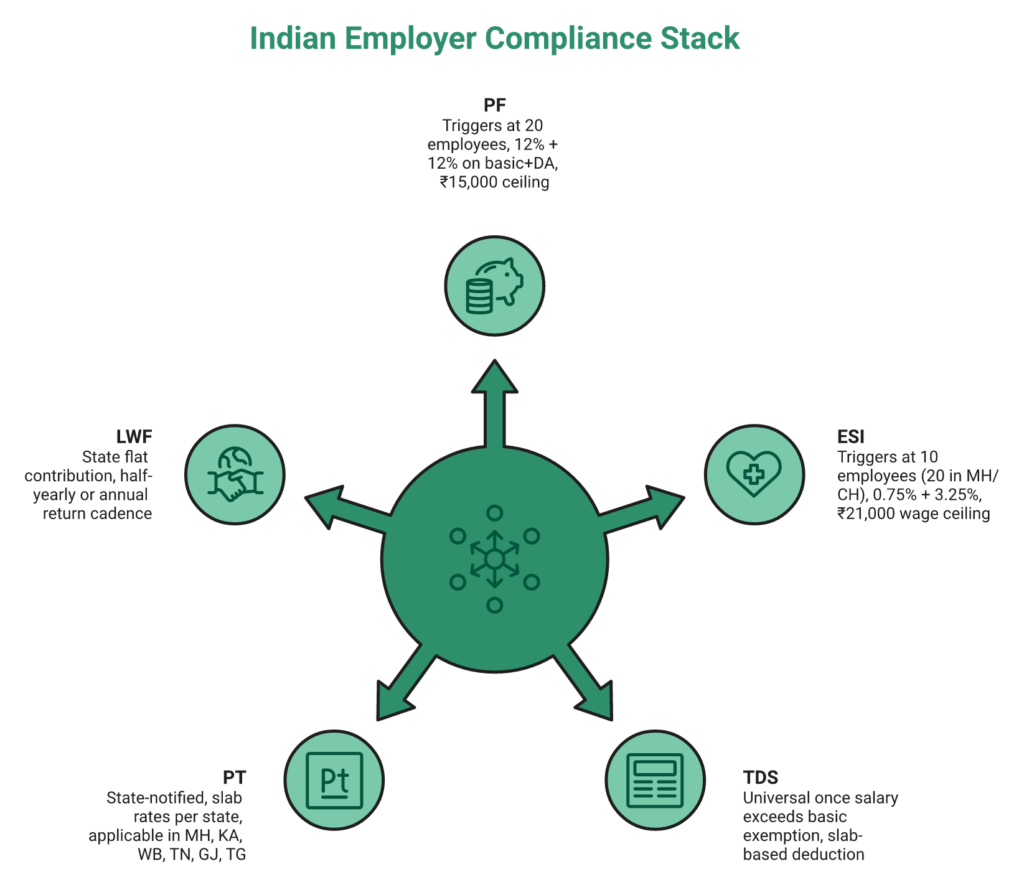
Indian employer compliance in 2026 spans EPF (with its sub-schemes EPS and EDLI), ESI, TDS on salary under Section 192, state Professional Tax, and Labour Welfare Fund, collectively requiring registration, monthly deduction and deposit, quarterly and annual returns (ECR, Form 24Q, Form 130), seven-year record retention, and inspection readiness against EPFO, ESIC, CBDT, and state labour authorities.
The Compliance Scope on a Single Page
I have watched too many 500-employee firms carry this load in three separate heads, each convinced their piece is the “main” piece. It never is. The snapshot below is the one sheet every CFO, CHRO, and payroll lead should be able to recite without opening a tab.
| Statute | Authority | Applicability Trigger | Rate | Monthly Due Date | Key Form | Penalty Exposure |
|---|---|---|---|---|---|---|
| EPF | EPFO | 20+ employees | 12% employee + 12% employer on basic+DA | 15th | ECR, Form 3A, Form 6A | Sec 7Q 12% p.a. plus Sec 14B 5 to 25% damages |
| EPS | EPFO | Via EPF | 8.33% of employer share, capped at ₹15,000 | 15th | ECR (same) | As EPF |
| EDLI | EPFO | Via EPF | 0.5% employer | 15th | ECR (same) | As EPF |
| ESI | ESIC | 10+ employees (20 in MH, CH); wage ≤ ₹21,000 | 3.25% employer + 0.75% employee on gross | 15th (21st for employee details) | ESI challan, Form 5A | 12% p.a. plus Sec 85 prosecution |
| TDS (Salary) | CBDT | Taxable income above slab | Slab-based per regime | 7th | Challan 281, Form 24Q, Form 130 | 1% / 1.5% monthly plus Sec 234E ₹200/day plus Sec 271C up to 100% |
| Professional Tax | State | State-notified (MH, KA, WB, TN, GJ, TS, etc.) | State slab | State-wise (mostly 10th to 21st) | State PT return | 10 to 50% state penalty |
| LWF | State | State-notified | State-specific flat | Half-yearly/annual | State LWF return | State penalty plus interest |
Who This Guide Is Built For
This playbook is written for 100 to 1,000 employee Indian employers, the band where compliance stops being a clerical task and starts behaving like a balance-sheet risk. If you are running payroll software on Excel, attendance on a biometric portal, and statutory compliance in payroll through an outsourced vendor who emails you a challan on the 14th, you are the reader.
The Three 2026 Reset Events
⏰ Why 2026 Is Not a Normal Year
Three events collapsed the old SOPs:
- Labour Codes operationalised in November 2025, redefining “wages” as at least 50% of CTC and re-basing PF and ESI.
- Form 16 was replaced by Form 130 effective 1 April 2026, with TDS sections renumbered and the “Tax Year” concept formally replacing “Assessment Year”.
- EPFO 3.0 and ESIC 2.0 moved employers to a unified digital file with auto-generated notices on ECR anomalies.
Any team still running a FY 2024-25 checklist in FY 2026-27 will fail a TRACES utility validation or an EPFO pre-deposit check inside the first cycle.
💸 Why This Belongs on the Board Agenda
A single missed cycle for a 500-employee firm routinely costs ₹8 to 10 lakh in combined Section 7Q interest, Section 14B damages, and Section 234E late-fees, before anyone opens a Section 7A or 45A proceeding. Multiply that by a quarter of drift, and the number becomes an audit-committee conversation, not a payroll footnote.
A CFO who cannot show penalty-avoided rupees, and a CHRO who cannot produce a compliance score on demand, are both exposed the next time the board asks “what’s our regulatory risk this quarter”. Compliance stopped being an HR back-office task the moment the penalty line became visible in the P&L.
How HROne Collapses the Five-Statute Stack Into One Engine
At HROne, we treat PF, ESI, TDS, PT, and LWF as one integrated compliance engine, not five side processes. Pre-deposit validations catch UAN, IP, and PAN mismatches before the ECR leaves your system, seven-year digital archival keeps every challan and acknowledgement inspection-ready, and the inbuilt ROI calculator rolls compliance health into a board-ready score, replacing the “three portals and a spreadsheet” model most mid-market firms still run.
Q2: Which Applicability Thresholds Trigger PF, ESI, TDS, PT, and LWF Obligations as Your Headcount Scales from 50 to 1,000 Employees?
PF applies the moment an establishment crosses 20 employees (with voluntary coverage below that) and covers employees earning basic+DA up to ₹15,000; ESI applies at 10 employees (20 in Maharashtra and Chandigarh) in notified areas with a ₹21,000 wage ceiling (₹25,000 for PwD); TDS applies universally once taxable income crosses the basic exemption; PT and LWF vary state by state.
The Headcount-Band Diagnostic
Most compliance failures I see are not about rates, they are about missing the moment an obligation switched on. This is how the stack actually layers as you scale:
50-Employee Startup
✅ TDS is always live; every salaried hire above the basic exemption triggers Section 192 deduction.
✅ ESI is live in most notified areas once you cross 10 employees (20 in MH/CH).
✅ Professional Tax is live if you operate in Maharashtra, Karnataka, West Bengal, Tamil Nadu, Gujarat, or Telangana.
⚠️ PF is voluntary below 20 employees, but voluntary coverage, once opted in, is irreversible.
100-Employee Mid-Market
✅ PF and ESI are both compulsory.
✅ LWF triggers in states that have notified schemes (MH, KA, TN, GJ, WB, DL, and others).
⚠️ First exposure to Shram Suvidha single-window inspections.
250-Employee Firm
✅ EPFO Section 7A inquiry risk rises materially, especially on wage-base classification.
✅ Contractor coverage becomes non-negotiable under EPF Section 2(f) and ESI Section 2(9) principal-employer liability.
✅ ESI Section 45A self-assessment enters play for wage-suppression disputes.
500-Employee Firm
✅ Multi-state PF, ESI, and PT codes; separate ECRs per region.
✅ International workers are covered under EPF Section 83 irrespective of the ₹15,000 wage ceiling or nationality.
⚠️ Cross-border social security agreements (Germany, France, Belgium, Netherlands, and 20+ others) change contribution mechanics for detached workers.
1,000-Employee Enterprise
✅ Internal statutory audit and board-level compliance reporting become standard.
✅ Gig and platform-worker treatment under the Code on Social Security enters the conversation.
✅ EPFO 3.0 digital notices on ECR anomalies are auto-generated, so data hygiene at source matters more than filing speed.
❌ Where Spreadsheet-Run Compliance Breaks
The Ceiling-Crossing Blind Spot
The single most common failure I have fixed personally is the employee who crosses the ₹21,000 ESI contribution calculation ceiling mid-quarter because of a revised CTC, and whose payroll Excel never recalculates coverage. Three months later, an ESIC SSO visits, and the firm is on the wrong end of a Section 45A self-assessment for 38 employees.
The same pattern repeats on PF when a contractor is misclassified, on PT when a hire relocates state, and on LWF when a state scheme gets notified mid-year and nobody updates the master.
How HROne Catches Threshold Events at Source
At HROne, multi-legal-entity core HCM auto-activates PF, ESI, PT, and LWF the moment a headcount or wage threshold is crossed per state, includes contractors and international workers under distinct compliance flows, and fires a HR inbox alert the day a ceiling-crossing or state-expansion event happens, so the spreadsheet gap simply never materialises.
Q3: How Do Contribution Rates, Wage Definitions, and the Code on Wages Transition Compute Your Monthly Liability, With Worked Examples?
Monthly statutory liability stacks as PF 12% employee + 12% employer (split EPS 8.33% capped at ₹15,000, EPF 3.67%, EDLI 0.5%, admin 0.5%) on basic+DA, ESI 0.75% employee + 3.25% employer on gross up to ₹21,000, and TDS per annual projection under the old regime (₹3 lakh exemption, FY 2025-26) or new regime (₹4 lakh exemption plus standard deduction, FY 2025-26), with “wages” now defined as at least 50% of total CTC under the Code on Wages.
The Five-Step Monthly Computation
Step 1: Classify CTC Components Against the New “Wages” Definition
Under the Code on Wages, “wages” must be at least 50% of total remuneration. HRA, conveyance, special allowance, and performance pay that previously sat outside basic now have to be tested against the 50% floor. Where basic+DA falls short, it is deemed to be 50% for PF and gratuity bases.
Step 2: Compute PF on Basic+DA With the EPS/EPF/EDLI Split
- Employee: 12% of basic+DA to EPF.
- Employer: 8.33% to EPS (capped at ₹15,000, so ₹1,250 max), balance 3.67% to EPF, plus 0.5% EDLI and 0.5% admin charges.
- Voluntary higher contributions above the ₹15,000 ceiling are permitted but require an irrevocable election.
Step 3: Compute ESI on Gross (Up to ₹21,000)
ESI base is gross wages including most allowances but excluding annual bonus, gratuity, and retrenchment compensation. 0.75% employee plus 3.25% employer.
Step 4: Project Annual Taxable Salary and Apply Deductions
- Capture Form 12BB declarations for HRA exemption (minimum of actual HRA, 50%/40% of basic, or rent minus 10% of basic).
- Apply Section 80C (₹1.5 lakh), 80D, and 80CCD(1B) deductions under the old regime; the new regime disallows most.
- Add prior-employer income if disclosed via Form 12B, re-compute TDS for the remaining year.
- Value perquisites under Rule 3 (car, accommodation, ESOPs, loans).
Step 5: Pick the Employee-Optimal Regime and Deduct TDS
Run both regimes in parallel and default to the lower liability; record the employee’s written election at year-start.
Worked Examples
Example A: ₹8 Lakh Annual Salary, Old vs New Regime (FY 2025-26)
| Head | Old Regime | New Regime |
|---|---|---|
| Gross | ₹8,00,000 | ₹8,00,000 |
| Standard deduction | ₹50,000 | ₹75,000 |
| 80C (PF+ELSS) | ₹1,50,000 | , |
| 80D | ₹25,000 | , |
| Taxable | ₹5,75,000 | ₹7,25,000 |
| Tax plus cess | ~₹29,640 | ~₹28,600 |
| Monthly TDS | ~₹2,470 | ~₹2,383 |
Example B: Basic+DA ₹25,000, PF Split
- Employee EPF: ₹3,000
- Employer EPS: ₹1,250 (capped at 8.33% of ₹15,000)
- Employer EPF: ₹1,750 (3,000 minus 1,250)
- EDLI: ₹75 (0.5% of ₹15,000)
- Admin: ₹75
Example C: ESI on Gross ₹20,000
- Employee: ₹150 (0.75%)
- Employer: ₹650 (3.25%)
- Total monthly ESI: ₹800
Example D: Cross-Base Reconciliation
For the same employee, PF wages (basic+DA), ESI wages (gross capped at ₹21,000), and TDS taxable salary (gross minus exemptions minus deductions) are deliberately three different numbers. Compliance failures stem from treating them as one.
How HROne Runs the Math for You
Our payroll calculation explained engine applies the Code-on-Wages 50% rule at CTC setup, splits basic-DA to keep PF and ESI bases correct, runs both tax regimes in parallel to suggest the employee-optimal choice, captures Form 12BB digitally, re-computes TDS when prior-employer income arrives, and outputs a ready ECR, ESI challan, and Form 24Q without a single manual formula. The TDS calculator lets HR teams sanity-check any projection in seconds.
Q4: How Do You Register on EPFO, ESIC, TRACES, Shram Suvidha, and State PT/LWF Portals, And What Is the Monthly, Quarterly, and Annual Filing Calendar?
Within 15 days of crossing each applicability threshold, register on Shram Suvidha (for the LIN), EPFO Unified Portal, ESIC portal, TRACES (for TAN holders), and the relevant state PT and LWF portals; then run a fixed monthly rhythm: 7th TDS deposit, 15th PF ECR plus ESI contribution plus PT, 21st ESI employee details, quarterly Form 24Q, half-yearly ESI Form 5A, annual PF Form 6A, ESI annual return by 11 May, and Form 130 by 15 June.
Part A: Registration Playbook
EPFO Unified Portal
- Create employer login on unifiedportal-emp.epfindia.gov.in.
- Upload PAN, incorporation certificate, cancelled cheque, address proof, and a class-3 DSC.
- Obtain the PF establishment code; link it to Shram Suvidha LIN.
- Generate UANs for all eligible employees and complete Aadhaar KYC.
ESIC Portal
- Register on esic.in with PAN, incorporation, bank details, and the list of employees with Aadhaar and dispensary preference.
- Obtain the 17-digit ESI code within 15 days of crossing the threshold.
- Generate IP numbers and map each to a dispensary.
TRACES for TAN Holders
Register with TAN, PAN, and DSC; TRACES is your interface for Form 24Q, Form 27A corrections, and Form 130 issuance.
Shram Suvidha Single Window
Apply for the Labour Identification Number (LIN) linking EPFO, ESIC, CLC, and DGMS in one record; this is the file an inspector opens first.
State PT and LWF
Register separately in each state of operation on the commercial-tax and labour-welfare portals; rules, slabs, and frequencies differ by state.
❌ The Five Rejections That Waste Week One
- Aadhaar-UAN name mismatch (honorifics and middle names).
- Wrong NIC activity code.
- DSC expired, or class-2 submitted instead of class-3.
- IFSC mismatch between cancelled cheque and employer master.
- Missing dispensary mapping on ESI IP generation.
Part B: The 2026 Filing Calendar
| Statute | Activity | Form / Challan | Due Date | Authority |
|---|---|---|---|---|
| TDS | Monthly deposit | Challan 281 | 7th of next month | CBDT |
| PF | Monthly ECR plus payment | ECR | 15th | EPFO |
| ESI | Monthly contribution | ESI challan | 15th | ESIC |
| ESI | Employee details | Monthly return | 21st | ESIC |
| PT | Monthly deposit | State PT return | State-wise (10th to 21st) | State |
| TDS | Quarterly return | Form 24Q (Q1/Q2/Q3/Q4) | 31 Jul / 31 Oct / 31 Jan / 31 May | CBDT |
| TDS | Correction | Form 27A | As required | TRACES |
| ESI | Half-yearly | Form 5A / Annual | 11 May, 12 Nov | ESIC |
| PF | Annual consolidated | Form 6A / 3A | 30 April | EPFO |
| TDS | Annual certificate | Form 130 (replaces Form 16) | 15 June | CBDT |
| TDS | Non-salary credit | Form 12BAA | With Form 24Q | CBDT |
| AIS/TIS | Reconciliation | AIS view | Ongoing | CBDT |
| LWF | State return | State LWF challan | Half-yearly / annual | State |
⭐ Field-Tested Habits That Keep the Calendar on Rails
- Freeze payroll inputs 72 hours before the 15th, not 24 hours.
- Run a UAN/IP/PAN hygiene sweep on the 5th of every month; notices almost always trace back to stale master data.
- Keep a shared RACI so the person who owns the challan upload is never the person who approves payment.
How HROne Runs the Calendar for You
The HROne compliance calendar surfaces every deposit and return date inside the Super Inbox with 72-hour escalations, auto-generates ECR, ESI challan, Form 24Q, Form 130, and state PT and LWF outputs, and keeps a single audit trail across authorities, so a first-time filer never bounces an ECR on day one for a name-match mismatch. Teams looking to pressure-test the rhythm can start with a book a demo or review the payroll solution in detail.
Q5: What Does the Unified PF, ESI, TDS, and PT Penalty and Interest Matrix Look Like, With Quantified Cost-of-Non-Compliance Scenarios?
PF delays attract 12% p.a. interest under Section 7Q plus 5 to 25% damages under Section 14B (5% for less than two months, 10% for 2 to 4 months, 15% for 4 to 6 months, 25% beyond six months); ESI attracts 12% interest and Section 85 prosecution; TDS attracts 1% per month for non-deduction, 1.5% for late deposit, Section 234E ₹200/day, Section 271C up to 100% penalty, and Section 276B prosecution; PT carries state-specific penalties typically 10 to 50%.
The Unified Penalty and Interest Matrix
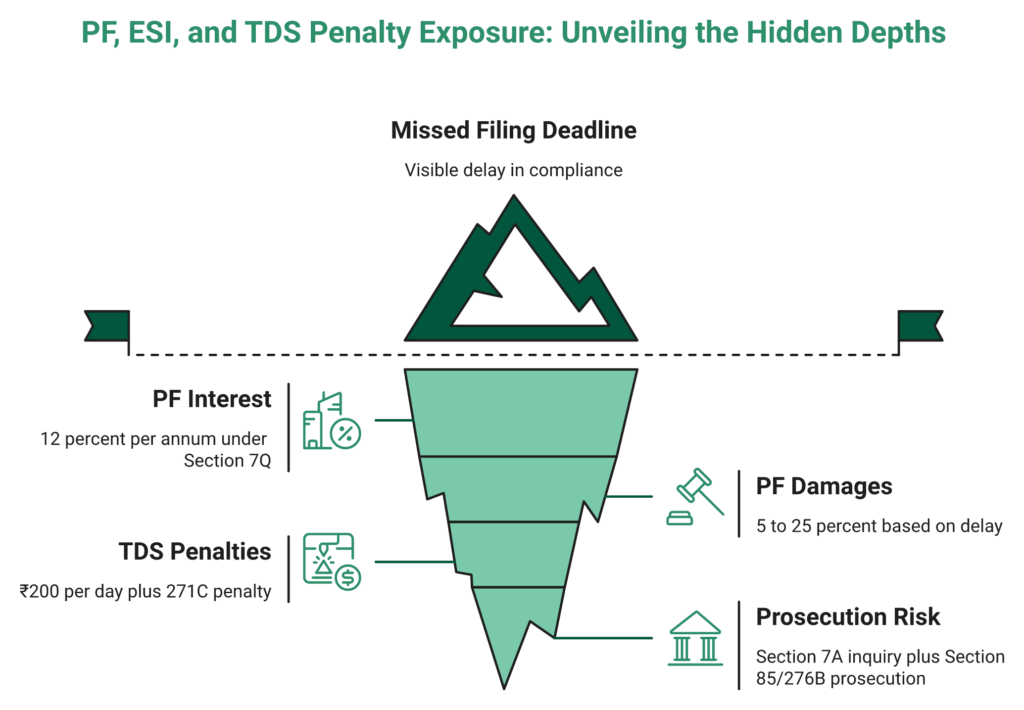
This is the single sheet I hand every CFO who asks me “is our exposure actually material?” The answer sits in the rightmost column.
| Violation | Statute Section | Interest | Damages / Penalty | Prosecution Risk |
|---|---|---|---|---|
| PF non-deposit | EPF Sec 7Q plus 14B | 12% p.a. | 5% less than 2m, 10% 2 to 4m, 15% 4 to 6m, 25% greater than 6m | Sec 14 prosecution possible |
| PF short-deposit | EPF Sec 7A | 12% p.a. on shortfall | Damages at 14B slabs on shortfall | Sec 7A inquiry |
| ESI non-contribution | ESI Act Sec 39 plus 85B | 12% p.a. | Up to 25% damages | Sec 85: 6 mo to 3 yr imprisonment plus fine |
| ESI wage-suppression | ESI Sec 45A | 12% p.a. on reassessed wages | Self-assessment plus damages | Sec 85 |
| TDS non-deduction | IT Sec 201(1A) | 1% per month | Sec 271C: up to 100% of tax not deducted | Sec 276B: 3 mo to 7 yr |
| TDS late deposit | IT Sec 201(1A) | 1.5% per month | Disallowance u/s 40(a)(ia) | Sec 276B |
| Form 24Q late filing | IT Sec 234E plus 271H | , | ₹200/day, capped at TDS amount; 271H up to ₹1 lakh | , |
| Form 130 delay | IT Sec 272A(2)(g) | , | ₹100/day per certificate | , |
| PT default | State Acts | State-specific (usually 1.25 to 2% p.m.) | 10 to 50% penalty | State prosecution in some states |
⚠️ Quantified Cost-of-Non-Compliance by Company Size
The Numbers CFOs Rarely See on a Single Slide
These are modelled on a typical basic-plus-DA wage base, a blended TDS liability, and the assumption that the delay is caught at the next quarter’s audit rather than a year later.
| Firm Size | Scenario | Approx. Exposure |
|---|---|---|
| 100 employees | 1 PF cycle missed 45 days | ~₹1.2 lakh (7Q interest plus 10% 14B damages) |
| 250 employees | PF plus TDS missed 60 days | ~₹4.0 lakh (combined interest, damages, and 234E) |
| 500 employees | PF plus ESI plus TDS missed 90 days | ~₹8 to 10 lakh |
| 1,000 employees | Full quarter slippage across PF, ESI, and TDS | ~₹18 to 22 lakh |
💸 Why the Leak Compounds Silently
Three things turn a one-month slip into a quarterly write-off:
- Section 14B damages are applied on the outstanding principal, so short-deposits accrue alongside interest.
- Section 234E fines run per day with no grace window, even when the underlying TDS was deposited on time.
- Section 271C penalties can be levied years later on a reopened assessment, and by that point the CA bill to contest it often exceeds the original penalty.
How HROne Turns Penalty Exposure Into Board-Reportable Savings
Our auto-scheduled payroll software freezes disbursal if the statutory math fails, runs pre-deposit validations on UAN, IP, and PAN integrity, surfaces avoided-penalty rupees on the inbuilt ROI calculator, and maintains a per-employee compliance audit trail, so the ₹8 to 10 lakh quarterly leak most mid-market firms absorb silently becomes a reportable, board-ready saving.
Q6: Why Do EPFO and ESIC Notices Actually Arrive, and How Do You Run an Inspection-Ready Compliance File?
EPFO, ESIC, and CBDT notices almost always trace to five upstream root causes: late deposits, wage-base under-reporting, UAN/IP/PAN duplication or mismatch, contractor coverage gaps under principal-employer liability, and CTC revisions not reflected in the ECR. Inspection-readiness means keeping registrations, monthly ECRs, challans, Form 24Q and Form 130, wage registers, attendance logs, and contractor agreements digitally indexed for seven years.
What Actually Triggers the Summons
The Scene I Have Lived Through Too Often
A Payroll Manager at a 300-employee manufacturer gets a Section 7A summons on a Tuesday morning. By Wednesday afternoon, the team is pulling three years of Excels from a former outsourced vendor, realising that 14 contractor workers were never mapped under principal-employer liability, and that the CTC revision done in October 2024 never flowed into the ECR because someone “updated it in the payroll sheet”. The next two weeks are not a compliance exercise. They are an archaeology project.
❌ Where the Industry Quietly Gets This Wrong
Most Indian mid-market firms treat notices as legal events and hand them straight to a CA to reply. That preserves the symptom. Outsourced payroll vendors, Keka, and greytHR all deliver competent monthly filing, but none of them catch contractor coverage gaps, wage-definition drift, UAN duplication across legal entities, or AIS/TIS mismatches at the source. Roughly 80% of notices I have reviewed were upstream data-hygiene failures that the filing vendor had no mandate to flag.
“What I like most about HROne is how it blends smart HR technology with a genuine human touch. It doesn’t simply automate processes like payroll, attendance, and compliance, it makes them easier to handle and more approachable for both HR teams and employees.”
— Nijanthan R., HR HROne G2 – Verified Review
The Strategic Shift, From CA Firefight to Data Architecture
Notices are symptoms of a data-architecture flaw, not a filing flaw. The fix is a single statutory engine that validates pre-deposit, auto-archives seven years of evidence, and generates sample-ready reply drafts with portal-linked proof, so a Section 7A reply takes 48 hours, not two weeks.
✅ The Inspection-Ready File (Three Buckets, 7-Year Retention)
- Registrations and master data: PF code, ESI 17-digit code, TAN, LIN, state PT and LWF registrations, DSC audit log, and NIC activity code.
- Monthly deposits and returns: ECRs with challan receipts, ESI challans and returns (monthly, half-yearly, and annual), Challan 281, Form 24Q (Q1 to Q4), Form 27A corrections, Form 130, Form 12BAA, and state PT and LWF challans.
- Employee-level evidence: Wage registers, attendance logs, leave cards, CTC revision letters, Form 12BB declarations, Aadhaar-UAN-PAN match proofs, and contractor agreements with principal-employer liability clauses.
How HROne Replaces the Archaeology Project
Our payroll solution module runs pre-deposit validations on PF wage base, ESI coverage, UAN uniqueness, and contractor principal-employer liability, archives every ECR, challan, Form 24Q, Form 130, and acknowledgement for the full seven-year window, generates inspection-ready PDF bundles by date range, and ships sample reply drafts for Section 7A, 14B, 45A, and 201 notices, so the next summons lands on a file that is already built. Teams with heavy contractor footprints can read the payroll software compliance risk guide for the full architecture.
“Proper calculation of PF and ESI was a pain area for us before, but now with the HROne automated calculation process, results are up to the mark and following Indian tax compliances properly.”
— Ajay K., Payroll Lead HROne G2 – Verified Review
“It handles salary calculations, statutory deductions, PF, ESI, and taxes, and filings automatically, with zero manual intervention, removing payroll errors and compliance anxiety during audits.”
— Waldon S., HR Operations HROne G2 – Verified Review
Q7: How Does the April 2026 TDS Overhaul (Form 16 to Form 130, Section Renumbering, Tax Year Concept) and EPFO 3.0/ESIC 2.0 Modernisation Change Payroll Operations?
From 1 April 2026, CBDT replaced Form 16 with Form 130, renumbered TDS sections for clarity, formally introduced the “Tax Year” concept replacing “Assessment Year”, and mandated Form 12BAA for non-salary TDS credit. Simultaneously, EPFO 3.0 and ESIC 2.0 moved employers onto a unified digital file with auto-generated notices and ECR reconciliation.
⏰ How It Works Under the New Regime
What Actually Changed in the Schema
- Form 130 consolidates Part A and Part B of the old Form 16, pulls AIS/TIS reconciliation directly from the CBDT backend, and cross-links every TDS credit against the employee’s PAN.
- Form 12BAA is a new employee declaration that pushes non-salary TDS credit (FD interest, rent TDS, and dividend) into the payroll engine so withholding is adjusted in real time.
- Tax Year maps cleanly to the financial year, collapsing the “AY = FY + 1” confusion that has tripped employees for two decades.
- Code on Wages re-bases PF and ESI wages at 50% of CTC, changing the denominator of every statutory calculation.
- EPFO 3.0 auto-generates digital notices the moment an ECR shows a wage-base variance, a missing UAN, or a contractor coverage gap.
The Employee-Facing Reality
Employees will see a Form 130 that looks materially different from last year’s Form 16, and they will ask why. Payroll teams without a pre-patched HRMS will spend April and May answering the same three questions fifty times each week.
❌ Why It Matters, The Penalty Trap Hiding in Plain Sight
Employers running legacy Excel templates or un-patched Keka and greytHR utilities will file Form 24Q that the TRACES utility quietly rejects on the new schema, which triggers Section 234E at ₹200/day even when the deposit was timely. Meanwhile, EPFO 3.0 auto-flags contractor coverage gaps against the principal employer’s code instead of waiting for an inspector visit, so the window to self-correct has shrunk from months to days.
⚖️ Comparison Anchor, Patched-In-Time vs Caught-On-The-Cycle
- Manual tax teams patching Excel templates are running a race against CBDT’s utility releases; miss a revision, and Q1 FY 2026-27 filings bounce.
- Outsourced vendors issue last-minute email circulars two weeks before deadlines; the lag sits entirely on the employer.
- Un-patched HRMS products need a back-end developer to remap section codes and wage bases, exactly the developer-dependency that the 100 to 1,000 employee market does not have in-house.
- A native, India-first HRMS ships Form 130, renumbered sections, 12BAA, and the Code-on-Wages wage-base update as a standard release before 1 April 2026.
✅ Product Connect, How HROne Shipped the Transition
At HROne, our TDS engine released the Form 130, renumbered-section, and Tax Year update before 1 April 2026, auto-maps existing CTC structures to the new schema, produces Form 130 and Form 12BAA from the same employee record, reconciles AIS/TIS inside the employee self-service tab, and handles EPFO 3.0 auto-notice responses with one-click portal replies, so the transition is a product update, not a migration project. Our TDS calculator and the payroll taxes calculation India reference give HR and finance teams a way to pressure-test every new slab before the first cycle.
The philosophy is simple. When a CBDT circular or an EPFO release drops, the customer should hear about it from their HRMS, not from their CA.
Q8: How Does the Compliance Maturity Model (Level 0 Reactive to Level 4 Automated) and a 90-Day Onboarding / Recovery Playbook Apply to Your Organisation?
The Compliance Maturity Model ranks employers across five levels: Level 0 Reactive (Excel and missed deadlines), Level 1 Process (calendar and SOP), Level 2 Integrated (payroll engine with validations), Level 3 Predictive (pre-deposit analytics), and Level 4 Automated (auto-scheduled runs and a board-ready ROI dashboard). A 90-day onboarding or recovery playbook moves most mid-market firms from Level 0 or 1 to Level 3 in a single quarter.
The Five Levels on One Page
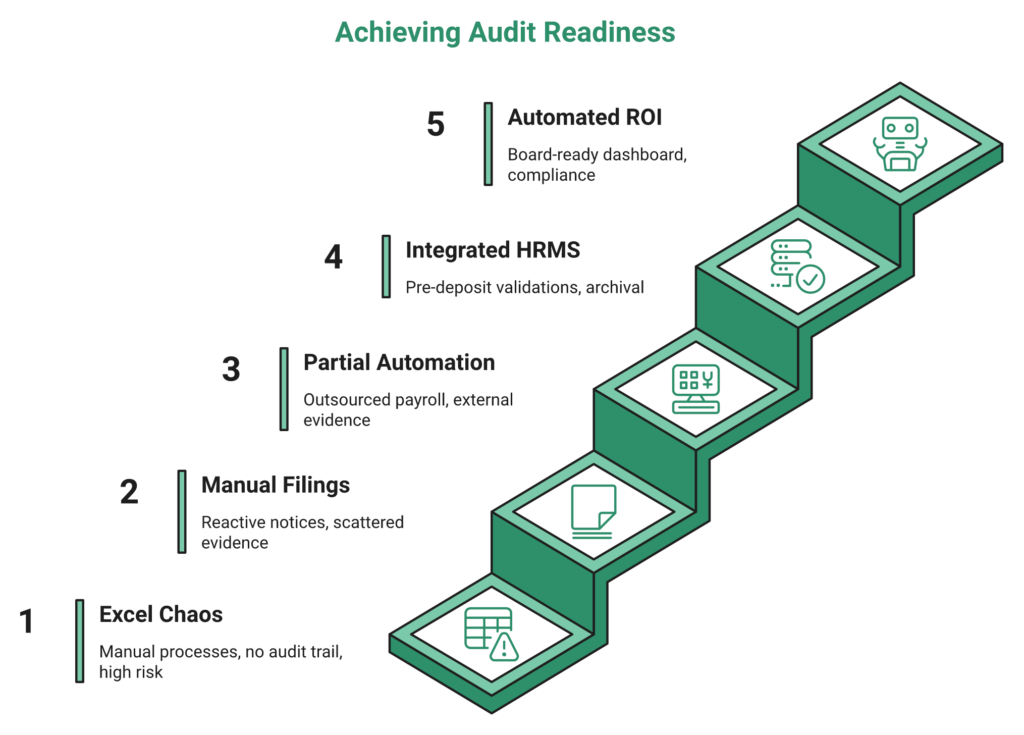
| Level | Signature Behaviour | Typical Penalty Exposure | KPIs Tracked |
|---|---|---|---|
| 0. Reactive | Excel, emailed challans, and missed deadlines | ₹8 to 20 lakh/year | None formally tracked |
| 1. Process | Documented calendar, RACI, and outsourced filings | ₹3 to 6 lakh/year | On-time deposit % |
| 2. Integrated | Payroll engine with statutory validations | ₹1 to 2 lakh/year | Deposit % plus active-notice count |
| 3. Predictive | Pre-deposit analytics and contractor coverage flags | Less than ₹50,000/year | All 5 compliance KPIs |
| 4. Automated | Auto-scheduled runs and an inbuilt ROI Dashboard | ~₹0, surplus reported | Board-ready scorecard |
The five KPIs worth locking in from Day 1: on-time deposit percentage, active-notice count, penalty rupees avoided versus prior-year baseline, inspection-readiness score, and contractor coverage percentage.
⏰ The First 90 Days, For Newly Threshold-Crossed Employers
Days 1 to 30: Registrations and Clean-Up
- Register on Shram Suvidha, EPFO, ESIC, TRACES, and relevant state PT and LWF portals.
- Audit every CTC against the Code-on-Wages 50% rule, and rebuild basic-DA splits where needed.
- Run a UAN, IP, and PAN hygiene sweep; fix every Aadhaar name mismatch before the first filing cycle.
Days 31 to 60: First Full Cycle and File Digitisation
- File the first ECR, ESI challan, Form 24Q, and state PT return.
- Digitise the last 24 months of challans, wage registers, attendance logs, and contractor agreements into the 7-year retention folder.
- Publish the compliance calendar with 72-hour escalations against every due date.
Days 61 to 90: Scoring and Hand-Off
- Score the organisation against the Maturity Model; publish the first CHRO compliance scorecard via CHRO solutions.
- Lock in monthly RACI, freeze payroll inputs 72 hours before the 15th, and hand off the operating rhythm.
🛠️ The Recovery Playbook, For Already-Non-Compliant Employers
- Voluntary disclosure first, before an inspector forces a Section 7A inquiry; negotiated Section 14B damages are almost always softer than imposed ones.
- Back-period ECR upload with clearly flagged arrears, paired with a cover letter explaining the correction.
- ESI Section 45A self-assessment for wage-suppression corrections, which caps the assessment window and protects against prosecution under Section 85.
- Revised Form 24Q for prior quarters with Section 234E mitigation arguments, particularly where deposits were timely but returns slipped.
✅ Product Simplification, The 30-Day Go-Live That Skips Level 0 and 1
At HROne, our prior-HR onboarding consultant model takes customers live in roughly 30 days, ships a Level-3 stack on Day 1 with pre-deposit validations already switched on, and publishes the maturity score on the inbuilt ROI Dashboard, collapsing the 90-day journey into a single quarter with board-visible KPIs rather than a PowerPoint retrofit assembled the night before a review. Teams that want to see the architecture end-to-end can explore the core HCM spine, the payroll audit checklist, or book a demo.
Q9: Should You Run PF, ESI, and TDS Compliance In-House, Outsource It to a Bureau, or Operate It Through a SaaS HRMS?
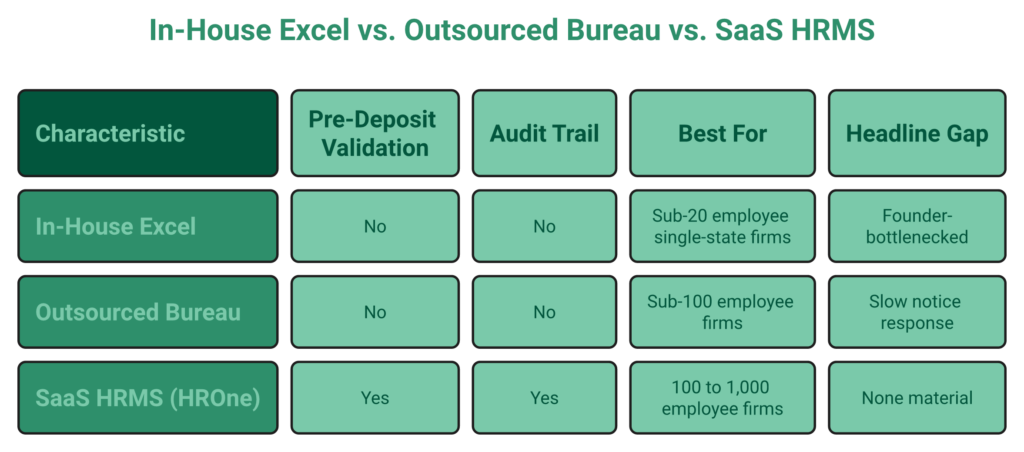
Choose the operating model by compliance surface-area (headcount × states × entities), internal expertise, penalty exposure, and single-source-of-truth integrity, not by per-employee vendor price. 100 to 250 employee firms are best served by HRMS-led SaaS compliance, 250 to 1,000 by HRMS paired with a specialist retainer, and sub-100 by an outsourced bureau only if the payroll data stays clean.
The Real Stakes Behind the Choice
Why This Is Not a Vendor-Price Conversation
The stakes here are ₹8 to 10 lakh of quarterly penalty exposure and the CHRO’s inability to show a single compliance dashboard at a board review, not the monthly vendor invoice. Every CFO I have watched debate this choice anchors on PEPM cost and loses sight of the data-flow question: who owns the employee master, who validates the wage base pre-deposit, and who has the evidence file if an inspector walks in on Monday.
❌ The Wrong Way to Decide
- Picking the cheapest PEPM and assuming compliance comes bundled.
- Staying with the outsourced payroll vendor because “they know our data”.
- Copying the peer-CHRO’s HRMS choice without matching the compliance surface-area.
- Treating the CA as the compliance owner, and the HRMS as a filing portal.
Each of these ignores the only question that matters: does every PF, ESI, and TDS event emerge from the same employee record that runs payroll, attendance, and CTC revisions?
✅ The Right Evaluation Framework, 7 Criteria
- Multi-state PF, ESI, and PT code handling on a single instance.
- Code-on-Wages and April-2026 TDS patch cadence shipped on time as a product release.
- Pre-deposit validation for UAN, IP, and PAN integrity before any ECR or Form 24Q is generated.
- Seven-year inspection-file auto-archival with indexed retrieval by date, employee, or authority.
- Notice-response SLA with portal-ready evidence bundles and sample reply drafts.
- ROI visibility on avoided-penalty rupees, rolled into a board-ready scorecard.
- Front-end configurability, a leave policy or PT slab change without raising a developer ticket.
Buyers weighing this trade-off often cross-reference the how to choose payroll software checklist before committing.
⭐ Applying the Framework, Scorecard
| Operating Model | Score (/7) | Headline Gap |
|---|---|---|
| HROne (SaaS HRMS) | 7/7 | None material for 100 to 1,000 employee band |
| Darwinbox | 5/7 | Day-one billing, tab fatigue, and weaker ROI instrumentation |
| Keka | 4/7 | Email-only support, slower patch cadence |
| greytHR | 4/7 | Rigid configuration on multi-entity PT/LWF |
| Zoho Payroll | 3/7 | Thin on multi-legal-entity India depth |
| Outsourced bureau | 3/7 | Evidence file lives outside the employer |
| In-house Excel | 1/7 | No pre-deposit validation, and no audit trail |
How HROne Slots Into the Framework
At HROne, we designed the payroll software and Compliance modules to score against all seven criteria on Day 1: multi-entity code handling (Asia Healthcare Holdings runs 20 pan-India units on a single instance), shipped Form 130 and Code-on-Wages before 1 April 2026, pre-deposit validation built into the auto-scheduler, seven-year archival, sample reply drafts for Section 7A, 14B, 45A, and 201 notices, and the inbuilt ROI calculator translating avoided penalties into rupees.
“I use HROne to automate our HR processes, eliminating manual errors, and ensuring compliance. It reduces HR’s admin time by 60 to 70% through features like Inbox for HR, which centralizes tasks. Payroll is automated, cutting errors.”
— Waldon S., HR Operations HROne G2 – Verified Review
“Salary processing along with exact calculation of LWF and PT slabs makes the work more convenient process.”
— Komal S., HR HROne G2 – Verified Review
Q10: Which PF, ESI, and TDS Compliance Platforms Actually Serve Indian Mid-Market Employers in 2026?
Five platforms consistently surface in 100 to 1,000 employee compliance conversations in India: HROne, Keka, greytHR, Zoho Payroll, and RazorpayX Payroll. They are evaluated here against the same Q9 anchors: multi-state code handling, April-2026 patch cadence, pre-deposit validation, seven-year archival, and ROI visibility. For a broader market view, see the top 10 payroll software India listicle.
#1 HROne ⭐
Best For: 100 to 1,000 employee India-HQ firms with multi-state or multi-entity operations wanting a single Payroll plus Compliance engine with an inbuilt ROI Dashboard.
Skip If: you are a sub-50 employee single-state startup where a ₹5,000/month outsourced bureau will do.
Compliance Coverage: PF, EPS, EDLI, ESI, TDS (Form 130 ready), PT, LWF, Code-on-Wages wage base, seven-year digital archival, pre-deposit validations, and EPFO 3.0 auto-notice response.
Pricing: flat PEPM, billed from go-live, no hidden per-entity charges, and no multi-year lock-in. Full details on the pricing page.
Proof: G2 #3 overall satisfaction, 9.8 NPS on onboarding SPOC, Asia Healthcare Holdings running 20 units on a single instance, and MR DIY India collapsing payroll from 10 days to 5 to 6.
“Proper calculation of PF and ESI was a pain area for us before, but now with the HROne automated calculation process, results are up to the mark and following Indian tax compliances properly.”
— Ajay K., HR Lead HROne G2 – Verified Review
#2 Keka
Best For: 100 to 500 employee firms prioritising surface UX polish and a clean dashboard.
Skip If: you need phone support within 24 hours, multi-entity India depth, or the April-2026 TDS patch on Day 1.
Compliance Coverage: PF, ESI, TDS, and PT baseline; Form 130 cadence lags on customer reports.
Pricing: published PEPM with module tiers.
Honest Limitations: email-only support, slower onboarding, and weaker escalation matrix. Buyers can explore the HROne vs Keka comparison for a side-by-side view.
“We started working with Keka HRMS in August, and to this day, we have been unable to implement the tool in our company due to their consistently delayed responses and poor coordination between their internal teams.”
— Divya P., HR Keka – G2 Verified Review
#3 greytHR
Best For: SMB payroll in single-state setups where the compliance surface is narrow.
Skip If: you need 127 pre-built hire-to-retire workflows, or complex multi-entity PT and LWF.
Compliance Coverage: strong PF, ESI, and TDS baseline; weaker on Code-on-Wages workflow and TDS revision.
Pricing: published PEPM with module add-ons.
Honest Limitations: rigid configuration, limited workflow automation, and TDS revision gaps. The HROne vs greytHR page surfaces the delta.
“Reporting configuration, TDS filing, and revising of TDS is not possible. UI for mapping of challans, and visibility of income considered for TDS filing.”
— Krishnanand B., HR greytHR – G2 Verified Review
#4 Zoho Payroll
Best For: single-entity Indian startups already deep inside the Zoho ecosystem.
Skip If: you run multi-legal-entity structures, FBP-heavy CTCs, or principal-employer contractor liability.
Compliance Coverage: PF, ESI, TDS, and PT basics; thin on contractor and multi-entity workflows.
Pricing: low-end PEPM, with feature depth that tapers as headcount crosses 200.
Honest Limitations: slow support response, and limited India-specific workflow depth.
#5 RazorpayX Payroll
Best For: digitally-native sub-200 employee firms wanting fast payout and baseline compliance.
Skip If: you need Code-on-Wages re-basing, multi-state LWF, or an inspection-ready evidence file.
Compliance Coverage: PF, ESI, TDS, and PT basics with strong bank-integration UX.
Pricing: low PEPM tied to banking relationship.
Honest Limitations: compliance depth and notice-response workflow are not core strengths.
Q11: What Case Studies and Expert Perspectives Prove What Works (and Fails) in PF, ESI, and TDS Compliance?
Three operator stories illustrate the pattern: late is not terminal if the evidence file is clean, ceiling-crossings silently destroy ESI coverage, and multi-unit consolidation is the fastest route to a 5-day payroll cycle. More operator proof sits on the customer success stories hub.
Case Study 1, The 50-Employee Startup and the Section 14B Notice
A Bengaluru SaaS company crossed the 20-employee PF threshold in August and treated the registration as a back-office item. By March, six months of late deposits had accumulated ₹4.8 lakh in 14B damages plus 7Q interest. The founder’s instinct was to fight the notice. The CA’s advice was the opposite: voluntary disclosure, migrate off the founder-maintained Excel sheet onto an HRMS with an ECR generator, upload clean back-period returns, and request damage moderation. The notice closed in 45 days with a significantly lower settlement.
Transferable principle: late filing is not terminal if the underlying data is clean, and the evidence file is indexed. ⏰
Case Study 2, The 400-Employee E-Commerce ESI Ceiling Crossing
A D2C e-commerce firm gave a 9% increment in July. Thirty-eight employees crossed the ₹21,000 ESI wage ceiling mid-quarter. The outsourced payroll vendor continued to deduct ESI on the old gross because the CTC revision letter landed on email, not in the payroll master. ESIC flagged the wage variance under Section 45A in October.
- Back-contribution plus interest exposure: ₹2.1 lakh.
- Root cause: CTC revision was an email, not a system event.
- Fix: automated ceiling-crossing alerts tied to the same record that triggers the payroll cycle.
Case Study 3, Multi-Unit Consolidation Compressing the Payroll Cycle
An MR DIY India-style retailer running 18 legal entities across 11 states collapsed the payroll cycle from 10 days to 5 to 6 days after consolidating onto a single HRMS instance with integrated PF, ESI, and TDS compliance. The quantified saving, visible on the ROI Dashboard, was roughly 1,800 HR lifetime hours per annum plus zero-rupee penalty exposure across four quarters.
Expert Panel, Two Perspectives Worth Stealing
On TDS Recomputation (Chartered Accountant)
“The joining-quarter TDS recomputation is where 70% of over-deduction cases originate. Prior-employer income disclosure under Form 12B, now layered with Form 12BAA for non-salary TDS credit, and the new-versus-old regime toggle have to be rerun every time a major CTC component changes. An HRMS that does not recompute on every CTC event will silently over-deduct for six months.”
On Inspection Readiness (Labour-Law Advocate)
“80% of Section 7A inquiries I have defended since 2022 were decided on the quality of the documentary evidence, not the statutory argument. Principal-employer liability on contractor workers is the single most under-mapped exposure in Indian mid-market, and it is the easiest finding for an EPFO inspector to flag on day one.”
✅ Product Connect, What Each Case Leveraged
- Case 1: HROne’s ECR generator and sample 14B reply drafts.
- Case 2: Ceiling-crossing alerts on the employee master tied to live core HCM.
- Case 3: Multi-legal-entity instance and the inbuilt ROI Dashboard.
“It handles salary calculations, statutory deductions, PF, ESI, and taxes, and filings automatically, with zero manual intervention, removing payroll errors and compliance anxiety during audits.”
— Waldon S., HR Operations HROne G2 – Verified Review
Q12: What Should You Do in the Next 30, 60, and 90 Days to Make PF, ESI, and TDS Compliance Board-Ready for 2026?
Compliance maturity moves in a quarter if the plan is sequenced correctly: audit first, patch second, and commit to an operating model third.
⏰ The 30-60-90 Day Plan
Days 1 to 30, Audit and Clean-Up
- Audit every CTC against the Code-on-Wages 50% rule; rebuild basic+DA splits where needed.
- Refresh the UAN, IP, and PAN master; fix every Aadhaar name mismatch before the next ECR.
- Score the organisation against the Compliance Maturity Model (Levels 0 to 4), using the payroll audit checklist as your baseline.
Days 31 to 60, Patch and Digitise
- Close inspection-file gaps for the last seven years: challans, ECRs, Form 24Q, Form 130, and contractor agreements.
- Ship the April-2026 TDS and Form 130 patch through the HRMS; communicate the change to employees.
- Pilot pre-deposit validations on one payroll cycle before rolling to all entities.
Days 61 to 90, Commit and Report
- Commit to in-house, outsourced, or SaaS per the Q9 framework.
- Publish the inaugural ROI Dashboard to the board: avoided-penalty rupees, on-time deposit %, and active-notice count.
- Lock monthly rhythm with 72-hour escalations inside the HR inbox.
💰 Quick-Reference Cheat Sheet
| Statute | Rate | Ceiling | Key Form | Due Date | Interest/Penalty |
|---|---|---|---|---|---|
| PF | 12% plus 12% | ₹15,000 basic+DA | ECR, Form 6A | 15th | 12% p.a. plus 5 to 25% damages |
| ESI | 0.75% plus 3.25% | ₹21,000 gross | ESI challan, Form 5A | 15th / 21st | 12% p.a. plus Sec 85 |
| TDS | Slab-based | , | Challan 281, Form 24Q, Form 130 | 7th | 1%/1.5% plus ₹200/day |
| PT | State slab | State | State return | 10th to 21st | 10 to 50% |
| LWF | State flat | State | State return | Half-yearly/annual | State penalty |
Start the 30-Day Path Today
Run PF, ESI, and TDS on Auto-Pilot
Trusted by 2000+ brands and 10 lakh+ users across India. Ship Form 130, EPFO 3.0, and Code-on-Wages updates without a single Excel formula.
Book a Demo See HROne Pricing
















 Secures Top Spot in
