


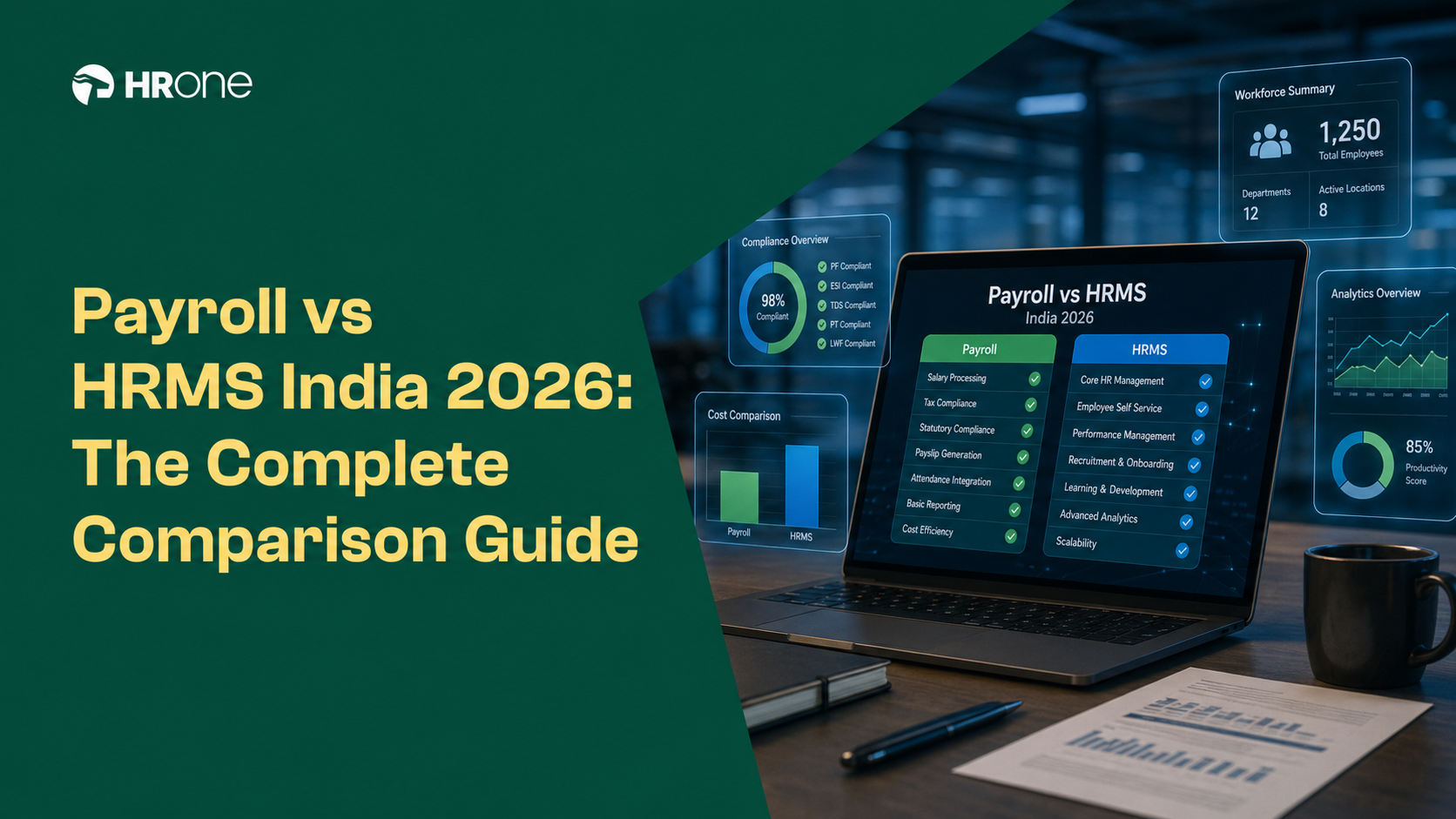
Q1: Payroll Software vs Full HRMS India: The 60-Second TL;DR Verdict
When it comes to Payroll Software vs Full HRMS India, here is the verdict I give every HR leader who calls me at month-end: stay on standalone payroll software only if you are under 30 employees, single-entity, single-state, with no shifts and no field workforce. The moment any two of those conditions flip, you need a full HRMS, because payroll accuracy in India is a data-flow problem, not a calculator problem.
⭐ The Quick-Answer Verdict Box
✅ Payroll-only fit zone: under 30 heads, one legal entity, one state of operation, no Flexible Benefit Plan (FBP), no shift or field workforce, and a monthly payroll error rate comfortably under 1%.
⚠️ Full HRMS fit zone: the moment you cross 30 heads, operate across multiple states, register a second legal entity, introduce shifts or a field team, or see payroll errors cross 1% per month, the upstream data chaos has already outgrown a standalone payroll tool.
💰 Pricing benchmark: standalone payroll lands at ₹50 to ₹100 PEPM, full HRMS at ₹150 to ₹300 PEPM, and a 3-year TCO comparison typically shows a unified HRMS costing 1.4 to 1.8 times less than a four-tool Frankenstein stack once implementation, integration, and error-remediation are loaded in. See the full pricing breakdown.
⏰ 2026 compliance lift: the DPDP Act 2023 and the Income Tax Rules 2026 (effective 1 April 2026) have raised the bar on both categories. Default tax regime, Form 24Q field mappings, biometric consent, breach-notification SLAs, and data residency now all sit on the buying checklist.
✅ Why HROne Bridges Both Worlds
HROne runs payroll inside one hire-to-retire core HCM on a single employee master, with flat PEPM billed only after go-live and no per-entity surcharge. Buyers who start with payroll-only needs never re-implement when they cross the tipping point, they just toggle the next module on from the admin console.
Q2: What Is the Real Difference Between Payroll Software, HRMS, and HCM in the Indian Context?
Payroll software, HRMS, and HCM are three concentric layers, not synonyms. Payroll software computes salary, TDS, PF, ESIC, PT, LWF, bonus, and overtime, and generates payslips, NEFT statements, and Form 16/24Q. HRMS adds attendance (touchless, biometric, and geo-fence), leave workflows, ESS, recruitment/ATS, onboarding, performance, L&D, analytics, and gratuity/FFS. HCM extends HRMS with talent, succession, and workforce-planning analytics. For a deeper category breakdown, see HCM vs HRIS vs HRMS.
🧾 Payroll Software: The Core Features Checklist
A standalone Indian payroll tool has to own the following without any plugin dependency:
- Salary calculation with CTC-to-net build-up and component mapping.
- Payslip generation with statutory breakup and digital signature.
- TDS deduction, Form 16 issuance, and Form 24Q quarterly filing.
- PF computation with UAN, ECR upload, and multi-establishment mapping.
- ESIC contribution, IP number generation, and branch-wise filing.
- State-wise Professional Tax and Labour Welfare Fund handling.
- Bonus, overtime, arrears, and leave-encashment computation.
- NEFT bank-transfer statement generation for disbursal.
- Statutory compliance reports ready for EPFO, IT, and ESIC scrutiny.
🏗️ HRMS: The Core Modules That Sit on Top
- Touchless, biometric, and geo-fence attendance management for desk, shop-floor, and field workforces.
- Leave management workflows with accrual, encashment, and holiday calendars.
- Employee self-service portal with profile, payslip, tax declaration, and helpdesk.
- Recruitment software and applicant tracking from requisition to offer acceptance.
- Onboarding workflows covering documentation, asset assignment, and buddy programs.
- Performance management with goals, 360° feedback, and automated bell curves.
- Learning and development with course assignments, assessments, and badges.
- HR analytics dashboards for HR Ops heat maps and workforce reporting.
- Gratuity and full-and-final settlement aligned to the new wage-code 2-day rule.
📊 Side-by-Side Feature Matrix
| Dimension | Payroll Software | Full HRMS | HCM |
|---|---|---|---|
| Primary purpose | Run month-end salary and statutory filings | Run the full employee lifecycle | Run lifecycle plus strategic workforce planning |
| Modules | Payroll, compliance reports | Payroll, attendance, leave, ESS, ATS, onboarding, performance, L&D, and analytics | HRMS plus succession, talent, and workforce analytics |
| Data scope | Salary, tax, and statutory | Entire employee master across lifecycle | Employee, organisational, and strategic data |
| ESS | Limited (payslip, TDS) | Full (leave, expenses, helpdesk, and documents) | Full plus career and learning paths |
| Integrations | Tally/ERP JV post | Biometric, ERP, ATS, SSO, BGV, and LMS | Enterprise ERP, BI, and planning tools |
| Scalability | Caps at single entity, single state | Multi-entity, multi-state, and multi-location | Multi-country and enterprise-grade |
| India compliance depth | TDS, PF, ESIC, PT, and LWF | All of payroll plus DPDP, new wage code, and FBP | All of HRMS plus IT Rules 2026 ready |
🔗 Why Payroll-Inside-HRMS Beats Standalone
When payroll lives as a module inside an HRMS on one employee master, attendance corrections, leave adjustments, CTC revisions, and FBP declarations propagate natively into the payroll run. Standalone payroll tools depend on CSV imports from biometric portals and Excel sheets for leave, and roughly 80% of Indian payroll errors are born in those CSV handoffs, not in the calculator. This is why integrating payroll with HR systems natively beats bolt-on connectors.
HROne is architected as a full HCM: Core HR, Payroll, Time Office, Performance, Recruitment, Engagement, LMS, and HelpDesk, all on one employee master. Activating payroll today and adding performance or L&D next quarter happens from the admin console, not via a second implementation project.
Q3: How Do Standalone Payroll Tools and Full HRMS Compare on TDS, PF, ESIC, PT, LWF, DPDP, and IT Rules 2026 Compliance?
Standalone payroll tools cover TDS, PF, ESIC, PT, and LWF computation plus returns filing. Full HRMS suites add the upstream data integrity (attendance, leave, CTC revisions, and FBP) that those computations depend on, and extend DPDP obligations from payroll data alone to the entire employee lifecycle. The Income Tax Rules 2026, effective 1 April 2026, reshape default tax regime handling and Form 24Q field mappings, which both categories now have to absorb. For a primer, see statutory compliance payroll.
📋 Compliance Deep-Dive: Central Statutes
| Statute | What It Covers | Payroll Software | Full HRMS |
|---|---|---|---|
| TDS | Form 16, Form 24Q, new regime default, IT Rules 2026 | ✅ Computes and files | ✅ Computes plus auto-propagates CTC revisions |
| PF (EPFO) | UAN, ECR, and multi-establishment | ✅ | ✅ plus multi-entity isolation |
| ESIC | Slabs, IP number, and branch mapping | ✅ | ✅ plus attendance-driven eligibility |
| Gratuity | 5-year rule, payout computation | Partial | ✅ Fully automated at FFS |
| Bonus Act | Statutory bonus computation | ✅ | ✅ |
| New Wage Code | 2-working-day FFS rule | ⚠️ Manual in most tools | ✅ Automated via exit workflow |
🗺️ State-Wise PT and LWF Matrix
| State | Professional Tax | Labour Welfare Fund |
|---|---|---|
| Maharashtra | ₹200/month slabs | ₹6 employee plus ₹18 employer (half-yearly) |
| Karnataka | ₹200/month above ₹15,000 | ₹20 employee plus ₹40 employer (annual) |
| Tamil Nadu | Half-yearly slabs | ₹10 employee plus ₹20 employer (half-yearly) |
| Gujarat | ₹200/month above ₹12,000 | ₹6 employee plus ₹12 employer (half-yearly) |
| West Bengal | ₹200/month slabs | ₹3 employee plus ₹15 employer (half-yearly) |
| Telangana | ₹200/month above ₹20,000 | ₹2 employee plus ₹5 employer (half-yearly) |
For background on state slabs, see the professional tax slab rates reference.
🔒 DPDP Act 2023 and IT Rules 2026 Obligations
- Biometric attendance data requires explicit, purpose-limited consent and defined retention periods.
- Employers are Data Fiduciaries; the HRMS vendor is the Data Processor, and the contract must reflect that.
- Breach notification SLAs to the Data Protection Board are now binding, not aspirational.
- Data residency: Indian hosting is no longer a nice-to-have for public-sector and BFSI buyers.
- IT Rules 2026 shift the default tax regime and rewire Form 24Q field mappings: engines that auto-patch survive audits; those that need developer tickets do not.
Good employee data privacy best practices are the starting point for any DPDP-aligned rollout.
🔍 Audit Readiness Checklist
Before any EPFO, IT, or ESIC inspection, the vendor should be able to generate on demand: PF/ESIC challans and receipts, monthly ECR summary, Form 24Q variance reports, archived payslips for seven years, RBAC audit logs showing who accessed which payroll screen when, and a documented consent trail for biometric data. If the vendor takes more than 24 hours to produce any of these, the audit is already at risk. A disciplined payroll audit checklist catches most of these gaps pre-inspection.
HROne bakes multi-state PF/ESI/PT, LWF, new wage-code 2-day FFS, FBP, and CTC revisions into the core engine. DPDP-grade RBAC and consent capture apply across all eight modules, IT Rules 2026 changes ship as engine updates rather than developer tickets, and data hosts India-side with a documented breach-notification SLA.
Q4: What Does Payroll vs HRMS Actually Cost in India, PEPM Pricing, 3-Year TCO, and Break-Even Headcount?
Standalone payroll in India runs ₹50 to ₹100 PEPM; full HRMS runs ₹150 to ₹300 PEPM. Break-even flips to full HRMS at roughly 60 to 80 employees once implementation, integration, error-remediation, and admin-hour savings are loaded into a 3-year TCO, and earlier for multi-state or multi-entity buyers. For a quick benchmarking read, see HR software pricing transparency.
💰 The Numbers You Should Actually Benchmark Against
PEPM bands by tier: greytHR and RazorpayX Payroll typically land in the ₹50 to ₹100 PEPM payroll-only band; Keka, Zoho People, and HROne sit in the ₹150 to ₹300 PEPM full-HRMS band; Darwinbox and SAP SuccessFactors price higher and often bill from day one of purchase. For direct comparisons, see HROne vs Keka and HROne vs Darwinbox.
3-Year TCO stack math: payroll ₹50 to ₹100, plus biometric portal ₹30 to ₹50, plus ATS ₹40 to ₹80, plus expense tool ₹20 to ₹40, plus integration and middleware fees, plus separate implementation for each, typically totals 1.4 to 1.8 times a unified HRMS at ₹150 to ₹300 PEPM all-in.
💸 Error-Penalty and Time-Savings Modelling
💸 Error-penalty modelling: a 2 to 4% monthly payroll error rate at ₹400 to ₹1,200 remediation per incorrect payslip, plus EPFO/ESIC interest and penalty exposure for late or wrong contributions, quietly adds lakhs a year that never show up on the PEPM invoice.
⏰ Time-savings baseline: roughly 30 admin hours per month saved per 100 employees on a consolidated HRMS, multiplied by a fully-loaded HR cost of ₹600 to ₹900 an hour, lands between ₹18,000 and ₹27,000 saved every month per 100 heads, before you count the CHRO hours reclaimed. Plug your own numbers into the ROI calculator to size it.
✅ How HROne Prices This Honestly
HROne publishes a flat PEPM across Professional and Enterprise tiers, bills only after go-live (MR DIY India went live in 30 days on this model, see the MRDIY case study), includes multi-entity in one instance with no per-entity surcharge, and surfaces the exact hours-saved number natively inside India’s first inbuilt ROI Dashboard: no Power BI overlay, no data engineer, and no PowerPoint deck at the board review.
Q5: What Is the Upgrade Tipping Point, When Should an Indian SME Move From Payroll-Only to a Full HCM?
The tipping point is not a headcount number. It is a 12-signal composite score. Most Indian SMEs cross it between 50 and 100 employees, many cross it at 40 the moment multi-state exposure enters the picture, and every buyer should score themselves honestly before the next renewal conversation. For a category-level primer, see HCM vs HRIS vs HRMS.
⚠️ The Wrong Way to Decide
Most teams upgrade because a peer company did, because a vendor pitched hard at the right quarter, or because headcount just crossed a round number. Those shortcuts ignore what actually breaks a payroll-only setup: entity complexity, field workforce distribution, state-wise compliance, and the compounding error cost that never shows up on the PEPM invoice but does show up as attrition, grievances, and EPFO interest notices. A disciplined how to choose HRIS HRMS software checklist cuts through most of those heuristics.
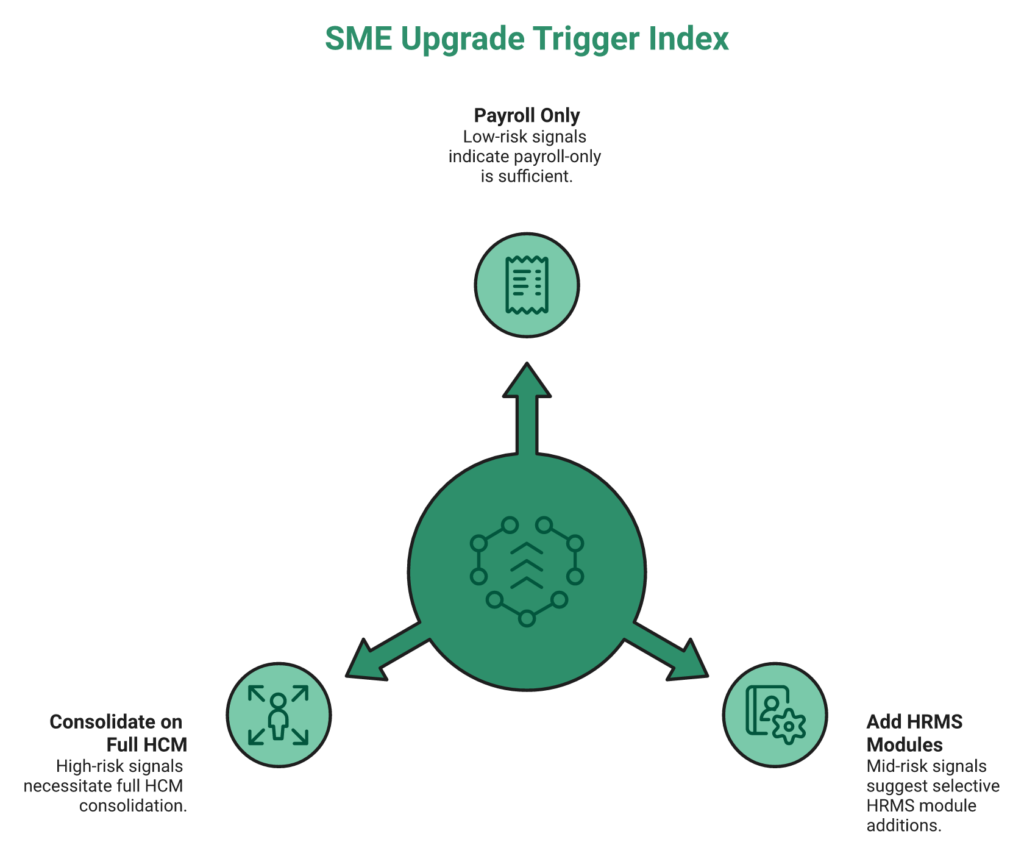
✅ The Right Evaluation Framework, The 12-Signal Upgrade Trigger Index
Score yourself 0 to 10 on each signal; total out of 120, rebased to a 100-point score.
- Headcount band: 10 to 50, 50 to 100, 100 to 500, or 500+.
- Legal entities greater than one.
- States of operation greater than two.
- Payroll cycle longer than six working days.
- Monthly payroll error rate above 1%.
- Manual attendance correction hours above 20 a month.
- Leave ticket backlog running into HR inboxes.
- Offer-to-onboarding delay beyond 14 days.
- Recurring compliance near-misses in PF, ESIC, or PT.
- Multi-location workforce expansion on the roadmap.
- Shift-based or field workforce already operating.
- Disconnected HR tools already in use: three or more.
Scoring bands: 0 to 30, payroll-only is genuinely enough; 31 to 60, start adding HRMS modules selectively; 61 to 100, consolidate on a full HCM now, before the next financial year’s compliance cycle.
📊 Applying the Framework Against HROne
| Signal | HROne Match |
|---|---|
| Multi-entity unlimited | ✅ Single tenant, no surcharge |
| Multi-state PF/ESI/PT | ✅ Native, per-entity isolation |
| Payroll cycle time | ✅ Auto-Scheduler, group payout validations |
| Error rate control | ✅ Attendance-to-payroll propagation |
| Attendance correction | ✅ Super Inbox plus Time Office |
| Leave backlog | ✅ 127 pre-built workflows |
| Onboarding delay | ✅ Checklists plus salary-structure copy-over |
| Compliance near-misses | ✅ Engine updates for IT Rules 2026 |
| Multi-location | ✅ Mobile geo-fence attendance |
| Field workforce | ✅ Offline attendance with auto-sync |
| Tool consolidation | ✅ 8 modules, one master |
| ROI instrumentation | ✅ India’s first inbuilt ROI Dashboard |
⭐ The Meta-Insight and the Proof
The right question is not “is my payroll tool still working?” The right question is “what is the compounding cost of every month I delay consolidation?” Asia Healthcare Holdings runs 20 pan-India units on a single HROne instance, and the MRDIY case study shows MR DIY India collapsed payroll from 10 days to 5 to 6 days within a cycle of consolidating.
“HROne has effectively identified and addressed all of our previous pain points. Its mobile application has been particularly valuable, saving users significant time and reducing resource consumption… the well-known Inbox For HR has resolved many of our issues. It allows users to manage multiple tasks from a single window, eliminating the need to switch between different modules.”
— Vignesh J., HR User HROne G2 – Verified Review
“I love HROne for its cost efficiency and holistic approach, which is why I prefer it over other vendors like Workday… the recruitment module has automated onboarding, greatly boosting efficiency.”
— Priyanka S., Reviewer HROne G2 – Verified Review
Q6: Do I Still Need a Full HCM If I Already Have Biometric Attendance, and Can I Start With Just the Payroll Module and Add HR Modules Later?
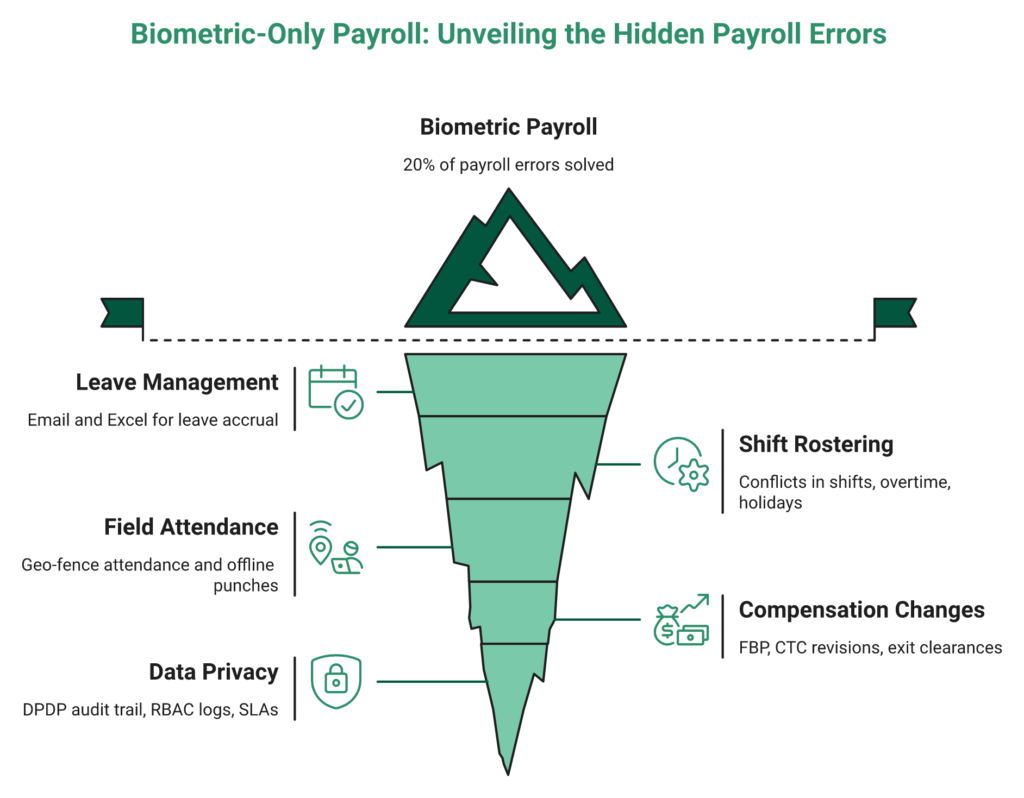
A biometric device plus an outsourced payroll vendor is not an HCM. It is a data pipe with two blind spots. Leave, confirmations, CTC revisions, FBP, and exit clearances still run on email and Excel, and those blind spots trigger roughly 80% of payroll errors. “Starting with payroll and adding modules later” only works if the vendor ships one tenant, one employee master, and front-end-configurable policies. Otherwise, the “upgrade” is a second implementation billed in a new SKU. For the alternative, see payroll solution inside a unified HCM.
❌ The Frankenstein Stack You Didn’t Realise You Chose
Walk into any 200 to 500 employee Indian firm still on payroll-only, and the pattern repeats: a biometric portal no one logs into after setup, payroll outsourced via CSV emails to a vendor, an ATS no one updates, expenses tracked in Excel, approvals happening on WhatsApp, and a confirmation letter template sitting in a shared drive. Tab fatigue is constant, payouts slip by a day or two every third month, attendance exceptions pile up unresolved, and no one can produce a clean audit trail if a DPDP inquiry lands tomorrow. A move to attendance management native to the HCM ends those handoffs.
⚠️ Why “Biometric-Only” Solves Only 20% of the Problem
A biometric device solves mark-in and mark-out. It does not solve leave accrual, shift rostering, overtime computation, regularisations, field geo-fence attendance, or holiday-calendar conflicts. That is the 80% of time-and-attendance that actually feeds payroll. Standalone payroll vendors that promise “modules later” often run duplicate employee tables underneath, which means adding performance or L&D is a data migration, not a toggle. For the underlying integration logic, see integrating payroll with attendance.
“GreytHR is not much good at customising based on our requirements. For our case, from implementation onwards, there were issues with leave balance and all. Many times we were manually correcting the leave balance of employees. We cannot properly implement our company policies due to the limitations of greytHR.”
— Verified User in IT Services greytHR – G2 Verified Review
🔁 The Strategic Shift: One Workflow, Not Three Tools
Attendance, leave, and payroll are one workflow living on one employee master, not three tools stitched by CSV. “Modular” only counts if activating the next module inherits existing RBAC, OU structure, approval chains, and flat PEPM, without a contract renegotiation or a new implementation fee.
✅ How HROne Handles Both Objections Natively
HROne ships all eight modules on one tenant with one employee master. Time Office, Super Inbox, and Auto-Scheduler propagate every attendance exception into the payroll run natively. Mobile geofencing attendance system handles field teams in low-connectivity zones, and 98% of customers run the full bundle because activation is an admin-console toggle, not a re-implementation. Adding performance management or L&D next quarter inherits your existing RBAC and workflows. It does not restart them.
“HROne has a very easy and intuitive UI, making navigation across the platform simple… Having the entire visibility at one place makes it easy for me to lead my team of three members effectively and make informed decisions.”
— Naman G., Manager HROne G2 – Verified Review
“HROne supports MS-SQL and API management for the integration purpose… salary processing along with deduction slabs are working perfectly as per Indian tax compliances, previously there were a lot of mess in this section.”
— Sanjeev K., HR Lead HROne G2 – Verified Review
Q7: Which Industry Playbook Applies to Me, IT/ITeS, Manufacturing, Retail/QSR, or Gig/Contractor-Heavy Operations?
The fit-for-purpose choice between payroll-only and full HRMS shifts sharply by industry. IT/ITeS needs recruitment and performance depth, manufacturing needs shift, OT, and multi-unit PF/ESI, retail/QSR needs mobile attendance and high-attrition hiring, and gig/contractor operations need flexible engagement types and geo-fence attendance. Those are capabilities no standalone payroll tool owns.
🏭 Industry Playbooks
- IT/ITeS: ATS with resume relevancy scoring, performance with automated bell curves, LMS for compliance training, ESOP vesting schedules, and variable-pay computation tied to quarterly KRA outcomes. Payroll-only leaves the pipeline, performance, and learning on Excel. See ITES HR for vertical fit.
- Manufacturing: shift rostering across A/B/C shifts, overtime computation under the Factories Act, multi-unit PF/ESI with branch-wise ECR, worker-versus-staff dual payroll, and field punch for sales engineers. A pure payroll tool cannot ingest shift rosters or resolve regularisations. See manufacturing HR.
- Retail and QSR: mobile attendance with store geo-fence, rapid onboarding for store associates, high-attrition cost-to-hire tracking, FFS compressed to the new wage-code 2-day rule, and manager self-service on a phone, not a laptop portal. See retail HR.
- Gig and Contractor Operations: flexible engagement types (full-time, contract, consultant, and gig), geo-fence attendance for field agents, TDS under Section 194J on professional fees, and e-signed agreements. Standalone payroll typically handles only the TDS line, not the lifecycle.
🔌 Integration Architecture to Validate Before Buying
| Category | What to Integrate | Evaluation Question |
|---|---|---|
| Finance | Tally, Zoho Books, QuickBooks, and SAP | Does the HRMS auto-post JV entries to the GL? |
| Hardware | Biometric devices, and access control | Is sync real-time and API-based, or overnight CSV? |
| Collaboration | Slack, and MS Teams | Do approvals surface inside chat, or only in a portal? |
| Identity | SSO, SAML, Azure AD, and Okta | Can RBAC flow through SSO groups without manual provisioning? |
| Verification | BGV partners, and LMS marketplaces | Is BGV native, or does it need a middleware layer? |
For a deeper dive into the plumbing, see HROne’s integrations.
✅ How HROne Maps to the Playbooks
HROne ships pre-built integrations with Tally, Zoho Books, QuickBooks, SAP, major biometric brands, Slack, MS Teams, SSO/SAML providers, and BGV and LMS marketplaces. It runs 1,500+ brands including Asia Healthcare Holdings (20 pan-India units, healthcare) and MR DIY India (retail) on a single instance. The HRV Studio low-code layer lets HR teams build custom apps for visitor management, vendor onboarding, or seating plans without raising a developer ticket, which is exactly where a manufacturing or retail rollout usually stalls on legacy suites.
Q8: Which Payroll and HRMS Vendors Should an Indian SME Actually Shortlist in 2026?
Eight vendors cover the payroll-only to full-HCM spectrum worth evaluating in 2026: HROne, Keka, greytHR, Zoho People, RazorpayX Payroll, Pravah HRMS, Zimyo, and Darwinbox. They are profiled on identical criteria (What It Is, Strengths, Pricing, and Best For / Skip If), with a Vendor-Fit Matrix scoring each on payroll depth, HRMS breadth, and go-live economics. For the broader landscape, see top 10 HR software India and top 10 payroll software India.
⭐ 1. HROne
What it is: full hire-to-retire HCM across 8 modules, namely Core HR, Workforce, Time Office, Payroll, Performance, Engagement, LMS, and HelpDesk, with Super Inbox, 127 pre-built workflows, One AI Suite, and India’s first inbuilt ROI Dashboard. Pricing: flat PEPM, Professional and Enterprise tiers, billed only after go-live. Best for: 100 to 5,000 employee Indian mid-market and enterprise. Skip if: under 25 employees needing only basic leave tracking.
“I really like HROne’s easy-to-use interface for both admin and employee… HROne has streamlined our payroll management by allowing me to map various components of CTC during onboarding and automatically process payroll after attendance approval.”
— Rishiraj R., HR Admin HROne G2 – Verified Review
2. Keka
What it is: mid-market HRMS with clean UX and a strong performance module. Pricing: PEPM mid-band. Best for: under 500 employee SMBs prioritising UX polish. Skip if: multi-legal-entity depth or phone-based SPOC support is required. See the head-to-head HROne vs Keka comparison.
“I have been Keka user since 2021, and the service is decreasing day by day… the chat was not at all helpful. Most of the times folks behind the chat window is not fully aware of the functionality. TAT on customer request on features is bad.”
— Verified User in Consulting Keka – G2 Verified Review
3. greytHR
What it is: SMB payroll stalwart with strong compliance filings. Pricing: ₹50 to ₹100 PEPM payroll-only band. Best for: under 500 employee single-entity firms needing payroll and basic attendance. Skip if: hire-to-retire workflows or multi-state entities are on the roadmap. See the HROne vs greytHR comparison.
4. Zoho People
What it is: lightweight HRMS inside the Zoho suite. Pricing: entry-level PEPM. Best for: under 100 employee Zoho-stack startups. Skip if: multi-legal-entity, FBP depth, or new wage-code FFS is required. See the HROne vs Zoho People comparison.
5. RazorpayX Payroll
What it is: payroll-only tool with integrated banking disbursal. Pricing: low PEPM, disbursal-linked. Best for: under 50 employee startups wanting payroll, compliance filings, and banking in one. Skip if: attendance, performance, or recruitment capability is needed.
6. Pravah HRMS
What it is: India-focused mid-market HRMS. Pricing: mid-band PEPM. Best for: single-entity 100 to 300 employee firms. Skip if: multi-state field workforce or deep AI is a must-have.
7. Zimyo
What it is: affordable mid-market HRMS. Pricing: low-to-mid PEPM. Best for: under 500 employee cost-sensitive buyers. Skip if: inbuilt ROI dashboards or enterprise-grade AI are required. See the HROne vs Zimyo comparison.
8. Darwinbox
What it is: enterprise HRMS with broad modules and unicorn brand halo. Pricing: higher PEPM, day-one-of-purchase billing, and multi-year lock-ins. Best for: 2,000+ employee enterprises already standardised on it. Skip if: no lock-in, go-live billing, or ROI instrumentation is non-negotiable. See the HROne vs Darwinbox comparison.
“Bad implementation experience, bad UI UX, configurations getting broken in production on its own due to product deployments, terrible customer service.”
— Verified User in Computer Software Darwinbox – G2 Verified Review
📊 Vendor-Fit Matrix
| Vendor | Payroll Depth | HRMS Breadth | Multi-Entity | DPDP Ready | Flat PEPM | Go-Live Billing |
|---|---|---|---|---|---|---|
| HROne | ✅ | ✅ | ✅ | ✅ | ✅ | ✅ |
| Keka | ✅ | ⚠️ | ⚠️ | ⚠️ | ✅ | ⚠️ |
| greytHR | ✅ | ❌ | ❌ | ⚠️ | ✅ | ⚠️ |
| Zoho People | ⚠️ | ⚠️ | ❌ | ⚠️ | ✅ | ✅ |
| RazorpayX | ✅ | ❌ | ❌ | ⚠️ | ✅ | ✅ |
| Pravah | ✅ | ⚠️ | ⚠️ | ⚠️ | ✅ | ⚠️ |
| Zimyo | ✅ | ⚠️ | ⚠️ | ⚠️ | ✅ | ⚠️ |
| Darwinbox | ✅ | ✅ | ✅ | ✅ | ❌ | ❌ |
Q9: What Is the 90-Day Migration Playbook for Moving From Standalone Payroll to a Full HRMS Without Breaking a Pay Cycle?
A clean payroll-to-HRMS migration takes 60 to 90 days for mid-market Indian buyers and runs in six phases: current-state audit and data mapping, vendor selection scoring, parallel-run configuration, cutover and go-live, change management and employee training, and rollback contingency. Schedule it to avoid appraisal cycles, bonus months, and statutory return windows (April TDS kick-off, quarterly 24Q filings, and October half-yearly PT), or you will be firefighting two systems at once. Pair it with a disciplined hassle-free payroll processing steps approach to avoid cycle slippage.
🗺️ The 6-Phase Playbook
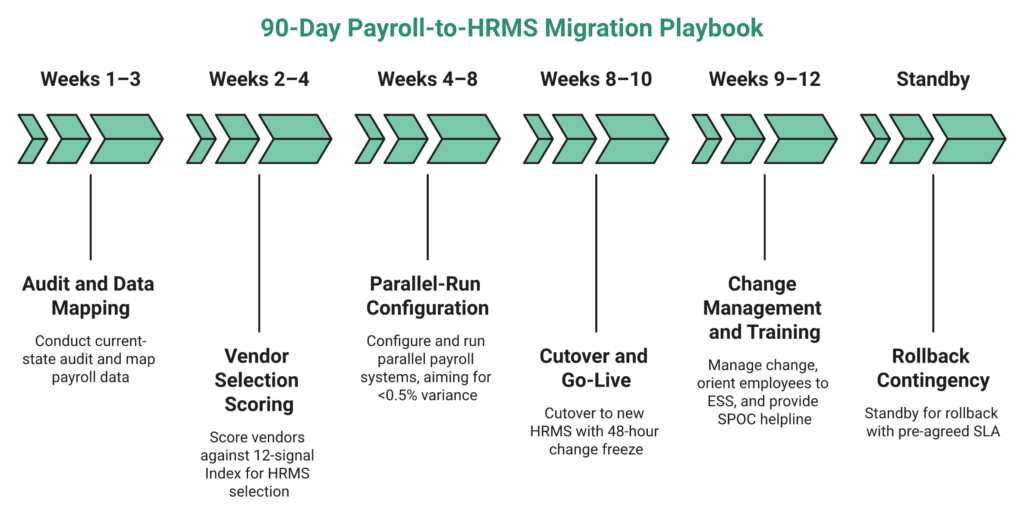
- Current-state audit and data mapping (Weeks 1 to 3): export the employee master, CTC structures, YTD tax deducted, PF/ESI contributions, leave balances, cost centres, OUs, and legal-entity mappings. Cleanse duplicates, fix orphan records, and reconcile against the last Form 24Q filing before a single row moves.
- Vendor selection scoring (Weeks 2 to 4): score shortlisted vendors against the 12-signal Upgrade Trigger Index from Q5, covering multi-entity support, multi-state PF/ESI/PT, DPDP posture, flat PEPM, go-live billing, and inbuilt ROI instrumentation. Commercial negotiations should lock flat PEPM and post-go-live billing in writing. A choosing payroll software checklist helps frame the RFP.
- Parallel-run configuration (Weeks 4 to 8): run one full payroll cycle on both systems with a variance tolerance under 0.5%. Reconcile line by line, covering gross, net, TDS, PF, ESIC, PT, LWF, reimbursements, and arrears, and sign off only when variance is explainable, not just small.
- Cutover and go-live (Weeks 8 to 10): execute a 48-hour change-freeze, lock the old system to read-only, and activate the new one with a documented rollback window. Communicate payday timelines clearly; the first live payout is the moment trust is earned or lost.
- Change management and employee training (Weeks 9 to 12): run ESS orientation for all employees, manager workshops for approvers, and a SPOC helpline for the first two cycles. Pre-record 3 to 5 minute explainer videos on the top ten employee tasks (apply leave, check payslip, and submit FBP).
- Rollback contingency (standby throughout): pre-agree the variance threshold, the rollback SLA, the data-restore path, and the communications template. A rollback plan you never use is cheaper than a cutover you cannot reverse.
🔒 DPDP-Aligned Data Transfer and RACI
- All data exports should be encrypted at rest and in transit, accompanied by a consent audit trail, and logged for DPDP data-fiduciary evidence. Start from employee data privacy best practices.
- Freeze RBAC during cutover. No new role grants or permission edits until post-go-live stabilisation.
- Stakeholder RACI: HR Ops (Responsible for data), Payroll Manager (Responsible for parallel-run variance), IT (Accountable for security and SSO), CFO (Consulted on GL mappings), and the vendor SPOC (Consulted on configuration).
- Post-go-live, stabilise over two full payroll cycles before declaring the project closed. Most migration regrets surface in cycle two, not cycle one.
⏰ Windows to Avoid
| Window | Why to Avoid |
|---|---|
| 15 March to 30 April | Year-end Form 16, investment proofs, and new FY CTC revisions |
| 1 to 15 July, October, and January | Quarterly 24Q filings |
| 15 September to 15 October | Half-yearly PT/LWF filings in most states |
| Appraisal month (varies) | CTC revisions hitting both systems |
| Bonus month (varies) | Statutory bonus computation overlap |
✅ How HROne Operationalises the Playbook
HROne’s onboarding consultants are prior-HR practitioners, not technical project managers reading from a checklist, assigned as a dedicated SPOC from kickoff to go-live, reflected in a 9.8 NPS on implementation. The MRDIY case study shows MR DIY India went live in 30 days on this model, and because subscription meters only after go-live, buyers never pay for air during setup. The prior-HR SPOC understands why a parallel-run variance of 0.3% on LWF matters more than it sounds, which is exactly the judgement call a checklist PM tends to miss.
Q10: What Is the ROI Math That Justifies Moving From Payroll-Only to a Full HRMS to Your CFO?
The upgrade breaks even in 4 to 7 months for a 200-employee firm when you count four things honestly: admin hours saved multiplied by fully-loaded HR cost, payroll error remediation avoided, vendor consolidation savings, and compliance penalty exposure eliminated. From there, the savings compound every cycle, and the CFO stops asking whether HR tech is worth it. Plug live numbers into HROne’s ROI calculator to size it yourself.
💸 The Contextual Reality CHROs Are Living
Every CHRO I have worked with in the last three years has been asked the same question by a board or an MD: “what is the ROI of the HRMS you rolled out?” And every time, without a native measurement layer, the answer devolves into “employees are happier,” “tickets are faster,” or “we saved time somewhere.” CFOs discount those narratives the same way they discount pipeline that doesn’t show up in the CRM. Meanwhile, roughly 30 admin hours per month per 100 employees leak into attendance reconciliation, leave follow-ups, offer-letter chasing, and payroll variance hunting, which is real money, invisibly. The CHRO solutions playbook is built around plugging exactly that leak.
❌ Why Most HRMS Vendors Fail the CFO Conversation
Most HRMS platforms promise ROI in a sales deck and then ship no native way to measure it. HR teams end up commissioning a Power BI or Tableau overlay that takes 3 to 6 months, a data engineer, and a monthly refresh routine, further delaying the conversation the upgrade was supposed to enable. By the time the dashboard is ready, the renewal is already on the table, and the ROI question is still open. The instrumentation gap is the reason HR tech keeps losing budget battles to sales tech and finance tech. This is also why HR software pricing transparency matters at contract time.
🔁 The Strategic Shift: ROI Has to Be Inside the System
ROI has to be measurable inside the HRMS in real time, against a baseline the system already owns: hours logged, tickets closed, workflows completed, and cycle-time per workflow. If the dashboard doesn’t live natively in the HRMS, HR leaders will never have the receipts when the CFO asks, and “we saved time” will never beat “we saved ₹X lakh” in a budget review. This is the single biggest architectural gap in the Indian HRMS market, and it is what separates digitising HR from proving HR. The 10 benefits automated payroll breakdown quantifies much of the upstream savings.
✅ How HROne’s ROI Dashboard Ends the Debate, A Worked Example
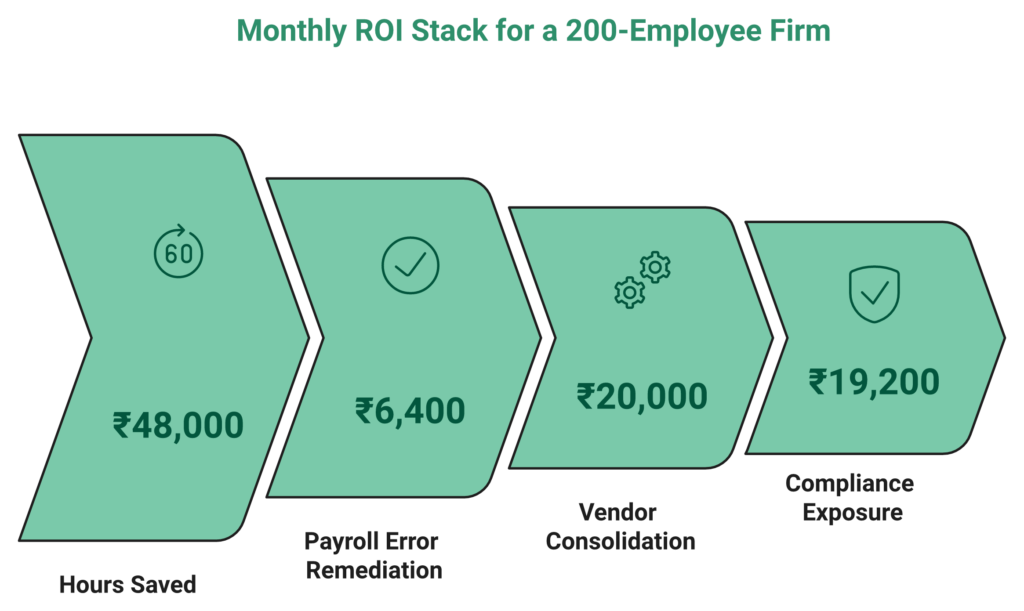
Worked example for a 200-employee firm:
- Hours saved: 30 admin hours/month multiplied by 2 (for 200 heads) equals 60 hours, multiplied by ₹800 fully-loaded HR cost, equals ₹48,000/month, or ₹5.76 lakh a year in reclaimed HR capacity.
- Payroll error remediation avoided: 2 to 4% error rate on 200 payslips, multiplied by ₹800 average remediation cost, equals ₹3,200 to ₹6,400/month, plus avoided EPFO/ESIC interest.
- Vendor consolidation: retiring a separate biometric portal (around ₹40 PEPM) and ATS (around ₹60 PEPM) on 200 heads equals ₹20,000/month saved.
- Compliance exposure: even one avoided ESIC late-payment notice can offset a full quarter of HRMS subscription.
India’s first inbuilt ROI Dashboard computes lifetime hours saved multiplied by average HR salary, and surfaces cost-per-hire, attrition cost, and revenue-per-employee, which is board-ready from month one, not month twelve. The HR inbox is where most of those reclaimed hours originate.
“HROne for its zero-touch payroll and compliance automation… The InboxforHR is a game-changer, centralizing every HR task into one simple inbox, cutting down administrative time by 60 to 70% and preventing tasks from falling through the cracks.”
— Waldon S., HR Leader HROne G2 – Verified Review
“HROne has revolutionized manual master data management, allowing me to pull reports rapidly without the hassle of multiple spreadsheets… the ability to manage various HR processes from a single platform is incredibly convenient and cost-effective for mid-level and enterprise customers.”
— Priyanka S., HR Head HROne G2 – Verified Review
Q11: FAQs on Payroll Software vs Full HRMS in India
The eight questions below are the ones Indian buyers actually ask on discovery calls, in RFPs, and inside buying committees, answered in under 60 words each so they are FAQPage-schema ready. For deeper reading, the HR resources hub carries extended guides.
⭐ Core Definition and Category Questions
1. Is payroll part of HRMS?
Yes. In a full HRMS, payroll is one module among attendance, leave, onboarding, performance, and ESS, all running on a single employee master. In a standalone payroll software, payroll stands alone and depends on CSV inputs from separate systems.
2. What is the difference between HRMS and HCM software?
HRMS runs the employee lifecycle, covering onboarding, attendance, leave, payroll, performance, and ESS. HCM extends that with strategic layers, covering succession planning, talent management, workforce analytics, and learning. HCM is HRMS plus the board-room view. See HCM vs HRIS vs HRMS.
3. Can I run payroll without an HRMS in India?
Yes, if you are under 30 employees, single-entity, and single-state, with no shifts or FBP. The moment any of those conditions flip, running payroll without an HRMS means reconciling attendance, leave, and CTC from separate tools every month, which is where 80% of Indian payroll errors are born.
4. Does DPDP Act 2023 require an HRMS?
No, but it raises the compliance bar on whoever processes employee data. Employers are Data Fiduciaries; vendors are Data Processors. An HRMS with unified RBAC, consent capture, breach-notification SLA, and India-hosted data is easier to defend in a DPDP inquiry than a five-tool stack.
⏰ Buying, Implementation, and Compliance Questions
5. What is the minimum headcount for an HRMS investment?
Pragmatically, 40 to 50 employees if you are multi-state or shift-based, and 75 to 100 if you are single-entity, single-state. Score yourself on the 12-signal Upgrade Trigger Index in Q5 before deciding on headcount alone.
6. Can biometric attendance alone meet labour audits?
Partially. Biometric devices solve mark-in and mark-out, covering roughly 20% of time-and-attendance. Audits also ask for leave, OT, shift rosters, regularisations, holiday calendars, and RBAC audit trails, which a standalone biometric portal does not produce. See attendance compliance improvement.
7. Do I need separate payroll software if I use Tally?
Tally handles accounting and can post JV entries, but it is not a statutory payroll engine for TDS, Form 24Q, PF ECR, ESIC, PT, or LWF. You need a payroll engine that computes and files; ideally one that auto-posts the JV into Tally.
8. How long does HRMS implementation take?
Standalone payroll: 2 to 4 weeks. Full HRMS: 4 to 12 weeks for mid-market, and up to 6 months for enterprise legacy suites. HROne’s prior-HR SPOC model has taken MR DIY India live in 30 days.
✅ How HROne Answers All Eight Structurally
HROne answers all eight questions with one architecture: a single core HCM on one employee master, DPDP-aligned RBAC and consent across all eight modules, unlimited multi-entity on flat PEPM, a 30-day go-live track record, and India’s first inbuilt ROI Dashboard that gives CHROs a board-ready ROI number without Power BI, data engineers, or a six-month dashboard build-out.
Q12: Ready to Consolidate Payroll and HR on One India-First HCM?
Running payroll, attendance, performance, and compliance on one employee master, instead of four disconnected tools that cannot talk to each other, is exactly what HROne was built for. The Super Inbox replaces tab-switching with three-click closures, the Auto-Scheduler runs zero-delay payroll under Indian statutory law, and India’s first inbuilt ROI Dashboard gives you the board-ready savings number before the next renewal conversation. If you want the full platform tour, start at why HROne.
⭐ Why 1,500+ Indian Brands Trust HROne
- 1,500+ Indian brands live across IT/ITeS, manufacturing, retail, BFSI, and healthcare, including MR DIY India and Asia Healthcare Holdings. Browse more customer success stories.
- 10 lakh+ active users on a mobile-first architecture with offline attendance for field and shop-floor teams, powered by the mobile HR app.
- G2 #3 overall satisfaction and 9.8 NPS on a dedicated prior-HR implementation SPOC.
- 127 pre-built hire-to-retire workflows, One AI Suite, HRV Studio low-code builder, and India’s first inbuilt ROI Dashboard.
- Flat PEPM with subscription billed only after go-live, no lock-in, and no per-entity surcharge. See live pricing.
✅ Paste-Ready HTML CTA Block
The Simplest HR Software for Indian Mid-Market
Trusted by 1,500+ brands. 10 lakh+ users. Payroll, attendance, and HR on one employee master, billed only after go-live.
Get Free Trial Book a Demo














 Secures Top Spot in
