


Most companies don’t fail because leaders stop caring. They fail because the rules that worked at 20 people quietly stop working at 200 and nobody rewrites them in time.
Early on, a founder can hold the whole company in their head. Every decision, every value, every bit of context lives with one or two people. It works beautifully until the business gets complex enough that it can’t.
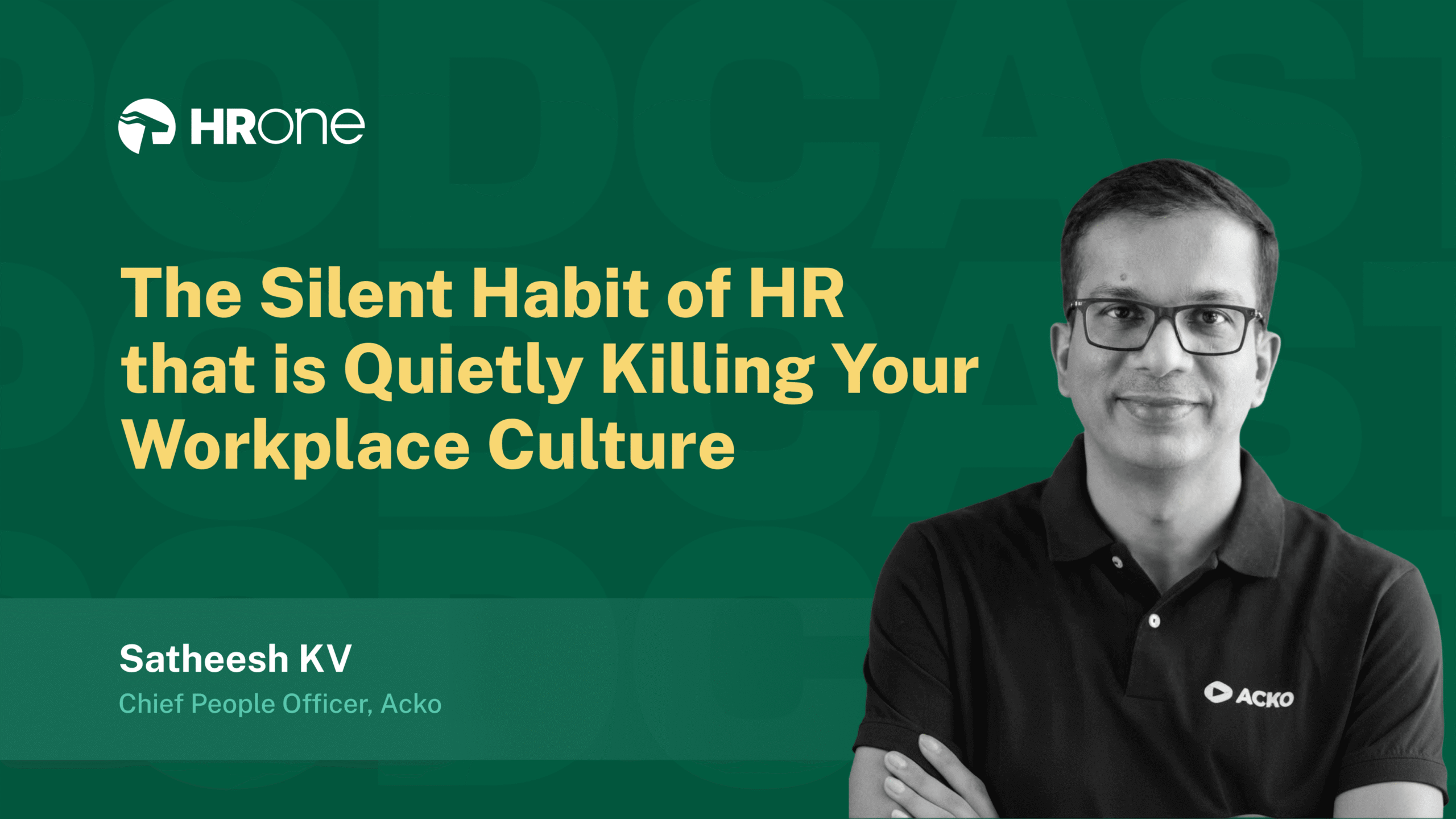
In this blog, you’ll find 7 leadership and organization-design rules that Satheesh KV, Chief People Officer at Acko and recent guest on The CHRO Mindset Podcast, says quietly stop working as a company scales and what he builds instead.
Here are the 7 rules that break, and what actually replaces them.
1. You need to hire an HR head at a certain headcount (It’s about complexity, not the number)
Founders love a clean number: hire HR at 100 employees, or 200, or 300. Satheesh hears this question constantly in his advisory conversations and his answer surprises most of them.
It’s not about how many people you have. It’s about how complex the business has become – multiple product lines, more customer journeys, more decisions that used to live in one founder’s head. That’s when communication genuinely starts to break, not at a round number on a slide.
What this means for you:
- Stop treating headcount as your trigger for hiring a people leader
- Track where decisions and context are starting to get lost instead
- Hire when complexity outpaces what your founding team can hold, not when you hit a milestone
2. The best HR practices are enough (Invisible systems decide if they actually work)
Every company has two versions of itself: the visible one (org charts, product, policies) and the invisible one (how decisions actually get made, how leaders behave under pressure, how information flows). Satheesh argues the invisible system is what determines whether the visible one delivers.
You can have the best-designed performance system or reward policy on paper but if the invisible system underneath isn’t intentional, none of it lands the way it’s supposed to.
What this means for you:
- Before redesigning any HR practice, map the invisible system it depends on
- Ask who actually holds decision rights today, not who’s supposed to on paper
- Treat decision-making, communication, and leadership behavior as designed systems, not accidents
3. More process makes scaling safer (Only if it improves decisions or trust)
Every scaling company eventually reaches for process as a safety net. Satheesh’s litmus test cuts through the noise: does this process improve the quality of decisions, or build trust? If it does neither, it has no reason to exist – no matter how official it looks.
One shift he recommends: replace rigid policy documents with decision guidelines. Instead of telling people exactly what to do, give them a framework for how to think and let them own the call.
What this means for you:
- Before adding a new process, ask what decision or trust problem it’s actually solving
- Cut (or never build) processes that only exist to look thorough
- Give people guidelines to reason with, not rules to hide behind
4. Accountability means finding who’s to blame (It’s a system you build before failure, not after)
Most organizations only talk about accountability after something has gone wrong which means, as Satheesh points out, you’re always looking in the rear-view mirror. That’s not accountability; that’s damage control.
Real accountability needs four things in place before failure ever happens: clarity on what people own, the authority to actually drive it, continuous feedback, and consistent follow-through from leadership — not just intervention when things break.
What this means for you:
- Build clarity, authority, and feedback loops before you need them, not after a failure
- Replace “who’s responsible for this?” post-mortems with ongoing check-ins
- Watch for a blame culture quietly training people to protect themselves instead of taking ownership
5. Talent strategy is about hiring and retaining the best (That’s only half the job)
Bringing in great people and keeping them used to feel like the whole talent mandate. Satheesh now sees it as roughly half the equation.
The other half is what happens after someone joins: do they get to move horizontally, take on stretch experiences, and build judgment across the business or are they boxed into one lane, waiting for a promotion that may or may not come?
What this means for you:
- Measure the experiences you’re creating for people, not just your retention rate
- Build real horizontal mobility, not just a promotion ladder
- Treat internal opportunity-matching as seriously as external hiring
6. Consistent leadership means one style for everyone (Standardize principles, not personalities)
It’s tempting to try to make every leader operate the same way — same tone, same process, same playbook. Satheesh pushes back hard on this: personalities shouldn’t be standardized, because forcing a single style onto every leader simply doesn’t work over time.
What does need to be shared are principles: how we make decisions, how we disagree respectfully, how we hold people accountable. Different styles, same DNA.
What this means for you:
- Stop trying to make every leader sound the same
- Define 3–5 shared principles every leader is expected to operate by, regardless of style
- Judge consistency by outcomes and employee experience, not by uniform behavior
7. Engagement score tells you how healthy your culture is (It’s one of the most overused metrics in HR)
Ask Satheesh for one overused people metric and he doesn’t hesitate: engagement. Too many different systems feed into that single score for it to be a reliable signal on its own.
His preferred lens instead: internal mobility — not the traditional version measured through internal job postings, but a real count of how many meaningful experiences you’re creating for people inside the company.
What this means for you:
- Stop treating engagement score as a standalone health check
- Track internal mobility and the experiences behind it as a leading culture indicator
- If a specific driver (like manager capability) is weak, fix that directly instead of chasing the aggregate score
So, What Does Strong Organization Design Look Like Now?
It’s less about writing more policy and more about being deliberate about the systems already running underneath your company.
A strong approach today focuses on three things:
- Visibility — Do you actually know how decisions, information, and accountability move through your company today?
- Judgment over rules — Are you building people’s ability to make good calls, or just handing them more rulebooks?
- Principles over personalities — Are your leaders aligned on how you operate, even if their individual styles differ?
What’s the Final Takeaway for You?
None of this is about adding more HR machinery. It’s about noticing the systems that are already running your company – often invisibly – and being intentional about designing them instead of letting them form by accident.
As Satheesh puts it, don’t design the organization until you’ve understood the one that already exists. The companies that get this right won’t just have better policies. They’ll be able to scale without losing what made them work in the first place.
And in a world where technology and competition move faster every year, that kind of organizational clarity is a real competitive advantage.
Listen to the full conversation on official Spotify channel of the CHRO Mindset Podcast – Spotify Link














 Secures Top Spot in
