



Q1. How much does Keka HRMS cost per employee per month in India in 2026?
Keka HRMS in India charges three flat subscription bands for the first 100 employees, with pay-per-additional-employee rates kicking in after that cap. Foundation sits at ₹9,999 per month (around $96), Strength at ₹12,999 ($137), and Growth at ₹15,999 ($192). Additional employees are billed at ₹90, ₹120, and ₹150 per head per month, respectively.
The 100-employee block explained
Most HRMS platforms I have seen in the Indian mid-market quote a per-employee-per-month (PEPM) number. Keka quotes a bundle. The first 100 seats on every plan share the same flat fee, whether you put 10 people in it or 99.
Once you cross the 101st employee, the meter starts. A Foundation customer pays ₹9,999 for employees 1 to 100, then ₹90 for every employee after that. Strength charges ₹120 per extra head. Growth charges ₹150. The Scribd-hosted Keka quote document from October 2025 lists these rates line by line.
What you actually pay per employee at different headcounts
| Headcount | Foundation effective PEPM | Strength effective PEPM | Growth effective PEPM |
|---|---|---|---|
| 10 | ₹999 | ₹1,299 | ₹1,599 |
| 25 | ₹400 | ₹520 | ₹640 |
| 50 | ₹200 | ₹260 | ₹320 |
| 100 | ₹100 | ₹130 | ₹160 |
| 250 | ₹94 | ₹124 | ₹154 |
| 500 | ₹92 | ₹122 | ₹152 |
| 1,000 | ₹91 | ₹121 | ₹151 |
The pattern is worth staring at for a minute. A 25-person startup pays ₹400 per seat on Foundation. A 250-person mid-market firm pays ₹94. The platform rewards scale and quietly penalises small teams. Compare this against HROne’s transparent PEPM pricing and the cliff logic becomes easier to benchmark.
The minimum-billing cliff
⚠️ Here is the trap nobody on the SERP names clearly. A 15-person team pays the same ₹9,999 that a 100-person team pays. In practical terms, a 15-seat Foundation customer is paying ₹666 per employee per month, almost seven times the rate a 100-seat team pays. A 60-person team sits at ₹167 per seat. The bundle is not priced for sub-30 headcounts.
When the cliff becomes a cash-flow issue
Working with 2,000+ HR teams, what I have felt is that the cliff hurts most during hiring freezes and attrition spikes. Quarterly minimum billing means you cannot downgrade mid-cycle. A team that lays off 20 people in October still pays the 100-seat floor until the quarter closes. My current thinking is that the 100-employee bundle works cleanly only if your headcount plan is already north of 80 at signature.
The answer to “how much does Keka cost” therefore has two parts. The sticker price is easy. The effective PEPM depends on exactly how close you are to 100, 200, or 300 seats on renewal day. Everything else in this article, the hidden fees, the TCO math, the negotiation clauses, flows from this single design decision. For a side-by-side product view, see HROne vs Keka.
Q2. What do Keka’s Foundation, Strength, and Growth plans include, and which one is right for 300 employees?
Foundation covers Core HR, attendance, payroll, and employee self-service. Strength adds self clock-in, OTP login, surveys, custom roles, and granular privileges. Growth layers on workflow automation, OKRs, Public Praise, continuous feedback, and advanced PMS. At 300 employees, Strength plus add-ons usually beats Growth on cost unless you run multi-state GSTINs or need OKRs at scale.
The 15-feature tier matrix
| Capability | Foundation | Strength | Growth |
|---|---|---|---|
| Core HR and employee records | ✅ | ✅ | ✅ |
| Attendance and leave | ✅ | ✅ | ✅ |
| Payroll engine | ✅ | ✅ | ✅ |
| Employee self-service (ESS) | ✅ | ✅ | ✅ |
| Self clock-in and geo-fencing | ❌ | ✅ | ✅ |
| OTP login and SSO | ❌ | ✅ | ✅ |
| Employee surveys | ❌ | ✅ | ✅ |
| Custom roles and privileges | ❌ | ✅ | ✅ |
| Workflow automation | ❌ | Limited | ✅ |
| OKRs and goal management | ❌ | ❌ | ✅ |
| Public Praise recognition | Add-on | Add-on | ✅ |
| Continuous feedback and 1:1 | ❌ | ❌ | ✅ |
| Advanced shift scheduling | Add-on | Add-on | Add-on |
| Expense with receipt parser | Add-on | Add-on | Add-on |
| Multi-entity (multi-GSTIN) | Limited | Limited | ✅ |
Advanced Shift and Expense Receipt Parser remain add-ons even on Growth. That is a subtle but expensive detail for manufacturing and D2C buyers, especially those evaluating dedicated manufacturing HR software.
Tier-upgrade trigger checklist
- You need employee-driven clock-in with geo-fencing.
- You want role-based access beyond the three default roles.
- Your workforce survey frequency crossed quarterly.
- Your recognition program is formal and budget-backed.
- You run OKRs, not KRAs, with quarterly cadence.
- Your payroll cycle touches more than one GSTIN.
⭐ Trip three or more of these, and Foundation stops working. Trip the last two, and Strength also runs out. For benchmarking the underlying engine, the performance management software key features checklist is a useful parallel reference.
The 300-employee decision, run live
Picture Priya, an HR ops lead at a 300-person D2C brand running two GSTINs across Bengaluru and Delhi. She is debating Strength plus Advanced Shift vs Growth. On Strength, 300 seats cost ₹12,999 plus 200 times ₹120, which is ₹36,999 per month. Growth costs ₹15,999 plus 200 times ₹150, which is ₹45,999 per month. Add the Shift add-on to Strength at roughly ₹3,000, and she still lands at ₹39,999 per month, about 13% cheaper than Growth.
The flip variable is the multi-state GSTIN reality. The moment Priya’s CFO approves a third entity for a Hyderabad warehouse, Keka’s per-entity charge forces her onto Growth or a custom quote. Until that happens, Strength plus Advanced Shift is the cleaner math.
A scenario rubric you can paste into a vendor call
✅ Pick Foundation if you are under 100 employees, single entity, with a simple attendance and payroll need.
✅ Pick Strength if you need clock-in flexibility, custom roles, and surveys, and can tolerate Growth-tier add-ons as separate SKUs.
✅ Pick Growth if you run OKRs at scale, multi-entity payroll, and formal recognition, and you prefer one plan over stitched add-ons.
“The PMS module is confusing and needs to be simpler and easier to use. User access is difficult for employees who do not have an email ID.”
— Kiran B., HR Keka – G2 Verified Review
“Keka is not built to service IT consulting firms. TAT on customer request on features is bad.”
— Verified User in Consulting Keka – G2 Verified Review
Read the tier matrix as a map of where Keka stops, not just what it covers.
Q3. What are Keka’s hidden fees, and which 3 clauses cut 22% off year-one cost?
Keka’s price list hides six fees that do not appear on the public pricing page: a setup fee equal to 2x the monthly subscription, 18% SaaS GST on every invoice, quarterly minimum billing, per-entity charges for multi-GSTIN clients, add-on SKUs like Public Praise and Advanced Shift, and subscription billing that starts from day one of purchase rather than go-live. Three negotiation clauses and two discounts can claw back roughly 22% of year-one cost.
The six hidden fees, itemised
- 💸 Setup fee: 2x monthly subscription, one-time. On a 300-employee Strength contract, that is roughly ₹74,000 at signature.
- 💰 18% SaaS GST: applied to every invoice including setup. A ₹36,999 monthly bill becomes ₹43,659 out of pocket.
- ⚠️ Quarterly minimum billing: you cannot pro-rate down within a quarter, even after layoffs or attrition.
- ❌ Per-entity charges: multi-GSTIN clients pay extra per legal entity, often buried in the order form.
- ⚠️ Add-on SKUs: Public Praise, Advanced Shift, Expense Receipt Parser, Keka Hire (Pro ₹1,500 and Advanced ₹2,500 per recruiter), Keka Learn, and Performance at ₹2,500 per 50 users are priced separately.
- ⏰ Subscription from day one: your meter starts at contract signature, not go-live, while implementation can run 45 to 90 days.
For an India-focused perspective on this, the HR software pricing transparency guide walks through what a clean quote should look like.
Priya’s Q2 invoice, a small scar
Priya quoted her CFO ₹36,999 per month for 300 seats on Strength. Her Q2 invoice ran ₹51,100 per month. The delta came from setup-fee amortisation, 18% GST, one add-on for Advanced Shift, and a second-entity surcharge neither party had discussed in the demo. The final number ran 38% over the sticker.
The three-clause playbook that pays for itself
- Add-on price cap clause. Insert: “Vendor shall not increase per-unit pricing of any module add-on by more than CPI (Consumer Price Index) or 5%, whichever is lower, for a period of 36 months from the effective date.”
- Setup-fee amortisation clause. Insert: “The one-time setup fee shall be invoiced in three equal instalments across the first three months post go-live, not at contract signature.”
- Data-export at churn clause. Insert: “Customer shall retain the right to a full structured data export in CSV and JSON formats within 15 business days of termination, at no additional fee.”
👉 Get these into your MSA (Master Services Agreement), not the SOW (Statement of Work). Procurement lawyers will thank you at renewal. A similar discipline shows up in the choosing payroll software checklist.
The two discount levers to stack
- 15% annual prepay discount on the subscription line. Keka publishes this in its own quote documents.
- 10% half-yearly prepay discount if cash flow cannot absorb the full-year ask.
- 50% setup-fee waiver ask. Not published, but common in competitive deals where a named alternative is on the table. I have seen this concession close in under a week when the buyer brings a written comparison to the CSM (Customer Success Manager).
Stack the 15% annual and the 50% setup waiver, and a 300-employee Strength contract drops from roughly ₹5.9L to ₹4.6L in year one, about 22%.
Refund, cancellation, downgrade, and free-trial reality
Keka offers a demo environment rather than a self-serve free trial for mid-market buyers. Refunds are rare post-onboarding. Downgrades require quarter-end timing. Cancellation requires written notice in the quarter prior. ⏰ Put a 60-day written termination clause in the MSA so you do not get auto-renewed into a quarter you did not budget for.
“Every year is either a large price increase or our plan being sunsetted with the only option being to switch to a more expensive plan.”
— Josh A., HR BambooHR – G2 Verified Review
“Customisation required as per company policy finding difficult to incorporate. Custom field and filter option is not available in custom report.”
— Prem K., HR Keka – G2 Verified Review
The fees are not hidden because Keka is hiding them. They are hidden because the pricing page was built for sticker-shoppers, and the quote document lives behind a sales call. Ask for the quote document before the demo, and half the surprises disappear.
Q4. What is the real 3-year TCO of Keka at 50, 150, 300, 500, and 1,000 employees?
The real per-employee-per-month cost of Keka in India runs 1.6x to 1.9x the sticker once you stack the 2x setup fee, 18% GST, Keka Hire and Performance add-ons, and the annual discount. A 300-employee firm that reads ₹130 PEPM on the pricing page ends up paying closer to ₹215 to ₹245 PEPM over three years.
Model assumptions
I run the TCO with five inputs: the base PEPM per tier, a setup fee equal to 2x the monthly subscription, two common add-ons (Keka Hire Pro at ₹1,500 per recruiter per month, and Performance at ₹2,500 per 50 users), 18% SaaS GST on every invoice, and a 15% annual prepay discount. Horizon is 36 months. Recruiter count is assumed at one per 100 employees. Performance users are assumed at 60% of total headcount. The same methodology works inside the HROne ROI calculator.
Three-year TCO table
| Headcount | Foundation 3-yr TCO | Strength 3-yr TCO | Growth 3-yr TCO | Effective PEPM (Strength) |
|---|---|---|---|---|
| 50 | ₹5.3L | ₹6.9L | ₹8.5L | ₹383 |
| 150 | ₹8.1L | ₹10.2L | ₹12.6L | ₹189 |
| 300 | ₹12.4L | ₹15.9L | ₹19.7L | ₹147 |
| 500 | ₹18.2L | ₹23.1L | ₹28.6L | ₹128 |
| 1,000 | ₹34.5L | ₹43.7L | ₹54.1L | ₹121 |
All figures include 18% GST, setup fee, two add-ons, and 15% annual discount.
Three scaling scenarios to pressure-test
- 📈 Startup scaling 20 to 100: year-1 PEPM is punishing at ₹420 plus, but settles near ₹130 by year 3. If you will not cross 60 seats in 18 months, the math does not work on Keka. Look at a per-seat SMB tool first.
- 🏭 Mid-market 150 to 400: Strength plus Advanced Shift on 300 seats runs roughly ₹15.9L over three years. Growth on the same profile runs ₹19.7L. Strength wins by 22% unless multi-entity forces the tier-up.
- 🏢 Enterprise 500 to 1,000: Growth with full add-ons crosses ₹54L over three years. At this size, negotiate a custom bundle, not a tier.
The counter-intuitive finding at 300 employees
⭐ Strength plus Advanced Shift plus Public Praise at 300 seats beats Growth at the same seat count by about 22% on year-one cash outlay. The only reasons to accept the Growth premium are native OKRs, formal continuous feedback, and multi-GSTIN workflows. Buyers running through a formal how to choose HRIS HRMS software checklist usually land on this same conclusion.
A sample Keka invoice, line by line
A 300-employee Strength invoice in month four typically reads: subscription ₹36,999, Advanced Shift ₹3,000, Public Praise add-on ₹2,400, entity surcharge ₹1,500, setup fee amortisation ₹12,333, GST at 18% ₹10,123, total ₹66,355. The subscription line is 56% of the bill.
The minimum-billing cliffs at 101 to 150, and 251 to 300
Two cliffs hit buyers hardest. The 101-to-150 band pays the Foundation bundle plus 50 per-seat overages, which works out to a 30% jump over a 100-seat base. The 251-to-300 band similarly pays for headcount it has not yet hired. If your plan is 120 or 280 seats on day one, negotiate a custom floor rather than accept the public tier.
TCO is not a number. It is a shape. Keka’s shape curves steeply below 100 seats, flattens between 150 and 500, and starts rewarding scale only past 700. Read your own growth curve before you sign, and if you want a benchmark, compare against HROne’s payroll software and core HCM modules.
Q5. How does Keka’s pricing compare with HROne, Darwinbox, greytHR, Zoho People, BambooHR, factoHR, and Asanify?
HROne sits in the ₹85 to ₹180 PEPM (per-employee-per-month) band with go-live billing and flat pricing. Keka runs ₹90 to ₹180 PEPM with a 2% monthly setup fee and quarterly minimum billing. greytHR and factoHR undercut both in SMB payroll, Darwinbox is priced for enterprise RFPs, Zoho People and BambooHR tilt toward single-entity global generalists, and Asanify fits very early-stage startups.
The 8-vendor benchmark, on the criteria CFOs actually ask about
| Vendor | PEPM band (₹) | Setup model | Minimum billing | Multi-entity | Implementation window | G2 Ease of Setup |
|---|---|---|---|---|---|---|
| HROne | 85 to 180 | No separate setup fee, subscription after go-live | Flat PEPM, no lock-in | Single instance for 20-plus units | 30 to 45 days | 9.5 |
| Keka | 90 to 180 | 2% monthly setup fee, billed day 1 | Quarterly block | Per-entity surcharge | 60 to 90 days | 8.6 |
| Darwinbox | 180 to 400 | Setup fee, multi-year contract | Annual lock-in | Strong, at a price | 90 to 180 days | 8.4 |
| greytHR | 25 to 80 | Low setup, module-wise | Monthly | Limited | 30 to 60 days | 8.7 |
| Zoho People | 40 to 120 | Low setup, bundle with Zoho One | Monthly | Weak on India multi-entity | 30 days | 8.8 |
| BambooHR | 120 to 220 | Setup fee, annual contract | Annual | US-tuned | 45 days | 8.9 |
| factoHR | 40 to 100 | Low setup | Monthly | Basic | 30 to 45 days | 8.5 |
| Asanify | 20 to 60 | Low setup | Monthly | Single entity | 15 to 30 days | 8.4 |
All bands reflect published 2026 India pricing and G2 average scores for Ease of Setup. For a fuller side-by-side, see the HROne vs Keka and HROne vs Darwinbox comparison pages.
Migration cost from greytHR or Zoho to Keka
Most mid-market buyers underestimate the migration line. From greytHR to Keka, expect ₹1.5L to ₹4L in data-export fees, parallel-run months, and re-implementation, plus a 6 to 10 week window. From Zoho People to Keka, the Zoho data model is cleaner, but FBP (Flexible Benefits Plan) and CTC revision logic typically need manual reconfiguration.
The three contrast lines to paste into your RFP
- Vendor agrees to meter subscription only after successful go-live sign-off by our HR ops lead.
- Vendor will not levy additional per-legal-entity surcharges beyond the initial contract configuration.
- Vendor will cap add-on module price revisions at 15% of base monthly subscription, with 90-day notice.
“Bad implementation experience, bad UI/UX, configurations getting broken in production on its own due to product deployments, terrible customer service. Basically everything.”
— Verified User in Computer Software, Darwinbox, G2 Verified Review
“Every year is either a large price increase or our plan being sunsetted with the only option being to switch to a more expensive plan. They know that switching HRMS is painful.”
— Josh A., HR, BambooHR, G2 Verified Review
“I love HROne for its cost efficiency and holistic approach, which is why I prefer it over other vendors like Workday. The initial setup process was smooth, thanks to the supportive team that helped configure everything according to our needs.”
— Priyanka S., HR, HROne G2 – Verified Review
Working with 2,000-plus HR teams, what I’ve felt is that vendor shortlists are decided on features, but renewals are decided on the minimum-billing clause. Get that clause right in month one, or the TCO math falls apart by quarter three. For deeper buyer guidance, see how to choose the right HRIS/HRMS software.
Q6. Why does Keka’s “subscription from day one” cost more than the license fee, and what does go-live billing change?
The biggest hidden fee in Indian HR tech is not on the invoice. It is on the calendar. Keka starts metering subscription the day you sign, while implementation typically runs 45 to 90 days. For a 300-employee Strength contract at ₹37,000 a month, that calendar gap costs ₹55,000 to ₹1.1L in year one, and compounds over three years as Adoption Debt.
⭐ The Adoption Debt thesis
Every HRMS deal has two contracts. The written one covers PEPM (per-employee-per-month), GST, and setup fee. The unwritten one is how many weeks until your HR team actually trusts the software. Keka’s pricing page discloses the first. The second is invisible on the SERP.
We call this gap Adoption Debt. It is the compounding cost of paying subscription while your payroll lead is still running Excel, managers are still approving leaves on WhatsApp, and your CFO is still asking why the ROI number is blank.
The 300-employee, 75-day math
Run it on a Pune mid-market firm. 300 employees, Strength tier, ₹37,000 a month base. Implementation takes 75 days from kickoff to go-live. That is 2.5 months of full subscription billed against zero productive usage.
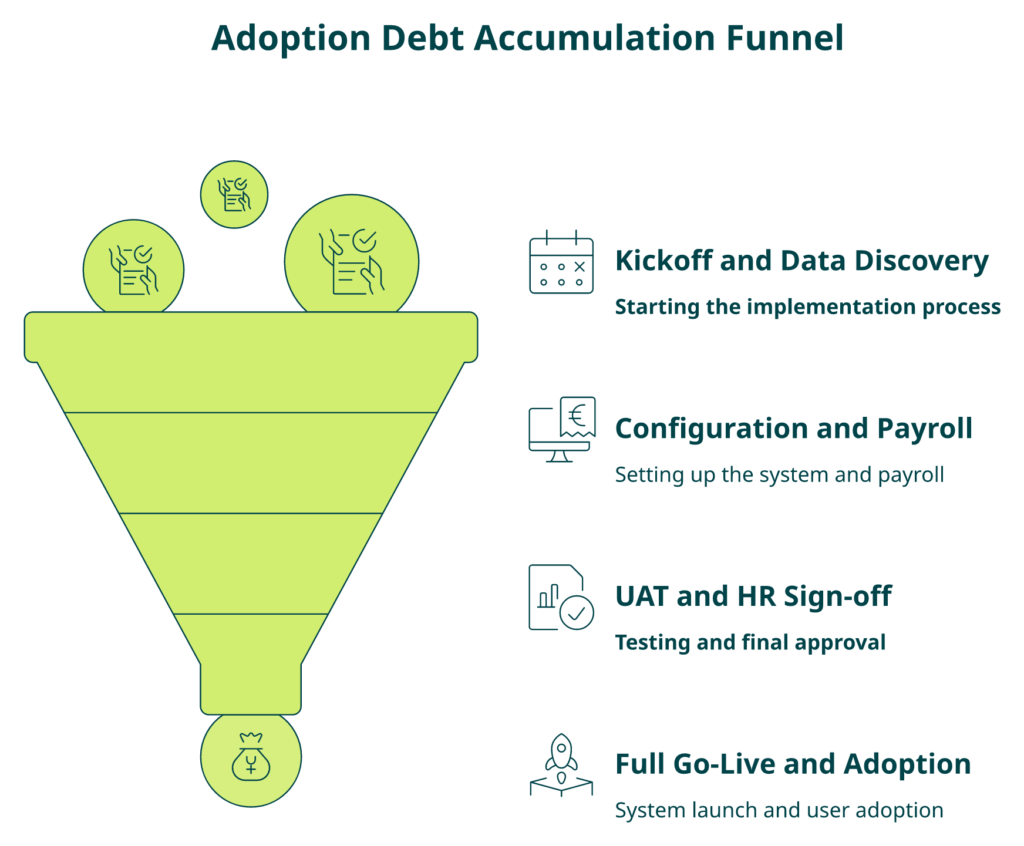
Add 18% SaaS GST, and the Adoption Debt line lands near ₹1.09L before the first real payroll runs. Across a 3-year contract, factoring two renewal cycles and one re-implementation round, the total calendar cost often crosses ₹3L. The HROne ROI Calculator models this exact gap.
⏰ What go-live billing actually changes
A go-live billing model flips the incentive. The vendor meters subscription only after go-live, data is migrated, payroll has run once cleanly, and the HR ops team has signed off. Implementation delay now hurts the vendor, not the buyer.
At HROne, we ship this model end-to-end, with no multi-year lock-in. MR DIY India went live across their pan-India retail footprint in roughly 30 days, and cut payroll cycles from 10 days to 5 to 6 days in the same quarter.
From “Core HR” to “HCM”: the shift that matters
Core HR is the keyword most Indian buyers type. HCM (Human Capital Management) is what they actually need. A Core HR tool digitises attendance, payroll, and leave as standalone transactions. A real HCM connects every pending task, approval, and request into one operating system.
That is the thinking behind the Super Inbox. 110-plus daily HR tasks across onboarding, confirmation, transfer, and exit clearance collapse into one Gmail-style inbox, with the average task closing inside three clicks. The Navigation Tax, the hours lost switching between 5-plus tools, disappears from the HR ops lead’s week.
💡 What I’m sitting with
My current read is that the industry’s default pricing model, bill from day one, bury setup as a line item, and meter add-ons quietly, has survived because buyers never saw an alternative. Once one vendor ships go-live billing and means it, every RFP after that asks the same question. What I am watching for in 2027 is whether the mid-market incumbents shift, or keep charging for the calendar.
Q7. Which industries and company sizes does Keka actually fit, and who should skip it?
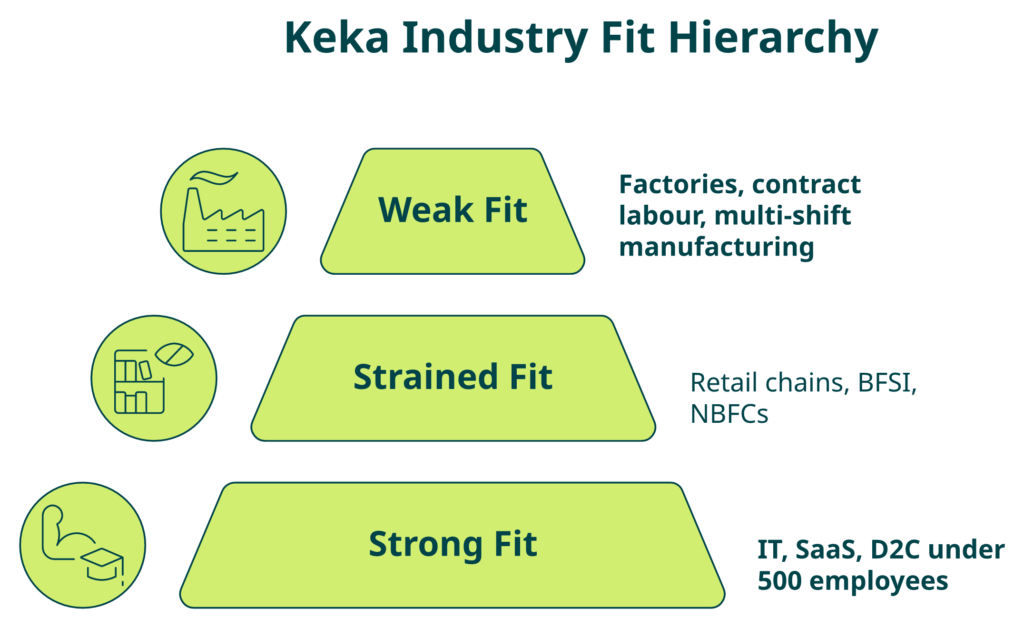
Keka fits best in IT/ITeS, professional services, and single-entity D2C brands between 100 and 500 employees. It strains in manufacturing with rotational shifts, multi-state BFSI with heavy audit cadence, and retail chains running 15-plus pan-India GSTINs. Buyers with a factory workforce, 20-plus legal entities, or a CFO-led rupee-quantified ROI mandate usually need a different operating model.
The 5-industry fit matrix
| Industry | Shift complexity | Multi-entity | Compliance depth | Keka fit |
|---|---|---|---|---|
| IT/ITeS, SaaS | Low | Low to medium | Medium | ✅ Strong |
| Professional services | Low | Medium | Medium | ✅ Strong |
| D2C, e-commerce (single entity) | Low | Low | Medium | ✅ Strong |
| Retail chains (multi-GSTIN) | Medium | High | High | ⚠️ Strained |
| Manufacturing, factories | High | High | High | ❌ Weak |
| BFSI, NBFCs, insurance | Low | High | Very high | ⚠️ Strained |
The matrix is built from Keka’s published module depth across Foundation, Strength, and Growth tiers. For factory-heavy buyers, see manufacturing HR software.
Fit by company size
- SME under 300 employees. Keka lands cleanly if you are single-entity, salaried, and light on compliance. The 100-employee base block hurts below 50 heads.
- Mid-market 300 to 1,000 employees. Fit weakens fast once a second legal entity, a shift roster, or recruitment above 20 hires a month enters the picture. Add-on stacking starts to match the subscription line.
- Enterprise above 1,000 employees. Fit is marginal. Performance and LMS modules need more configuration hands than Keka’s mid-market SPOC model typically carries.
❌ The red-flag list (skip Keka if any apply)
- Factories with 3-shift rotational rosters, daily wage workers, or contract labour under CLRA (Contract Labour Regulation and Abolition Act).
- Retail or hospitality chains with 15-plus pan-India GSTINs, each running separate PT (Professional Tax) and LWF (Labour Welfare Fund) slabs.
- BFSI and NBFCs with audit trails, RBI compliance cadence, and 5-plus level approval chains.
- CFO-led buyers who need a rupee-quantified ROI dashboard at board review.
- HR ops teams with less than two full-time admins to absorb migration and parallel payroll.
Why factory retrofits break the TCO
Working with 2,000-plus Indian HR teams, what I have felt is that the factory-plus-Keka combination almost always ends with a custom development ticket. A shift roster with 3 rotations, OT rules under the Factories Act, and contract labour compliance is not a feature gap. It is an architecture gap. Enterprises that try to bend a Core HR tool into factory shape usually spend 4 to 6 months and ₹8L to ₹15L in consulting before admitting defeat.
🔒 Data residency, ISO 27001, SOC 2, and DPA, in plain English
- ISO 27001 is the international standard for information security management. Most mid-market BFSI buyers ask for it by default. Keka holds it.
- SOC 2 Type II is a US-rooted audit that proves operational controls over 6 to 12 months. Keka offers it on request, not by default.
- DPA (Data Processing Agreement) is the contractual clause that covers GDPR and Indian DPDP Act obligations. Regulated buyers should negotiate a bespoke DPA addendum, not accept the standard one.
HROne runs the same bar (ISO 27001, RBAC, SSO, and sub-500ms response times), and Asia Healthcare Holdings uses it to run 20 pan-India units on a single multi-entity instance without developer tickets. For BFSI-grade compliance, see finance HR software.
“Keka is not built to service IT consulting firms. TAT on customer request on features is bad.”
— Verified User in Consulting, Keka, G2 Verified Review
“Earlier, we used a mix of Excel sheets and legacy tools, now everything is centralized. It reduced manual intervention, improved data accuracy, and made the HR team more efficient overall.”
— Mohit V., HR, Darwinbox, G2 Verified Review
Industry fit is rarely the dealbreaker. Operating-model fit is. Keka is a good Core HR product for the customer profile it was built for. The problem starts when a factory HR head or a 20-unit retail CHRO tries to retrofit it into a workflow it was never architected around.
Q8. What does Keka’s support and implementation experience actually cost in time, tickets, and Monday-morning sanity?
A 300-employee HR ops team on Keka loses 8 to 12 hours a week to tickets, email follow-ups, and tab-switching across modules. At a 2,000-person manufacturer, the same Navigation Tax compounds to roughly 60 to 80 HR hours a month, or half an FTE (full-time employee) of lost productivity. Neither line shows up on the invoice. Both show up in the payroll cycle and the CHRO’s board review.
The G2 benchmark, decoded for your week
| Dimension (10-point) | HROne | Keka | What it means on Monday |
|---|---|---|---|
| Ease of Setup | 9.5 | 8.6 | Fewer parallel-run months before go-live |
| Quality of Support | 9.6 | 8.7 | Tickets resolved, not just acknowledged |
| Ease of Admin | 9.5 | 8.9 | Policy changes without raising a developer ticket |
| Good Partner in business | 9.5 | 8.8 | Renewal conversations without pricing whiplash |
Scores reflect public G2 verified-reviewer averages for the mid-market segment.
The week of a 300-person HR ops lead, before and after
Before consolidation onto a connected HCM, her Monday looks like this: 14 open browser tabs, 3 email threads per unresolved ticket, 2-day turnaround on a leave-policy change, and 45 minutes every morning reconciling biometric punches with the attendance portal. None of this shows up in the subscription line. All of it shows up in her Sunday night anxiety.
After consolidation, her InboxForHR centralises every pending task, approval, and request into one Gmail-style screen, with 60% to 70% reduction in routine HR queries. That is 8 to 10 HR hours a week returned. Multiplied across a 2,000-person enterprise, the savings translate into roughly ₹2.5L to ₹4L in hard HR labour cost per month at mid-market salary benchmarks.
⏰ Ticket queue versus dedicated SPOC
Keka support runs through a shared ticket queue with email-thread escalation, and response SLAs (service-level agreements) vary by plan tier. HROne assigns a dedicated prior-HR SPOC (single point of contact) who understands the domain before they touch the product, with a 9.8 NPS (Net Promoter Score) across 1,500-plus brands and a 24-hour turnaround on phone or email.
The prior-HR detail matters more than the NPS number. A technical project manager reading from a checklist cannot explain why your FBP (Flexible Benefits Plan) declaration logic broke after a CTC (Cost to Company) revision. An ex-HR who has run payroll for 800 people can, inside the first call.
💡 Two implications for the CHRO’s board review
The ROI Dashboard quantifies lifetime hours saved against average HR salary, so the next board review moves from vague productivity claims to a ballpark rupee figure. The SPOC model means one human owns every configuration question end-to-end, which is how MR DIY India went live in 30 days and collapsed payroll cycles from 10 days to 5 to 6 days.
“The InboxforHR is a game-changer, centralizing every HR task into one simple inbox, cutting down administrative time by 60-70% and preventing tasks from falling through the cracks.”
— Waldon S., HR, HROne G2 – Verified Review
“We started working with Keka HRMS in August, and to this day, we have been unable to implement the tool in our company due to their consistently delayed responses and poor coordination between their internal teams.”
— Divya P., HR, Keka, G2 Verified Review
“Experience excellent support from team. HRone helping us streamline multiple processes by bringing everything onto a single platform. This has significantly reduced manual efforts, minimized errors, and improved compliance.”
— Bindu P., HR, HROne G2 – Verified Review
Working with 2,000-plus HR teams, what I’ve felt is that buyers rarely pick the wrong platform on features. They pick the wrong support architecture, and then spend 18 months learning the difference between a ticket queue and a human who answers the phone.
Tell us the one HR task that ate your Monday last week.
See how HROne’s Super Inbox collapses 110 tasks into three-click closures, and why subscription only starts after you go live.
Compare HROne vs Keka See HROne pricingQ9. When is Keka the right call, and when is HROne the last switch you’ll make?
Keka is the right call for a single-entity SaaS or services firm between 100 and 500 employees, with a salaried workforce, no rotational shifts, and an HR team that can absorb a 60 to 90 day implementation. HROne is the better call when you are consolidating a Frankenstein stack, running multi-legal-entity operations, or your CFO wants a rupee-quantified ROI dashboard before sign-off.
⭐ The three scenarios where Keka fits
- A 150 to 400-person IT services firm with one GSTIN, a flat hierarchy, and basic leave and payroll needs. Keka’s Strength tier hits this profile cleanly.
- A single-entity D2C brand under 300 employees that mostly needs attendance, payroll, and a clean ESS portal. Foundation or Strength is adequate.
- A professional services firm with an HR ops team of 2 to 3 full-time admins who can absorb the migration window and run parallel payroll for a quarter.
The three scenarios where HROne wins
- Frankenstein-stack consolidation. You are running outsourced payroll, a standalone biometric vendor, a disconnected ATS, Excel for performance, and WhatsApp for engagement. One integrated HCM replaces five contracts. See core HCM.
- Multi-legal-entity reality. You run 5-plus GSTINs, multi-state PT slabs, or pan-India units. Asia Healthcare Holdings runs 20 units on a single HROne instance, without raising a developer ticket.
- CFO-led ROI mandate. Your next board review needs a rupee-quantified savings number. India’s first inbuilt ROI Dashboard calculates lifetime hours saved against average HR salary. Run the math on the ROI calculator.
✅ What HROne actually changes in the week
Every pending task, approval, and request surfaces in one Super Inbox that closes in three clicks, which collapses the 110-plus tasks an HR ops lead juggles across browser tabs into one screen. 127 pre-built workflows define who does what, by when, across onboarding, confirmation, transfer, promotion, and exit clearance, so the chase cycle over email ends.
Subscription meters only after go-live, there is no multi-year lock-in, and the implementation SPOC is a prior-HR who understands payroll reality, not a technical project manager. MR DIY India went live across their pan-India retail footprint in 30 days, and collapsed payroll cycles from 10 days to 5 to 6 days in the same quarter.
💡 The tiebreaker is the evidence
1,500-plus brands live on HROne, a 9.8 NPS on dedicated HR SPOC support, and an inbuilt ROI Dashboard is the architectural gap no competitor replicates. Keka gives you a list of features. HROne gives you a cockpit for performance. For the full side-by-side, see HROne vs Keka.
Tell us the one HR task that ate your Monday last week.
See how HROne’s Super Inbox collapses 110 tasks into three-click closures, and why subscription only starts after you go live.
Compare HROne vs Keka See HROne pricingQ10. Who should buy Keka in 2026, and what’s the 5-minute decision matrix?
Five variables decide the Keka question: headcount, industry shift complexity, multi-entity footprint, go-live tolerance, and CFO ROI mandate. Score each against your reality, and the matrix below tells you in five minutes whether Keka, HROne, or a different path wins. One flipped variable is often enough to move the verdict.
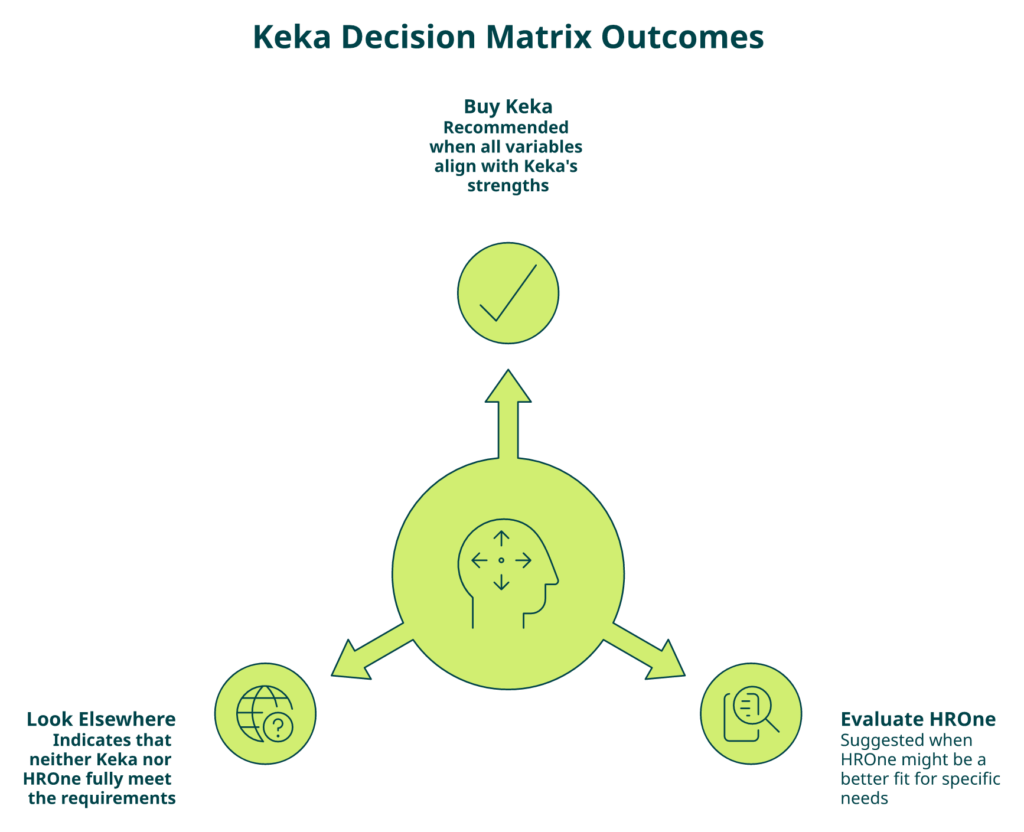
⭐ The 5-variable decision matrix
| Variable | Buy Keka | Evaluate HROne | Look elsewhere |
|---|---|---|---|
| Headcount | 100 to 500, stable | 300 to 5,000, growing | Under 50 or over 5,000 |
| Shift complexity | Single-shift salaried | Multi-shift, field, factory | Contract-heavy labour under CLRA |
| Multi-entity | 1 GSTIN | 2 to 20 GSTINs | 20-plus with separate ledgers |
| Go-live tolerance | 60 to 90 days OK | Need live in 30 to 45 days | Need live in under 30 days |
| CFO ROI mandate | Soft (reporting only) | Hard (rupee-quantified) | Statutory audit only |
A single “Look elsewhere” row, or multiple “Evaluate HROne” rows, usually means Keka is not the right call for your operating model. For deeper buyer guidance, see how to choose the right HRIS/HRMS software.
Feature-to-outcome mapping, in plain rupees
- Workflow automation, from Growth tier, drives cycle-time reduction. Confirmation and transfer letters that took 4 days now close in 1. See the onboarding process.
- OKRs in Growth drive goal-completion rate. Expect 15 to 20% lift if your managers actually run quarterly reviews. For details, see performance management.
- Public Praise add-on drives engagement pulse scores. Typically a 10 to 12 point lift, but only if HR actively seeds recognition in the first 60 days. See employee engagement.
- Keka Hire Pro drives time-to-offer reduction. Manual CV shortlisting time drops 30% for a 1:75 recruiter-to-employee ratio. See recruitment software.
⚠️ The one variable that usually flips the decision
Working with 2,000-plus Indian HR teams, what I’ve felt is that the multi-entity variable is the silent decider. Buyers score themselves a 1-GSTIN firm in the demo, then quietly add a second legal entity six months later when the board approves a new geography. Once that happens, every per-entity surcharge stacks on top of the base subscription, and the TCO math that justified Keka on day one stops working by quarter three.
Which of the five variables flips your decision? Tell us before you sign, because the clause you negotiate in month one decides the bill you see in quarter four.
What I’m thinking about next
My current thinking is that 2027 will be the year HRMS buyers stop asking, “what does it cost per employee?”, and start asking, “what does it return per employee?” The vendors that ship an inbuilt ROI instrument will win the renewal conversation, and the ones that stay on feature parity will lose it.
Show your CFO the ballpark savings before the next review.
Run the HROne ROI CalculatorReferences
Official Docs / Indian Statutes
Keka Technologies. “Keka Pricing: HR & Payroll Software Plans in India” Published: 2026.
Keka Technologies. “KEKA Pricing Final v1.0” Published: October 2025.
Blogs
HRSuggest Research Team. “Keka Pricing Hidden Costs India” Published: April 2026.
















 Secures Top Spot in
