



An employee is eligible for gratuity after 5 years of continuous service. The law treats this as met after 4 years plus 240 days of actual work in the fifth year (190 days for establishments working fewer than 6 days a week). Fixed-term employees qualify after 1 year of service and are paid pro rata when the contract ends. Gratuity is also payable on death or permanent disablement, with no minimum service.
Since 21 November 2025, gratuity is governed by chapter V (Section 53-58) of the Code on Social Security, 2020. It replaced the Payment of Gratuity Act, 1972.
What is Gratuity?
Gratuity is a statutory retirement benefit paid by an employer to an employee in recognition of long and continuous service with an organization. It is fully funded by the employer and becomes payable when an employee leaves employment after meeting the prescribed eligibility conditions, or in specific situations such as death or permanent disablement.
Source: Code on Social Security, 2020
Why Is Gratuity Important?
Gratuity is one of the most significant statutory benefits available to employees in India. Beyond being a legal requirement for eligible establishments, it serves as a long-term financial support mechanism that recognizes an employee’s contribution and loyalty to an organization.
For employees, gratuity acts as a financial cushion during major life and career transitions, such as retirement, resignation after long service, or unforeseen circumstances like disability. For employers, it helps strengthen employee retention, enhance workplace satisfaction, and build a fair rewards framework. Here you can read more about the gratuity.
Benefits of Gratuity for Employees
- Financial Security After Employment: Gratuity provides employees with financial benefit accumulated through years of service. Many employees use this amount to support retirement planning, repay financial obligations, fund higher education for their children, or meet other long-term goals.
- Recognition of Long-Term Service: Unlike performance bonuses or incentives, gratuity is directly linked to the length of service. It acknowledges an employee’s commitment and contribution to the organization’s growth over time.
- Protection for Families: In the event of an employee’s death, gratuity is payable to the nominee or legal heir, helping provide financial support to the employee’s family during a difficult period.
- Tax Benefits: Eligible employees may claim income tax exemption on gratuity under the provisions of the Income-tax Act, subject to the applicable limits and conditions.
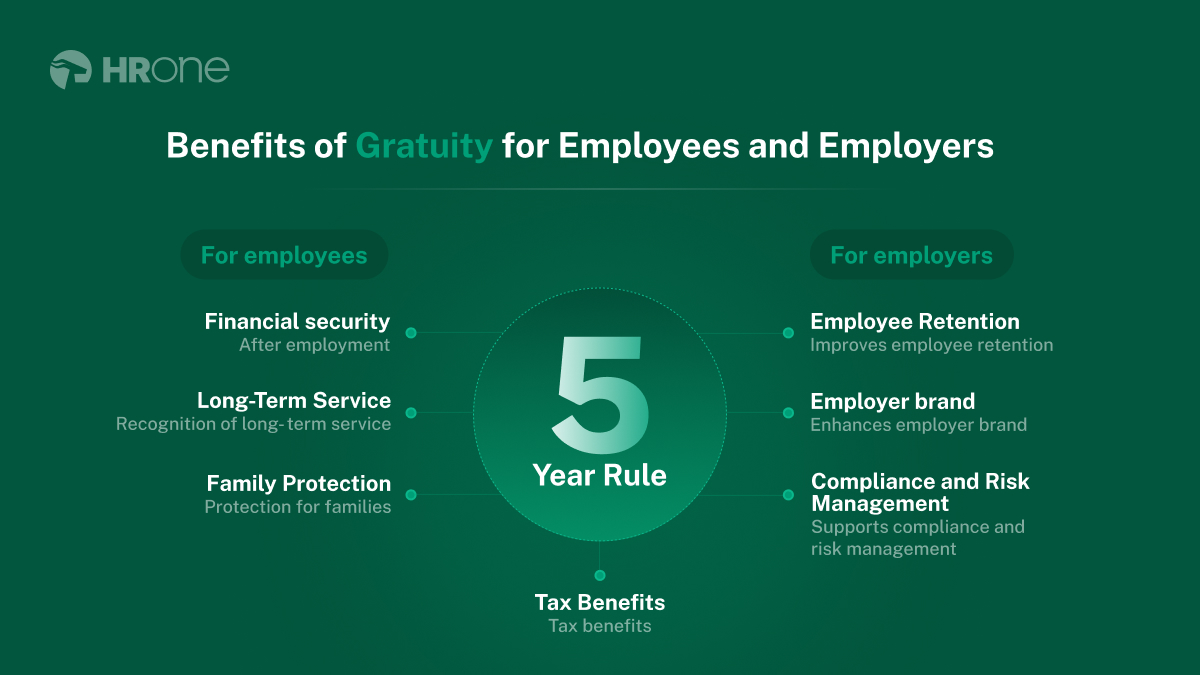
Benefits of Gratuity for Employers
- Improves Employee Retention: Since gratuity is typically payable after completing a prescribed period of service, it encourages employees to stay with an organization for a longer duration. This can help reduce attrition and improve workforce stability.
- Enhances Employer Brand: A well-managed gratuity policy demonstrates an organization’s commitment to employee welfare and statutory compliance. This contributes positively to employer branding and employee trust.
- Supports Compliance and Risk Management: Adhering to the provisions of the Payment of Gratuity Act, 1972 helps organizations avoid legal disputes, penalties, and compliance-related risks.
Who Is Eligible for Gratuity?
One of the most searched questions by employees is, “Who is eligible for gratuity?” Under the Payment of Gratuity Act, 1972, employees generally become eligible to receive gratuity after completing 5 years of continuous service with the same employer. The benefit is payable when an employee resigns, retires, reaches superannuation, becomes permanently disabled, or passes away while in service.
The Code on Social Security, 2020 introduces a key change for fixed-term employees. According to the new code, employees hired on fixed-term contracts may be eligible for gratuity after 1 year of service, calculated on a pro-rata basis. However, the 5-year rule will continue to apply to most permanent employees.
Eligibility Criteria for Gratuity
An employee may qualify for gratuity if:
- They are employed in an organization covered under gratuity law.
- They have completed at least five years of continuous service.
- They leave the organization through resignation, retirement, or superannuation.
- Employment ends due to death or permanent disablement (the 5-year condition does not apply in these cases).
The 5-Year Rule Explained
The 5-year rule is the foundation of gratuity eligibility in India. Under the Payment of Gratuity Act, 1972, employees are generally required to complete five years of continuous service with the same employer before they can claim gratuity upon resignation or retirement. The purpose of this rule is to reward employees who have contributed to an organization over a significant period. It also encourages long-term employment and helps employers retain experience.
What Does “Five Years of Continuous Service” Mean?
Many employees assume that they must complete exactly five calendar years without any breaks. However, the law uses the term continuous service, which includes certain authorized interruptions such as:
- Earned leave
- Sick leave
- Maternity leave
- Layoffs recognized under law
- Absence due to workplace accidents or illness
These periods do not break an employee’s continuity of service and are considered while determining gratuity eligibility.
When does the 5-Year Rule Apply?
The five-year requirement generally applies when an employee leaves the organization due to:
- Resignation
- Retirement
- Superannuation
For example, if an employee joins a company in January 2021 and resigns after completing five years of continuous service, they become eligible to receive gratuity from the employer.
Important Exceptions to the Rule
- The five-year condition does not apply in cases of:
- Death of an employee
- Permanent disability caused by an accident or illness
In such situations, gratuity is payable even if the employee has not completed five years of service. The amount is paid to the employee, nominee, or legal heir, depending on the situation.
What is the 4 Years 240 Days Rule for Gratuity?
Under Indian labour law, an employee becomes legally eligible for gratuity upon completing 4 full years of continuous service plus at least 240 days in the 5th year (roughly 4 years and 8 months). Working 240 days in the fifth year legally counts as completing a full fifth year, satisfying the mandatory 5-year minimum tenure requirement.
| Establishment type | Days needed in 5th year | Approx. total service |
| 6-day week | 240 | 4 years 8 months |
| Fewer than 6 days (e.g. 5-day corporate week) | 190 | 4 years 6.5 months |

One missed day = one dispute.
Let HROne HRMS count the days and alert HR before the exit is processed.
How the Rule Works
- The 5-Year Mandate vs. The 240-Day Rule: While gratuity ordinarily requires 5 years of continuous service, the law defines “one year of continuous service” as actually working 240 days in a 12-month period (for organizations operating 6 days a week).
- 5-Day Workweek Exception (4 Years + 190 Days): If your organization operates fewer than 6 days a week (e.g., a standard 5-day corporate workweek) or is an underground mine, the threshold drops to 190 days in the fifth year (roughly 4 years and 6.5 months).
- Counts Toward the 240 Days: The 240-day count is not limited to physical attendance at a desk; it includes paid leaves, weekly offs, public holidays, maternity leave, and periods of temporary disablement due to an accident on duty.
- Gratuity Calculation Formula: Once you cross the 4 years and 240 days mark, your fifth year is rounded up to a full year. The payout is calculated for 5 completed years using the standard formula. You can calculate your gratuity in just one click with HROne gratuity calculator.
Important Exceptions
- Fixed-Term Employees (1-Year Rule): Under the current labor codes, fixed-term employees hired directly on a contract are eligible for pro-rata gratuity after just 1 year of continuous service, making the 4-year 240-day rule unnecessary for them.
- Death or Disablement: The 5-year / 240-day service requirement is completely waived if employment ends due to the employee’s death or permanent disablement.
- Resignation Timing Risk: Notice periods count toward your active tenure. Always verify that your Last Working Day (LWD), not your resignation submission date, crosses the 240th day (or 190th day) of your fifth year to avoid losing eligibility by a few days.
Is Gratuity Taxable?
Gratuity counts as part of your salary, but most people don’t pay tax on all of it. If you work for the government, none of it is taxed. If you work in the private sector, the first ₹20 lakh is tax-free, and anything above that is added to your income and taxed at your slab rate.
| Employee type | Tax-free amount |
| Central/state government employees | Fully exempt |
| Private employees covered by the gratuity law | The least of actual gratuity received, ₹20 lakh, or the 15/26 formula amount |
| Private employees not covered | The least of actual gratuity received, ₹20 lakh, or half a month’s average salary for each completed year |
- ₹20 lakh is a lifetime limit across all employers. If you claimed ₹8 lakh at an earlier job, only ₹12 lakh remains.
- Voluntary excess is taxable. A company may pay more than ₹20 lakh, but the excess is taxed as salary.
- Labour law and tax law use different wage bases. The labour-law wage is broader, while the tax exemption formula uses only basic pay and DA.
Gratuity Under the Code on Social Security, 2020
It is now in force. The Code on Social Security, 2020 became effective on 21 November 2025, as one of the four Labour Codes. Gratuity is now dealt with under chapter V (Section 53-58) of this Code, which consolidates the Payment of Gratuity Act, 1972 along with eight other social security laws.
- Fixed-term employees: The new code reduces the eligibility requirement for fixed-term employees from five years to one year. They receive gratuity on a pro-rata basis when the contract ends.
- Regular employees: The five-year requirement continues for permanent staff.
- Continuous service: An employee is deemed to have completed a year with 240 days in the preceding twelve months, or 190 days for below-ground mine employees and establishments working fewer than six days a week.
- Wage definition: The definition of wages used for gratuity calculations has been broadened. The income-tax exemption still calculates basic pay and DA only, so labour law and tax law don’t fully line up.
| Regular employee | Fixed-term employee | |
| Minimum service | 5 years (or 4 years + 240/190 days) | 1 year |
| When paid | On exit | When the contract ends |
| Amount | Full | Pro rata |
| Death or disablement | No minimum | No minimum |
Source: Ministry of Labour and Employment
How HR Teams Can Ensure Compliance?
- Update policy references: Cite the Code on Social Security, 2020 (not just the 1972 Act) in employment contracts, offer letters and HR policy manuals.
- Split your workforce by category: Fixed-term and permanent employees now follow different eligibility rules, so tag them separately in your HR system.
- Check eligibility against the last working day: Count the 240th (or 190th) day of the fifth year to the last working day, not the resignation date.
- Recheck your wage base: Confirm which wage definition applies to the gratuity calculation, and which applies to the tax exemption.
- Provision for liability: Short-term and project-based staffing now creates more gratuity exposure for employers. Budget for it.
- Keep nomination records current: Collect and update nominee details so death-related payouts aren’t delayed.
- Use the updated forms: The forms for gratuity administration were revised under the Social Security (Central) Rules, 2026.
- Start the gratuity calculation: When an exit is confirmed, not after the employee has left.
- Automate it: Manual calculation is where most errors creep in, so put the calculation inside payroll.


















 Secures Top Spot in


