




Q1. What is RazorpayX Payroll pricing in 2026?
RazorpayX Payroll pricing starts at ₹2,499 per month for Prime (up to 20 employees) on annual billing, or ₹2,999 on semi-annual. Elite costs ₹5,499 per month for 50 employees (₹5,999 semi-annual), with extra employees at ₹150 each per month. Enterprise, for 100+ employees, lists at ₹8,499 per month or is quoted directly. All prices exclude 18% GST.
A finance head in Pune sent me a screenshot last quarter. Four browser tabs, four different prices for the same product. One said ₹2,499, one said ₹2,999, one said ₹30 per employee, and one said “available on request”.
She was not confused because she is careless. She was confused because the market publishes the number carelessly, which is exactly why we keep a public breakdown of payroll software price in India updated.
💰 The actual price grid
| Plan | Employee cap | Annual billing | Semi-annual billing | Extra employees |
|---|---|---|---|---|
| Prime | 20 | ₹2,499/mo | ₹2,999/mo | Not applicable |
| Elite | 100 | ₹5,499/mo (for 50) | ₹5,999/mo | ₹150/employee/mo |
| Enterprise | 100+ | ₹8,499/mo | ₹9,999/mo | On quote |
Every figure above sits on Razorpay’s own pricing page, behind a billing toggle.
The toggle is the whole answer to the ₹2,999 mystery. Semi-annual billing costs ₹500 more per month on Prime and Elite, and ₹1,500 more on Enterprise.
⚠️ Why directories quote four different numbers
Aggregators screenshot whichever toggle state loaded first. SaaSworthy lists no free plan, SoftwareSuggest lists a $1 per user entry price, and Techjockey shows ₹2,999 as the headline.
None of them are lying. They are each frozen at a different moment.
Founders on Reddit have done better arithmetic than most review sites.
“If you’re after Razorpay payroll, the cost begins at 2,499/- per month on an annual plan.”
– u/Razorpay_Community member, r/Razorpay_Community Reddit Thread
⏰ The GST line nobody budgets
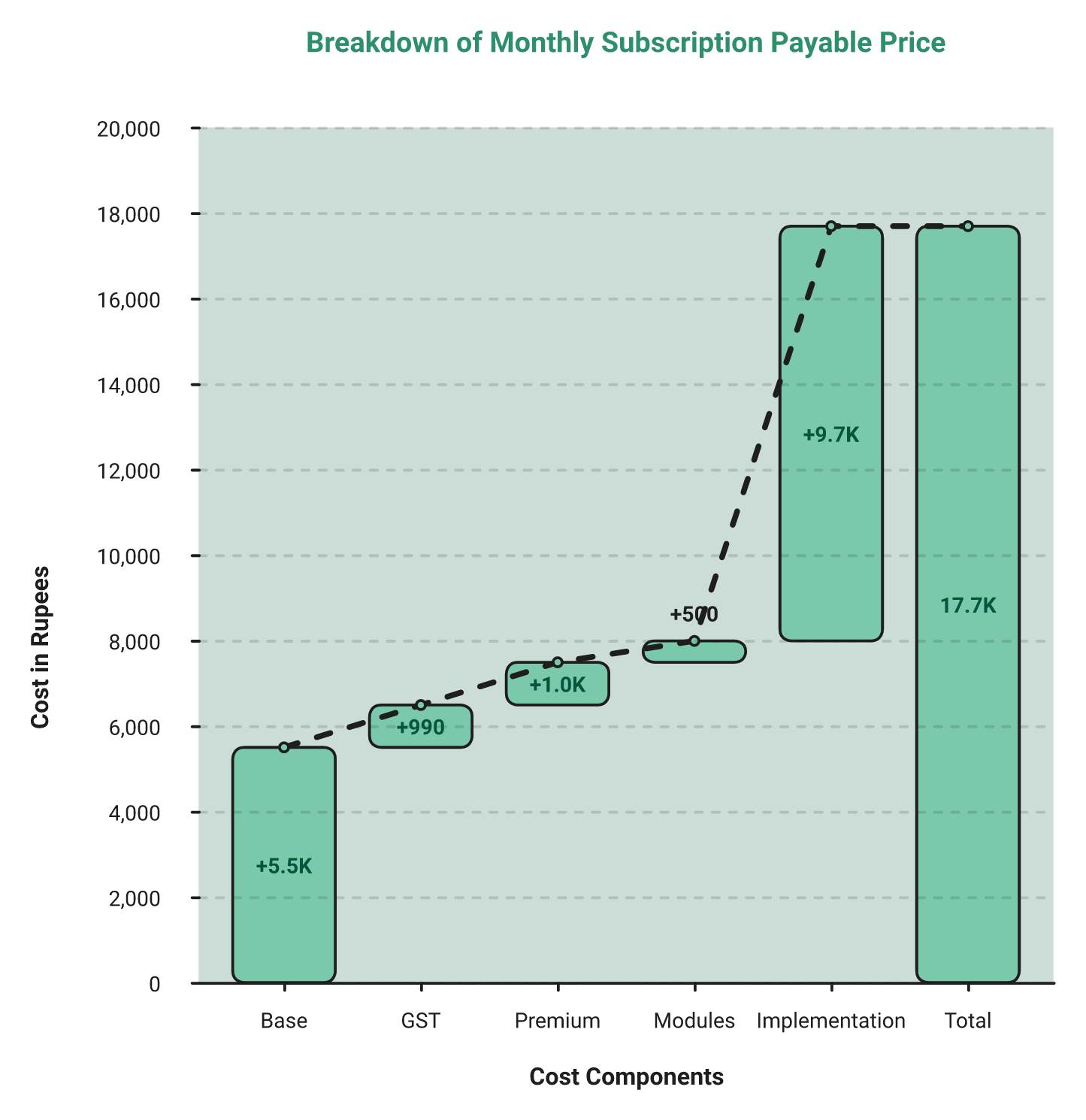
The pricing page carries one small footnote: additional 18% GST applicable. On Elite at 50 employees, that is roughly ₹990 extra every month.
I have watched three procurement cycles stall over exactly that number. The budget was approved at ₹5,499, and the invoice arrived at ₹6,489.
Razorpay is also running a promotion at the time of writing: one month free plus 20% off semi-annual plans. Promotions expire, so treat them as timing, not as pricing.
✅ What to do with these numbers today
Write down your headcount for the next twelve months, not today’s headcount. Then pick the row, add GST, and multiply by twelve.
That single line is your real budget ask. Everything else is negotiation, and the same discipline applies when you benchmark broader HR software pricing.
HROne prices on flat per-employee-per-month terms with no lock-in and no per-entity charge, so a 250-person manufacturing team can model a twelve-month figure on the HROne pricing page before the first sales call rather than after it.
Q2. Is RazorpayX Payroll actually free, and what does the free tier not do?
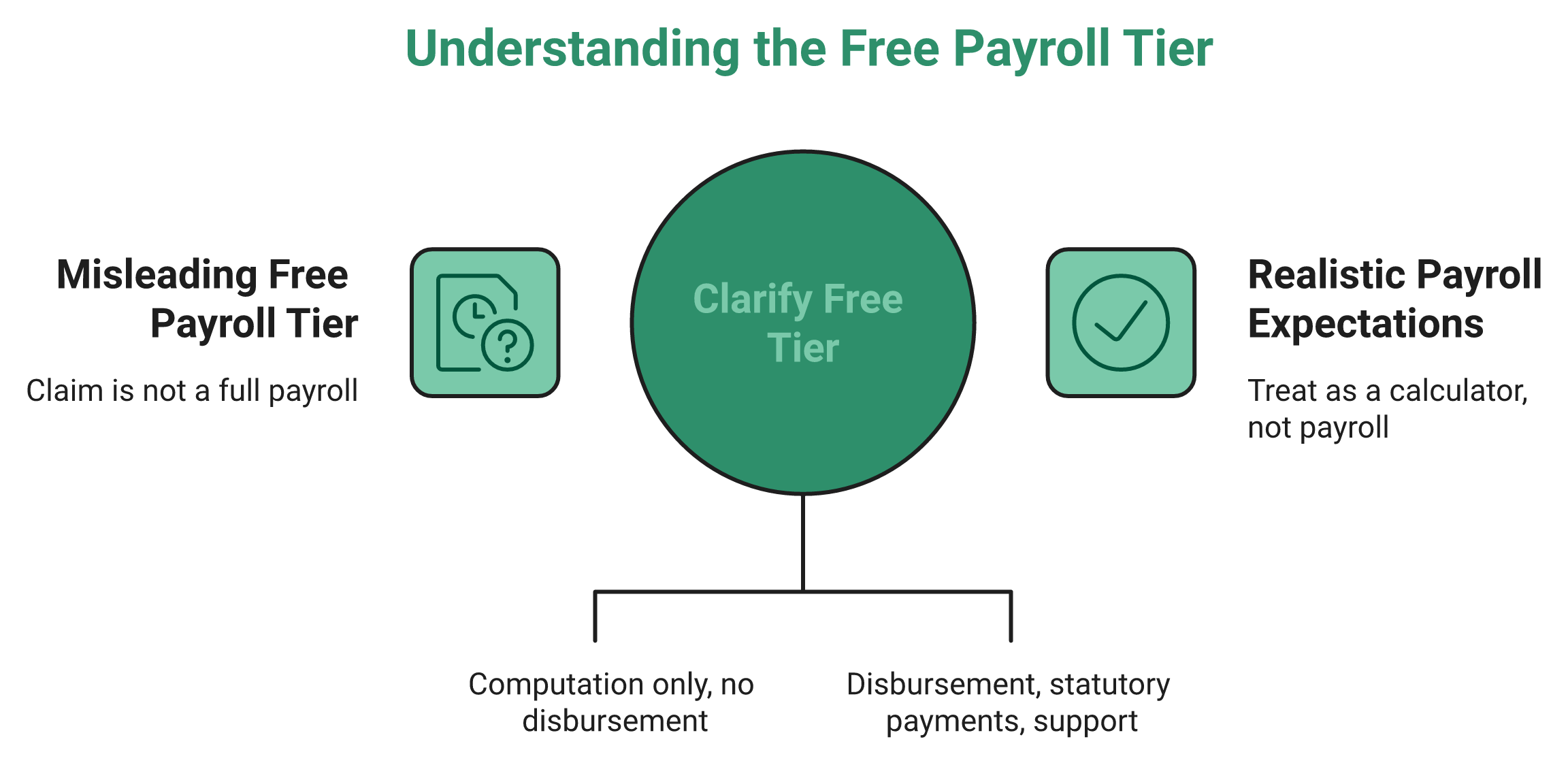
No free tier appears on Razorpay’s public pricing page, which lists only Prime, Elite, and Enterprise. Some directories still list a free plan covering payroll calculation, leave, attendance, and PF, TDS, and ESIC math. Salary disbursement, the actual reason you buy payroll software, sits behind a paid plan. Treat any free claim as a calculator, not a payroll run.
Most articles on this keyword answer “is it free” with a shrug. Here is the sharper version: it was free, for some users, and then it was not.
❌ The free tier that disappeared
A manufacturing SME owner documented the switch on Reddit, and the detail that matters is the notice period.
“I was spoilt by the free version of RazorpayX Payroll, and now they’re changing to ₹2k per month for my 4 employees, with literally 2 weeks of notice in Q3 of the FY. Sucks.”
– u/IndiaTax member, r/IndiaTax Reddit Thread
Four employees. ₹2,000 a month. That is ₹500 per employee, which is the worst per-head economics in the Indian market.
🔍 Who says what, and when they last checked
The contradiction is documented and datable. SoftwareSuggest lists a Free Plan alongside a Pro Plan. SaaSworthy states there is no free plan. An analyst scorecard verified on 7 May 2026 found no publicly advertised free tier.
My read is that free access now arrives as a sales concession, not as a published product. I could be reading the pattern too strongly, but three sources checked on three different dates support it.
⚠️ What “free” quietly excludes
A calculator-grade free tier typically stops before the parts that carry legal risk.
- Salary disbursement to employee bank accounts
- Statutory challan payment, not just computation
- Support response commitments
- Multi-entity or multi-state configuration
Free tiers also change the vendor’s incentive to help you. Small unqualified accounts get deprioritised quietly, and you discover it during a payroll week, not during a demo.
✅ Three questions to ask before you sign
Ask them in writing, in one email, before any discount conversation.
- Is disbursement included at my plan, or only computation?
- What notice period applies if the plan or price changes mid-year?
- What is the support response time on my tier, in hours?
If the answers arrive as “our team will guide you,” you have learned something useful. A structured payroll software checklist keeps that conversation honest.
HROne runs no free tier and prices from go-live, which means implementation and a dedicated prior-HR onboarding SPOC (9.8 NPS) are contractually owned rather than discovered as missing at employee 51.
Q3. What do you actually get in Prime vs Elite vs Enterprise?
All three RazorpayX Payroll plans include payroll calculation, payslip generation, direct salary payment, one-time payments, salary adjustments, and compliance calculation, payments, and filings. Prime shows Limited access to Advanced Payroll, Expense Management, Support Assist, and Integrations. Elite still shows Limited Expense Management and Support Assist. Razorpay’s own footnote confirms some modules are unavailable and reachable only at extra cost.
There is a word on that pricing grid doing a lot of quiet work. The word is “Limited.”
📋 Module scope by plan
| Module | Prime | Elite | Enterprise |
|---|---|---|---|
| Payroll calculation, payslips, direct salary payment | Included | Included | Included |
| One-time payments, salary adjustment, salary register | Included | Included | Included |
| Compliance calculation, payments, filings | Included | Included | Included |
| Advanced Payroll | Limited | Included | Included |
| Expense Management | Limited | Limited | Included |
| Time and Attendance | Included | Included | Included |
| Support Assist | Limited | Limited | Included |
| Integrations | Limited | Included | Included |
Source: Razorpay’s live pricing grid, including its footnote that a dash means the module is unavailable and accessible at extra cost.
Read that table as a floor, not a ceiling. Two of the modules an HR manager touches weekly, expenses and support, stay Limited even on the ₹5,499 plan.
⚠️ The slab contradiction worth catching before renewal
Razorpay’s pricing page caps Prime at 20 employees and Elite at 100. Razorpay’s product documentation defines the same plans as Prime 11 to 30, Elite 31 to 1,000, and Enterprise 1,001 and above.
Both pages are live. Both are official. They do not agree.
If you are at 28 employees, that gap decides whether you are a Prime customer or an Elite customer. I would get the slab written into the order form, not inferred from a webpage.
🐖 Buy the modules you will actually use
There is an old line I keep returning to on HR buying calls. You do not want to buy the whole hog if you are not going to eat the whole hog.
The mistake is not buying too much. It is buying a bundle that cannot be extended later without a fresh implementation, which is the core of the payroll software versus full HRMS decision.
✅ How to test module depth in one demo
Bring three real tasks from last month’s payroll. A mid-month CTC revision, a rejected expense claim, and a shift-based attendance correction.
Ask the sales engineer to complete all three live. “Limited” becomes visible in about four minutes.
HROne runs payroll software, attendance, and performance on a single instance with 127 pre-built hire-to-retire workflows, so a 400-person logistics firm can start with payroll and switch on performance later without a second implementation.
Q4. What does RazorpayX Payroll really cost at 20, 50, and 100 employees?
At 20 employees, Prime works out to about ₹35,386 a year including 18% GST. At 50, Elite lands near ₹77,866. At 100, add ₹150 for each of the 50 extra heads, which is ₹12,999 a month, or roughly ₹1.84 lakh a year. Effective cost falls from about ₹147 to ₹130 per employee per month. HROne meters its subscription only after go-live, so the implementation window is not billed.
Every competing article on this keyword restates list prices. None of them multiply by twelve and add GST.
💸 All-in annual cost at three headcounts
| Headcount | Plan | Monthly base | Monthly with GST | Annual all-in | Effective PEPM |
|---|---|---|---|---|---|
| 20 | Prime | ₹2,499 | ₹2,949 | ₹35,386 | ₹147 |
| 50 | Elite | ₹5,499 | ₹6,489 | ₹77,866 | ₹130 |
| 100 | Elite plus 50 extra | ₹12,999 | ₹15,339 | ₹1,84,066 | ₹153 |
Method: base price from the annual billing toggle, 18% GST applied, multiplied by twelve, with extras at ₹150 per employee per month.
Notice the curve. Cost per employee drops from ₹147 to ₹130, then climbs back to ₹153 once overages stack.
⚠️ Where the ₹30 figure comes from
Some 2026 roundups publish ₹30 per employee per month for RazorpayX Payroll. Nothing on the official pricing page produces that number at any headcount.
My working assumption is that ₹30 is a legacy or promotional rate that survived in a comparison table. If a vendor quotes it to you, get it on the order form.
⏰ The hidden line items
Four costs sit outside the sticker price, and three of them are documented on Razorpay’s own pages.
- ⚠️ Semi-annual premium: ₹500 to ₹1,500 more per month than annual
- ⚠️ Extra-cost modules marked with a dash on the pricing grid
- ⚠️ 18% GST on every invoice
- ⚠️ Implementation weeks billed at full rate while nobody is running payroll on the system
💰 The go-live trigger is the cheapest thing to negotiate
Ask for one clause: the subscription meters from go-live, not from signature. On Elite, a six-week implementation is roughly ₹9,700 of software you paid for and did not use, which is why the HRMS implementation timeline belongs in your pricing conversation.
Support quality is what determines whether that window is six weeks or sixteen. Founders have been blunt about the risk.
“I had to send payments/salaries to my employees and vendors and suddenly I was not able to do so. I just filed support tickets for 4 days and they were ‘LOOKING into the issues’.”
– u/indianstartups member, r/indianstartups Reddit Thread
For contrast, here is the same category risk from a verified buyer of a full HCM, including the part that annoyed them.
“What I like most about HROne is how it blends smart HR technology with a genuine human touch… one thing I don’t like is that it can sometimes feel a bit overwhelming for new users.”
– Nijanthan R., 3/5 rating, HROne G2 – Verified Review
Getting the statutory side right matters just as much as the invoice, so read our employer guide to PF, ESI, and TDS compliance before you finalise a plan.
HROne bills from go-live with flat per-employee pricing and no lock-in, which is how MR DIY India compressed its payroll cycle from 10 days to 5 to 6 days without paying for months of unused software first.
Q5. What happens to your bill when headcount changes mid-contract?
Additional employees are billed monthly as you hire. If headcount falls, Razorpay’s documentation states extra free months are granted only after the 14th month. Annual subscribers cannot switch to monthly mid-term, and unused months are not refunded. That asymmetry, instant upside billing and delayed downside credit, is the real cost for seasonal or shrinking teams.
Situation: you sign an annual plan at 60 employees in April. Complication: by October you are at 40. The plan does not shrink with you.
⚠️ The asymmetry, in rupees
At 60 employees on Elite, you pay ₹5,499 base plus ₹150 for each of the 10 extra heads. That is ₹6,999 a month before GST.
Drop to 40 employees and the base does not fall below ₹5,499. You keep paying for 50 seats while using 40.
Razorpay’s own docs are honest about the correction mechanism. Extra free months for a headcount decrease arrive only after the 14th month of subscription.
⏰ Two clauses worth negotiating
I have sat in enough vendor calls to know these are the only two that move.
- ⏰ A mid-term downgrade clause tied to active headcount, not to seats purchased
- 💰 A billing start date pegged to go-live, not to signature
Ask for both in the order form. Verbal assurance during a demo is not a contract term, which is why our HRMS evaluation checklist puts commercial terms before feature lists.
💸 Mid-year price changes are a real risk
The sharpest warning on this comes from an owner who lost a free plan with almost no notice.
“I was spoilt by the free version of RazorpayX Payroll, and now they’re changing to ₹2k per month for my 4 employees, with literally 2 weeks of notice in Q3 of the FY. Sucks.”
– u/IndiaTax member, r/IndiaTax Reddit Thread
Two weeks in Q3 leaves no room in an approved budget. That is the part that stings, not the ₹2,000.
❌ Why teams stay in bad contracts
Lock-in does not always look like a legal clause. Sometimes it just looks like a budget with no slack left in it.
“Nothing. I would not recommend this platform to anyone. Its because of our budget constraint that we are using it. Else we wud have moved out.”
– Maheshkumar J., 0.5/5 rating, greytHR G2 – Verified Review
That review is about a different vendor, and the mechanism is identical. A team paid for the year, so it stayed for the year, which is the pattern behind most switching decisions from greytHR.
✅ The parachute test
There is a simple way to frame this to a vendor. A good pricing model works like a parachute, opening when you need it and costing you only what you use.
HROne bills on active headcount within the term with no lock-in, which matters for retail HR and F&B clients whose December strength looks nothing like their April strength.
Q6. Does the price cover full Indian statutory compliance?
All paid RazorpayX Payroll plans automate PF, ESI, professional tax, and TDS computation, with challan support and Form 16. What no pricing page tells you is whether the wage definition is configurable. The Code on Wages requires basic plus DA to be at least 50% of remuneration. HROne runs multi-legal-entity payroll on a single instance with no per-entity charge.
Think of statutory compliance as two different jobs. One is doing the maths. The other is filing on time, every month, without a human remembering.
Most pricing pages only promise the first job.
📅 The monthly calendar your plan must cover
Here is the cadence an Indian payroll team actually runs.
| Obligation | Rate | Due date |
|---|---|---|
| TDS deposit | Per slab | 7th of next month |
| PF (EPF plus EPS) | 12% of basic plus DA | 15th of next month |
| ESI | 3.25% employer, 0.75% employee | 15th of next month |
| Professional tax | State slab | State-specific |
ESI applies on wages up to ₹21,000 a month under the current ceiling. Miss any of these dates and the penalty is not a software problem anymore. Teams running several states usually formalise this inside a multi-state payroll compliance process.
⚠️ The 50% wage rule beats any discount
The Code on Wages fixes a uniform definition of wages. Basic plus DA must be at least half of total remuneration.
Section 50 of the same Code also requires registers, muster rolls, and wage slips for every wage period. That is a data structure requirement, not a report you download later.
So the real question at demo stage is boring and important. Can you change the wage definition yourself, or does it need a support ticket? That single answer decides how much statutory compliance software actually saves you.
🔍 Real-time checks versus batch-at-filing
A 2025 patent for automated compliance management describes ingesting payroll and census data, then flagging missing or mislabelled fields near real time.
I would ask every vendor which model they use. Catching a wrong PF base on the 3rd is cheap. Catching it on the 20th is a revision.
❌ What broken compliance looks like to a CA
Reviewers describe the failure pattern clearly, and it is rarely about missing features.
“CA raised a concern that tax figures deducted in the last FY vs the amounts reflecting on system now are different… The CTC structure doesn’t show PT in deductions which adds to confusion.”
– Pooja M., 2/5 rating, Keka G2 – Verified Review
The same problem, solved, sounds like this.
“Proper calculation of PF and ESI was a pain area for us before, but now with the HROne automated calculation process, results are up to the mark and following Indian tax compliances properly.”
– Ajay K., 5/5 rating, HROne G2 – Verified Review
✅ Your Monday test
Pull last month’s payroll register. Check whether basic plus DA clears 50% for your lowest three CTCs.
If it does not, no subscription price matters until that is fixed.
HROne handles PF, ESI, LWF, PT slabs, and TDS on a single instance, which is how Asia Healthcare Holdings runs 20 pan-India units with separate policies and no extra entity charge, a pattern we detail for multi-entity companies in India.
Q7. What does the price not buy, and what breaks past 50 employees?
The subscription buys compliant salary disbursal, not an HR system. Past 50 employees, three gaps surface: no deep native leave and attendance layer, thinner support on lower tiers, and manual reconciliation between payroll and everything else. HROne closes an approval or attendance correction inside a Super Inbox in three clicks. The bill grows at ₹150 per head while manual work grows faster.
Most HR systems do not fail because they are unfair. They fail because they are too uniform.
A payroll tool treats a 40-person team and a 400-person team as the same shape. The second one is not.
❌ The run-around nobody prices in
A CHRO once described her pre-system life to me as chasing, not managing. Inconsistent data, missing fields, and asking people whether they had updated anything.
She was not sure she could trust her own analytics. That uncertainty is the hidden line item, and it is the reason scaling HR processes from 100 to 1,000 employees breaks tooling first.
💸 Linear price, non-linear work
At 100 employees, RazorpayX Payroll costs about ₹12,999 a month. Add a separate attendance or leave tool and you are running two vendors and one reconciliation.
Reviewers of payroll-first tools name the same residue.
“Lack of customizations options are not expected from a full service HRMS. No self onboard options as well. lot of manual work that the team still has to do.”
– Verified User in Internet, 2.5/5 rating, Keka G2 – Verified Review
“from implementation onwards, there were issues with leave balance and all. Many times we were manually correcting the leave balance of employees.”
– Verified User in IT Services, 2/5 rating, greytHR G2 – Verified Review
⏰ What the research says the upside is worth
A 2025 study of AI-enabled payroll in small firms found processing time falling 40% to 50%, with fewer disputes.
A study of robotic process automation in HR reported task completion improvements of 62% to 71% on routine admin.
Put that against an HR salary. If payroll eats six days a month, half of that is real money, not a soft benefit. Our ROI of HR software breakdown shows how to model that in rupee terms.
⚠️ Where integrated systems still annoy people
HROne users flag their own gaps, and I would rather you read those than a feature list.
“Engage module limited to hardly 3 reports and minimum functionalities available… Geofencing radius not work properly.”
– Manna S., 4.5/5 rating, HROne G2 – Verified Review
That is an honest trade-off. No platform is uniformly strong, and pretending otherwise wastes your evaluation time.
✅ When staying put is the right call
Stay on a payroll-only tool if you are single-entity, under 50 heads, and your attendance is genuinely simple. The migration cost will exceed the savings.
Move when you start reconciling two systems by hand every month. That is the signal, not the invoice, and the payroll software versus full HRMS comparison lays out both paths.
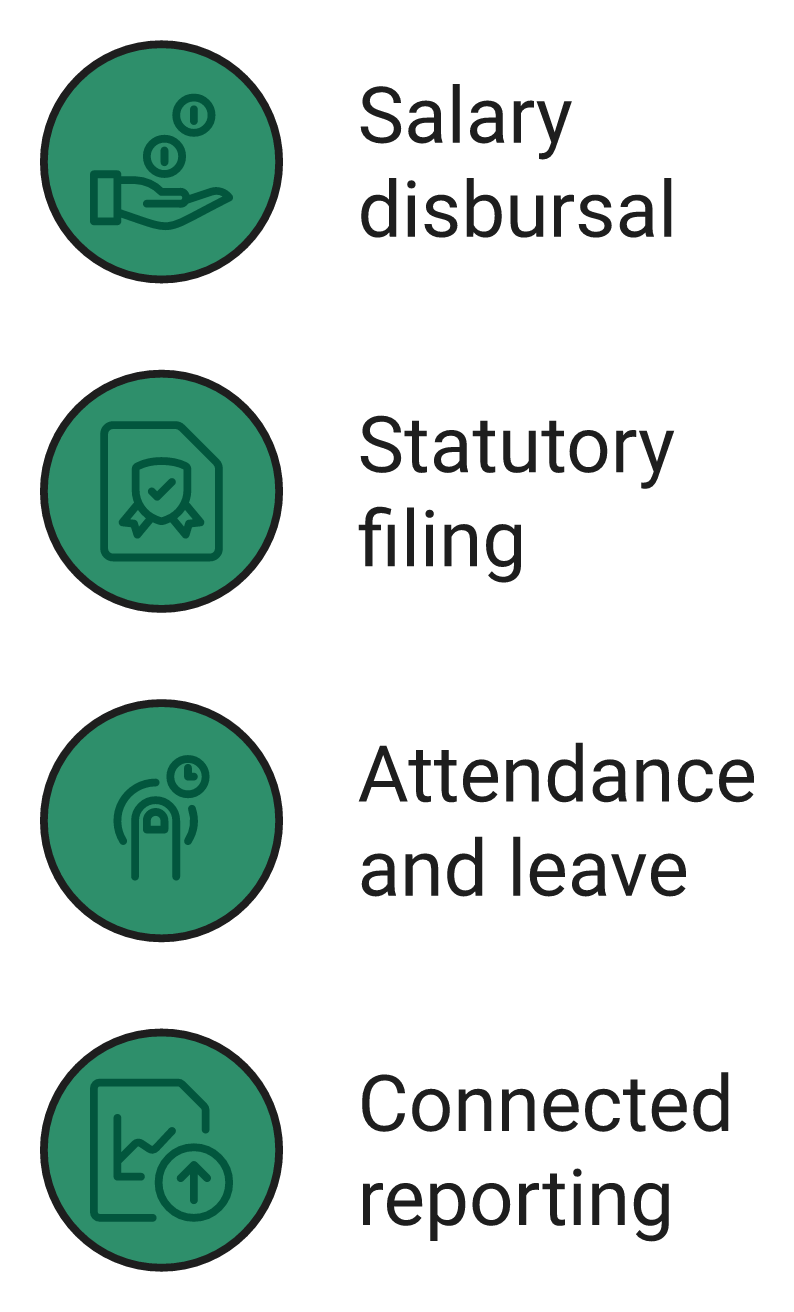
HROne runs 127 pre-built hire-to-retire workflows through one HR inbox, which is how MR DIY India compressed its payroll cycle from 10 days to 5 or 6 days.
Q8. How does RazorpayX Payroll pricing compare to HROne, Zoho, greytHR, and Keka?
HROne lists ₹4,950 per month for 50 users, then ₹99 per additional user, positioned for teams where payroll is one module of a full HCM. Zoho Payroll starts at ₹1,000 per month for 25 employees plus ₹40 per extra head, undercutting RazorpayX Payroll’s ₹2,499 for 20. greytHR starts at ₹2,495 for 50. The lowest rate wins only if payroll stays the only job.
💰 India payroll and HCM pricing, 2026
| Vendor | Entry price (annual billing) | Additional employee | Scope at that price | Best fit |
|---|---|---|---|---|
| HROne | ₹4,950/mo for 50 users (Basic) | ₹99/user | Core HR, payroll, attendance, mobile, PF/ESI/TDS/PT | 100 to 5,000 employees |
| RazorpayX Payroll | ₹2,499/mo for 20 (Prime) | ₹150 above 50 on Elite | Payroll, compliance filings, disbursal | Under 50, single entity |
| Zoho Payroll | ₹1,000/mo for 25 (Standard) | ₹40/employee | Payroll only, per organisation | Startups in Zoho stack |
| greytHR | ₹2,495/mo for 50 (Basic) | ₹45/employee | Core HR and payroll | SMB payroll |
| Keka | ₹6,999 to ₹9,999/mo for 100 (Foundation) | ₹90 to ₹150 | Core HR, leave, attendance, basic payroll | 50 to 500, IT/ITES |
Sources: each vendor’s public pricing page or verified 2026 pricing analysis. All exclude 18% GST. For deeper tier-by-tier maths, see our Keka pricing breakdown and greytHR pricing breakdown.
⚠️ The per-organisation trap
Zoho’s own FAQ states the model charges per organisation, so each separate legal entity needs its own subscription.
That single line changes the maths for any Indian group with three entities. Three subscriptions, three renewals, and three reconciliations.
HROne charges no separate per-entity fee on a single instance, which is why multi-entity groups often model cost differently from single-company startups.
🌱 A bouquet is not a garden
Most startup HR stacks are bouquets. Nice individual stems, cut, bound together, and not connected to anything.
A garden is different. Attendance feeds payroll, payroll feeds the ledger, and nobody re-enters data at month end. That connective tissue is what HRMS integrations with Tally, SAP, and biometric devices are actually for.
The category sells the bouquet because it is easier to price. My read is that the reconciliation hours are where the real spend hides.
⭐ What buyers say about the trade
Keka reviewers praise payroll and flag the modules around it.
“strong payroll and compliance automate salary and attendance processing with pf/esi tds… PMS module is confusing and needs to be simpler and easier to use.”
– Kiran B., 3/5 rating, Keka G2 – Verified Review
The integrated version of the same job reads like this.
“HCM makes salary disbursement process as a easy one and error less with bank Challan creation functionality supported.”
– Sachin K., 5/5 rating, HROne G2 – Verified Review
✅ Verdict by company stage
- Under 25 employees, single entity: Zoho Payroll or RazorpayX Prime
- 25 to 50, needs disbursal inside Razorpay banking: RazorpayX Elite
- 50 to 100, attendance-driven payroll: HROne Basic or greytHR
- 100 plus, multi-entity, board-level ROI reporting: full HCM territory
Mid-market buyers comparing shortlists usually start with the best HR software for the Indian mid-market before locking a budget line.
HROne runs 120 plus cross-module automations with flat per-employee pricing and go-live billing, which is why teams that shortlist on entry price alone often re-evaluate within eighteen months.
Q9. How do you evaluate any payroll quote before you sign?
Score any payroll quote on six things: all-in annual cost with GST, module scope versus extra-cost add-ons, headcount-change mechanics, whether compliance validation is real-time or batch-at-filing, wage-definition configurability under the Code on Wages, and whether billing starts at signature or go-live. HROne reports a 9.8 NPS on its dedicated implementation SPOC, the criterion buyers weigh last and regret first. Five of the six never appear on a pricing page.
Most buyers evaluate payroll software on features. Features are the easy part. Almost every India-focused tool computes PF and TDS.
What separates them is what happens in week three of implementation.
📋 The six-criterion rubric
Score each from 1 to 5, then total. Anything under 20 needs a second conversation.
| Criterion | What to ask | Where the answer hides |
|---|---|---|
| All-in annual cost | Twelve months plus 18% GST plus overages | Pricing page footnote |
| Module scope | Which modules are Limited or extra cost? | Feature grid symbols |
| Headcount mechanics | What happens if I shrink by 20 in month six? | Product documentation |
| Compliance validation | Real time or only at filing? | Nowhere public |
| Wage configurability | Can I set basic plus DA at 50% myself? | Support ticket history |
| Billing trigger | Signature date or go-live date? | Order form only |
Criteria three through six are the ones vendors have never been asked. Ask them and watch the call change tone. Our HR software buyer checklist for mid-sized firms turns the same six into a scoring sheet you can circulate internally.
⏰ Run it in one 30-minute call
Book a working session, not a demo. Bring last month’s payroll register and one real problem.
Ask the sales engineer to configure the wage definition live, in front of you. If that needs “our team will get back,” you have your score.
❌ What a weak implementation actually costs
Implementation risk is invisible on a quote and brutal in practice.
“We started working with Keka HRMS in August, and to this day, we have been unable to implement the tool in our company due to their consistently delayed responses and poor coordination between their internal teams.”
– Divya p., 0/5 rating, Keka G2 – Verified Review
“We had to go in rounds and spend so many man hours to configure our payroll and later found so many gaps for which we are running in rounds to get it fixed!”
– Verified User in IT Services, 1/5 rating, greytHR G2 – Verified Review
Both reviews describe the same failure. Nobody in the room understood payroll as a job, only as a product. That is exactly what a realistic HRMS implementation timeline is meant to expose before you sign.
✅ Two migration rules that save weeks
I have watched teams stall for months trying to import five years of history. That is the wrong priority.
- ✅ Prioritise rents over records. Getting salaries paid accurately in month one matters more than backfilling old data.
- ✅ Assign permanent employee codes on joining day, not after probation, so the database never fragments.
Academic work on SME payroll automation reaches the same conclusion. Staged rollout with a pilot beats a full cutover, which is the backbone of our HRMS migration guide for India.
💰 The clause that pays for itself
Ask for a single-entity pilot before an annual commitment. One payroll cycle tells you more than three demos, and it is the fastest way to improve payroll accuracy before you scale the rollout.
HROne meters its subscription only after go-live and has taken mid-market enterprises live in as little as 30 days using 127 pre-built workflows, which removes the incentive to rush a bad configuration.
Q10. Who should buy RazorpayX Payroll, and who should look elsewhere?
Buy RazorpayX Payroll if you are under 50 employees, single-entity, already banking with Razorpay, and want compliant disbursal without an HRMS. Look elsewhere if you run multiple legal entities, need attendance-driven payroll, or expect to cross 150 heads within eighteen months. HROne serves 1,500 plus brands in the 100 to 5,000 employee range where payroll inherits attendance data rather than receiving it by upload.
The verdict first, then the reasoning. This tool is excellent at one job and honest about not doing the other nine.
✅ Three buyer profiles
Here is how I would sort it after reading the pricing, the docs, and the reviews.
- ✅ Good fit: a 22-person SaaS startup in Bengaluru, one entity, salaried staff, already on a Razorpay current account
- ⚠️ Borderline: a 60-person services firm with two states, shift variation, and growing attendance complexity
- ❌ Poor fit: a 400-person manufacturer with three legal entities, contract labour, and biometric attendance
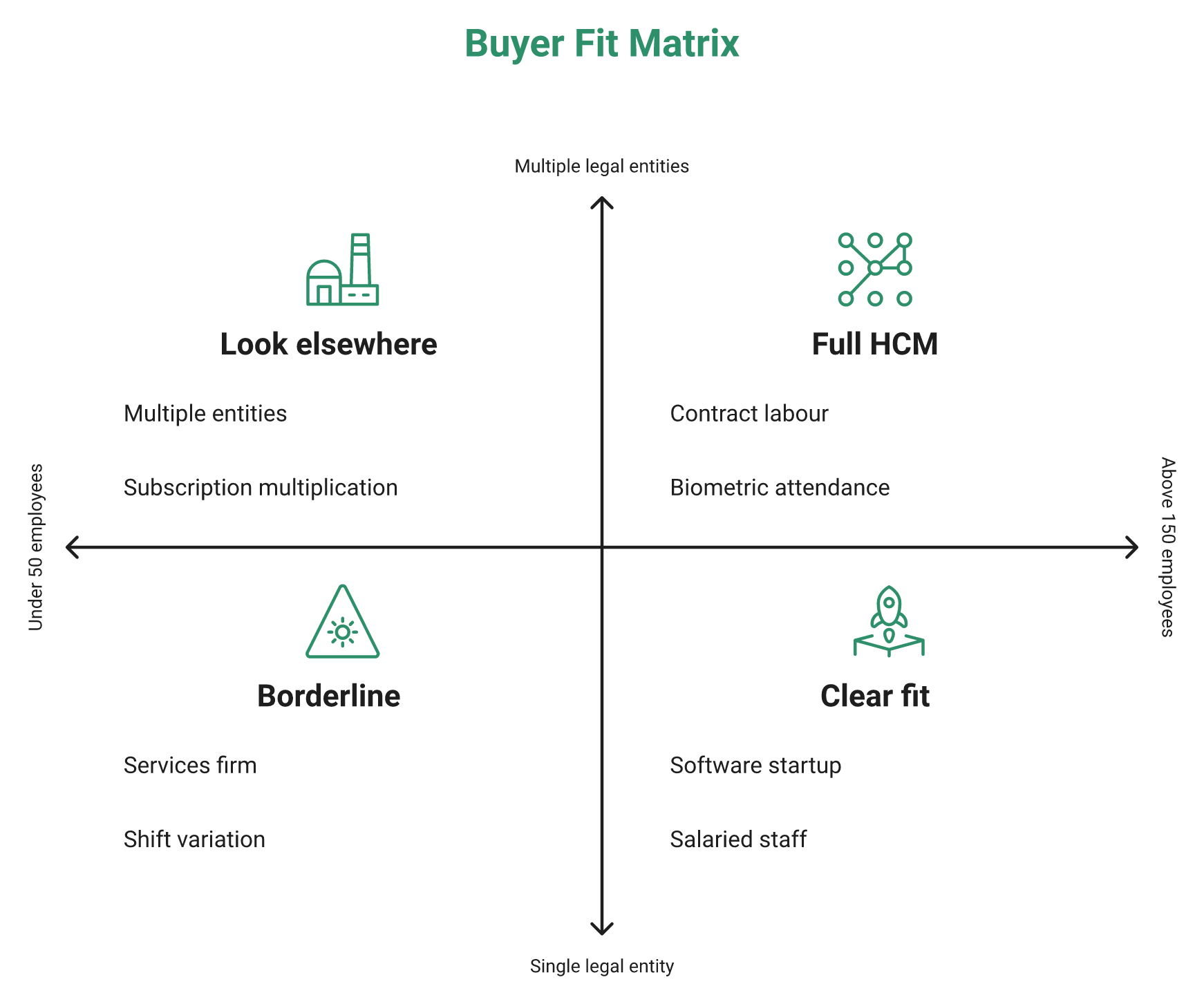
Founders reach the same conclusion in public forums, usually with a caveat attached. Manufacturing and field-heavy teams in that third bucket usually end up shortlisting from the best HRMS for manufacturing companies in India.
“Indeed, RazorpayX payroll services typically range from 3,000 to 5,000 INR, but you still need to handle some tasks yourself.”
– r/IndiaBusiness member, r/IndiaBusiness Reddit Thread
💸 The switching cost nobody quotes
Salary disbursal runs through Razorpay’s banking stack, which is provided by partner banks under RBI regulation. That is convenient while it works.
It also means your payroll and your banking share one dependency. Ask what your fallback is if disbursal fails on the 30th, because that single question surfaces most payroll problems Indian companies discover too late.
⚠️ Migration is where the real money goes
Moving off any HR system costs more than the subscription difference. Buyers say this plainly.
“Transitioning from the old system to Darwinbox is quite difficult… User interface of Darwinbox is very outdated.”
– Ankush B., 4/5 rating, Darwinbox G2 – Verified Review
“The initial setup was straightforward and simple, and I didn’t require training to use it from the first day.”
– Prajwal B., 5/5 rating, HROne G2 – Verified Review
Two very different first weeks. Same category, same promise, different operating model.
🔀 Self-serve or managed, pick deliberately
There is a genuine fork here, and it is not a feature gap. Small teams often prefer self-serve because it is cheaper and faster.
Larger teams want a named person who understands payroll deadlines. My honest read is that most 100-plus teams underestimate how much they want the second option, though I could be over-indexing on the messy migrations I see. Teams crossing 1,000 heads usually formalise that need while comparing the best enterprise HRMS in India.
⏰ What I think happens next
The four labour codes will make wage-structure configurability the deciding feature within two years, not price. Tools that hard-code the wage definition will start failing audits quietly, which is why labour law compliance software is becoming a board-level line item.
So here is the question I am sitting with. If your payroll tool cannot let you change the basic plus DA ratio yourself, is it software you own, or software you rent access to?
Tell me what your renewal date looks like, and what your headcount will be by then. That number decides more than any pricing table, and our ROI calculator will price the gap in rupees.
HROne runs payroll, attendance, and statutory filing on one instance with flat per-employee pricing and no lock-in, which is how Asia Healthcare Holdings operates 20 pan-India units without a separate subscription per entity.




















 Secures Top Spot in
