


Q1:12 Payroll Problems in Indian Companies, the 2026 Cost, and the Fix Framework
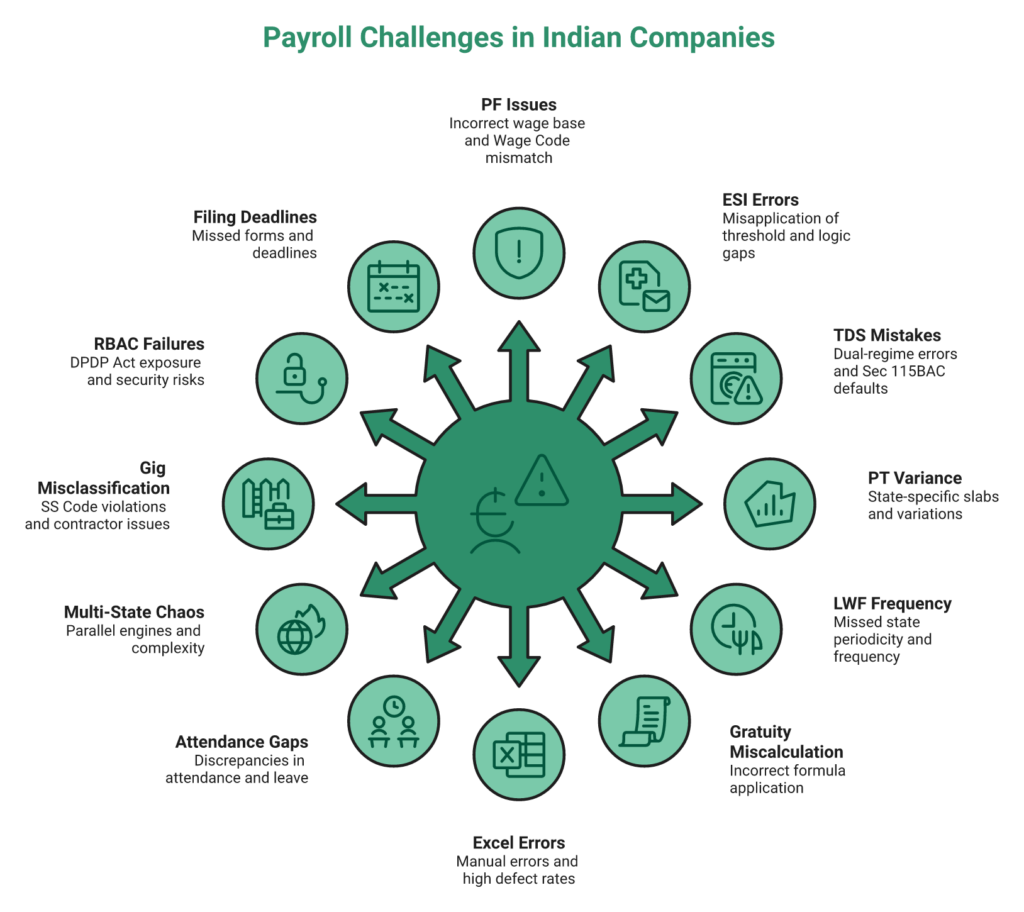
Indian companies face 12 recurring payroll problems, including PF on wrong wage base, ESI threshold misapplication, dual-regime TDS errors, state PT variance, LWF misses, gratuity and bonus mistakes, manual Excel processing, attendance-leave gaps, multi-state chaos, gig and contractor misclassification, data-access failures, and missed statutory deadlines. These drive a 45 to 49% annual error rate across mid-market firms, costing ₹10,000 to ₹1,00,000 per violation.
⚠️ The Four Numbers That Frame This Entire Article
I have cleaned up enough botched payroll runs to know the damage isn’t in one giant failure. It is in a dozen small leaks that compound every month. Four data points set the floor for every decision in this guide:
- 45 to 49% of Indian companies report at least one material payroll error every year, based on compiled SME and mid-market survey data across 2024 to 2026.
- ₹10,000 to ₹1,00,000 is the typical penalty range per statutory default, before EPF Sec 14B damages (5 to 25%), ESI interest at 12% p.a., and TDS interest under Sec 201(1A) at 1% per month stack on top.
- ₹42,130.89 crore in unresolved payments sits on the MSME Samadhaan portal, which is the cash-flow context that pushes payroll delays deeper into the supply chain.
- Fix framework is three stages: diagnose (the 12-problem taxonomy below), quantify (cost-by-company-size benchmark), and decide (in-house vs HRMS vs managed service).
✅ How HROne Collapses This Surface Area
At HROne, we treat this as one architecture problem, not 12 separate fires. The Super Inbox, 127 pre-built hire-to-retire workflows, and India’s first inbuilt ROI Dashboard pull diagnosis, quantification, and the fix into one instance. A Payroll Manager stops stitching data across four disconnected tools and starts closing cycles from a single screen.
Q2: Why Is Payroll Uniquely Broken in India Compared to the Rest of the World?
Indian payroll is uniquely broken because four structural forces collide inside one monthly cycle: 28 state labour codes with divergent PT, LWF, and minimum-wage rules; a dual old-vs-new tax regime employees can toggle annually under Sec 115BAC; instant-credit expectations set by UPI and neo-banking salary products; and an MSME ecosystem where ₹42,130.89 crore of unresolved payments stresses cash-flow discipline across the entire supplier chain.
⏰ The Reality Inside a 400-Employee Firm
Picture the Payroll Manager at a Bengaluru-headquartered firm with branches in Chennai, Mumbai, and Gurugram. By the 25th of every month, that one person is running four different PT engines, two ESI thresholds (the state Shops and Establishments variance between 10-employee and 20-employee applicability), three minimum-wage notifications revised on different dates, and a single TDS engine serving two parallel tax regimes, all rolling into one Excel-driven payroll cycle.
No amount of willpower fixes that. It is a data-architecture problem dressed up as a calendar problem.
❌ Where Global and Local Platforms Both Fall Short
The Indian HRMS market has sorted itself into three camps, and each one leaves a gap exactly where Indian complexity lives:
- Global HR suites like SAP SuccessFactors and Workday treat Indian payroll as a localisation plugin, bolted on, not built in.
- Domestic SMB tools like greytHR and Zoho People handle single-state payroll competently but cap the moment a multi-legal-entity or shift-based manufacturing reality appears.
- Managed-service vendors solve compliance but hand back black-box reports HR teams cannot audit or modify.
“GreytHR is not much good at customizing based on our requirements. For our case, from implementation onwards, there were issues with leave balance and all. Many times we were manually correcting the leave balance of employees.”
— Verified User, IT Services greytHR – G2 Verified Review
None of them treat the 28-state, dual-regime, instant-credit, MSME-cashflow problem as one architectural challenge.
⭐ The Strategic Shift, An Operating System, Not a Localisation Layer
Indian payroll needs a native operating system, not a localisation layer. That means one tenant holding unlimited legal entities, state-wise statutory logic encoded as policy rules, regime-switching TDS per employee per month, and real-time disbursal readiness, with HR controlling the policy engine from the front end without raising a developer ticket every time a state revises minimum wage.
✅ How HROne Delivers This India-First
We built HROne India-first, not India-adapted. The payroll engine ships with pre-configured state-wise PT, LWF, and ESI logic; dual-regime TDS runs a monthly comparison per employee; the Auto Scheduler is locked to statutory compliance calendars; and one tenant holds unlimited entities with independent compliance isolation.
Asia Healthcare Holdings runs 20 pan-India units on a single HROne instance with one RBAC layer. MR DIY India went live in 30 days. That is the proof that an India-native architecture is practical at mid-market and enterprise scale.
“Proper calculation of PF and ESI was a pain area for us before, but now with the HROne automated calculation process, results are up to the mark and following Indian tax compliances properly.”
— Ajay K. HROne G2 – Verified Review
Q3: What Are the 12 Payroll Problems Indian Companies Face, and What Is the Statutory Root Cause of Each?
The 12 recurring payroll problems in Indian companies map to specific statutory root causes under the EPF and MP Act, ESI Act, state PT Acts, state LWF Acts, Income Tax Act, Payment of Gratuity Act, Payment of Bonus Act, and the Wage Code 2019. Each carries a distinct penalty tier, systemic fix, and accountable RACI owner.
📑 The Master Matrix, Problem, Root Cause, Penalty, Fix, Owner
| # | Problem | Statutory Root Cause | Penalty Exposure | Systemic Fix | RACI Owner |
|---|---|---|---|---|---|
| 1 | PF on wrong wage base | Wage Code 2019: basic ≥50% of CTC; conveyance/HRA excluded incorrectly | EPF Sec 14B damages 5 to 25% + 12% p.a. interest | Encode wage definition in policy engine | Payroll Manager (R), CHRO (A) |
| 2 | ESI threshold misapplication | ESI Act ₹21k wage ceiling; state S&E variance (10/20 employees) | 12% interest + damages + prosecution | Auto state-S&E mapping at entity level | Payroll (R), Compliance (A) |
| 3 | Dual-regime TDS errors | Sec 115BAC toggle; Form 10-IEA election | Sec 201(1A) 1% per month + penalty | Monthly regime comparison per employee | Payroll (R), Finance (A) |
| 4 | State PT variance | 17-state PT Acts with different slabs | ₹300 to ₹1,000 per default | State-wise PT slab in one tenant | Payroll (R), Compliance (C) |
| 5 | LWF misses | State LWF Acts, frequency varies | State-specific fines + interest | Frequency-aware auto-scheduler | Payroll (R) |
| 6 | Gratuity and Bonus mis-calc | Gratuity Act 15/26 formula; Bonus Act 8.33 to 20% | Recovery + interest + fine | Formula-locked payroll engine | Payroll (R), Finance (A) |
| 7 | Manual Excel errors at scale | No statutory trigger, process defect | Indirect via cascading errors | Replace Excel with unified data layer | HR Ops (R), CHRO (A) |
| 8 | Attendance-leave integration gap | Payment of Wages Act wage-accuracy obligation | ₹7,500 to ₹37,500 per violation | Native Time Office to payroll propagation | HR Ops (R) |
| 9 | Multi-state coordination chaos | Multiple state labour departments | Cumulative across states | Unlimited entities in one tenant | CHRO (A) |
| 10 | Employee/contractor/gig misclassification | SS Code 2020 Sec 2(35); Sec 40(a)(ia) IT Act | Disallowance + EPFO action | Parallel payroll for each worker class | Legal (A), Payroll (R) |
| 11 | Data security and RBAC failures | DPDP Act 2023 + IT Act 2000 Sec 43A | ₹250 cr cap under DPDP | Front-end RBAC at OU and entity level | IT Director (R) |
| 12 | Missed Form 24Q / Form 16 / ECR deadlines | Income Tax Rules; EPFO; ESIC | Sec 234E ₹200 per day + late-fee stack | Statutory-calendar-locked Auto Scheduler | Payroll (R), Finance (A) |
🗺️ State-Variance Snapshot, The 8 Most-Employed States
| State | PT Slab (Max/Year) | LWF Frequency | ESI S&E Threshold | Current Minimum Wage Status |
|---|---|---|---|---|
| Maharashtra | ₹2,500 | Half-yearly | 20 employees | Revised semi-annually |
| Karnataka | ₹2,400 | Annual (Dec) | 10 employees | Revised semi-annually |
| Tamil Nadu | ₹2,500 | Annual | 20 employees | Revised annually |
| Telangana | ₹2,400 | Not applicable | 10 employees | Revised annually |
| West Bengal | ₹2,496 | Half-yearly | 10 employees | Revised biannually |
| Gujarat | ₹2,400 | Half-yearly | 10 employees | Revised semi-annually |
| Delhi | ₹2,400 (staying) | Not applicable | 10 employees | Revised quarterly |
| Uttar Pradesh | Not applicable | Half-yearly | 20 employees | Revised annually |
📆 Form 24Q and Form 16 Filing Calendar
- Form 24Q Q1: 31 July (prior FY quarter), penalty Sec 234E ₹200 per day of delay.
- Form 24Q Q2, Q3: 31 October, 31 January.
- Form 24Q Q4: 31 May, triggers Form 16 generation.
- Form 16 issue: by 15 June every year.
- EPF ECR: by 15th of each month.
- ESIC MC: by 15th of each month.
✅ How HROne Encodes All 12 Root Causes as Policy Rules
HROne’s payroll engine turns every one of the 12 problems above into a policy rule rather than a human checklist. 127 pre-built workflows trigger the fix, RBAC enforces owner accountability at the OU and entity level, and Form 24Q, EPF ECR, and ESIC MC generate from the same data layer that ran payroll. The Auto Scheduler locks to every statutory deadline on this calendar, so nothing slips because a person forgot. For a deeper audit walkthrough, see our payroll audit checklist.
Q4: Which Payroll Problems Is No One Writing About, Gig, Expat, ESOP, Fraud, Vendor Downtime, Maternity, and POSH?
Six payroll problems that rarely show up on Indian SERP carry disproportionate financial and regulatory risk: gig workforce compliance under the Code on Social Security 2020, expat split-payroll under DTAA and RNOR rules, ESOP and RSU perquisite TDS under Sec 17(2)(vi), payroll fraud (ghost employees, duplicate accounts, vendor kickbacks), payroll-partner downtime, and Maternity Benefit plus POSH-fund compliance.
🧩 The Six Under-Covered Risk Categories
a) Gig and platform workforce: Sec 2(35) of the Code on Social Security 2020 pulls aggregator-mediated workers into statutory social security. Red flag: paying 50+ freelancers monthly without an aggregator levy accrual. Detection test: reconcile 26Q vendor payments against gig-platform count.
b) Expat payroll: the 183-day residency rule, DTAA tax credit, split payroll across home and host country, and hypothetical-tax equalisation drive most errors. Red flag: expat on assignment for 10+ months without an RNOR assessment. Detection test: match FRRO register against Form 24Q entries.
c) ESOP and RSU perquisite: Rule 3(8) FMV, TDS on exercise date (not vesting), Sec 192 timing. Red flag: listed-company RSU vesting without a same-day TDS challan. Detection test: exercise register vs Form 24Q quarter mapping.
d) Payroll fraud: ghost employees detected via EPF-UAN-Aadhaar triangulation, receipt fraud surfaced by AI expense-fraud detection flagging duplicate vendor IDs or round-number amounts, and JV-reconciliation mismatches that flag arrear manipulation.
e) Vendor downtime: outsourced payroll vendors create a single-point-of-failure if their portal or compliance calendar breaks. Red flag: no SLA clause for salary-credit delay. Detection test: RTO and RPO documented in the vendor contract.
f) Maternity Benefit and POSH: Maternity Benefit Act 2017 (26 weeks, creche for 50+ employees), POSH Act internal complaints committee with annual return to the District Officer. Red flag: no POSH annual filing in the last three years.
📊 Under-Covered Risk Matrix
| Topic | Who Audits | Typical Penalty | Early Signal |
|---|---|---|---|
| Gig/SS Code | Labour Department + EPFO | Aggregator levy + back-pay | 50+ recurring monthly vendor payments |
| Expat | Income Tax + FRRO | Sec 201(1A) + FRRO notice | Long-stay expat without DTAA filing |
| ESOP/RSU | Income Tax | Short-deduction + Sec 271C | Vesting not tied to payroll trigger |
| Payroll fraud | Internal audit + CAG (PSUs) | 0.5 to 2% of payroll leakage | UAN gaps, round-value receipts |
| Vendor downtime | Business continuity review | Salary-delay penalties under PWA | No SLA for outage in vendor contract |
| Maternity + POSH | Labour Department + District Officer | ₹10,000 to ₹50,000 + prosecution | Missing annual POSH return |
❌ Why Competing Platforms Leave These Gaps Open
Most mid-market HRMS tools, including Keka, greytHR, and Zoho People, handle on-roll employees competently and leave everything else to spreadsheets, email, or a separate outsourced vendor. The result is exactly what this G2 reviewer flagged on a competing tool:
“No option to add monthly incentive separately, needs to be added as Adhoc payment in monthly salary… Insurance details cannot be added. ESOPs cannot be added on the system.”
— Pooja M. Keka – G2 Verified Review
When ESOPs, insurance, and adjustments sit outside the payroll engine, reconciliation moves to Excel, and reconciliation is where every one of the six risks above goes undetected.
✅ How HROne Closes All Six Gaps Inside One Instance
At HROne, we run parallel payroll streams for on-roll employees, contract workforce, gig pools, and ESOP-perquisite processing inside one tenant. The One AI Suite receipt parser flags duplicate, round-number, and out-of-policy expenses automatically. The platform carries its own uptime SLA rather than sitting behind a third-party vendor. Maternity registers and POSH policy annual returns are workflow-native, not spreadsheet artefacts.
“HROne for its zero-touch payroll and compliance automation. It handles salary calculations, statutory deductions, PF, ESI, taxes, and filings, automatically, with zero manual intervention, removing payroll errors and compliance anxiety during audits.”
— Waldon S. HROne G2 – Verified Review
Q5: How Do the Old vs New Tax Regime and the 4 Labour Codes Change Payroll Calculation in 2026?
In 2026, two regulatory shifts reshape Indian payroll. Sec 115BAC makes the new regime the default (old regime elective via Form 10-IEA), and the 4 Labour Codes mandate basic wage ≥50% of CTC, FFS within 2 working days of exit, gig social-security coverage, and tighter overtime. Together, they force CTC restructuring, monthly regime re-comparison, and a redesigned exit workflow.
⚖️ Dual Tax Regime, What the Engine Has to Do Every Month
TDS under Sec 115BAC is no longer a once-a-year April declaration. Employees can switch regimes with a fresh Form 10-IEA, revise FBP mid-year, or join post-June carrying prior-employer income, and each event changes monthly TDS. Our payroll taxes calculation India guide breaks down the mechanics for payroll leaders.
| Dimension | Old Regime | New Regime (Default FY26) |
|---|---|---|
| Slab structure | 5% to 30% with exemptions | 5% to 30%, rebate up to ₹7L |
| HRA, 80C, 80D | Allowed | Not allowed |
| Standard deduction | ₹50,000 | ₹75,000 |
| FBP-linked re-declaration | Recomputes TDS | Limited impact |
| Form 10-IEA | Required to opt-out of new | Default, no form needed |
| Form 24Q flag | “Old” per employee | “New” per employee |
📜 4 Labour Codes, Impact on Payroll Mechanics
| Code | Key Payroll Change | Immediate HR Action | Operational Risk if Ignored |
|---|---|---|---|
| Wage Code 2019 | Basic ≥50% of CTC | Restructure CTC templates | Higher PF and gratuity liability retro |
| Social Security Code 2020 | Gig/platform workers covered | Map aggregator levy 1 to 2% | Aggregator penalty + back-pay |
| Industrial Relations Code 2020 | FFS within 2 working days of exit | Redesign exit workflow | Labour officer action, interest |
| OSH Code 2020 | Tighter overtime caps (125 hrs/qtr) | Update Time Office OT rules | Prosecution, employee claims |
✅ The 7-Step 2026 Readiness Checklist
- Restructure CTC templates so basic ≥50%. This alone shifts PF and gratuity liability upward; project the cash-flow impact before you change payslips. Use the CTC breakup calculation format as a reference.
- Re-run gratuity liability on the new wage definition, and refresh the actuarial number in the balance sheet.
- Run monthly old-vs-new regime comparison per employee, and expose the lower-tax option at FBP declaration time.
- Map the gig and contract workforce to SS Code obligations, and start accruing the aggregator levy.
- Reconfigure the FFS workflow to hit the 2-working-day SLA. Asset recovery, leave encashment, gratuity, and final tax must close in parallel, not sequence.
- Update overtime logic in Time Office to the 125-hours-per-quarter cap. See our attendance management module for native OT configuration.
- Auto-generate Form 24Q with PAN, regime flag, and prior-employer income pre-validated.
⭐ How HROne Handles Both Shifts Natively
At HROne, the Policy Engine lets HR reconfigure CTC templates, FFS SLAs, and overtime rules from a front-end UI, with no developer tickets. The payroll software engine runs the regime comparison per employee every month, auto-recomputes TDS when FBP declarations change, and generates Form 24Q with pre-validated PAN and regime flags. These are exactly the capabilities that competing platforms either require plugins for or still process manually. The reviewer below flags what that costs in practice on another tool:
“Payroll not getting processed due to RBI regulations. No option to add monthly incentive separately… CA raised a concern that tax figures deducted in the last FY vs the amounts reflecting on system now are different.”
— Pooja M. Keka – G2 Verified Review
Q6: How Much Do Payroll Errors Cost an Indian Company, by Size, Penalty Tier, Rework Hours, and Attrition?
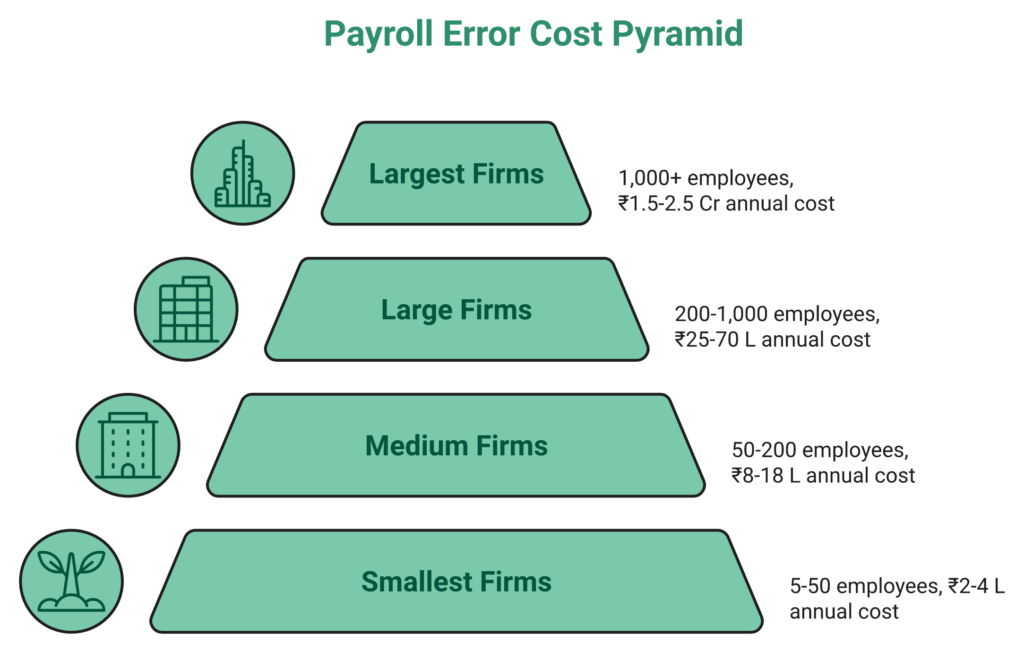
Payroll errors cost Indian companies ₹1,800 to ₹4,500 per affected employee annually, scaling from roughly ₹2 to 4 lakh a year for 5 to 50 employee firms, to ₹1.5 to 2.5 crore a year for 1,000+ employee firms. These spread across four heads: statutory penalties (₹10,000 to ₹1,00,000 per default), rework labour, attrition-linked replacement, and compliance-audit provisioning.
💰 The Cost Matrix by Company Size
| Size Band | Typical Error Rate | Annual Penalty Exposure | Rework Hours/Year | Attrition-Linked Loss | Total Realistic Cost |
|---|---|---|---|---|---|
| 5 to 50 employees | 6 to 8% | ₹50,000 to ₹1,50,000 | 180 to 300 hrs | ₹1 to 2 L | ₹2 to 4 L |
| 50 to 200 employees | 5 to 7% | ₹1.5 to 5 L | 400 to 700 hrs | ₹4 to 9 L | ₹8 to 18 L |
| 200 to 1,000 employees | 4 to 6% | ₹5 to 20 L | 900 to 1,800 hrs | ₹15 to 40 L | ₹25 to 70 L |
| 1,000+ employees | 3 to 5% | ₹20 to 90 L | 2,500 to 5,000 hrs | ₹50 L to 1.5 Cr | ₹1.5 to 2.5 Cr |
⚠️ Penalty Tiers That Compound Silently
- EPF Sec 14B: damages 5 to 25% per annum on delayed PF remittance, plus 12% p.a. interest under Sec 7Q.
- ESI Act: 12% p.a. simple interest on delayed contributions, plus damages and possible prosecution. See our ESI contribution calculation explainer.
- TDS Sec 201(1A): 1% per month for short deduction, 1.5% per month for late deposit.
- State PT default: ₹300 to ₹1,000 per default plus state-specific interest.
- Payment of Wages Act: ₹7,500 to ₹37,500 fine per violation for wage-delay complaints.
📉 The Talent-Shortage Multiplier Nobody Prices In
Payroll errors don’t stay constant; they compound with staffing gaps. Three data points shape that risk across the 200 to 1,000 employee band:
- 75%: the APAC-highest payroll-staff shortage reported by Indian firms across recent industry surveys.
- 93% of Indian firms signal expansion intent, with payroll roles among the hardest to fill.
- 38% of payroll teams cite automation gaps as the primary root cause of monthly errors.
Combined, these multiply the baseline error probability by roughly 1.6× at 200 to 1,000 employee scale. A 400-employee firm that assumed a 5% error rate is likely running closer to 8% in practice, which pushes the ₹25 to 70 L band up by another ₹10 to 15 L annually.
💸 Worked Example, A 300-Employee Firm
- 12 incorrect paycheques per month = 144 a year.
- 36 HR rework hours per month at fully-loaded cost.
- ₹1.8 L in annual statutory exposure before damages.
- Two attributable resignations at 6 to 9× monthly CTC each.
- Total realistic loss: ₹14 to 18 L per year, before the 1.6× talent-shortage multiplier.
✅ How HROne Turns Cost Into a Board Metric
At HROne, the inbuilt ROI Dashboard, India’s first native HR-analytics layer, converts all four cost heads into real-time, board-ready rupee metrics. CHROs stop exporting to Excel or waiting on BI teams, and CFOs get a live view of lifetime hours saved against average HR salary. That is the instrumentation Darwinbox and SAP SuccessFactors leave to external tools.
Q7: How Do You Run a Payroll Health Self-Diagnostic, 15 Questions, Risk Tier, and Cost of Inaction?
Run a 15-question payroll-health self-diagnostic across four dimensions: statutory accuracy, data-flow integrity, compliance-calendar discipline, and audit readiness. Each “yes” scores 1 point. A score below 8 signals critical risk, with projected annual penalty exposure of ₹8 to 25 L at 300-employee scale.
✅ The 15-Question Scorecard
Statutory Accuracy (5 questions)
- Is PF calculated on basic ≥50% of CTC per the Wage Code definition?
- Is ESI applicability mapped to state Shops and Establishments thresholds (10 or 20 employees)?
- Does the payroll engine apply state-specific PT slabs automatically for every branch?
- Is LWF frequency (monthly, half-yearly, or annual) configured per state, not set globally?
- Is the gratuity formula locked to 15/26 × last-drawn basic × completed years?
Data-Flow Integrity (4 questions)
- Does attendance data flow into payroll natively, without a CSV export? Reference: integrating payroll with attendance.
- Are leave balances synced to payroll in real time, including encashment accrual?
- Do CTC revisions flow through a workflow (not email), and trigger arrear auto-calc?
- Do reimbursements feed into payroll via a receipt-parser or structured claim, not a manual tally?
Compliance-Calendar Discipline (3 questions)
- Is Form 24Q filed by the quarterly deadline, with zero revisions in the last 12 months?
- Is EPF ECR generated by the 15th of every month, automatically?
- Is ESIC MC filed by the 15th every month, with challan matched?
Audit Readiness (3 questions)
- Is RBAC enforced at the OU and entity level, with a quarterly access review?
- Is a ghost-employee reconciliation run against UAN-Aadhaar at least quarterly?
- Does the FFS workflow close within the 2-working-day SLA mandated by the Wage Code?
📊 Score Interpretation and Cost of Inaction
| Score Band | Risk Tier | Projected Annual Exposure (300 employees) | Recommended Action |
|---|---|---|---|
| 0 to 7 | Critical | ₹8 to 25 L | Immediate audit, tool re-evaluation, parallel-run pilot |
| 8 to 10 | High | ₹3 to 8 L | Close specific gaps within one quarter |
| 11 to 13 | Moderate | ₹1 to 3 L | Patch data-flow and calendar gaps |
| 14 to 15 | Optimised | <₹1 L | Move to ROI-dashboard instrumentation |
⚠️ The Honest Read on This Score
Most mid-market firms I’ve walked through this scorecard land at 7 to 9 on the first pass. The gaps are almost never on the statutory side. They are on data flow and calendar discipline, which is exactly where manual stacks silently bleed money. A firm scoring 9 on a 15-point scale is not “mostly fine”. It is running a 40% gap in an area that compounds monthly. Our payroll audit checklist goes deeper into each gap category.
⭐ How HROne Turns the Scorecard Into a Live Metric
At HROne, customers complete this same diagnostic inside the ROI Dashboard automatically. Every one of the 15 questions maps to a system check, not a manual review. The self-score becomes a living metric updated in real time, not a one-off exercise a consultant runs. When a state revises its PT slab or a new Form 24Q deadline appears, the dashboard flags the affected question, and the Auto Scheduler reconfigures the run.
Q8: How Do You Compress Payroll from 5 Days to 1 Day, the Hour-by-Hour Playbook?
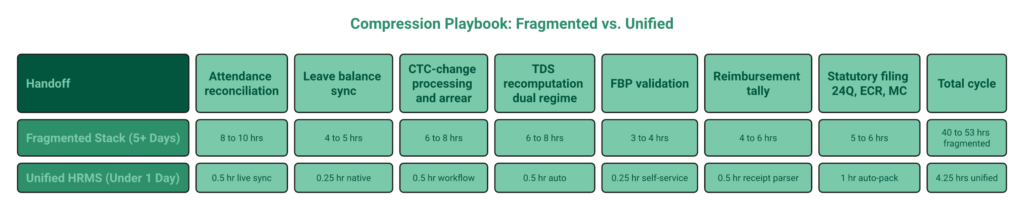
Reduce payroll from 5 days to 1 day by collapsing four handoffs, attendance-to-payroll, leave-to-payroll, CTC-revision-to-payroll, and reimbursement-to-payroll, into a single data layer. Then replace Excel reconciliation with group payout validations and auto-scheduled runs.
⏰ The 6-Step Compression Playbook
- Unify the source of truth for attendance, leave, and payroll so the payroll engine reads live data, not a month-end CSV.
- Switch to auto-scheduled cycles that trigger arrears, overtime, and statutory deductions on a fixed calendar, rather than an HR-initiated run.
- Enforce CTC-revision-via-workflow, not email. Every increment or promotion flows into arrear calc automatically, with approver audit trail.
- Run group payout validations pre-disbursal so statutory and computation errors are blocked before salary hits bank accounts. See hassle-free payroll processing steps.
- Automate Form 24Q, EPF ECR, and ESIC MC generation from the same data layer that processed salary.
- Push payslip, Form 16, and tax declaration via self-service mobile app, so HR stops fielding fifty repeat queries in the first week of the month.
📉 Before vs After, Hour-by-Hour Breakdown
| Task | Fragmented Stack (Hours) | Unified HRMS (Hours) |
|---|---|---|
| Attendance reconciliation | 8 to 10 | 0.5 (live sync) |
| Leave balance sync | 4 to 5 | 0.25 (native) |
| CTC-change processing and arrear | 6 to 8 | 0.5 (workflow) |
| TDS recomputation (dual regime) | 6 to 8 | 0.5 (auto) |
| FBP validation | 3 to 4 | 0.25 (self-service) |
| Reimbursement tally | 4 to 6 | 0.5 (receipt parser) |
| Group payout validation | 2 to 3 | 0.5 (pre-disbursal) |
| Payslip generation and dispatch | 2 to 3 | 0.25 (auto) |
| Statutory filing (24Q/ECR/MC) | 5 to 6 | 1 (auto-pack) |
| Total | 40 to 53 hrs (5+ days) | 4.25 hrs (<1 day) |
⭐ What Makes the 1-Day Cycle Realistic
The gap isn’t calculation speed. It is that a unified data layer eliminates reconciliation entirely. The four handoffs where errors are born never have to happen. Once the data is clean at source, the payroll engine is just running math.
✅ HROne’s Delivery of the 1-Day Cycle
At HROne, the Auto Scheduler, Super Inbox, group payout validations, and native Time Office integration deliver exactly this 1-day compression. MR DIY India compressed cycles from 10 days to 5 to 6 days within 30 days of go-live, and customers running the full 4-module bundle routinely close payroll in under 8 working hours.
💬 What Operators Say About the Compression
“I like HROne for its zero-touch payroll and compliance automation. It handles salary calculations, statutory deductions PF, ESI, taxes, and filings automatically, with zero manual intervention… The InboxforHR is a game-changer, centralizing every HR task into one simple inbox, cutting down administrative time by 60 to 70%.”
— Waldon S. HROne G2 – Verified Review
“Salary processing along with exact calculation of Comp off and overtime is achieved now. Sharing appointment letter with single click is now possible.”
— Deepak S. HROne G2 – Verified Review
“Salary process is fast, error less, as per Indian Tax compliances. Challans filling for PT or ESI filling becomes a quick and easy task.”
— Sachin K. HROne G2 – Verified Review
Q9: Spreadsheets, Payroll Software, Managed Services, or Global Payroll, Which Fix Actually Works for You?
Choose your payroll fix by workforce size, multi-entity and multi-country complexity, and statutory-control requirement. Spreadsheets work only under 50 employees in one state, payroll software or HRMS fits 50 to 5,000 employee India-focused firms, managed services suit teams with a near-zero HR bench, and global payroll providers fit multi-country workforces.
⚠️ The Decision Dilemma Most Buyers Walk Into
Pick the wrong fix, and one of two things happens. Either you pay for a black-box managed vendor whose reports you cannot audit, or you keep HR buried in spreadsheets that still break every month-end. Both outcomes look cheap on a quote and expensive on a P&L.
❌ The Wrong Way to Decide
Most buyers choose by the cheapest PEPM quote, or by asking three peers what they use. That ignores data ownership, multi-entity isolation, policy configurability, and whether the fix survives a 2× headcount expansion or a new legal entity in a different state. Peer familiarity is not an architecture. Our how to choose payroll software guide walks through what actually matters.
⭐ The 7-Criteria Evaluation Framework
Score each option out of 7. Anything below 5 signals you will be re-buying within 18 months.
- Data ownership and exportability: can you pull a complete payroll, attendance, and employee master export without a vendor ticket?
- Multi-entity and multi-state statutory isolation: one tenant holding unlimited entities with independent PT, LWF, and ESI logic.
- Front-end policy configurability: HR changes a leave policy or CTC template without raising a developer ticket.
- Attendance-to-payroll propagation: live sync, not month-end CSV. See integrating payroll with attendance.
- Statutory filing automation: Form 24Q, ECR, and MC generated from the same data layer.
- CHRO and CFO ROI visibility: a native dashboard, not a BI export.
- Total cost including implementation and day-one billing: flat PEPM, subscription after go-live, no multi-year lock-in. Review transparent pricing.
📊 The Four-Option Scorecard
| Criterion | HROne (HRMS) | Spreadsheets | Managed Service | Global Payroll Provider |
|---|---|---|---|---|
| Data ownership | ✅ | ✅ | ❌ | ⚠️ |
| Multi-entity isolation | ✅ | ❌ | ⚠️ | ⚠️ |
| Front-end policy config | ✅ | ⚠️ | ❌ | ❌ |
| Attendance-to-payroll sync | ✅ | ❌ | ❌ | ⚠️ |
| Statutory filing automation | ✅ | ❌ | ✅ | ⚠️ |
| CHRO/CFO ROI visibility | ✅ | ❌ | ❌ | ⚠️ |
| Flat PEPM, go-live billing | ✅ | N/A | ❌ | ❌ |
✅ The Meta-Insight and Proof
The real question is not “which fix is cheapest today?” It is “which fix survives your next legal entity, the next state minimum-wage notification, or the next Sec 115BAC amendment?” Asia Healthcare Holdings runs 20 pan-India units on a single HROne instance. MR DIY India went live in 30 days.
“We have recently moved to HRone from HrpearlsWebtel, I find HRone more intuitive, streamlined better leave management system.”
— Ayush G. HROne G2 – Verified Review
“GreytHR is not much good at customizing based on our requirements. Many times we were manually correcting the leave balance of employees.”
— Verified User, IT Services greytHR – G2 Verified Review
Q10: What Do Real Indian Payroll Turnarounds Look Like, Manufacturing, IT, and Multi-State Retail?
Indian payroll turnarounds share one pattern: consolidation of fragmented data into one tenant, then a redesign of the policy engine around state-specific rules. Documented outcomes include 90% error reduction at a Tamil Nadu manufacturing SME, a clean dual-regime switchover at a Bengaluru IT firm, and 15-state payroll unification at a retail chain.
🏭 Case 1, Manufacturing SME, Tamil Nadu
A 180-employee auto-components firm was running payroll on a mix of Excel and an outsourced vendor. ESI threshold misapplication was the core leak. Employees crossing ₹21k mid-quarter were still showing as covered. The numbers before and after:
- Error rate: 6% to 0.6% (90% reduction)
- Monthly rework hours: 40 to 4
- ESI default notices: 3 per year to 0
- Cycle time: 7 days to 2 days
The lever was not a smarter formula. It was moving the ESI threshold check into the payroll engine so wage-crossing events auto-updated coverage status. The broader playbook is documented in our manufacturing HR guide.
💻 Case 2, IT Firm, Bengaluru
A 420-employee services firm hit a Q4 TDS shock when Sec 115BAC became the default regime. Employees who had toggled mid-year were under-deducted, triggering grievance tickets and two Form 24Q revisions. Post-consolidation:
- Monthly old-vs-new regime comparison per employee eliminated Q4 shortfalls.
- Form 24Q revisions dropped from 2 per year to 0.
- TDS grievance tickets down 78% in the first full cycle.
- Form 16 dispatch moved from 15 June to 31 May.
🛍️ Case 3, Retail Chain Across 15 States
A 1,100-employee multi-state retail chain was running six parallel payroll engines, one per regional office. PT slabs were applied correctly in four states, and incorrectly in two. Unification on one instance delivered:
- Cycle time: 9 days to 2 days
- State-wise PT and LWF, all 15 states encoded as policy rules. See statewise professional tax slab rates.
- Form 16 dispatch audit-ready: 21 days to 4 days
- Internal audit findings: 12 to 1 in the following FY.
⭐ The Transferable Principle
Across all three, the lever is never a better calculator. It is collapsing data handoffs and moving statutory logic into a policy engine HR controls from the front end. Once that shift lands, the error rate, cycle time, and audit-readiness metrics all move together, not one at a time.
💬 What Operators Say About the Shift
“Salary processing along with deduction slabs are working perfectly as per Indian tax compliances, previously there are lot of mess in this section. Form-16 can be released to employee letter section directly. Previously we have to share on emails to employees.”
— Sanjeev K. HROne G2 – Verified Review
“Salary processing along with exact calculation of LWF and PT slabs makes the work more convenient process.”
— Komal S. HROne G2 – Verified Review
“Proper calculation of PF and ESI was a pain area for us before, but now with the HROne automated calculation process, results are up to the mark and following Indian tax compliances properly.”
— Ajay K. HROne G2 – Verified Review
Q11: What Is the 30-60-90 Day Roadmap to Fix Payroll Problems Permanently?
Fix Indian payroll in 90 days across three phases: Days 1 to 30 audit (run the 15-question diagnostic, map the 12 problems, size the penalty exposure), Days 31 to 60 select (apply the 7-criteria framework, shortlist two vendors, pilot a parallel run), and Days 61 to 90 cutover (data migration, parallel run, go-live, decommission legacy).
🗺️ The Three-Phase Plan at a Glance
| Phase | Milestones | Owner | Deliverable |
|---|---|---|---|
| Days 1 to 30, Audit | Diagnostic complete; 12-problem mapping; penalty-exposure sizing; current-state process map | CHRO + Payroll Manager | Cost-of-inaction report with rupee projection |
| Days 31 to 60, Select | 7-criteria vendor shortlist; 2-vendor RFP; reference calls; parallel-run pilot scoped | CHRO + CFO + IT Director | Signed MSA with go-live date |
| Days 61 to 90, Cutover | Data migration; UAT sign-off; RBAC mapping; parallel run for 1 cycle; go-live; legacy decommission | Implementation SPOC + HR Ops | Live payroll cycle closed under SLA |
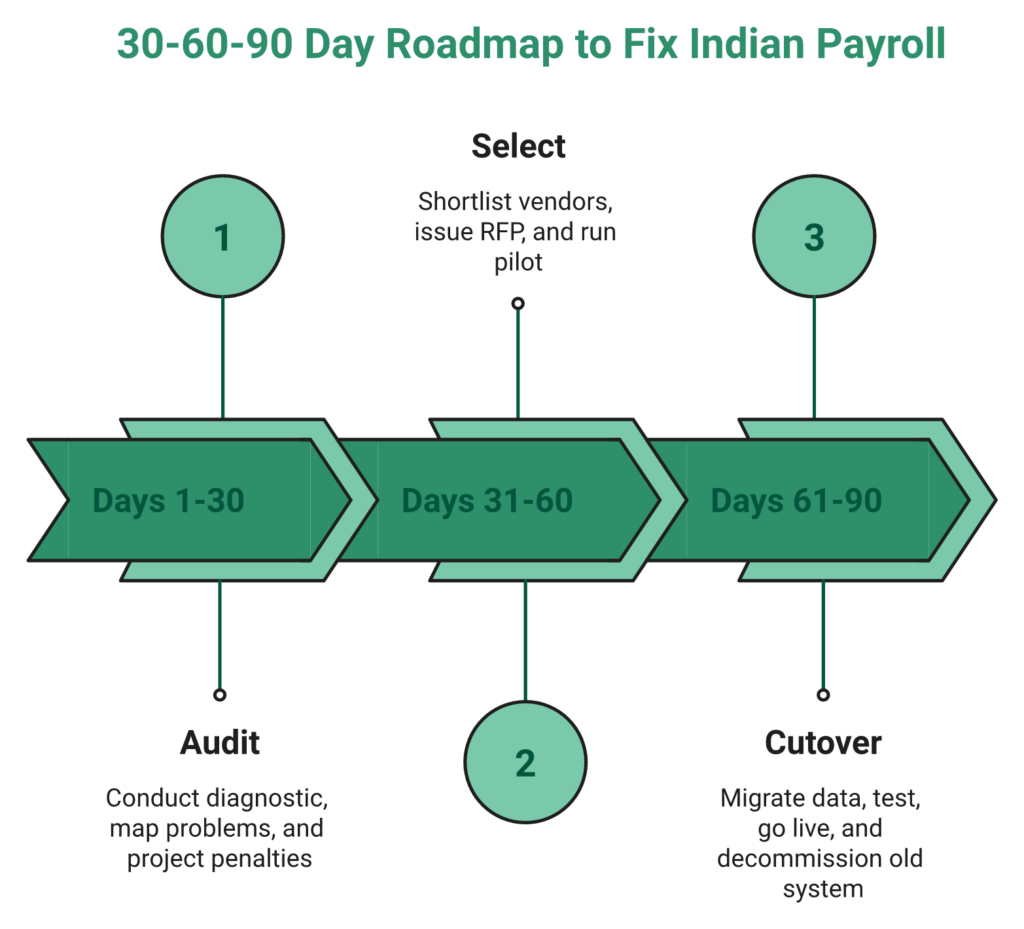
⏰ Days 1 to 30: The Audit Phase That Sets Everything
- Run the 15-question payroll-health self-diagnostic across statutory, data-flow, calendar, and audit-readiness dimensions.
- Map each of the 12 recurring problems to your current stack, and identify which are actively leaking money.
- Size penalty exposure using the company-size cost matrix. This becomes the business case.
- Document the current-state process map with every handoff, owner, and SLA. The payroll audit checklist accelerates this.
- Align the CFO on the rupee impact before you shortlist any vendor.
🔍 Days 31 to 60: The Selection Phase
- Apply the 7-criteria framework and score 4 to 6 vendors; shortlist the top two. Start with the top 10 payroll software India list.
- Issue an RFP that asks for architectural answers, not checklist ticks: multi-entity isolation, front-end policy configurability, and ROI-dashboard instrumentation.
- Run reference calls with two live customers per vendor in the same employee band and industry.
- Scope a parallel-run pilot for one full payroll cycle. This is where vendors either hold up or fall apart.
- Lock commercials: flat PEPM, subscription only after go-live, and no multi-year lock-in.
✅ Days 61 to 90: The Cutover Phase
- Data migration with source-to-target field mapping, and a signed reconciliation report.
- UAT sign-off against a 50-scenario script: multi-state, dual regime, arrear, FFS, maternity, and ESOP.
- RBAC mapping at OU and entity level, reviewed by IT Director.
- Parallel run for one full cycle with a <0.5% variance threshold.
- Statutory cutover dates aligned to quarter-end, so Form 24Q continuity is preserved.
- Go-live, then decommission the legacy stack within 30 days to stop double-billing.
⚠️ Risk-Mitigation Checklist
- Data migration integrity validated on a full payroll run, not a sample.
- UAT sign-off documented with scenario-level pass/fail.
- Statutory cutover aligned to quarter-end, never mid-quarter.
- Parallel-run variance threshold held at <0.5% before go-live.
- Decommission plan with explicit dates for each legacy system.
⭐ How HROne Compresses 90 Days to 30
At HROne, the prior-HR onboarding consultant model compresses this 90-day plan into roughly 30 days. This is MR DIY India’s documented go-live. The Policy Engine, 127 pre-built workflows, and India’s first inbuilt ROI Calculator are configured by HR from the front end, not a developer team reading from a checklist. The 9.8 NPS on SPOC support is the operating evidence that the compression is real, not marketing. Why HROne walks through the full implementation model.
Q12: Ready to Run 2026-Ready Payroll Without the Month-End Firefight? Here’s Your Next Step
Running accurate, 1-day, statutorily bullet-proof payroll across multi-state, multi-entity, and gig-expat-ESOP workforces without juggling four disconnected softwares is exactly what HROne was built for, and here is the shortest path to try it.
⭐ The Diagnostic-to-Decision Arc in One Paragraph
Use the Q1 TL;DR taxonomy to diagnose which of the 12 problems apply, the Q6 cost matrix to quantify the rupee impact (₹2 to 4 L at 50 employees scaling to ₹1.5 to 2.5 Cr at 1,000+), the Q7 15-question scorecard to pressure-test your current stack, the Q9 decision framework to choose between spreadsheets, HRMS, managed service, and global payroll, and the Q8 1-day compression playbook to target a cycle your HR team can actually plan around. The proof is already in the market. MR DIY India went live in 30 days, and Asia Healthcare Holdings runs 20 pan-India units on a single HROne instance. The single next action is a 30-minute HROne Payroll demo, on a flat PEPM plan, with subscription metering only after go-live and no multi-year lock-in.
✅ Your Next Step
Stop firefighting payroll. Start running it in one day.
See how HROne collapses the 12 payroll problems into one Super Inbox with 127 pre-built workflows, India’s first inbuilt ROI Dashboard, and a 30-day go-live, billed only after you go live, on a flat PEPM plan with no lock-in.
Book a 30-Minute HROne Payroll Demo →Explore more: HROne Payroll Software · Flat PEPM Pricing · HR ROI Calculator · Super Inbox & 127 Workflows
Explore the deeper product and comparison pages: HROne Payroll Solution, Super Inbox, 127 Workflows, HROne vs Keka, HROne vs Darwinbox, and HROne vs greytHR.















 Secures Top Spot in
