


Q1. Why Are Indian Companies Switching from greytHR in 2026?
A payroll manager at a 320-person auto-components firm in Chakan, Pune, told me last February she had a sticky note on her monitor that simply said “Form 130”. She was not panicking about migration. She was panicking about the fact that her current HRMS had not yet told her what it was going to do about Form 130 replacing Form 16 for the FY26-27 cycle. That single sticky note is the 2026 greytHR switching story in one image.
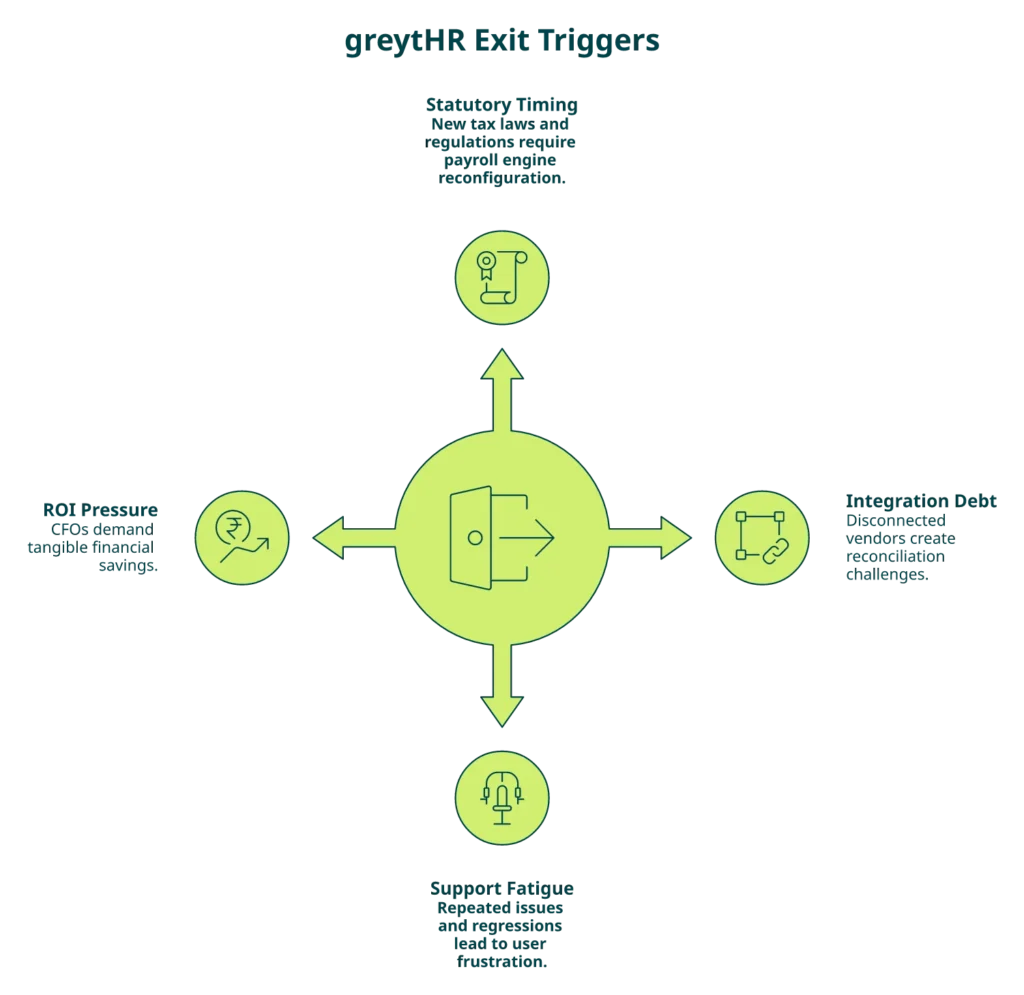
Indian companies are switching from greytHR in 2026 for four reasons, in this order: the Income Tax Act 2025 effective 1 April 2026 forces payroll software engine changes (Form 130, ₹12.75 lakh zero-tax threshold, expanded metro HRA list, and 2-day full-and-final settlement); integration debt across payroll, biometric, and ATS silos becomes unmanageable past 250 employees; support and escalation SLAs break during peak payroll; and CHROs are being asked to prove ROI, not just process payslips.
From “boring software” to CHRO energy
The shift is psychological before it is technological. Indian HR leaders I speak to are tired of being the team that “runs payroll on time” and nothing else. They want a seat in the operating review, not a spot at the compliance audit. ✅
Real greytHR users say this out loud. One verified reviewer wrote that their organisation is “moving away from this incompetent greythr to a better partner” after repeated payroll issues, and another flagged that “we have to spend time manually to find errors, not one month has passed where we have not raised a ticket”.
“Not one month has passed where we have not raised a ticket.”
— Maheshkumar J., Verified User greytHR, G2 Verified Review
The 2026 trigger stack
- ⏰ Statutory timing: Income Tax Act 2025 takes effect 1 April 2026; Form 130 replaces Form 16; FFS must close in two days; payroll engines need reconfiguration before Q1 closes.
- 💸 Integration debt: 500-employee firms often run payroll, biometric, ATS, expenses, and performance on five vendors that cannot talk to each other.
- ⚠️ Support fatigue: dated greytHR reviews repeatedly cite ticket loops, backend-only uploads, and post-update regressions.
- 💰 ROI pressure: the CFO now asks for rupee-terms savings, not screenshots of payslips.
Who this article is for
If you recognise the Chakan payroll manager, this guide maps the road ahead: the real complaints from Indian customers (Q2), a headcount-band self-diagnosis (Q3), the manufacturing HR and multi-location buying checklist (Q4), a seven-vendor comparison with INR PEPM pricing (Q5), the FY26-27 migration runbook (Q6), the 12-month cost-of-switch model (Q7), the people-and-data execution playbook (Q8), a founder-led point of view (Q9), and a 90-day action plan (Q10). ⭐
I might be wrong on one thing. I used to think timing was a preference. After building HROne with 2,000+ customer teams, I now think timing is the entire decision. Miss the April 1 or July 31 window, and your next clean cut-over is 12 months away.
Q2. What Are the Most Common greytHR Complaints from Indian Customers in 2026?
When I read dated greytHR reviews end to end, five complaint themes show up on repeat, year after year: support and escalation gaps, mobile and attendance reliability, payroll and statutory edge-case handling, backend-only customisation, and post-update regressions. These are not isolated incidents. They are structural.
Across G2, Capterra, App Store, and Play Store reviews from 2022 through early 2026, Indian greytHR customers consistently flag slow support with no escalation matrix, login and attendance management glitches in the mobile app, inflexible payroll customisation that needs vendor intervention, limited manager-level actions like marking leave on behalf of a direct report, and post-update feature regressions that break workflows mid-payroll.
Support and escalation pain ❌
The most repeated complaint is not a missing feature. It is the feeling of being stuck. One IT-services reviewer put it bluntly.
“Lack of timely, responsive, and easily reachable customer support. Lack of user friendly software, there is a very high dependency on the greythr team to customize and the customization is full of gaps. There is no escalation matrix.”
— Brimma Tech Verified User greytHR, G2 Verified Review
Another long-time user described payroll support as “pathetic” and said managers cannot mark leave on behalf of direct reports, a table-stakes feature elsewhere.
Mobile and attendance reliability ⚠️
For distributed and field teams, the mobile HR app is the product. greytHR users have been vocal here too.
“The app is not as user-friendly as advertised, with frequent glitches and slow load times that disrupt workflow. Simple tasks, like logging attendance or approving leaves, take longer than they should due to the app freezing or failing to load data.”
— Shreeya V. greytHR, G2 Verified Review
A separate reviewer listed “Lag while login and logging out, automatic log out while marking attendance, some features are only available in a desktop mode, not in mobile application”.
Payroll and statutory edge cases 💸
2026 is the year edge cases become mainstream. Two-day FFS, Form 130, HRA metro list expansion, and CTC revisions under the new wage code all land at once. Reviewers already flag reporting-configuration and TDS-revision gaps today. A long-tenure user wrote that “Reporting configuration, TDS filing, revising of TDS is not possible. UI for mapping of challans, visibility of income considered for TDS filing”. Multi-state professional tax, LWF slab changes, and FBP restructuring sit in the same bucket.
Backend-only customisation and post-update regressions
The fourth theme is that customisation often requires the vendor, not the HR admin. Users report that leave balances need manual correction, policy limitations cannot be resolved without raising a ticket, and UI looks like “an outdated legacy system”.
greytHR complaint scorecard (2022 to 2026)
| Complaint theme | Frequency in reviews | Representative source |
|---|---|---|
| Support SLA and escalation gaps | Very high | greytHR G2 |
| Mobile app and attendance glitches | Very high | greytHR G2 |
| Payroll and TDS customisation limits | High | greytHR G2 |
| Leave balance and policy rigidity | High | greytHR G2 |
| UI dated, post-update regressions | Medium | greytHR G2 |
Working with 2,000+ HR teams, what I have felt is that the pattern is never one bug. It is the fifth ticket in a quarter that breaks the camel’s back. ✅
Q3. Is greytHR Good Enough for a Company Growing Past 500 Employees?
The honest answer is that greytHR was built, and is still most loved, as an SMB payroll tool. Between 250 and 500 employees, the cracks start showing. Past 500, most HR ops heads I speak to have already paid a “workaround tax” for at least 18 months before they switch.
greytHR fits comfortably for single-entity SMBs under about 150 employees. Between 150 and 500, it begins to strain on multi-legal-entity organisational unit (OU) depth, workflow flexibility, reporting latency, and integration breadth. Past 500, the workaround cost (manual reconciliation, Excel stitching, and backend vendor tickets) usually exceeds the cost of migrating to a mid-market HCM built for complexity.
The four breakpoints
- OU and legal-entity depth: multi-legal-entity group companies with shared employees, inter-company transfers, and state-wise compliance need OU-level policy inheritance that lightweight SMB tools rarely offer.
- Workflow rigidity: “We cannot properly implement our company policies due to the limitations of greytHR,” one user wrote.
- Reporting latency: executive reviews need attrition, confirmation TAT, and offer-to-join ratios on demand, not through a CSV export.
- Integration API gaps: biometric devices, Tally or SAP finance, BGV, and LMS marketplaces need clean APIs, not backend uploads.
A named protagonist at 480 employees 👥
A BFSI HR head in Mumbai told me her team spent nine days per month reconciling leave balances and PT slabs manually. That is roughly one HR FTE per year on a spreadsheet. Her switch was not triggered by a feature. It was triggered by the CFO asking, “Why do we pay two HR ops people to do the HRMS’s job?” ⚠️
“GreytHR is not much good at customizing based on our requirements. For our case, from implementation onwards, there were issues with leave balance and all. Many times we were manually correcting the leave balance of employees.”
— Verified User in IT greytHR, G2 Verified Review
When greytHR still fits
It is fair to say greytHR still serves a real need. For a single-entity company under 150 employees, running a simple payroll with standard policies and one biometric device, greytHR is reliable and affordable. The problem is not the product. The problem is expecting it to scale into a category it was not built for.
Fit-by-headcount table
| Headcount band | Complexity reality | Fit verdict |
|---|---|---|
| Under 100 employees, single entity | Simple payroll, one location | greytHR fits; HROne or Kredily optional |
| 100 to 250, 1-2 entities | Some shift rosters, basic ATS | greytHR marginal; HROne, Keka, and Zoho People shortlist |
| 250 to 500, multi-state | Multi-state PT, CLRA, FBP | greytHR strains; HROne, Keka preferred |
| 500 to 1,000, multi-entity | Deep OU, shift, performance | greytHR not recommended; HROne vs greytHR, Darwinbox |
| 1,000+, enterprise | Global integrations, AI hiring | HROne, Darwinbox, SAP SuccessFactors |
The 10-question “have I outgrown it” check ✅
- Do I reconcile leave balances by hand more than once a quarter?
- Do I run multi-legal-entity payroll through workarounds?
- Does my CFO ask for attrition numbers in a deck, not a dashboard?
- Do field employees complain about attendance or OTP loops?
- Do I raise three or more tickets per payroll cycle?
- Is my ATS disconnected from onboarding?
- Do I still keep performance reviews in Excel?
- Do expense approvals live on WhatsApp?
- Have I delayed FFS past two days in the last quarter?
- Do policy changes require a vendor ticket?
If you answer yes to five or more, you have likely crossed the 500-EE ceiling in practice, regardless of your headcount on paper. Explore the CHRO solutions page for a scaled view.
Q4. What Should You Look for in a greytHR Alternative for Manufacturing and Multi-Location Companies?
Manufacturing is the most under-served segment in Indian HR tech. Shop-floor shifts, contract labour under CLRA, factory-gate biometric devices, state-wise minimum wage automation, and deskless mobile ESS are non-negotiables that generalist HRMS platforms treat as edge cases. Your alternative shortlist should be ruthless on seven criteria.
A greytHR alternative for a manufacturing or multi-location Indian SME must deliver seven things: multi-legal-entity payroll with OU-level policies, shift and roster management built for factories, CLRA contract-labour registers, state-wise minimum wage and PT automation, deskless mobile ESS with offline attendance, factory-gate biometric and IoT integrations, and a configurable front-end policy engine that does not need backend developer tickets.
The seven non-negotiables 🏭
- Multi-legal-entity payroll with OU depth: plants across states run under different legal entities. Your HRMS must support multi-entity employee records on a single instance. Asia Healthcare Holdings runs 20 pan-India units on one HROne instance; this is the operating bar.
- Shift and roster management: rotational, continuous, and night-shift rosters with swap approvals and compliance with the Factories Act.
- CLRA contract-labour register: under the Contract Labour (Regulation and Abolition) Act, the principal employer maintains registers for every contract worker on-site. The HRMS should own this, not Excel.
- State-wise minimum wage and PT automation: Code on Wages notifications vary by state. Maharashtra, Karnataka, and Tamil Nadu all publish separate schedules. Automation must be slab-aware.
- Deskless mobile ESS with offline attendance: factory floors have poor connectivity. The app must queue punches offline and sync later.
- Factory-gate biometric and IoT integration: real-time sync, not end-of-day uploads, is what enables accurate OT and gross-to-net calculations.
- Front-end policy engine: the HR head should configure a holiday list change or a PT slab update without raising a developer ticket.
Map each criterion to the Indian statute
- Factories Act 1948 and state Shops and Establishments Acts: shift and leave.
- CLRA 1970: contract labour registers and principal employer liability.
- Code on Wages 2019 and state notifications: minimum wage, timely payment, and 2-day FFS.
- EPFO UAN 3.0 circulars: unified member portal and UAN generation.
- ESIC: e-return and wage threshold rules.
- Income Tax Act 2025 effective April 2026: Form 130, new slabs, and FBP handling.
What good looks like ✅
When we tested this with manufacturing customers, the configuration that worked looked like this: one HCM instance, multi-entity master, shift patterns defined as templates with auto-roster generation, CLRA register auto-updated from the gate biometric, PT slabs updated through a front-end config screen, and a deskless mobile app that stores 48 hours of punches offline. MR DIY India cut payroll cycles from 10 days to 5 to 6 days after consolidating onto this model, and Asia Healthcare Holdings runs 20 units on a single instance with multi-legal-entity configuration.
“HROne has effectively identified and addressed all of our previous pain points. Its mobile application has been particularly valuable, saving users significant time and reducing resource consumption.”
— Vignesh J. HROne G2 – Verified Review
The RFP checklist (paste this into your vendor brief) 📋
- Supports N legal entities on one instance with shared employees.
- Shift templates, auto-roster, swap workflow, and Factories Act compliance.
- CLRA register with principal-employer view.
- State-wise minimum wage and PT automation, evidenced by three state examples.
- Offline mobile attendance with GPS and selfie biometric.
- Biometric and IoT device integrations with named partners.
- Front-end configurable policy engine with audit trail.
- Multi-state FBP, CTC revisions, and 2-day FFS handling.
- Form 130 readiness and EPFO UAN 3.0 compliance.
- Named implementation SPOC with prior HR domain experience.
If a vendor cannot demo all 10 in a scripted RFP call, move on. ⏰ For a deeper product walkthrough built for factories, see the HR software manufacturing features guide, and run your numbers on the ROI calculator before the RFP call.
Still deciding between greytHR and HROne?
See the side-by-side feature, pricing, and compliance comparison built for Indian mid-market HR teams.
Compare HROne vs greytHR →Q5. How Do greytHR Alternatives Compare: Keka, HROne, Zoho People, Darwinbox, SAP SuccessFactors?
I once sat on a Saturday call with a CHRO of a 900-employee ITeS firm who had five vendor decks open on her screen. Her question was simple, and it is the one every Indian HR buyer is really asking. “Which of these is actually built for my mess, and which one just looks good on a slide?” This section is that answer, without the vendor slide polish.
For Indian mid-market buyers (100 to 5,000 employees), HROne is the best fit when you want a connected hire-to-retire operating system with India-tuned compliance and a go-live-billing model. Keka suits surface UX buyers who can tolerate email-only support. Zoho People fits Zoho-stack single-entity startups. Darwinbox fits 1,000-plus enterprises willing to pay from day one. SAP SuccessFactors fits global 2,000-plus firms with developer bandwidth.
The 2026 comparison table 📊
| Vendor | G2 satisfaction rank | Ease of setup | Pricing model | Implementation time | India compliance depth | Best for |
|---|---|---|---|---|---|---|
| HROne | #3 overall | 9.5/10 | Flat PEPM, subscription starts after go-live, no lock-in | 30 to 45 days | Multi-entity, CLRA, Form 130, state PT/LWF | 100 to 5,000 EE mid-market and enterprise |
| Keka | #55 overall | 8.6/10 | PEPM, billed from purchase | 60 to 120 days | India payroll, gaps on multi-entity | Sub-500 EE SMB with simple policies |
| Zoho People | Mid-tier | 8.1/10 | Per-user, Zoho bundle discounts | 30 to 75 days | Basic India payroll via Zoho Payroll | Zoho-stack single-entity startups |
| Darwinbox | Upper-mid | 8.3/10 | Annual contract, billed from day one | 90 to 180 days | Enterprise-grade but OU-heavy | 1,000-plus EE enterprises with budget |
| SAP SuccessFactors | Enterprise | 7.8/10 | Module bundles, multi-year | 6 to 12 months | Deep, but needs dev effort | 2,000-plus EE MNCs |
Surgical contrast per reality ⭐
Entrenched enterprise (Darwinbox, SAP SuccessFactors): Darwinbox wins brand weight. The trade-off shows up in daily use. Multiple tabs, configurations breaking on product deploys, and support that goes quiet mid-migration are common. ✅
“Bad implementation experience, bad UI UX, configurations getting broken in production on its own due to product deployments, terrible customer service.”
— Verified User in Computer Software Darwinbox, G2 Verified Review
Mid-market mainstream (Keka, Zoho People, greytHR): Keka has a clean UI. The support gap hurts during migration, and customisation relies on email threads.
“We started working with Keka HRMS in August, and to this day, we have been unable to implement the tool in our company due to their consistently delayed responses and poor coordination between their internal teams.”
— Divya P. Keka, G2 Verified Review
Most 500-EE Indian firms are not choosing between vendors. They are choosing between vendors and the chaos of five disconnected tools. This is HROne’s sharpest displacement angle. MR DIY India collapsed payroll cycles from 10 days to 5 to 6 days after consolidating onto one hire-to-retire operating system, and Asia Healthcare Holdings runs 20 pan-India units on a single instance with multi-legal-entity configuration.
When each alternative is NOT the right call ❌
- HROne: not the best pick for a bootstrapped under-50-EE single-entity startup with zero compliance load.
- Keka: avoid for multi-legal-entity groups or when you need phone support during payroll week. See the HROne vs Keka comparison for specifics.
- Zoho People: avoid if you are not already on the Zoho stack or need deep CLRA, FBP, or 2-day FFS workflows.
- Darwinbox: avoid if you cannot absorb billing from day one while implementation drags for months. The HROne vs Darwinbox page breaks down the billing differences.
- SAP SuccessFactors: avoid under 2,000 EE or if you do not have a dedicated HR-IT squad.
What we tested 🧪
In our experience of shipping HR software to 2,000-plus Indian HR teams, the tiebreaker is rarely the feature matrix. It is two questions on a buyer’s desk. “Will the CFO agree to pay before go-live?” and “Will my SPOC actually pick up the phone at 8 PM on payroll day?” Those answers decide the switch.
“The InboxForHR is a game-changer, centralizing every HR task into one simple inbox, cutting down administrative time by 60-70 percent.”
— Waldon S. HROne G2 – Verified Review
Still deciding between greytHR and HROne?
See the side-by-side feature, pricing, and compliance comparison built for Indian mid-market HR teams.
Compare HROne vs greytHR →Q6. What Does the True Cost-of-Switch from greytHR Actually Look Like?
A CFO at a 380-person ed-tech firm in Gurugram asked me last quarter, “What is the total bill, not the brochure price?” That question is the honest starting point. The per-employee-per-month price (PEPM, the monthly fee you pay per active employee) is the smallest number on the invoice.
For a 300-employee Indian firm switching from greytHR in 2026, the true 12-month cost-of-switch usually lands between ₹18 lakh and ₹32 lakh before offsets. Faster payroll cycles, plugged expense leakage, and subscription-starts-after-go-live billing typically recover 40 to 70 percent of that cost within the first year. Net payback lands inside 12 to 18 months. Run your own numbers with the ROI calculator.
How we built the model 🧮
- Headcount: 300 employees, two legal entities, three states.
- Modules: Core HR (employee master), Workforce (policies), Time Office (attendance and leave), Payroll.
- Parallel run: one full payroll cycle (45 days of running both systems at the same time).
- Labour rate: HR ops and IT blended at ₹1,200 per hour (fully loaded, meaning salary plus overheads).
The six line items your CFO will actually ask about 💸
| Line item | Typical range (INR) | What it means in plain English |
|---|---|---|
| License delta | ₹9L to ₹14L | New HCM fee minus what you were paying greytHR. HROne bills only after go-live. |
| Internal HR and IT labour | ₹3L to ₹6L | 250 to 500 hours your team spends on mapping, training, and testing. |
| Vendor migration fee | ₹1.5L to ₹4L | One-time setup paid to the new vendor. |
| Parallel run double licensing | ₹1L to ₹2L | 45 days where you run both greytHR and the new system. |
| Compliance risk reserve | ₹2L to ₹4L | Buffer for Form 130 and UAN 3.0 edge cases (Form 130 is the new TDS certificate replacing Form 16 from FY26-27). |
| Productivity dip | ₹1.5L to ₹2L | First-month adoption slowdown (2 to 4 hours per employee learning the tool). |
The offsets most CFOs do not see on day one ✅
MR DIY India moved from a 10-day payroll cycle to a 5-to-6-day cycle on HROne. For a 300-EE team, that is roughly 50 to 60 HR ops hours reclaimed every month, worth ₹7 lakh to ₹9 lakh over a year. The expense receipt parser (which reads receipts and flags duplicates) cuts expense leakage that typically runs 0.5 to 1 percent of the expense budget. And HROne’s subscription-starts-after-go-live billing ends the three-to-six-month “paying for air” window that Darwinbox and SAP customers routinely absorb while their project drags.
What I got wrong the first time ⚠️
When we built our first cost model with customers in 2024, we forgot the productivity dip entirely. A payroll manager at a 420-person Pune firm told me her team lost about 18 hours per person in month one, “just finding the right buttons”. We now bake in a 2-to-4-hour training allowance and a manager-level adoption call in week three. That single change moved our estimate accuracy from plus-or-minus 30 percent to plus-or-minus 10 percent.
What you can do on Monday 🗓️
Open a blank sheet. Copy the six line items above. Plug in your own headcount, your own labour rate, and a 45-day parallel window. In under an hour you will have a defensible cost number, one you can walk into a CFO review with. That is the Monday deliverable, not another vendor demo. For more on the CFO lens, see CXO solutions.
“HROne is good in terms of pricing when compared with market rate.”
— Verified User in Computer Software HROne G2 – Verified Review
Q7. What Is the FY26-27 Compliance-Triggered Migration Runbook?
A head of HR ops at a 520-person BFSI firm in Mumbai once told me she had migrated HRMS tools three times in her career, and every single time she missed Form 16 issuance by a week. This runbook exists so you do not repeat her story in 2026.
The FY26-27 migration has three safe cut-over dates: 1 April 2026 (cleanest, aligns with the new financial year), 31 July 2026 (after Q1 TDS filing is closed), and a January 2027 freeze window (for testing only, not cut-over). Target 45 days of execution in four simple phases. Before you touch data, lock the date. Pair this with the statutory compliance payroll guide for the policy lens.
What the new rules mean for you in plain English 📘
- Form 130: the new TDS (tax deducted at source) certificate that replaces Form 16 from FY26-27. Your payroll engine must know how to issue it.
- ₹12.75 lakh zero-tax threshold: the new income band below which no tax is deducted. Your tax engine must be reconfigured.
- HRA metro list expansion: more cities now qualify for the 50 percent HRA slab. Your employee master needs a city cleanup.
- 2-day FFS rule: full and final settlement (the last salary paid after an employee exits) must close within two working days. Your exit workflow needs to match.
- EPFO UAN 3.0: the upgraded Universal Account Number portal for PF (Provident Fund) members. Your payroll must plug into the new APIs.
Phase 1 (Day 1 to 15): audit and shortlist 🔍
- Export employee master, payroll history (at least 24 months), TDS year-to-date numbers, leave balances, and the list of tools greytHR currently talks to.
- Read your greytHR contract for the exit clause and the data-retention window in writing.
- Lock the legal entity list, state footprint, and module scope.
Phase 2 (Day 16 to 30): statutory reconciliation 📋
- Reconcile PF (Provident Fund), ESI (Employee State Insurance), PT (Professional Tax, which varies by state), LWF (Labour Welfare Fund), and TDS 24Q (the quarterly TDS return).
- Confirm Form 130 readiness with the new vendor in writing.
- Check 2-day FFS rule compatibility and FBP (Flexible Benefit Plan, how employees choose tax-saving salary components) structures.
- Audit POSH (Prevention of Sexual Harassment) committee data and annual return readiness.
Phase 3 (Day 31 to 45): parallel payroll ⏰
Run one full payroll on both greytHR and the new system at the same time. Build an exception log for every employee, for every pay component. Aim for less than 1 percent variance before you cut over. Get a joint sign-off from HR, Finance, and IT on the same page before go-live.
Phase 4 (Post-go-live, 30 days): Form 130 safety net ✅
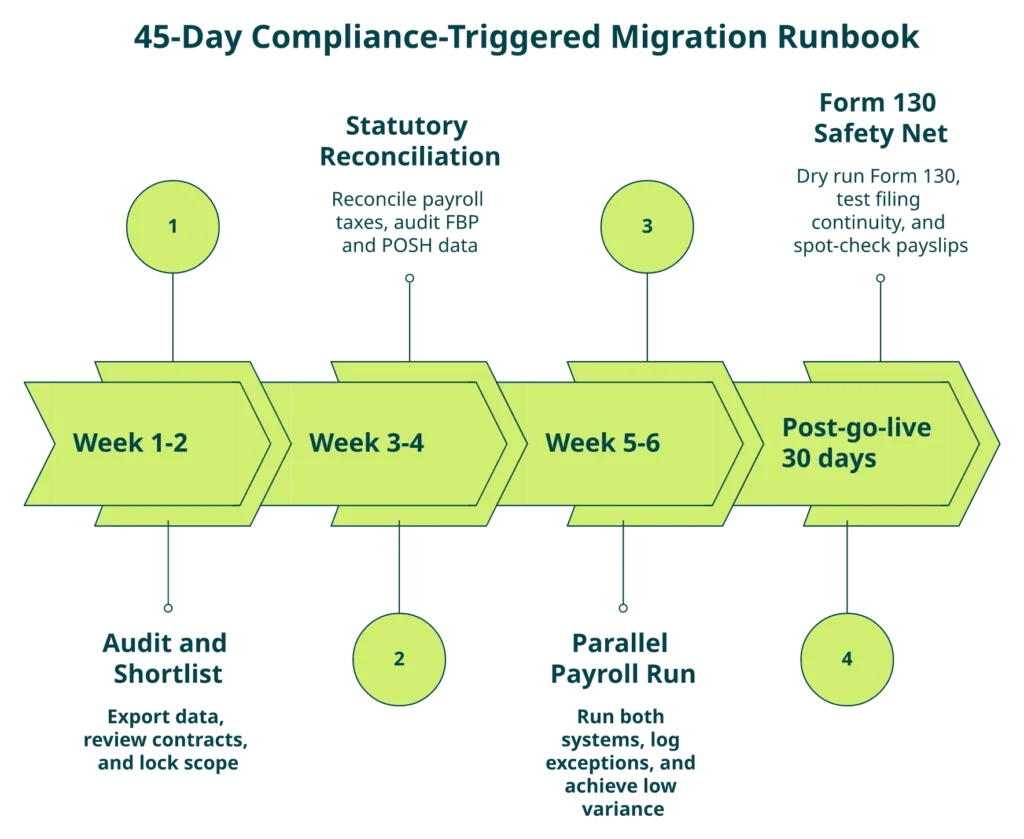
- Issue a Form 130 dry run by day 15 after cut-over.
- Run a statutory filing continuity test on the first post-switch payroll cycle.
- Spot-check payslips across a 10 percent random sample of employees.
- Confirm biometric and ATS (Applicant Tracking System, your recruitment tool) integrations are healthy via the integrations hub.
45-day runbook at a glance 🗓️
| Week | Phase | Key deliverables |
|---|---|---|
| Week 1 to 2 | Audit | Data dump, integration inventory, and exit clause review |
| Week 3 | Shortlist | Scripted demos and RFP scoring |
| Week 4 to 5 | Data mapping | Field mapping, payroll history carry-over, and TDS YTD |
| Week 6 | Parallel run | First full payroll on both systems |
| Week 7 | Go/no-go | Exception log, sign-offs, and cut-over |
Monday action for every persona 🧭
Meera: print this runbook and walk your HR ops team through Phase 1 on the next stand-up. Rajiv: share Phase 2 with your Finance controller today. Ananya: take the plain-English glossary above and ask your manager which two terms you will own end-to-end. ⭐
What my experience of shipping HROne tells me is that the teams hitting 45 days are the ones who over-invest in Phase 2. The cut-over is the easy part. The reconciliation is where the project is won.
Q8. How Do You Manage the Change: People, Data, and the Fear of a Payroll Break?
Every HR leader I speak to has one recurring nightmare about switching. Not the migration itself. The fear of one late salary email landing in 800 inboxes. Change management is the antidote to that nightmare, and it comes in three pillars.
Managing a greytHR switch well means separating three workstreams and never letting them bleed into each other: people (stakeholder comms, training, and adoption), data (export, mapping, and parallel-run validation), and process (payroll continuity and rollback triggers). Do all three in parallel with a named owner each, and you can compress the fear to 45 days.
Pillar one: people 👥
Pena4 Tech completed a 360-degree appraisal process for four companies in just 15 days after moving onto HROne, with a 90 percent reduction in manual involvement. That was not a product story. It was a change-management story. Their HR ops head ran three calls: one with managers, one with department heads, and one all-hands. No PDFs, no long emails. Three live calls. ✅ See the best onboarding practices guide for the adoption cadence we follow.
Pillar two: data
Data is where migrations quietly die. Field-mapping mistakes like “Emp_ID” versus “Employee Code” break downstream payslip generation. Excel format mismatches cause leave-balance drift. Payroll history gaps break Form 130 reconciliation. Build a field-mapping spreadsheet with your vendor in week one, and sign off on it before parallel run starts. ⚠️
“GreytHR is not much good at customizing based on our requirements. For our case, from implementation onwards, there were issues with leave balance and all. Many times we were manually correcting the leave balance of employees.”
— Verified User in IT greytHR, G2 Verified Review
Pillar three: process ⏰
Define rollback triggers before cut-over, not after. Common thresholds:
- More than 2 percent payroll variance in parallel run: rollback.
- More than 10 percent employees unable to log in by day 3: rollback.
- Any statutory filing failure in the first cycle: rollback.
Have a named decision owner with a 4-hour SLA for rollback calls.
Stakeholder comms template 📣
- CFO: weekly cost-of-switch dashboard, and a first-payroll go/no-go memo.
- IT: integration inventory, SSO/RBAC sign-off, and a data security brief.
- Managers: 30-minute “what changes for your team” call in week 2. Share the manager solutions page for the role lens.
- Employees: two-email sequence (what, when, and how), plus a mobile walkthrough video.
The “last switch” promise
What I have felt working with 2,000-plus HR teams is that the fear of a payroll break is really the fear of switching again in 18 months. That is why we commit to a 45-day parallel-run guarantee and a named prior-HR SPOC with a 9.8 NPS. The goal is not a good migration. The goal is that this is the last migration you ever run. ⭐
“The initial setup of HROne was surprisingly straightforward, much lighter than expected for a full HRMS.”
— Waldon S. HROne G2 – Verified Review
Q9. Why Is HROne the Switch Indian HR Teams Make in 2026, A Founder POV from Karan Jain
Most HR software tracks where you have been. The best HR software builds where you are going. I have spent the last nine years at HROne watching the difference between those two sentences quietly shape the careers of Indian HR leaders.
The contrarian thesis 🧠
Core HR is the keyword buyers type into Google. HCM (human capital management) is what they actually need. The mid-market Indian HR team I meet in 2026 is not looking for a payroll tool with a portal. They are looking for a system that closes 110 daily tasks from one screen and proves the savings to the board in rupees. That is an operating system problem, not a software-shopping problem. For the category-level framing, see HCM vs HRIS vs HRMS.
The Super Inbox thesis
I used to think the winning HRMS would be the one with the most modules. I was wrong. The winning HRMS is the one that collapses tabs. The HR inbox mimics Gmail: every pending approval, confirmation, transfer, exit clearance, and expense arrives in one inbox, and closes in three clicks.
HROne ranks #3 out of 1.17 lakh software products globally for customer satisfaction, while greytHR sits at #20 in the same category. On G2 directly, Quality of Support is 9.6 for HROne against 8.7 for greytHR, and Ease of Setup is 9.5 against 8.7. ✅
“The InboxforHR is a game-changer, centralizing every HR task into one simple inbox, cutting down administrative time by 60-70 percent and preventing tasks from falling through the cracks.”
— Waldon S. HROne G2 – Verified Review
Go-live billing and the 45-day promise ⏰
Here is the commitment that matters more than any feature list. Your HROne subscription starts metering only after go-live, and we guarantee a 45-day parallel-run window. The “pay-for-air” era, where Darwinbox or SAP customers pay full subscription for six months while implementation drags, ends the day you sign with us. MR DIY India went live in 30 days and cut payroll cycles from 10 days to 5 to 6 days. That is the track record, not the sales pitch. For transparent pricing, see the pricing page and the HR software pricing transparency guide.
“The initial setup of HROne was surprisingly straightforward, much lighter than expected for a full HRMS.”
— Waldon S. HROne G2 – Verified Review
The HR Commune: peers, not a help desk 👥
HR is lonely. Most HR leaders I know do not have an internal peer running the exact same payroll calendar in the exact same state. The HR commune (an 8,000-strong community of Indian HR leaders we host) is not marketing. It is the quiet reason many of our customers stay. You get peers who have already solved the problem you are staring at on a Thursday evening.
“I like HROne for its cost efficiency and holistic approach, which is why I prefer it over other vendors like Workday.”
— Priyanka S. HROne G2 – Verified Review
An invitation, not a demo button ⭐
I might be wrong about many things in this article. I am not wrong about one. The switch you are planning should be your last. If that is what you are after, do not book a demo. Tell us what you are building. Share your headcount, your states, your cut-over window, and we will show you exactly how a 300-person team in your industry got there in 45 days. Start the conversation via contact us or read why HROne.
Planning a switch before the FY26-27 cut-over?
Get a personalised 45-day migration plan and a Form 130-ready payroll walkthrough from an HROne product specialist.
Plan My greytHR-to-HROne Switch →Q10. What Is Your 90-Day Action Plan to Leave greytHR Without Breaking Payroll?
A CHRO of a 600-person logistics firm told me last month that she had been “planning to switch for 14 months” and still had not started. Ninety days is the honest runway. If you commit to it today, the first payroll on your new HCM lands before the next FY closes. Pair this plan with the logistics HR view for your industry.
Days 1 to 15 are for audit and shortlist. Days 16 to 45 are for scripted demos, data export, and field mapping. Days 46 to 75 are for parallel payroll run and exception log closure. Days 76 to 90 are for cut-over, Form 130 dry run, and first-cycle validation. Block the calendar this week, or the 14-month drift will quietly claim another year.
Days 1 to 15: audit and shortlist 🔍
- Export greytHR employee master, 24-month payroll history, TDS YTD, leave balances, and the integration inventory.
- Review your contract exit clause and data-retention rights in writing.
- Shortlist three vendors using the seven-criterion rubric from Q5 (HROne first, then two peers). Use the how to choose HRIS HRMS software guide for scoring.
- Book scripted demos with a written scenario, not a product tour.
- Confirm cut-over window (1 April, 31 July, or post Q4 freeze).
Days 16 to 45: data and field mapping 🗂️
This is the phase where migrations succeed or die quietly. Lock the field-mapping spreadsheet with your chosen vendor by day 25. Confirm payroll-history carry-over, Form 24Q YTD, and FBP declarations by day 35. Sign off on SSO, RBAC (role-based access control), and integration endpoints for biometric and Tally by day 40. Run the first pre-parallel dry run on day 45. Reference the payroll audit checklist for the reconciliation discipline.
Days 46 to 75: parallel payroll run ⏰
Run a full payroll cycle on both systems. Build an exception log per employee, per pay component. Target under 1 percent variance before cut-over. Hold a weekly go/no-go review between HR, Finance, and IT.
Days 76 to 90: cut-over and first validation ✅
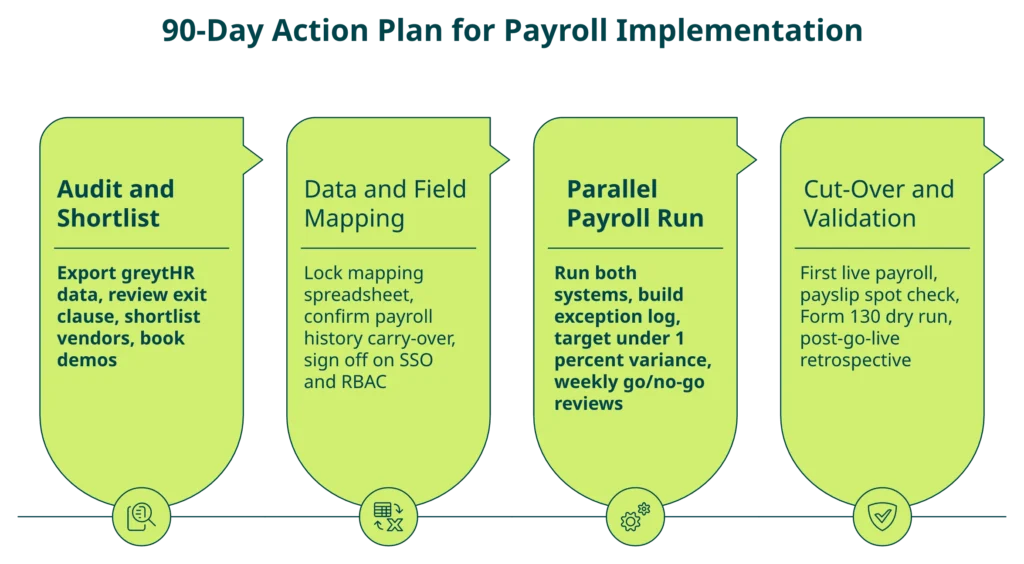
- Day 76: cut-over decision gate.
- Day 80: first live payroll on the new system.
- Day 82: employee payslip spot-check across a 10 percent random sample.
- Day 85: Form 130 dry run and statutory filing continuity test. See the payroll software compliance risk guide.
- Day 90: post-go-live retrospective, adoption metrics, and integration health.
What I want you to do this week 🗓️
Pick a date. Pick a name for the exit-side owner. Pick a name for the implementation owner. Write those three things on a whiteboard and take a photo. That whiteboard is your plan.
Working with 2,000-plus HR teams, what I have felt is that the teams that start with a photo on a whiteboard are the ones that finish in 90 days. The teams that start with a detailed PowerPoint are the ones still drafting in month 14. ⭐
If you are ready to move, we would rather hear the story of what you are building than pitch you a demo. Share the cut-over window, the headcount, and the one number on your sticky note. That is where the real conversation starts. For templates and enablement, browse download templates and HR resources.
“HROne has effectively identified and addressed all of our previous pain points. Its mobile application has been particularly valuable, saving users significant time and reducing resource consumption.”
— Vignesh J. HROne G2 – Verified Review
References
Official Docs / Indian Statutes
Ministry of Finance, Government of India, “Income Tax Act 2025 and FY26-27 TDS forms transition,” 2025 notifications.
Ministry of Labour and Employment, “Code on Wages 2019.”
EPFO, “UAN 3.0 circulars,” 2025-26.
Blogs
Maheshkumar J., “Worst experience in terms of Tax and Attendance calculation,” greytHR G2 Review, Feb 2025.
Brimma Tech Verified User, “greytHR G2 Review,” G2, Oct 2022.
Shreeya V., “Disappointing Experience with GreytHR,” G2 Review, Oct 2024.
Verified User in IT, “greytHR G2 Review,” G2, Jan 2023.
Verified User in IT, “greytHR G2 Review,” G2, Mar 2021.
HROne, “Customer outcomes: MR DIY India and Asia Healthcare Holdings,” 2024-25.















 Secures Top Spot in
