


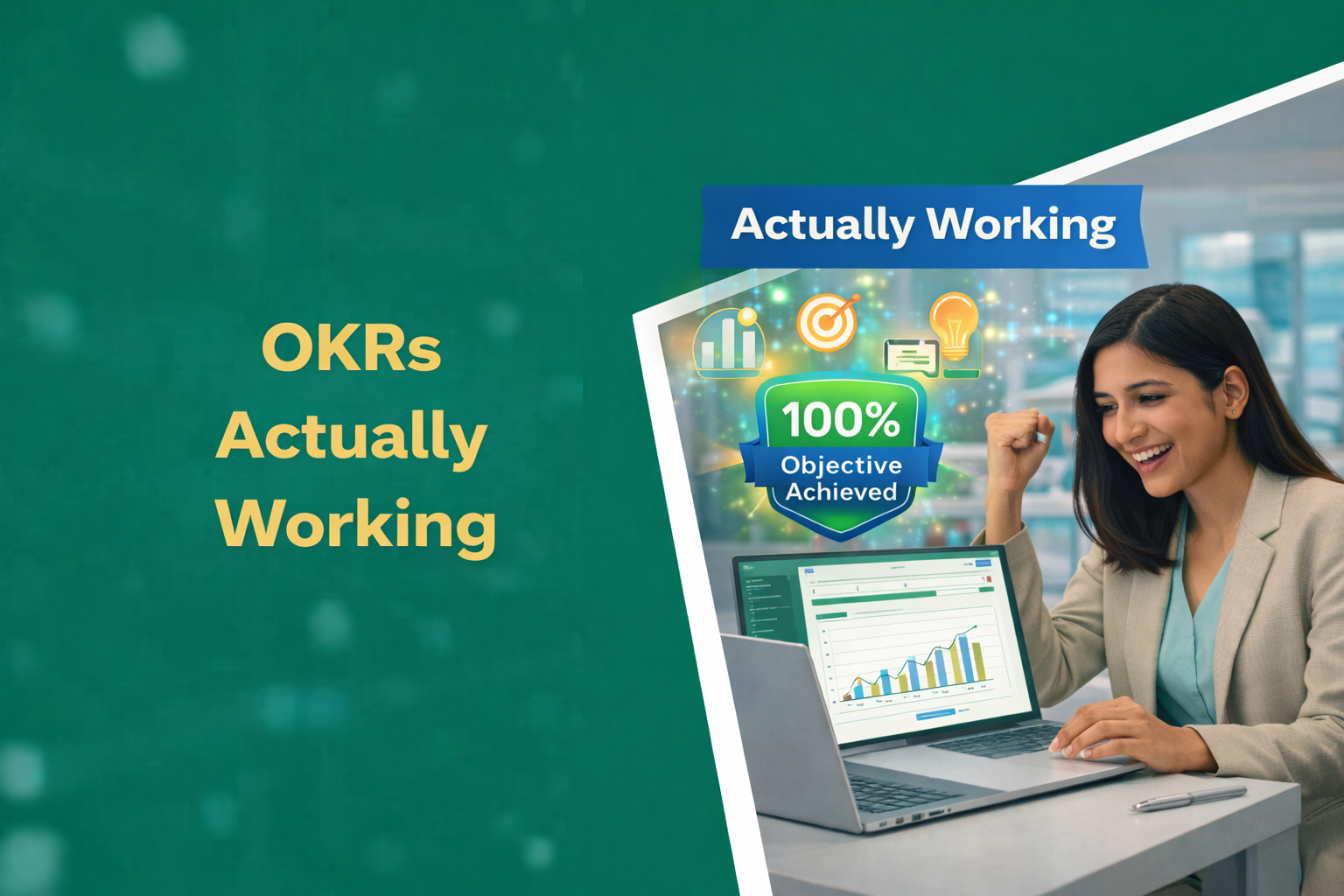
OKR and KPI management software has become the backbone of goal tracking for growing Indian organisations.
I’ve watched HR teams struggle with spreadsheets that break down the moment a company crosses 200 employees. Goals get lost. Progress updates vanish into email threads. And performance reviews turn into guesswork sessions.
Here’s the thing. Your organisation probably sets ambitious objectives every quarter. But tracking whether teams hit those targets? That’s where chaos begins.
Performance management software for OKRs connects your strategic vision to daily execution. It gives you visibility into what’s working and what’s falling apart.
This guide breaks down exactly how these tools work, what features matter, and how to implement them without the usual headaches.
Understanding OKRs vs KPIs: Why Both Matter for Performance Management
OKRs and KPIs serve different purposes. Mixing them up creates confusion.
OKRs stand for Objectives and Key Results. They’re aspirational. You set a bold objective, then define measurable key results that signal progress. Think of them as your quarterly stretch goals.
A sales team might have an objective to “Become the preferred vendor in the manufacturing sector” with key results like “Close 15 new manufacturing clients” and “Achieve 90% customer satisfaction score.”
KPIs are Key Performance Indicators. They measure ongoing business health. Revenue per employee. Time to hire. Employee attrition rate. These numbers tell you if your operations are running smoothly. You track them continuously, not just quarterly.
The confusion? Many organisations treat KPIs as OKRs. They’re not the same.
OKRs push you forward. KPIs keep you stable.
| Feature | OKRs | KPIs |
|---|---|---|
| Purpose | Drive ambitious change | Measure ongoing performance |
| Timeframe | Quarterly cycles | Continuous tracking |
| Achievement target | 70% is considered success | 100% expected |
| Focus | What we want to achieve | How we’re currently performing |
| Flexibility | Changes each cycle | Remains consistent |
How OKR and KPI Management Software Connects Goals to Metrics
Performance software creates a bridge between these two systems. Your quarterly OKRs cascade from company level to team level to individual contributors. Your KPIs feed real-time data about operational health.
The software links them together. When your OKR is to “Reduce hiring time by 40%,” your KPI tracking tools for employees show the current average time-to-hire. You see exactly how far you need to go. And you track progress weekly without digging through reports.
This integration matters because isolated goals create silos. When everyone sees how their individual objectives connect to company priorities, coordination happens naturally.
Key Benefits of Using Performance Management Software for OKRs and KPIs
Manual goal tracking fails at scale. I’ve seen HR managers spend entire Fridays compiling progress updates from department heads. That’s time you don’t have.
Performance management software for OKRs delivers tangible benefits:
- Centralised visibility. Every goal, from CEO objectives to intern KPIs, sits in one place. No more hunting through shared drives.
- Real-time progress tracking. Updates happen as work happens. You don’t wait until month-end reviews to discover problems.
- Reduced reporting overhead. Automated dashboards replace manual compilation. What took hours now takes minutes.
- Data-driven conversations. Performance reviews become discussions about actual metrics, not subjective impressions.
- Accountability without micromanagement. People update their own progress. Managers see it without asking repeatedly.
The biggest shift we noticed after implementing performance software was in our review conversations. They became about data, not opinions.
HR Director, Mid-size IT Services Company, Bengaluru
How Performance Management Software Improves Team Coordination
Coordination breaks down in two places. First, people don’t know what leadership priorities are. Second, they don’t see how their work contributes.
Software fixes both problems.
When a CHRO sets company objectives, the platform shows everyone. Department heads create connected team objectives. Individual contributors set their personal goals that roll up to team priorities.
The cascade is visible. A junior developer can see exactly how her sprint goal connects to the CTO’s quarterly objective.
This transparency changes behaviour. People stop working on random projects. They focus on what matters.
Making Reviews Easier with KPI Tracking Tools for Employees
Performance reviews in most Indian organisations happen annually. Maybe semi-annually. The problem? Nobody remembers what happened eight months ago.
KPI tracking tools for employees create continuous documentation. Every goal update, every milestone hit, every metric improvement gets recorded.
When review time arrives, you have actual evidence. Promotions and increments become defensible decisions based on tracked performance, not recent memory.
The software also enables continuous feedback. Managers comment on goal updates in real-time. Course corrections happen immediately, not during year-end reviews when it’s too late.
Essential Features to Look for in OKR and KPI Management Software
Not all performance software works the same way. Some tools are built for startups with 50 people. Others handle enterprises with 10,000 employees. Here’s what matters.
Dashboard and Reporting Capabilities in KPI Tracking Tools
Your leadership team doesn’t want to dig through individual goal pages. They need dashboards that show company-wide progress at a glance.
Look for:
- Visual progress indicators. Colour-coded status bars that show green, yellow, and red at a glance.
- Drill-down capability. Click on a department’s overall score to see individual team progress.
- Custom reports. Generate reports by department, location, or goal type.
- Export options. PDF and Excel exports for board presentations.
- Trend analysis. See how goal achievement has changed over multiple quarters.
| Feature Category | Must Have | Nice to Have |
|---|---|---|
| Goal hierarchy | Yes | Parent-child linking with unlimited levels |
| Progress visualisation | Yes | Multiple chart types |
| Automated reminders | Yes | Custom reminder schedules |
| Mobile access | Yes | Offline mode |
| Custom scoring | Basic | Weighted scoring formulas |
| Analytics | Basic dashboards | Predictive insights |
Top Integration Features That Enhance Performance Management Software
Your performance software shouldn’t exist in isolation. It needs to connect with your existing tools.
HRIS Integration. Employee data should sync automatically. When someone joins or leaves, the goal system updates. No manual entry.
Project Management Tools. If your teams use Jira, Asana, or similar tools, task completion should update goal progress automatically. This removes the burden of double-entry.
Communication Platforms. Slack or Microsoft Teams integrations push goal reminders and celebrate achievements where people already work.
Payroll Connection. For organisations tying performance to compensation, integration with payroll systems like HROne creates a complete performance-to-pay workflow.
Step-by-Step Guide to Implement Performance Software Successfully
Implementation fails when organisations skip preparation. I’ve seen companies buy expensive software and abandon it within six months because they rushed the rollout.
Follow this sequence:
- Audit current processes. Document how you currently track goals. What works? What breaks? Where do people spend the most time?
- Define clear objectives for the software. What problem are you solving? Faster reviews? Better coordination? Reduced reporting time? Pick your primary goal.
- Select appropriate software. Evaluate based on your team size, budget, and integration needs. Request demos with your actual use cases.
- Configure goal structures. Decide on OKR cycles, scoring methods, and permission structures before launch.
- Train managers first. They’ll cascade training to their teams. Invest in making them comfortable with the tool.
- Pilot with one department. Run a full quarter with one team. Gather feedback on what’s working and what’s confusing.
- Iterate based on feedback. Adjust configurations before company-wide rollout.
- Launch with clear communication. Explain the why, not just the how. People adopt tools they understand the purpose of.
- Establish review cadences. Weekly check-ins, monthly reviews, quarterly planning. Put them on calendars.
Best Practices for Tracking OKRs and KPIs with Software Tools
Having software doesn’t guarantee success. How you use it matters more.
- Weekly check-ins are non-negotiable. Don’t let goals sit untouched for weeks. Brief progress updates keep momentum.
- Limit objectives. Three to five OKRs per person per quarter. More than that dilutes focus.
- Separate committed from aspirational. Some OKRs must be achieved. Others are stretch goals. Label them clearly.
- Set meaningful KPI thresholds. A KPI of “revenue” means nothing without a target range. Define what good looks like.
- Celebrate wins publicly. Use the software’s announcement features to recognise goal completion. Recognition drives adoption.
- Review and iterate quarterly. After each cycle, discuss what worked. Adjust processes for the next quarter.
We review our KPI thresholds every quarter now. What was ambitious last year is baseline today.
Head of People Operations, E-commerce Company, Mumbai
Common Mistakes to Avoid When Using KPI Tracking Tools for Employees
I see these mistakes repeatedly:
- Tracking too many metrics: Twenty KPIs per person means nobody knows what matters. Focus on five to seven critical indicators.
- Misaligned goals: Individual objectives that don’t connect to team priorities. Review connections during goal-setting.
- Infrequent updates: Monthly updates are too slow. Problems fester. Weekly or bi-weekly works better.
- Ignoring lagging indicators: Don’t wait for revenue numbers to tell you something’s wrong. Track leading indicators that predict outcomes.
- Making it punitive: If goal tracking becomes surveillance, people game the system. Frame it as support, not monitoring.
Frequently Asked Questions
Q: What’s the difference between OKRs and KPIs in performance management?
A: OKRs are aspirational quarterly goals with measurable key results that push teams forward. KPIs are ongoing metrics that track operational health continuously. You need both. OKRs drive change while KPIs maintain stability.
Q: How often should employees update their goals in performance software?
A: Weekly updates work best for OKRs. KPIs often update automatically through integrations. The key is consistency. Brief weekly progress notes prevent scrambling during review periods.
Q: Can small companies benefit from OKR and KPI management software?
A: Yes. Even 30-person teams struggle with spreadsheet tracking as they grow. Early adoption builds goal-setting habits. Many platforms offer affordable plans for smaller organisations.
Q: How do I get employees to adopt performance management software?
A: Train managers first. Explain why the tool exists, not just how it works. Start with a pilot team. Make goal updates part of existing meetings rather than extra work.
Q: Should KPIs be linked to employee compensation?
A: It depends on your culture. Direct links can motivate but also encourage gaming metrics. Many organisations use KPIs to inform compensation decisions without rigid formulas. The approach should match your values.
















 Secures Top Spot in
