


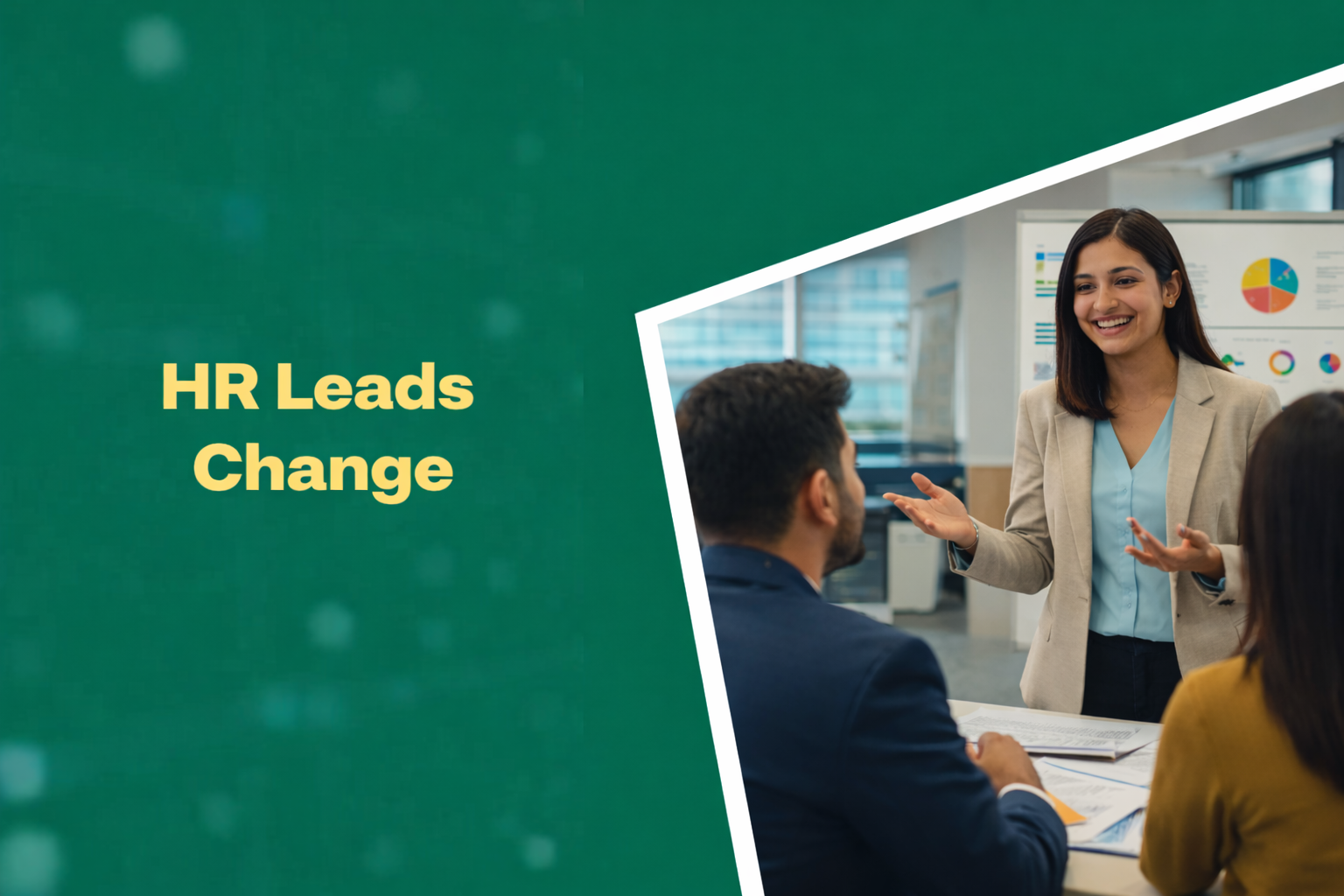
HR workplace change is no longer something happening to your organization. It’s something you’re expected to lead. I’ve watched HR teams across India scramble to keep pace with changes over the past three years. And here’s what I’ve noticed. The ones who thrive aren’t waiting for direction from the C-suite. They’re setting the agenda.
By 2026, Gartner predicts 60% of large enterprises will have restructured HR functions around skills and outcomes rather than roles. That’s a massive shift in how we think about work itself. The question isn’t whether your organization will change. It’s whether HR will be driving that change or reacting to it.
The future of work HR strategy requires a complete rethink. From AI adoption and employee wellbeing to workforce planning and hybrid models. Your playbook from 2023 won’t work anymore.

The Evolving Role of HR in Workplace Transformation
Remember when HR meant maintaining files, processing payroll, and managing leave applications? Those days feel distant now. The function has shifted dramatically toward business strategy and cultural architecture.
Today’s HR leaders sit at leadership tables. They influence decisions about mergers, market expansion, and digital change. A 2024 LinkedIn study found that 73% of Indian CEOs now consider their CHRO a critical strategic partner. Not a support function. A partner.
From Administrative Tasks to Strategic HR Workplace Transformation
This shift didn’t happen overnight. It required HR professionals to build new capabilities:
- Business acumen and financial literacy
- Data analysis and interpretation skills
- Change management expertise
- Technology evaluation and implementation knowledge
- Executive communication and influence
The administrative work hasn’t disappeared. But it’s been automated or delegated to shared services. What remains for HR leaders is the complex human work. Designing cultures where people perform at their best. Building talent pipelines for roles that don’t exist yet. Creating systems that attract and retain top performers.
In Indian organizations specifically, this transition has been accelerated by talent wars in IT, manufacturing, and financial services. When attrition rates hit 20-25% in some sectors, CEOs started asking different questions of their HR teams. Not “How do we process exits faster?” but “Why are people leaving and how do we stop it?”
That shift in questions signaled a shift in expectations. And HR stepped up.
Top HR Trends 2026: What Leaders Must Prepare For
The trends shaping HR in 2026 aren’t predictions anymore. They’re movements already underway. Smart HR leaders are positioning themselves ahead of these curves.
AI and Automation in HR Trends 2026
Artificial intelligence has moved from experimentation to execution. By 2026, most HR functions will use AI in some capacity.
Here’s where AI is making the biggest impact:
- Recruitment screening: AI tools now analyze thousands of applications in minutes, matching candidates to roles based on skills and potential rather than keywords alone.
- Performance insights: Continuous feedback systems are powered by AI identify patterns in employee engagement to flag concerns before they become resignations.
- Learning recommendations: Personalised training paths are based on individual career goals, skill gaps, and learning preferences.
- Workforce planning: Predictive models that forecast talent needs 12-18 months ahead.
The key here is augmentation, not replacement. AI handles data processing and pattern recognition. Humans handle judgment, empathy, and relationship building.
Skills-Based Hiring and Internal Mobility
Degrees and job titles are losing relevance. Skills are taking their place.
HR Trends 2026: Skills vs Traditional Hiring
| Criteria | Traditional Approach | Skills-Based Approach |
|---|---|---|
| Candidate Evaluation | Degree, years of experience | Demonstrated competencies, assessments |
| Job Requirements | Fixed role descriptions | Flexible skill profiles |
| Career Progression | Linear promotions | Lateral moves, project-based growth |
| Internal Mobility | Limited, manager-dependent | Skills marketplace, self-directed |
| Talent Pool | Narrow, credential-filtered | Expanded, ability-focused |
Indian companies like Infosys and TCS have already shifted toward skills-based hiring for tech roles. I’ve also observed this trend accelerating across mid-sized organisations too. When you hire for skills, you open doors to diverse talent pools. People who learned through boot camps, self-study, or on-the-job experience suddenly become visible candidates.
Internal mobility also benefits from this approach. Employees can move across functions based on transferable skills. This reduces external hiring costs and improves retention.
Building the Future of Work HR Strategy
Strategy without execution is wishful thinking. Future of work HR planning requires both vision and practical roadmaps.
Strategic Workforce Planning for the Future of Work HR Teams
Workforce planning has evolved beyond headcount forecasting. It now involves scenario modelling, skills mapping, and continuous recalibration.
Effective workforce planning includes:
- Identifying critical roles and succession risks
- Mapping current skills against projected future needs
- Building talent pipelines for emerging roles
- Creating flexible staffing models that blend full-time employees, contractors, and gig workers
- Developing reskilling programmes for at-risk roles
Indian manufacturing firms are using workforce analytics to predict retirement waves and plan knowledge transfer. IT services companies model different growth scenarios to determine hiring velocity. These aren’t abstract exercises. They directly inform budget decisions and business strategy.
Creating Agile Organisational Structures
The rigid hierarchies of traditional organisations can’t respond fast enough to market changes. Agile structures are replacing them.
This doesn’t mean chaos or constant reorganisation. It means:
- Cross-functional teams: Bringing together people from different departments to solve specific problems
- Project-based work: Assigning people to initiatives based on skills rather than reporting lines
- Flatter decision-making: Pushing authority closer to where work happens
- Rapid experimentation: Testing new approaches quickly and scaling what works
HR is central to enabling agility. From designing flexible reward systems to training managers on new leadership behaviours. Without HR’s involvement, agile changes often stall at the structural level.
Employee Experience as the Core of HR Transformation
You can’t change a workplace without changing how employees experience it. Employee experience (EX) has moved from a nice-to-have to a core business metric.
A 2024 Gallup study showed that organisations with strong employee experience see 23% higher profitability and 18% higher productivity. These aren’t soft benefits. They show up on the balance sheet.
Personalization and Employee-Centric HR Workplace Transformation
One-size-fits-all HR policies are losing effectiveness. Employees expect personalized experiences similar to what they get as consumers.
Key elements of personalized employee experience:
- Customized benefits: Flexible packages where employees choose what matters to them. Some want better health coverage. Others prioritize learning budgets or childcare support.
- Career path flexibility: Not everyone wants to become a manager. Some want to deepen technical expertise. Others want to try different functions. Good EX design accommodates both.
- Work arrangement choices: Hybrid, remote, or office based. Different roles and individuals have different needs.
- Wellbeing support: Mental health resources, financial wellness programmes, and work-life balance policies tailored to different life stages
I’ve seen Indian organisations increasingly segment their workforce when designing EX programmes. What works for a 25-year-old software developer in Bangalore differs from what works for a 45-year-old plant manager in Pune.
That’s the difference smart HR teams recognize fast.
Technology Enablers for HR-Led Transformation
Technology is the foundation of modern HR change. But technology alone changes nothing. It’s how you implement and adopt it that matters.
Essential Tech Stack Supporting HR Trends 2026
Your technology choices should align with your priorities. Here’s a guide for evaluating HR tech:
| Technology Category | Primary Function | Impact |
|---|---|---|
| HRIS/HCM Platforms | Core employee data and processes | Foundation for all other systems |
| People Analytics | Workforce insights and predictions | Data-driven decision making |
| Learning Experience Platforms | Skill development and reskilling | Building future capabilities |
| Collaboration Tools | Communication and teamwork | Enabling hybrid and remote work |
| Employee Engagement Platforms | Feedback and sentiment tracking | Real-time experience management |
| Talent Marketplaces | Internal mobility and gig work | Skills-based talent deployment |
Integration between these systems is critical. Siloed tools create fragmented experiences for employees and incomplete data for HR leaders.
When evaluating new technology, involve end users early. The most sophisticated platform fails if employees don’t use it. Pilot with small groups. Gather feedback. Iterate before scaling.
Indian organisations often face unique implementation challenges. Multiple languages, varying technology literacy across locations, and complex regulatory requirements. Factor these into your technology strategy from the start.
FAQs (Frequently Asked Questions)
Q1: What is HR workplace transformation and why does it matter in 2026?
A: HR workplace transformation refers to fundamental changes in how HR functions operate and deliver value. It matters in 2026 because technology, employee expectations, and business models are shifting rapidly. Organisations that don’t adapt will struggle to attract talent and maintain productivity.
Q2: How will AI change HR functions by 2026?
A: AI will automate repetitive tasks like resume screening and scheduling. It will provide predictive insights for workforce planning and retention. HR professionals will spend more time on strategic work and complex human problems while AI handles data processing.
Q3: What skills do HR professionals need for future of work HR roles?
A: Key skills include data analysis, business strategy, change management, and technology evaluation. HR professionals also need strong communication abilities to influence executives and guide managers through change. Continuous learning is essential.
Q4: How can Indian organisations prepare for HR trends 2026?
A: Start by auditing current HR capabilities and technology. Identify skill gaps in your HR team and create development plans. Pilot new approaches like skills-based hiring or AI tools in specific areas before scaling. Partner with technology providers who understand Indian market needs.
Q5: What role does employee experience play in HR transformation?
A: Employee experience is central to success. Poor experiences lead to disengagement and attrition. Good experiences improve productivity and retention. HR must design personalised experiences that meet diverse employee needs while aligning with business objectives.












 Secures Top Spot in
