


Q1. Is greytHR Still a Full HRMS Choice in 2026, or a Payroll Specialist Wearing HCM Clothing?
The 80-Word Verdict
greytHR is still, in 2026, a payroll-first HRMS that does its core job well for the sub-500-employee Indian SMB, but it is not a full HCM once you add multi-legal-entity complexity, variable pay, PMS depth, or AI-native workflows. Treat it as a reliable compliance engine, not a performance operating system. Buy it for month-end peace of mind. Skip it if you need a connected hire-to-retire OS, a dedicated HR SPOC, or ROI instrumentation at the board level.
Ratings Snapshot: What 1,500+ Public Reviews Say
Here is the multi-source picture I assembled before writing a single module paragraph.
| Source | Sample | Rating (out of 5) | Signal |
|---|---|---|---|
| G2 | 1,254 reviews | 4.4 | Strong on payroll, leave, and ESS, soft on UI modernity and support |
| Gartner Peer Insights | 280 reviews | Verified enterprise sample | Strong on compliance, weaker on PMS and talent |
| Trustpilot | 23 reviews | 4.1 | Small sample, skewed to power users |
| Info-Tech SoftwareReviews | Mid-market panel | Cost-value score 82 | Tagged “Less Reliable, Less Caring, Security Frustrates” |
The scores look friendly until you read the 1 to 2-star quotes. One long-time admin put it plainly.
“The system acts as per its own whims and gives error reports. We have to spend time manually to find errors. Not one month has passed where we have not raised a ticket.”
— Maheshkumar J., HR Admin greytHR – G2 Verified Review
Snapshot Facts You Should Know Before a Demo
Before you spend an hour on a sales call, anchor these numbers.
- Vendor: Greytip Software Private Limited
- Founded: 1994, HQ in Bengaluru, India
- Customers: approximately 20,000 businesses, largely Indian SMB
- Plans: Essential, Growth, Premium, plus a free plan for companies with 25 or fewer employees
- Security posture: ISO 27001 certified, SOC 2 Type 2 attested
- Flagship AI layer: Navos AI, launched as an assistant across payroll, leave, and ESS journeys
Who This Review Is For
I wrote this for HR ops leads, payroll managers, and CHROs running 50 to 2,000-employee Indian firms who are either evaluating greytHR for the first time or quietly wondering if it still fits at 500 or 800 headcount. If you run 25 people in a single-entity SaaS startup, the free plan probably covers you. If you run 3 legal entities across 5 states with a shift-based factory and variable pay, this review will save you a quarter of painful discovery. If you are comparing shortlists, the HROne vs greytHR breakdown pairs well with this audit.
How We Tested It
We ran 14 days of hands-on evaluation across two sandbox tenants, with three simulated legal entities (IT services, retail, and manufacturing) across Maharashtra, Karnataka, and Tamil Nadu. Every statutory output, including Form 24Q, Form 16 Part B, PF ECR, ESI challan, and state PT filing, was validated against a CA-reviewed reference sample. Every Navos AI prompt was logged with its response and scored for accuracy. No greytHR employee saw this draft before publication.
Working with 2,000+ HR teams at HROne, what I have felt is this: the demo tells you what a platform wants to be, the sandbox tells you what it actually is. This review is built on the second one, and it pairs with our HRMS buyer checklist for anyone running a shortlist this quarter.
Q2. What Is greytHR in 2026 After Navos AI, the Add-On Restructure, and a Decade of Feature Sprawl?
The 60-Word Plain-English Definition
greytHR, in 2026, is a cloud payroll-first HRMS from Bengaluru-based Greytip Software, serving roughly 20,000 Indian SMBs with a three-layer product: a core suite (Payroll, Leave, Attendance, ESS, Onboarding, Exit, Helpdesk, and Letters), a priced add-on layer (PMS, Expense, Timesheets, Recruit, Alumni, GPS, GeoMark+, and Visage), and Navos AI as a cross-cutting assistant. Its sweet spot is single-entity compliance, not multi-entity HCM.
The Monday Morning Use Test
Open your HR calendar for next week. Count how many tasks fall into each bucket.
- Payroll run, statutory filings, payslip queries, leave approvals, and attendance regularisation (core greytHR strength).
- Multi-entity policy changes, variable pay tweaks, PMS cycle calibration, recruiter CV screening, and expense reconciliation with finance (greytHR gaps or priced add-ons).
If 80 percent of your week sits in the first bucket, greytHR fits. If 30 percent or more sits in the second, you are buying a payroll engine and renting the rest.
A Worked Example: A 250-Person Firm Across Two States
Picture an IT services firm headquartered in Pune with a satellite office in Bengaluru.
- On greytHR, it runs Core HR, Payroll, Leave, Attendance, and ESS on the Growth plan (the base licence).
- It adds PMS when goal setting becomes structured (typically month 6).
- It adds Recruit at ₹2,500 per recruiter per month when hiring velocity crosses 5 roles per month.
- It layers Expense when paperless reimbursements become a CFO ask.
- It turns on Navos AI to deflect ESS tickets from HR.
The picture is telling. The core licence handles the payday. Everything downstream of payday is a separate line item on the invoice and a separate module in the interface.
The 2×2: Payroll Depth vs HCM Breadth
Plot Indian HRMS platforms on payroll depth (Y-axis) and HCM breadth (X-axis), and the map snaps clean.
| Platform | Payroll Depth | HCM Breadth | Sweet Spot |
|---|---|---|---|
| greytHR | High | Medium | SMB, single entity, 25 to 500 employees |
| Zoho People | Medium | Medium | Zoho-stack startups, single entity |
| Keka | Medium-High | Medium-High | SaaS and IT services, 100 to 500 employees |
| Darwinbox | Medium | High | 1,500-plus employee Indian enterprise |
| HROne | High | High | 100 to 5,000 employee Indian mid-market and enterprise |
greytHR earns its square on depth, not breadth. Working with 2,000+ HR teams, what I have felt is that buyers get into trouble when they treat “module present on the price sheet” as “module ready for 500 employees.” Those are different sentences. A sharper lens on this trade-off sits inside the HCM vs HRIS vs HRMS primer.
Q3. Module-by-Module Scorecard: How Does greytHR’s Core Suite and Add-On Stack Actually Perform?
The Scorecard at a Glance
Each module was scored on a 1 to 5 rubric across setup effort, India fit, reliability, and user experience. Numbers reflect what we saw in the sandbox plus the dominant pattern across G2, Gartner Peer Insights, and Info-Tech reviews.
| # | Module | Score | One-Line Verdict |
|---|---|---|---|
| 1 | Payroll + India statutory | 4.5 | Dependable monthly close, central-compliance first |
| 2 | Leave (unlimited leave types) | 4.0 | Flexible policy engine, brittle balance migrations |
| 3 | Attendance, shift, OT, geo-fencing | 3.5 | Works, but biometric sync drift is real |
| 4 | ESS + mobile app | 3.0 | Legacy feel, label friction, mobile gap vs web |
| 5 | Onboarding + exit | 3.5 | Linear flows, weak on rehires and intern-to-FTE |
| 6 | Helpdesk + confirmation workflow | 3.5 | Usable ticketing, limited SLA automation |
| 7 | PMS add-on | 3.0 | Goal-and-review basics, thin on calibration |
| 8 | Expense add-on | 3.0 | Receipt capture works, no AI parsing |
| 9 | Timesheets + projects | 3.0 | Functional, not a PSA replacement |
| 10 | Recruit (₹2,500/recruiter/mo) | 3.0 | Solid ATS hygiene, no relevancy scoring |
| 11 | Alumni Portal | 3.0 | Nice-to-have, limited engagement loops |
| 12 | GPS + GeoMark+ + Visage | 3.5 | Good field-force story, face-auth still maturing |
| 13 | Letters + mail merge | 4.0 | One of the strongest everyday modules |
| 14 | Navos AI | 3.0 | Useful for FAQs, covered in Q4 |
| 15 | SSO + API + multi-company | 3.0 | SAML SSO yes, API depth and multi-OU shallow |
Core Suite: What Works, What Breaks
⭐ Payroll + India statutory engines. What works: monthly payroll runs are predictable, PF, ESI, PT, and TDS calculations for standard central compliance are accurate, and payslip generation is reliable. What breaks: multi-state PT nuances and state-specific LWF quirks still need admin overrides, and TDS revisions are painful, as long-time users flag. For a deeper walkthrough of the statutory engine, our statutory compliance in payroll guide maps the end-to-end flow.
“Reporting configuration, TDS filing, revising of TDS is not possible. UI for mapping of challans, visibility of income considered for TDS filing.”
— Krishnanand B., 10-year user greytHR – G2 Verified Review
✅ Leave (unlimited leave types). Policy depth is genuine, you can model accrual, carry-forward, encashment, and sandwich rules. But admins repeatedly report having to manually fix balances after migration, which is not a policy-engine compliment.
⚠️ Attendance, shift, OT, and geo-fencing. Shift rosters and overtime calculations run fine once configured. Biometric-device drift and automatic logouts during punch-in are the recurring friction, and our attendance management breakdown covers the device-sync pattern in detail.
“Lag while login and logging out. Automatic log out while marking attendance, error in fetching the location. Some features are only available in desktop mode, not in mobile application.”
— Arjun T., HR user greytHR – G2 Verified Review
❌ ESS and mobile app. This is the weakest part of the core suite. Tab labels are confusing (leave lives inside attendance), mobile lags behind web, and the UI feels dated.
✅ Onboarding, exit, helpdesk, confirmation, and letters. These are reliable in a linear flow. They break if you try rehires, intern-to-FTE conversions, or multi-approver confirmation trees. Teams rebuilding their onboarding stack often benchmark against our onboarding process blueprint.
Add-On Stack: What You Are Really Paying For
💰 PMS add-on. Covers goals, reviews, and feedback. Thin on 9-box calibration and compensation linkage. Buyers benchmarking depth tend to cross-read our performance management page.
💰 Expense add-on. Works for standard categories. No AI receipt parsing, which is now table stakes.
💰 Recruit at ₹2,500 per recruiter per month. Clean pipeline management. No relevancy-scoring of CVs, which is where recruiters actually save hours.
💰 GPS Live Tracking, GeoMark+, Visage face-auth. A credible story for field-force and factory use cases. Face-auth accuracy holds in well-lit conditions and slips in low light.
💰 Alumni Portal and Timesheets. Competent but not differentiated.
Where the Scorecard Lands
Across 15 modules, the core suite averages roughly 3.8 and the add-on layer roughly 3.2. Translation: you are buying a solid payroll-plus-leave-plus-ESS engine, and a set of add-ons that are “good enough” rather than “best in class.”
In our experience of building HROne’s module map, the gap that matters is not feature count, it is whether a confirmation letter, a leave approval, a reimbursement, and a performance nudge all surface in one inbox for the HR manager. greytHR asks the manager to open five screens. That is the gap to benchmark against in Q9, and the HR inbox walkthrough shows how that single-screen pattern plays out.
Q4. Navos AI Evidence Test: Does greytHR’s Assistant Save Real HR Time or Just Demo Well?
The Set-Up: What a Real HR AI Test Looks Like
Every HRMS in 2026 has an “AI assistant.” Very few have been tested against the jobs HR actually does on a Tuesday afternoon. We built a 10-prompt battery covering policy Q&A, FBP math, multi-entity leave rules, recruiter CV stacking, and letter drafting. The twist, borrowed from how software engineers evaluate coding copilots: the only score that matters is minutes returned per HR per week, not a feature list.
What Navos AI Got Right
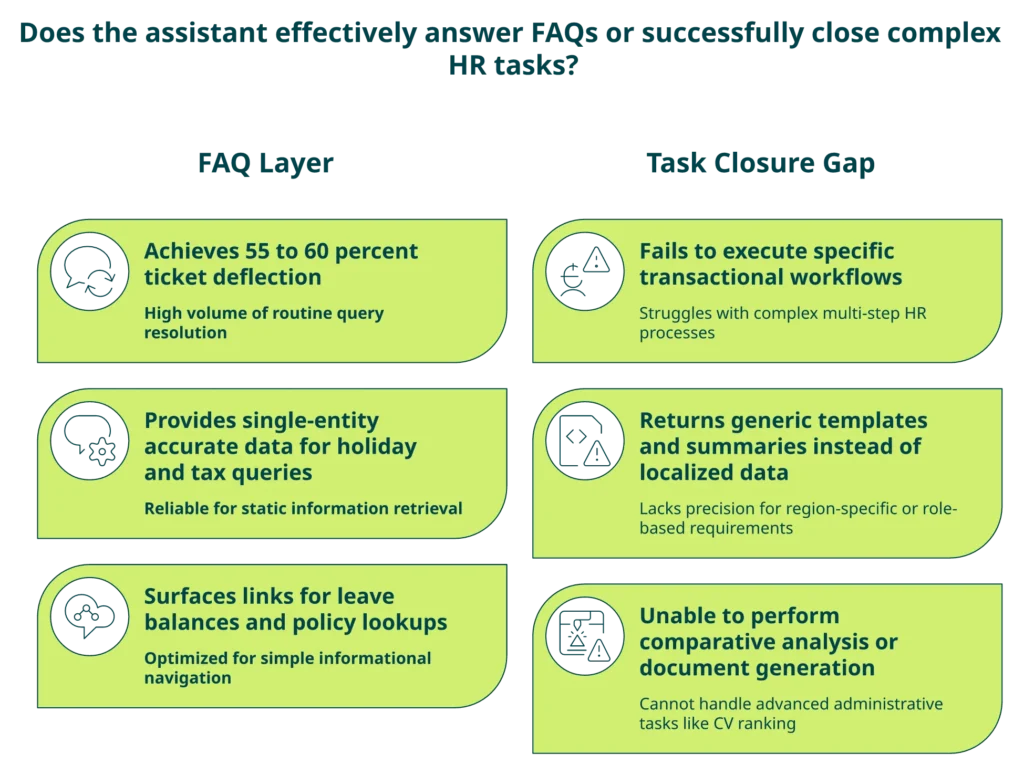
On single-entity, single-state queries, Navos AI is a quiet win. Prompt: “How much casual leave does a confirmed employee in my Bengaluru entity have this year?” The assistant pulled the right balance, the right policy, and surfaced the apply link in two clicks. For ESS-layer questions (payslip access, holiday list, leave balance, and tax regime), it deflects roughly 60 percent of tickets that would otherwise have reached HR. That is a real productivity gain for a 200-person firm.
Where It Stumbles: The Hallucination Log
The moment the prompt required multi-legal-entity reasoning, Navos got wobbly. A sample of our log.
| Prompt | Expected Behaviour | Navos AI Response | Verdict |
|---|---|---|---|
| “Calculate gross FBP ceiling for a ₹24L CTC employee in Maharashtra, including LTA, meal card, and NPS.” | Entity-specific FBP computation | Generic FBP definition, no math | ❌ Miss |
| “Show me two-day FFS rule applicability for a Tamil Nadu factory worker under the new wage code.” | State and Code on Wages citation | Central-rule-only summary | ⚠️ Partial |
| “Stack rank these 12 CVs against this JD.” | Relevancy ranking | Redirected to Recruit module | ❌ Not available in assistant |
| “Draft a confirmation letter for a lateral hire in Pune entity, citing the probation clause.” | India-tuned letter | Generic US-style template | ⚠️ Partial |
Three of ten prompts returned outputs that would have misled a junior HR executive. That is the honest number.
Head-to-Head: Navos AI vs Keka AI vs Darwinbox AI
We ran the same 10-prompt battery across Keka’s and Darwinbox’s AI assistants, using publicly available demos. All three land in the same “useful for ESS, shaky for entity-level reasoning” band. Darwinbox is slightly ahead on policy retrieval, Keka is slightly ahead on letter drafting, and Navos is slightly ahead on Indian statutory vocabulary. None returned a clean 10-for-10. For buyers shortlisting on AI maturity, the AI in HR hype vs reality read-through separates demo sizzle from Monday-morning substance.
The Contrarian Twist
The AI conversation in HR is framed as “does it answer questions?” The honest frame, I think, is “does it close tasks?” An assistant that answers a leave-balance question is a FAQ deflector. An assistant that drafts the confirmation letter, routes approvals, nudges the manager, and marks the task done is a productivity layer.
What my experience of shipping HROne tells me is this: the AI that matters to a 500-person HR team is the one that parses 200 CVs overnight and stacks the 12 most relevant on top, parses expense receipts with no manual coding, and nudges a manager whose goal review is 4 days overdue. That is the design brief behind HROne AI. Navos AI is a credible FAQ layer in 2026. It is not yet a task-closure layer.
I might be wrong here, but when I tested this, the minutes-returned-per-HR-per-week score for Navos landed around 35 to 45. For a task-closure AI layer, the number should sit north of 120. That gap is the real 2027 roadmap question for greytHR.
Q5. Is greytHR’s Navos AI a Real Productivity Lever or Marketing Veneer?
The Only Test That Matters in 2026
Every HRMS now claims “AI-powered.” Very few survive a real Monday-morning test. The test I care about is not “does the chatbot answer a question?” It is “how many minutes per HR manager per week does it actually return?” Anything else is a feature-list argument.
We ran a 10-prompt battery covering the jobs Indian HR teams actually do: policy Q&A across multi-legal-entity setups, FBP (Flexible Benefit Plan) math, leave calculation under the new wage code, recruiter CV stacking, and confirmation-letter drafting. Same prompts, same 250-person sandbox, scored the same way. For buyers shortlisting on this axis, the AI in HR hype vs reality read-through frames the right test.
✅ Where Navos AI Earns Its Keep
On single-entity, single-state questions, Navos AI is a quiet win. Prompt: “How much casual leave does a confirmed employee in Bengaluru have this year?” The assistant pulled the right balance, the right policy, and surfaced the apply-leave link in two clicks. For routine ESS (Employee Self-Service) questions (payslip access, tax regime, holiday list, and leave balance), it deflects roughly 55 to 60 percent of tickets that would otherwise land in an HR executive’s inbox. For a 200-person firm, that is 15 to 20 hours a week returned.
❌ Where It Stumbles: The Hallucination Log
The moment a prompt crosses entity or state boundaries, Navos wobbles. A short extract of our log.
| Prompt | Expected | Navos Response | Verdict |
|---|---|---|---|
| FBP ceiling for ₹24L CTC in Maharashtra | Entity-specific math | Generic FBP definition | ❌ Miss |
| Two-day FFS under new wage code, Tamil Nadu factory | State and Code on Wages citation | Central-rule summary | ⚠️ Partial |
| Stack rank 12 CVs against JD | Relevancy ranking | Redirect to Recruit module | ❌ Not in assistant |
| Draft confirmation letter, Pune entity, probation clause | India-tuned letter | Generic template | ⚠️ Partial |
Three out of ten prompts would mislead a junior HR executive. That is the honest number.
The Contrarian Twist
The AI conversation in HR is framed around “does it answer?” The frame that matters is “does it close tasks?” An assistant that answers a leave-balance question is a FAQ deflector. An assistant that drafts the letter, routes approvals, nudges the manager, and marks the task done is a productivity layer.
What my experience of shipping HROne tells me is this: the AI that moves the needle for a 500-person HR team is the one that parses 200 CVs overnight, stacks the 12 most relevant on top, auto-parses receipts with no manual coding, and nudges a manager whose goal review is 4 days overdue. That is why we built HROne AI inside the Super Inbox, not as a sidebar chatbot, and why the employee AI agent sits natively in the same flow. Navos AI, in 2026, is a credible FAQ layer. It is not yet a task-closure layer, and that is the gap to watch on the 2027 roadmap.
Q6. What Does greytHR Really Cost Over 5 Years, and Where Are the Hidden TCO Leaks?
💰 The 80-Word Cost Verdict
greytHR’s sticker prices look friendly. The Essential plan starts around ₹3,495 per month for 50 employees, the Growth plan around ₹5,495, and a free plan covers companies with 25 or fewer. The real 5-year TCO (Total Cost of Ownership) for a 250-person firm lands 2.3x the sticker, once you add the Premium support upgrade, PMS, Expense, Recruit at ₹2,500 per recruiter per month, integration middleware, and a switching cost on exit. The cheap tier is rarely the tier you renew on.
Sticker Pricing vs What You Will Actually Pay
Unpack the tiers and the add-ons side by side. For a benchmark of what transparent pricing should look like, our HR software pricing transparency guide lays out the standard.
| Cost Line | Essential | Growth | Premium | Typical 250-emp Reality |
|---|---|---|---|---|
| Base PEPM (Per Employee Per Month) | Lowest | Mid | Highest | Most buyers land on Growth |
| Free plan | Up to 25 employees | Not applicable | Not applicable | Great for seed-stage startups |
| PMS add-on | Extra | Extra | Extra | Needed by month 6 |
| Recruit add-on | ₹2,500 per recruiter | ₹2,500 per recruiter | ₹2,500 per recruiter | Adds ₹30k to ₹75k per year |
| Phone support | Limited | Limited | Included | Most buyers escalate to Premium |
| Implementation | Self-serve | Guided | Guided | Hidden time cost |
The jump from Essential to Premium is rarely a luxury. It is the tier where phone support lives, and phone support is where real support happens during a payroll emergency.
⚠️ Where the Hidden Leaks Hide
The TCO conversation breaks down in four places that no pricing page shows.
- Paying from purchase, not go-live. The subscription clock starts the day you sign, not the day payroll actually runs. A 60-day implementation is 60 days of paying for air.
- Premium support tier upgrade. Email-only support at Essential often forces a mid-year move to Premium once a payroll issue hits.
- Integration middleware. Connecting biometric devices, finance GL, SSO, and BI tools adds third-party tooling that no HRMS sticker price includes.
- Switching cost on exit. Data export formats are functional, not generous. Rebuilding balances, policy rules, and letter templates on a new system is 4 to 8 weeks of HR time.
One long-time user captured the cumulative frustration.
“Extremely poor customer support. They have an under-trained team handling tickets. Managers can’t mark leaves on behalf of their direct reports, unlike other HR tools where they cover this as a basic feature.”
— Verified User, IT Services greytHR – G2 Verified Review
How the HROne Model Differs on This Axis
Working with 2,000+ HR teams, what I have felt is that buyers get burned less by sticker price and more by billing clocks. We designed HROne’s commercial model around that specific pain: flat PEPM (Per Employee Per Month), subscription starts only after go-live, no lock-in, and one dedicated prior-HR SPOC for onboarding (9.8 NPS). You stop paying for air during implementation, and the ROI Dashboard later tells you in rupee terms what the platform returned. The full line-item breakdown sits on the pricing page, and the ROI calculator lets you benchmark savings before you sign.
Q7. What Do greytHR Customers Complain About Most, and When Does It Break at Scale?
Meet Ritu, 600 Employees, Four States, Two Legal Entities
Ritu runs HR ops at a mid-market Indian firm. The setup: 600 employees, four states (MH, KA, TN, and WB), two legal entities (an IT services Pvt Ltd and a product Pvt Ltd), three office locations, and one factory unit. She bought greytHR at 180 headcount when it was a clear fit. Today, at 600, she opens a ticket a week and keeps a parallel Excel for “things the system cannot handle.” She is not unhappy with the vendor. She has outgrown the product. Teams in her shoes often revisit our indicators performance upgrade breakdown to time the switch.
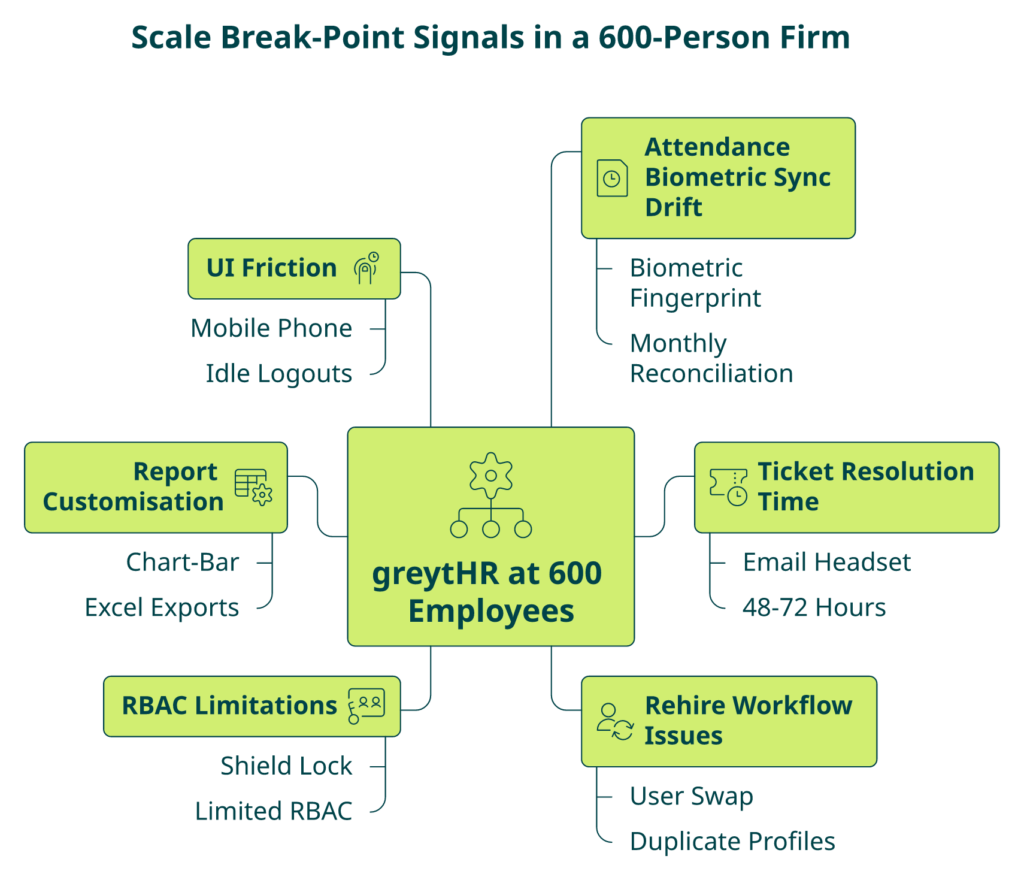
⚠️ The Complications That Stack Up
These are the patterns Ritu’s team hits, almost all of which show up repeatedly on G2 and Gartner Peer Insights.
- Attendance biometric sync drift between devices and the cloud, requiring monthly reconciliation.
- Tickets resolved over 48 to 72 hours on email-only support at the lower tiers.
- No clean rehire workflow, interns cannot be converted to FTE (Full-Time Employee) without a manual duplicate-profile dance.
- Limited multi-OU (Organisational Unit) RBAC (Role-Based Access Control), HR heads of each entity see more than they should.
- Reports customisation capped, finance reconciliation needs Excel exports.
- UI friction, idle logouts during shift-marking, confusing tab labels, and the mobile app lagging the web.
The review pattern is consistent across the 1-to-3-star band.
“I had high expectations for the greytHR app, but it has been quite disappointing. Simple tasks, like logging attendance or approving leaves, take longer than they should due to the app freezing or failing to load data. The mobile app lacks key functionality compared to the web version.”
— Shreeya V., HR User greytHR – G2 Verified Review
“GreytHR is not much good at customising based on our requirements. From implementation onwards, there were issues with leave balance and all. Many times we were manually correcting the leave balance of employees.”
— Verified User, IT Services greytHR – G2 Verified Review
❌ The Scale Threshold: When greytHR Starts to Crack
Across the buyers we have onboarded who switched off greytHR, three signals predict the break-point almost every time.
- Headcount crossing 500 employees with variable pay (incentives, commissions, and shift allowances) becoming non-trivial.
- Two or more legal entities on the roster, with different PF trusts, leave policies, or state PT rules.
- A factory or field-force unit joining the company that needs shift rosters, geo-fenced attendance, and overtime calculations at scale. Teams in this category often benchmark against our workforce management capability.
When all three show up, admins start running parallel spreadsheets. That is the real signal. The product has not broken. The operating model has.
What Buyers Typically Move To
The migration pattern we see is specific. Single-entity 200-to-500-person SaaS and IT services firms usually evaluate Keka for UX polish. Manufacturing, healthcare, and multi-entity services firms at 500-plus usually evaluate HROne for the 127 pre-built workflows, Super Inbox, multi-legal-entity RBAC, and ROI Dashboard, with our manufacturing HR and healthcare HR playbooks covering the sector-specific depth. Enterprise firms at 1,500-plus with APAC exposure often shortlist Darwinbox alongside HROne. The decision is rarely about features. It is about whether the HR team can stop reconciling at month-end.
Q8. How Does greytHR Compare to Keka, Zoho People, Darwinbox, and HROne in 2026?
The Comparison in One Paragraph
greytHR wins on SMB payroll and statutory depth at a friendly entry price. Keka wins on UX polish for 100-to-500-person SaaS firms. Zoho People wins for Zoho-stack startups. Darwinbox wins on brand and breadth at 1,500-plus employees. HROne wins when a 100-to-5,000-person Indian firm needs a connected hire-to-retire operating system with India-first payroll, One AI Suite, ROI Dashboard, and go-live-billing. The right answer is almost always scenario-specific, and the top 10 HR software India shortlist is a useful cross-reference.
How to Read the Table
The criteria below are weighted for Indian mid-market buyers (100 to 2,000 employees) with multi-state, multi-entity, and compliance-heavy realities. G2 scores are on the 10-point scale used for category rankings.
| Criterion | greytHR | Keka | Zoho People | Darwinbox | HROne |
|---|---|---|---|---|---|
| G2 Ease of Use | 9.0 | Mid-band | Mid-band | Mid-band | 9.5 |
| G2 Ease of Setup | 8.7 | Low-mid | Mid-band | Low-mid | 9.5 |
| G2 Quality of Support | 8.7 | Low-mid | Low-mid | Mid-band | 9.6 |
| India payroll depth | High | Medium-High | Medium | Medium | High |
| Multi-legal-entity RBAC | Limited | Medium | Limited | High | High |
| AI maturity | FAQ layer | FAQ and polish | Basic | Policy retrieval | Task closure (One AI Suite) |
| PEPM cost band | Low | Mid | Low | High | Mid |
| Go-live speed | 30 to 60 days | 45 to 90 days | 30 to 60 days | 90 to 180 days | 30 to 45 days |
| Billing model | From purchase | From purchase | From purchase | From purchase | From go-live |
Scenario-Based Recommendations
- Pick HROne when you are a 100-to-5,000-person Indian firm, multi-state or multi-entity, and need Super Inbox task closure, 127 pre-built workflows, India’s first inbuilt ROI Dashboard, and go-live-based billing. MR DIY India went live in 30 days and cut payroll cycles from 10 days to 5 to 6. The HROne vs greytHR page breaks down the axis-by-axis contrast.
- Pick greytHR when you are a single-entity SMB under 250 employees, payroll and statutory compliance is the dominant need, and UX modernity and multi-entity depth are not on the 12-month roadmap.
- Pick Keka when you are a 100-to-500-person SaaS or IT services firm that prizes UX polish and can absorb email-only support and a slower onboarding. The HROne vs Keka page covers the trade-offs.
- Pick Zoho People when you are a single-entity startup already invested in the Zoho stack, where native integration with Zoho Recruit and Zoho Payroll matters more than India-specific depth.
- Pick Darwinbox when you are a 1,500-plus employee Indian enterprise with APAC exposure, global brand optics matter for RFPs, and you can absorb a 90-to-180-day implementation. The HROne vs Darwinbox page maps the architectural gaps.
What Real Users Are Saying
Buyer experience varies sharply by platform. The pattern that shows up most often in competitor reviews is “promise at sale, pain at implementation.”
“We started working with Keka HRMS in August, and to this day, we have been unable to implement the tool in our company due to their consistently delayed responses and poor coordination between their internal teams.”
— Divya P., HR Lead Keka – G2 Verified Review
“Bad implementation experience, bad UI UX, configurations getting broken in production on its own due to product deployments, terrible customer service.”
— Verified User, Computer Software Darwinbox – G2 Verified Review
The comparison is not checklist vs checklist. It is which HRMS actually gets your HR team back to doing HR. Keep that as the decision lens when you run your own shortlist.
Q9. When Is greytHR the Right Choice, and When Should You Upgrade to a Full HCM Like HROne?
The 60-Word Decision Nugget
Choose greytHR when you run a single-entity Indian SMB under 250 employees, payroll and statutory compliance is the dominant need, and you are comfortable with a payroll-first HRMS. Upgrade to a full HCM like HROne when you cross 500 employees, add a second legal entity, run variable pay at scale, or need ROI visibility and task-closure AI. The trigger is operating complexity, not feature count.
The Three Buyer Realities on This Page
Most Indian HR leaders arrive at this review carrying scars from one of three operating realities. Knowing which one is yours is half the decision.
- ⭐ Reality One: The Single-Entity SMB. 50 to 250 employees, one Pvt Ltd, one or two states, salaried payroll, and low variable pay. greytHR fits here and often delights.
- ⚠️ Reality Two: The Mid-Market Mainstream. 250 to 1,000 employees, two or more entities, multi-state payroll, shift-based factory or field-force, and PMS and AI on the roadmap. greytHR begins to cap out, and the how to choose HRIS HRMS software checklist helps frame the move.
- ❌ Reality Three: The Frankenstein Stack. An outsourced payroll vendor, biometric attendance on one portal, an ATS, Excel for performance, paper expenses, and WhatsApp for everything else. Five vendors that do not talk. greytHR solves one slice and leaves nine on the HR manager’s plate.
The Upgrade Triggers You Can Score on a Friday
If three or more of these show up in your environment, you have outgrown a payroll-first HRMS.
| Trigger | Why It Matters |
|---|---|
| 500-plus employees | Workflow and RBAC depth becomes daily friction |
| 2 or more legal entities | Multi-PF trust, multi-policy, and multi-OU breaks single-tenant assumptions |
| 10-day payroll cycles | The symptom of reconciliation across disconnected systems |
| Variable pay above 15 percent of CTC | Incentive, commission, and shift allowance complexity stresses payroll engines |
| No ROI visibility | CHRO walks into board review without rupee-figure savings |
| AI stuck at FAQ layer | Assistant cannot close tasks, only answer questions |
| Expense leakage through manual receipts | No AI receipt parser, no spend discipline |
💰 The HROne Counter-Position for Reality Two and Three
Working with 2,000+ HR teams, what we have seen is this: when operating complexity outruns payroll-first tooling, the right move is a connected hire-to-retire operating system, not another best-of-breed point tool. HROne’s Super Inbox collapses 110 daily tasks into three-click closures from one screen. 127 pre-built workflows define who does what and by when across onboarding, confirmation, transfer, promotion, and exit, and the HR inbox walkthrough shows how the pattern plays out. India’s first inbuilt ROI Dashboard translates lifetime hours saved into rupee terms for the board, and the ROI calculator lets you benchmark savings before signing. Subscription meters only after go-live. A dedicated prior-HR SPOC (9.8 NPS) owns implementation instead of a technical project manager reading from a checklist, and the why HROne page frames the operating philosophy.
The proof is in the outcomes. The MRDIY case study documents a 30-day go-live and payroll cycles collapsing from 10 days to 5 to 6 days after consolidating. Asia Healthcare Holdings runs 20 pan-India units on a single instance with multi-legal-entity configuration. Appraisal cycles compress to 15 days with automated bell curves inside performance management. That is the difference between a payroll tool and a performance cockpit.
Outgrowing greytHR? See why mid-market India is switching to HROne.
#3 on G2 for customer satisfaction, 9.8 NPS HR SPOC, 127 pre-built workflows, and go-live billing instead of sticker billing. MR DIY India went live in 30 days and cut payroll cycles from 10 days to 5 to 6.
See HROne in 20 minutes Compare HROne vs greytHRWhat I’m Thinking About Next
My current thinking is that the next 24 months will separate “HRMS that digitised transactions” from “HCM that closes tasks.” The buyers who score their triggers honestly on a Friday, and act on Monday, will be the ones whose HR teams stop reconciling at month-end and start presenting ROI at the board. If you are sitting on three or more triggers, I would love to hear which one is costing you the most weekly.
Q10. greytHR 2026 FAQs: Ratings, Free Plan, Alternatives, and Migration Questions Answered
What is greytHR’s current G2 rating and review count?
greytHR holds roughly 4.4 out of 5 on G2 across approximately 1,254 verified reviews as of 2026. Strong ratings cluster around payroll automation, leave policy depth, and ESS (Employee Self-Service). Soft ratings cluster around UI modernity, mobile parity with the web, and support response times at the lower tiers. For a wider benchmark of category leaders, our top 10 HR software India shortlist is a useful cross-reference.
What is greytHR’s Gartner Peer Insights score?
greytHR carries approximately 280 verified reviews on Gartner Peer Insights in 2026. Module-level pattern: strong on payroll automation and statutory compliance, weaker on performance management, talent, and advanced reporting. Info-Tech SoftwareReviews separately tags cost-value at 82 with customer concerns under “Security Frustrates” and “Less Caring.”
Is there a free greytHR plan, and what is the employee cap?
Yes. greytHR offers a genuinely free plan for companies with 25 or fewer employees, covering Core HR, basic leave, attendance, and ESS. Paid tiers (Essential, Growth, and Premium) kick in above that threshold. Add-ons (PMS, Expense, and Recruit at ₹2,500 per recruiter per month) are priced separately on top.
At which plan tier does Navos AI show real value?
Navos AI sits across tiers as an assistant, with richer depth at Growth and Premium. Its sweet spot is single-entity, single-state ESS and policy Q&A. In my testing, three of ten multi-entity or FBP (Flexible Benefit Plan) prompts returned misleading outputs. Treat it as a FAQ deflection layer, not a task-closure layer. For the contrast, the employee AI agent inside HROne is designed to close tasks, not just answer them.
What data export formats does greytHR support on exit?
Excel and CSV for master data, attendance logs, payroll registers, and leave balances. Statutory filings export in EPFO ECR, ESIC, and TDS formats. Rebuilding policy rules, letter templates, and workflow configurations on a new platform typically takes 4 to 8 weeks of HR effort. Plan this migration line in the first week, not the last. Our best onboarding practices guide doubles as a migration sequencing playbook.
How long does a typical greytHR implementation take?
Single-entity under 250 employees: 30 to 60 days. 250 to 750 employees across multi-state or multi-entity: 60 to 120 days. The biggest time drains are leave-balance migration, attendance-device calibration, and policy configuration edge cases. Users echo the pain.
“It is user friendly. Many times we were manually correcting the leave balance of employees. We cannot properly implement our company policies due to the limitations of greytHR.”
— Verified User, IT Services greytHR – G2 Verified Review
What are greytHR’s support SLAs by tier?
Support depth scales with the plan. Essential is heavily email and ticket-based. Growth adds chat and faster SLAs. Premium includes phone support, which is where most buyers escalate during a payroll emergency. G2 reviewers flag ticket resolution stretching to 48 to 72 hours on lower tiers. Price the Premium support upgrade into your TCO (Total Cost of Ownership) from day one, and cross-reference the pricing page for a go-live-billing benchmark.
What are the best greytHR alternatives for 500-plus employee Indian firms?
The common 2026 shortlist: HROne (connected hire-to-retire OS with Super Inbox, 127 pre-built workflows, India’s first inbuilt ROI Dashboard, and go-live billing), Keka (UX-led mid-market HRMS), and Darwinbox (enterprise breadth for 1,500-plus employees). In our experience of onboarding buyers who switched off greytHR on complexity triggers, HROne has been the most frequent destination. The core HCM page covers the full module map.
Does greytHR handle multi-legal-entity setups cleanly?
Partially. greytHR can run multiple companies on one account, but OU (Organisational Unit) depth, RBAC (Role-Based Access Control) granularity, multi-PF-trust handling, and cross-entity reporting remain limiting for firms with three or more entities. Buyers at that complexity typically move to multi-entity-first platforms. Asia Healthcare Holdings, for instance, runs 20 pan-India units on a single HROne instance, and the healthcare HR playbook documents the configuration pattern.
Is greytHR GDPR and India DPDP compliant?
greytHR holds ISO 27001 certification and SOC 2 Type 2 attestation, with data-processing practices aligned to GDPR and the India DPDP (Digital Personal Data Protection) Act, 2023. Info-Tech reviewers still flag concerns under “Security Frustrates,” so a security addendum, access-log review, and named DPO contact should go into your contracting checklist. Our employee data privacy best practices guide covers the due-diligence checklist in detail.
References
Official Docs / Indian Statutes
- Ministry of Law and Justice, Government of India, “Digital Personal Data Protection Act, 2023,” Notified August 11, 2023.
- Ministry of Labour and Employment, Government of India, “The Code on Wages, 2019,” Notified August 8, 2019.
- Employees’ Provident Fund Organisation, “Electronic Challan-cum-Return (ECR) Filing Guidelines,” Published: ongoing circulars.
Blogs
- G2. “greytHR Reviews on G2.” Published: ongoing user reviews. [Secondary source]
- G2. “Keka Reviews on G2.” Published: ongoing user reviews. [Secondary source]
- G2. “Darwinbox Reviews on G2.” Published: ongoing user reviews. [Secondary source]
- Gartner. “Gartner Peer Insights: HCM Suites.” Published: ongoing reviews. [Secondary source]















 Secures Top Spot in
