


Q1. What Does “Budget HRMS” Actually Mean in India 2026, and Why Is the Sticker Price a Trap?
A budget HRMS in India in 2026 is not the one with the lowest monthly sticker. It is the one with the lowest 3-year cost of operation after you add implementation fees, per-module top-ups, integration charges, and the productivity you lose while HR chases managers across five tools. Cheap on day one often means expensive by month nine.
The moment the price tag stops mattering
A payroll manager at a 480-person logistics firm in Pune told me her Keka invoice looked clean on paper. Nine months later, she was still running parallel payroll on Excel because a biometric sync never stabilised, and the “support” thread had 37 emails and zero phone calls. That is the real unit economics of budget HRMS in India, not the ₹6,999 you saw on a comparison page.
Quick-glance: HROne, factoHR, Keka, Zimyo (2026)
| Vendor | Starting Price (India, 2026) | Best Size Fit | Best For | G2 Overall Satisfaction Rank | Free Trial / Demo |
|---|---|---|---|---|---|
| ⭐ HROne | Flat PEPM, billing starts post go-live | 100 to 5,000 employees | Mid-market and enterprise needing InboxForHR and ROI Dashboard | #3 globally across 1.17 lakh products | Demo + sandbox |
| factoHR | ~₹2,999/mo base + ₹20/emp (quote-led beyond 100) | 50 to 2,000 | Retirement-heavy, manufacturing, BFSI | Mid-pack | Demo |
| Keka | ₹6,999 to ₹13,999/mo + ₹60 to ₹130/addl emp | 50 to 500 | IT/ITES, tech startups | #55 on overall satisfaction | Demo |
| Zimyo | From ₹60/user/mo annual, quote-based above that | 50 to 1,000 | Scaling mid-market, localisation | Mid-pack | Demo |
The three scars every Indian HR buyer carries
✅ Scar one: paying for air during implementation. Most vendors bill from the day you sign. If implementation drags ten weeks, you have paid ten weeks for software nobody is using. HROne’s counter is simple, and in my view, should be the 2026 default: subscription meters only after go-live.
❌ Scar two: the per-module mirage. The base plan rarely includes what you actually need. Performance, OKRs, expense, ATS, BGV, and shift AI often sit in higher tiers. A “₹6,999” plan for a 120-person company becomes ₹18k+ once the real modules load.
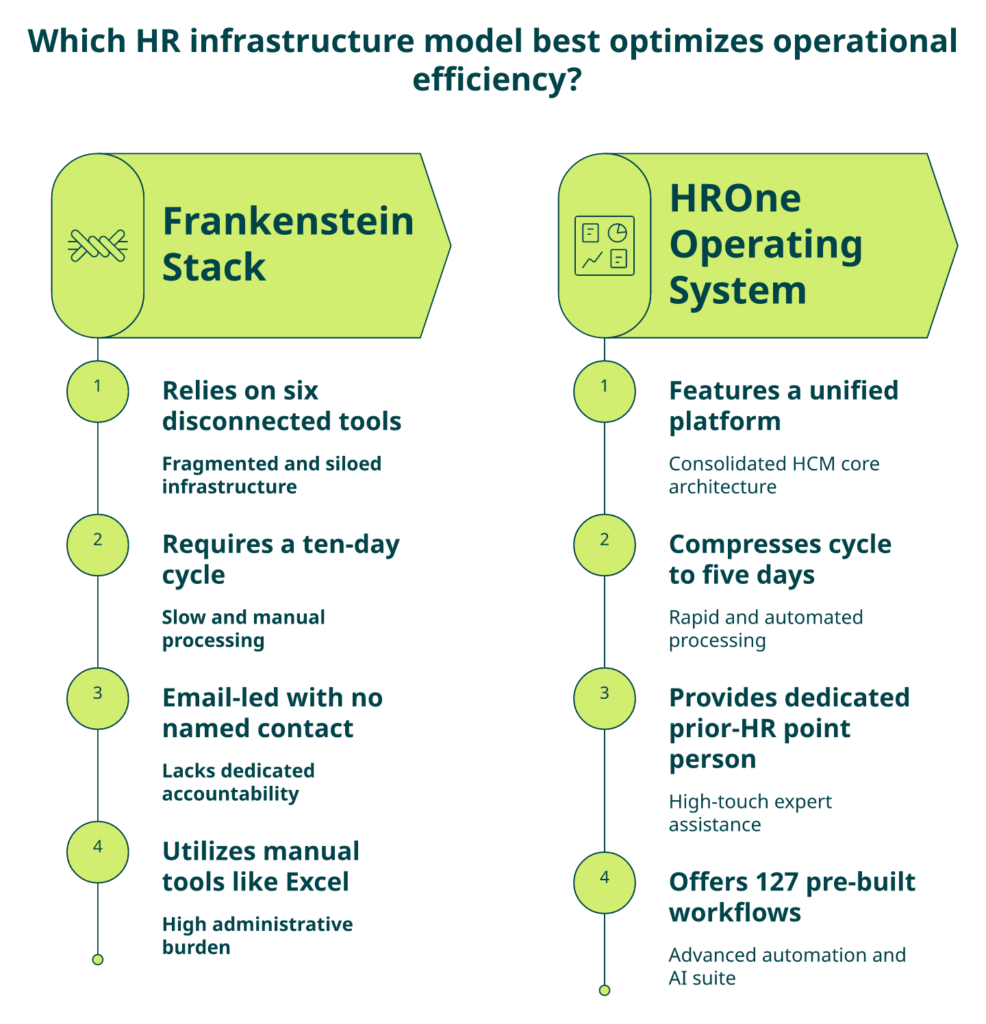
⚠️ Scar three: the Frankenstein stack. A 500-person firm juggling outsourced payroll, a biometric portal, a separate ATS, Excel for performance, and WhatsApp for everything else looks cheap on invoice and bleeds on reconciliation. MR DIY India cut payroll cycles from 10 days to 5 to 6 days only after consolidating on HROne.
The CFO question nobody answers
Here is the open loop I want you to carry into the next section: what is the 3-year ballpark saving, in rupees, of picking one of these four? List price cannot answer that. Cost of operation plus adoption ROI can, and you can model both using HROne’s ROI calculator. That is the real definition of budget HRMS in 2026.
“It is standard HRMS portal. Sometimes, they can or cannot change details as per client requirement.”
— Verified User in Research Keka – G2 Verified Review
Q2. factoHR, Keka, Zimyo: Who Are They, Who Do They Serve, and What Are Their Real Strengths and Weaknesses?
Four vendors dominate India’s budget HRMS conversation in 2026: HROne, factoHR, Keka, and Zimyo. They look similar on a feature grid and behave very differently the moment a multi-entity, shift-heavy, or compliance-dense reality shows up. Here is the honest profile of each, ordered by operating fit for Indian 100 to 5,000 employee teams.
HROne: the hire-to-retire operating system
⭐ HROne launched in 2016 with a sharp bet: stop digitising HR as transactions, start running it as an operating system. The result is the Super Inbox that collapses daily tasks into three-click closures, 127 pre-built hire-to-retire workflows, One AI Suite for resume relevancy and receipt parsing, India’s first inbuilt ROI Dashboard, and HRV Studio for no-code custom apps. 1,500+ brands run on it, including MR DIY India and Asia Healthcare Holdings (20 pan-India units on one instance). G2 puts HROne at #3 globally for overall satisfaction and in the top rungs for Ease of Setup, Ease of Admin, and Quality of Support.
“The InboxforHR is a game-changer, centralizing every HR task into one simple inbox, cutting down administrative time by 60 to 70%.”
— Waldon S. HROne G2 – Verified Review
factoHR: mobile-first, retirement-benefits depth
factoHR, founded in 1985 and scaling its cloud HCM post-2016, is a Surat and Ahmedabad anchored vendor with a mobile-first UX and unusually deep retirement benefits coverage (gratuity, superannuation, PF trusts). Strengths: statutory depth, manufacturing and BFSI fit, and an offline-tolerant mobile app. Weaknesses: pricing is quote-led beyond small plans, and first-time admins report a learning curve on report configuration. ICP is manufacturing, BFSI, and enterprises with retirement-benefits complexity. If retirement-benefits depth is your primary driver, compare architectures side-by-side on the HROne vs FactoHR page.
Keka: modern UX, fragile at scale
Keka, Hyderabad-based and founded 2015, won SMB share with a clean UI and an engagement layer recruiters genuinely liked. Strengths: employee-centric UX, OKRs, and hiring module. Weaknesses show up under pressure: email-threaded support, implementation drag, and a G2 overall satisfaction rank of #55 versus HROne’s #3. ICP is 50 to 500 employee IT/ITES and tech startups. For a head-to-head architecture view, see HROne vs Keka.
“We started working with Keka HRMS in August, and to this day, we have been unable to implement the tool in our company due to their consistently delayed responses and poor coordination between their internal teams.”
— Divya P., Verified User Keka – G2 Verified Review
Zimyo: localisation, affordability, complexity caps
Zimyo, Gurugram-based and founded 2018, serves 2,500+ customers with strong India localisation and a sharp entry price starting at ~₹60/user/mo on annual billing. Strengths: affordability for scaling teams, multilingual ESS, and engagement breadth. Weaknesses: pricing opacity for small teams, and configuration caps when multi-legal-entity or 1,000+ complexity appears. ICP is scaling mid-market between 50 and 1,000 employees. For a direct comparison, see HROne vs Zimyo.
What this means for you?
If you are 100 to 5,000 employees and running multiple legal entities, HROne is the hire-to-retire OS. If retirement benefits and manufacturing compliance dominate, factoHR deserves a look. If you are a 50 to 300 employee IT startup willing to live with email-only support, Keka’s UX is real. If you are a scaling mid-market firm that values localisation over deep configuration, Zimyo fits. None of that is checklist work. It is operating-model fit.
Q3. Why Is the ₹6,999 Base Price a Mirage, and How Do 2026 Pricing Tiers Really Stack Up Per Employee?
The ₹6,999 headline Keka price is for 100 employees on the Foundation tier, and it excludes performance, OKRs, hiring, and expense beyond basics. Add ₹60 per additional employee, then add the modules you actually need, then add implementation fees and integration charges. A 200-person company realistically lands between ₹18,000 and ₹28,000 per month on Keka, not ₹6,999. That is the mirage.

2026 pricing, side by side
| Tier | HROne | factoHR | Keka | Zimyo |
|---|---|---|---|---|
| Starter | Flat PEPM, go-live billing | ~₹2,999/mo base + ₹20/emp | ₹6,999/mo (100 emp) + ₹60/addl | From ₹60/user/mo annual |
| Growth | Flat PEPM, adds modules | Quote-led | ₹9,999/mo + ₹90/addl | Standard, quote-based |
| Enterprise | Flat PEPM, multi-entity | Quote-led | ₹13,999/mo + ₹130/addl | Enterprise, quote-based |
| Contract | No lock-in, post go-live billing | Annual, multi-year common | Annual, renewal escalations reported | Annual preferred for list price |
💰 My POV on the pricing mirage
Working with 2,000+ HR teams, what I have felt is that the real invoice has four layers nobody surfaces: implementation fees billed upfront, per-module add-ons for performance and ATS, integration charges for biometric and Tally or ERP syncs, and annual renewal escalations that quietly stretch 8 to 15%. Budget HRMS buyers price the first layer and get surprised by the other three. Contract exits add a fifth layer: data export fees and notice periods that extend the bleed by a quarter. For a primer on why transparent HR software pricing matters, read the breakdown.
✅ HROne’s counter on pricing psychology
Two design choices matter here. First, HROne bills a flat per-employee-per-month price with no hidden per-entity charges, so a 20-unit firm like Asia Healthcare Holdings pays for employees, not for legal entities. Second, subscription meters only after go-live. If implementation takes 30 days (MR DIY India shipped in 30), you pay for 30 days, not 90. That single change removes the “paying for air” scar and realigns vendor incentives to ship fast. See the full breakdown on the HROne pricing page.
“I love HROne for its cost efficiency and holistic approach, which is why I prefer it over other vendors like Workday.”
— Priyanka S. HROne G2 – Verified Review
⚠️ Contract flexibility and exit clause check
Before you sign anything, read three clauses: the lock-in period (many Indian mid-market contracts still carry 24 to 36 months), the annual renewal escalator (cap it at single digits), and the data export SLA (ask for a full export in CSV or SQL within 15 days at no extra charge). On Keka, verified users have flagged migration pain and inflexible customisation. Build the exit before you build the onboarding.
Want pricing without the surprise line items?
HROne publishes a flat per-employee-per-month price, bills only after go-live, and ships with no hidden per-entity charges. See the full breakdown for your headcount.
See HROne Pricing →Q4. Which Platform Handles Indian Payroll, Multi-Entity, and State-Wise Statutory Compliance Without Breaking?
HROne leads on multi-legal-entity configuration, state-wise PT and LWF coverage, and DPDP Act 2023 posture because policy changes happen on the HR front-end without a developer ticket. factoHR is strong on retirement benefits and statutory filing. Keka covers core PF, ESI, TDS, and Form 24Q well, but customers flag inflexibility on location-specific rules. Zimyo covers standard statutes but caps at deeper multi-entity configuration. For a deeper compliance primer, see statutory compliance in payroll.
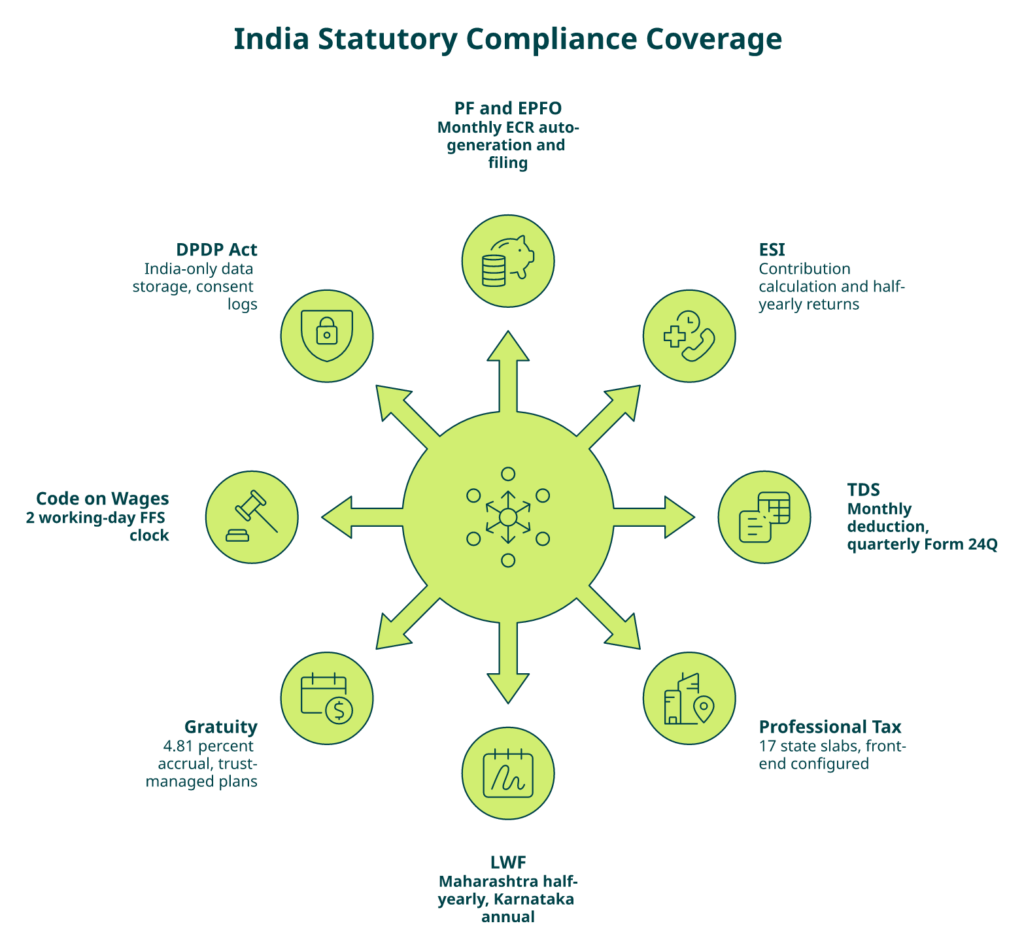
The 12-point India compliance rubric (2026)
| Compliance Dimension | ⭐ HROne | factoHR | Keka | Zimyo |
|---|---|---|---|---|
| PF (EPFO ECR, UAN) | ✅ Auto | ✅ Auto | ✅ Auto | ✅ Auto |
| ESI (ESIC, Form 5) | ✅ Auto | ✅ Auto | ✅ Auto | ✅ Auto |
| TDS + Form 24Q | ✅ Auto | ✅ Auto | ✅ Auto | ✅ Auto |
| PT state-wise (MH, KA, TN, WB, GJ) | ✅ Front-end config | ✅ | ⚠️ Ticket-led | ⚠️ Ticket-led |
| LWF (all applicable states) | ✅ Auto | ✅ Auto | ⚠️ Partial | ⚠️ Partial |
| Gratuity (Payment of Gratuity Act) | ✅ Auto | ✅ Deep | ✅ Auto | ✅ Auto |
| Code on Wages 2019 | ✅ Auto | ✅ Auto | ✅ Auto | ✅ Auto |
| Two-day FFS (new wage code) | ✅ | ⚠️ | ⚠️ | ⚠️ |
| Multi-legal-entity OU | ✅ Single instance, 20+ units | ✅ | ⚠️ | ⚠️ |
| FBP and CTC revisions | ✅ Self-serve | ✅ | ✅ | ⚠️ |
| DPDP Act 2023 posture | ✅ India data residency | ✅ | ✅ | ✅ |
| Shops & Establishment filings | ✅ Configurable | ✅ | ⚠️ | ⚠️ |
What each statute actually demands
- PF: monthly ECR upload to EPFO by the 15th, UAN generation and KYC seeding, and pensionable wage cap reconciliation.
- ESI: contribution filing by the 15th, Form 5 half-yearly returns, and wage-limit threshold management for the ₹21,000 cap. See ESI contribution calculation.
- TDS and Form 24Q: quarterly e-TDS return, Form 16 issuance by June 15, and reconciliation with Form 26AS.
- Professional Tax: rates and slabs differ across Maharashtra, Karnataka, Tamil Nadu, West Bengal, and Gujarat. Tamil Nadu is half-yearly, Maharashtra is monthly above ₹10,000, and Karnataka slab resets annually. The full state-wise PT slab reference is a useful bookmark.
- LWF: Maharashtra (June, December), Karnataka (annual), Tamil Nadu (annual), and Delhi (bi-annual). Missing a cycle means penalty interest.
- Code on Wages 2019: redefines “wages” to include 50% of CTC for PF and gratuity calculations, and mandates two-working-day FFS.
🔒 DPDP Act 2023 and data residency
The Digital Personal Data Protection Act 2023 reshapes how HR tech handles employee data in India. Ask each vendor four questions: where is primary data stored, what is the breach notification SLA, what consent artefacts exist for employee onboarding, and what is the data export and deletion process at exit. HROne, factoHR, Keka, and Zimyo all operate India data residency. The differentiation shows up in consent artefacts and exit data portability, where HROne’s self-serve export model is ahead. For baseline hygiene, see employee data privacy best practices.
My POV on compliance depth
In our experience of rolling HROne out for 20-unit pan-India enterprises like Asia Healthcare Holdings, the compliance gap nobody shows on a comparison page is state-wise S&E and LWF configurability from the HR front-end. On most budget HRMS, changing a Maharashtra LWF cycle means a ticket, a wait, and a developer. On HROne, it is a policy setting an HR manager configures in 10 minutes. That is the difference between a compliance feature and a compliance system.
“Proper calculation of PF and ESI was a pain area for us before, but now with the HROne automated calculation process, results are up to the mark and following Indian tax compliances properly.”
— Ajay K. HROne G2 – Verified Review
Filing PT, LWF, and ESIC across multiple Indian states?
HROne’s payroll engine configures multi-legal-entity rules and state-wise compliance from the HR front-end. No ticket, no developer. See how it handles 20+ pan-India units on one instance.
Explore HROne Payroll →Q5. How Do Attendance, Leave, Shift, and Mobile ESS Compare Across HROne, factoHR, Keka, and Zimyo?
For distributed teams, shift-heavy operations, and field sales, HROne leads on real-time biometric sync, geo-fenced selfie punch with liveness detection, and three-click leave approvals from the Super Inbox. factoHR is strongest on offline-tolerant mobile attendance for manufacturing plants. Keka delivers a clean ESS UX, but verified users flag Bengaluru-specific location rule configuration limits. Zimyo covers basics well but caps on shift rostering above 800 employees. For a deeper primer on the category, see the attendance management definitive guide.
The three-layer reality nobody writes about
Attendance in 2026 is not a biometric machine anymore. It is three layers stitched together, and budget HRMS platforms usually win only the first.
- Capture layer: biometric punch, selfie with liveness detection, GPS, web punch, and offline capture.
- Policy layer: shifts, rosters, state-wise holiday calendars, leave accruals, and carry-forward and encashment rules.
- Approval layer: manager workflows, regularisation requests, exception handling, and audit trail.
A vendor that wins capture but loses policy leaves your HR team configuring rules on call with a CSM for six weeks. A vendor that wins policy but loses approvals leaves your regional managers chasing HR on WhatsApp. If you are formalising rules right now, start with attendance policy implementation practices.
Feature matrix: attendance, leave, shift, mobile ESS
| Capability | ⭐ HROne | factoHR | Keka | Zimyo |
|---|---|---|---|---|
| GPS punch with geo-fence, radius configurable | ✅ | ✅ | ✅ | ✅ |
| Selfie punch with liveness detection | ✅ | ✅ | ✅ | ⚠️ Basic |
| Biometric API real-time sync | ✅ Live | ✅ | ⚠️ Periodic | ⚠️ Periodic |
| Shift AI + bulk roster edit | ✅ | ✅ | ✅ | ⚠️ Caps above 800 emp |
| State-wise leave accrual, carry-forward | ✅ Self-serve | ✅ | ✅ | ✅ |
| State holiday calendar auto-apply | ✅ | ✅ | ⚠️ Ticket-led | ✅ |
| Mobile ESS Android + iOS parity | ✅ | ✅ | ⚠️ Admin gaps | ⚠️ Gaps |
| Offline attendance capture | ✅ | ✅ | ❌ | ❌ |
| Three-click approval inside inbox | ✅ Super Inbox | ❌ | ❌ | ❌ |
A Bengaluru IT firm scenario, walked end to end
Take a 420-person hybrid IT services firm with two offices in Bengaluru and a sales bench across Mumbai, Pune, and Hyderabad. Monday 9:47 a.m., a sales lead punches in at a client site on the HROne mobile app with geo-fenced selfie. At 10:15 a.m., her manager sees one approval card in the Super Inbox and closes it in two taps. Same scenario on Keka typically involves a periodic biometric sync, a separate leave configuration ticket for location-specific rules, and a manager chasing exceptions over email. For a city-specific rollout lens, see HR software Bangalore.
“The UI of Keka is very intuitive and easy to navigate, but I was trying to configure menstrual leave only for Bangalore location and needed some help, the chat was not at all helpful.”
— Verified User in Consulting Keka – G2 Verified Review
“The best part about HROne is its mobile application because marking attendance with geofencing is extremely smooth and accurate.”
— Priti D. HROne G2 – Verified Review
What this means for you?
In every vendor demo, test three things with your own data, not their sandbox. First, ask to configure a Bengaluru-only leave type in under 10 minutes. Second, time the delay between a biometric punch and the HR dashboard updating. Third, log in as a regional manager and approve 20 exceptions, then count the clicks. If any of those three fail, the adoption will fail. For an architecture view, compare HROne attendance management and leave management.
Q6. Who Wins on Performance, OKRs, Recruitment, Onboarding, Engagement, Expenses, and Analytics?
HROne wins on the connective tissue across performance, recruitment, onboarding, engagement, expenses, and analytics because every module triggers the next through the Super Inbox and 127 pre-built workflows. Keka leads on employee-engagement UX for IT startups. factoHR is strong on structured annual reviews for manufacturing. Zimyo covers the basics for scaling mid-market. Only HROne ships India’s first inbuilt ROI Dashboard.
The governing claim
Budget HRMS platforms win module-by-module feature checklists and lose on the handoffs between modules. A great OKR module (OKR means Objectives and Key Results, the goal-setting framework popularised at Google) that does not trigger payroll incentives is a spreadsheet with better fonts. The real mid-market question is whether the system closes the loop from manpower requisition to FFS (Full and Final Settlement) with proof of ROI attached.
Pillar 1: Performance, OKRs, and 360 reviews
All four vendors cover goals, annual reviews, and 360 feedback. HROne compresses appraisal cycles to 15 days with automated bell curves and triggers confirmation letters or PIP letters straight from the review outcome. Keka’s performance module has a clean UI, but verified users flag it as confusing, which hits adoption hard. For context on why cycles should get shorter, read continuous feedback vs annual reviews. If you are evaluating the category, HROne’s performance management module is worth a direct look.
“PMS module is confusing and needs to be simpler and easier to use. LMS module needs improvement to be more user-friendly and useful.”
— Kiran B. Keka – G2 Verified Review
Pillar 2: Recruitment, ATS, and AI hiring
HROne’s One AI Suite stacks relevant CVs on top instead of relying on keyword filters, auto-generates JDs, and parses resumes with a relevancy score. Keka Hire is solid for IT/ITES pipelines and integrates well with job boards. factoHR covers sourcing-to-offer workflows. Zimyo’s ATS handles basics but lacks AI ranking depth. For a primer on what shifts when AI enters hiring, see AI automation in recruitment.
Modules comparison at a glance
| Module | ⭐ HROne | factoHR | Keka | Zimyo |
|---|---|---|---|---|
| Performance + OKRs + 360 | ✅ 15-day cycle, auto letters | ✅ | ⚠️ UX flagged | ✅ |
| Recruitment + ATS + AI CV stack | ✅ One AI Suite | ✅ | ✅ Keka Hire | ⚠️ Basic |
| Onboarding checklist + asset tracking | ✅ 127 workflows | ✅ | ✅ | ✅ |
| Offboarding + 2-day FFS | ✅ Workflow-chained | ⚠️ Manual | ⚠️ Manual | ⚠️ Manual |
| Engagement + pulse + recognition | ✅ | ✅ | ✅ Strong | ✅ |
| Expense + AI receipt parser | ✅ Receipt OCR | ✅ | ⚠️ Print/export gaps | ✅ |
| HR analytics + ROI Dashboard | ✅ India’s first ROI Dashboard | ⚠️ Basic | ⚠️ Basic | ⚠️ Basic |
Pillar 3: Onboarding, offboarding, and FFS
HROne’s onboarding process checklist splits tasks department-wise so IT, Admin, and HR each know what they own on day 1 to day 7. FFS runs to the new two-working-day rule under the Code on Wages 2019. Keka and factoHR handle onboarding well. FFS speed is where the architecture gap shows, because most budget platforms still run FFS as a manual multi-step process outside any workflow engine.
“HROne has ease the process of new joiners onboarding and induction process, with onboarding checklist functionality, it is very easy to define department wise work and HR head can easily track the stage of completion in just one click.”
— Ajay K. HROne G2 – Verified Review
Pillar 4: Engagement, expense, and analytics
Keka’s engagement surveys and peer recognition are genuinely strong for IT startups. HROne’s differentiator is the receipt parser that reduces expense fraud at manual touchpoints, plus the ROI Dashboard that calculates lifetime hours saved against average HR salary so CHROs walk into the board with a rupee number, not a narrative. factoHR and Zimyo cover analytics but do not instrument ROI natively.
Pick one metric your CHRO gets asked about every quarter (attrition rate, time-to-hire, payroll accuracy, or expense TAT) and ask every vendor to show you that exact metric live on day 1 of their dashboard, with your own industry benchmarks layered in. If the answer needs a ticket, a consultant, or six weeks of setup, the analytics are decorative.
Q7. What Does Switching-Cost Math Look Like, Implementation, Data Migration, and 3-Year TCO?
Switching-cost math for a 200-person firm, across three years, lands between ₹8 lakh and ₹22 lakh depending on the vendor. Implementation fees, data migration from greytHR or SAP or Excel, parallel payroll runs, and change-management time matter more than the monthly sticker. HROne’s 30-day go-live plus post-go-live billing compresses the real cost more than any per-employee discount. For a sanity check on common mistakes, skim HRIS buyer pitfalls.
Priya’s day 90
Priya, HR Ops Lead at a 220-person SaaS firm in Bengaluru, signed Keka in July expecting a 6-week go-live. It is now October, parallel payroll is running on Excel for the third month, leave balances migrated from greytHR are 8% off, and the support channel is a 47-email thread with a CSM she has not spoken to on the phone. Billing has run since day one. That is the switching-cost scar this section exists to prevent.
The complication, unpacked
Three things break quietly in Indian HRMS implementations. First, biometric mapping against employee IDs when the old system used a different schema. Second, leave balance migration when accrual rules differ. Third, CTC structure import when the old system stored components the new one does not recognise. Budget HRMS vendors typically expect the customer to clean the data. HROne assigns a prior-HR SPOC who has done this work before, which is why the 9.8 NPS holds up. For the underlying logic on CTC structures, see CTC breakup calculation format.
Implementation reality, vendor by vendor
| Vendor | Typical Go-Live (100 to 500 emp) | Support Model | Data Migration Pain Points |
|---|---|---|---|
| ⭐ HROne | 30 days (MR DIY India benchmark) | Dedicated prior-HR SPOC, 9.8 NPS, phone + email | Structured migration from greytHR, SAP, and Excel |
| factoHR | 4 to 8 weeks | Dedicated CSM | Retirement benefits mapping well-handled |
| Keka | 6 to 10 weeks (verified user reports of drag) | Email-led, chat | Migration and customisation flagged |
| Zimyo | 3 to 6 weeks | CSM on higher tiers | Multi-entity mapping gaps |
3-year TCO model, 200 employees
| Cost Bucket (₹, 3 years) | ⭐ HROne | factoHR | Keka | Zimyo |
|---|---|---|---|---|
| Subscription (PEPM x 36 months) | 10,80,000 (est.) | 8,64,000 (est.) | 14,40,000 (Growth tier) | 9,00,000 (est.) |
| Implementation fee | Included or phased | 50,000 to 1,00,000 | 75,000 to 1,50,000 | 40,000 to 80,000 |
| Add-on modules (perf, ATS, expense) | Flat (bundled) | Variable | 2,00,000 to 4,00,000 | 1,00,000 to 2,00,000 |
| Integrations (Tally, biometric, BGV) | Marketplace | Variable | 50,000 to 1,00,000 | 50,000 |
| Parallel-run payroll cost (HR time) | Minimal (30-day go-live) | Moderate | High (6 to 10 weeks) | Moderate |
| Renewal escalation (yr 2, yr 3) | Capped | 8 to 12% | 10 to 15% | 8 to 10% |
| 3-year TCO band | ₹11L to ₹14L | ₹10L to ₹13L | ₹18L to ₹22L | ₹11L to ₹14L |
💸 My POV on switching-cost math
Working with 2,000+ HR teams, what I have felt is that the hidden line item nobody prices is HR team hours during parallel run. A 200-person firm typically burns 120 to 180 HR hours across a 6 to 10 week implementation. At an average HR Ops cost of ₹800 per hour, that is ₹96,000 to ₹1,44,000 of invisible cost. Compress the go-live to 30 days, and that bucket drops by half. That is why MR DIY India’s 30-day go-live matters more than any per-employee discount. You can sanity-check your own numbers using the ROI calculator.
“I love HROne for its cost efficiency and holistic approach. The initial setup process was smooth, thanks to the supportive team that helped configure everything according to our needs.”
— Priyanka S. HROne G2 – Verified Review
“We started working with Keka HRMS in August, and to this day, we have been unable to implement the tool in our company due to their consistently delayed responses and poor coordination between their internal teams.”
— Divya P. Keka – G2 Verified Review
Before signing anything, ask the vendor three questions in writing: (1) guaranteed go-live date with a penalty if missed, (2) named SPOC with phone number, and (3) data migration ownership (who cleans the legacy export). If any answer is vague, the TCO will blow through your model.
Want a go-live plan built around your payroll cycle?
HROne ships with a dedicated prior-HR SPOC, flat PEPM billing that starts only after go-live, and a 30-day benchmark already delivered at MR DIY India. See how the plan lands on your headcount and state footprint.
Book a Demo →Q8. How Do Integrations, AI Automation, and Scalability Hold Up From 50 to 10,000 Employees?
HROne holds sub-500ms response times from 50 to 10,000 employees on a single instance with multi-legal-entity support, ships One AI Suite natively for resume parsing, goal creation, and receipt OCR, and offers a marketplace for ERP, BGV, and LMS integrations. Keka and factoHR scale well up to ~2,000 employees. Zimyo fits 50 to 1,000 comfortably. Above 2,000 employees, the architecture gap between HROne and the rest widens visibly. See the full HROne integrations surface for the current marketplace.
Integrations matrix (2026)
| Integration | ⭐ HROne | factoHR | Keka | Zimyo |
|---|---|---|---|---|
| Slack + MS Teams + O365 | ✅ | ✅ | ✅ | ✅ |
| Tally, QuickBooks, Zoho Books | ✅ JV + GL code logic | ✅ | ⚠️ Oracle sync flagged | ✅ |
| ERP (SAP, Oracle, Dynamics) | ✅ API + marketplace | ✅ | ⚠️ | ⚠️ |
| Biometric hardware (Matrix, eSSL, ZKTeco) | ✅ Real-time API | ✅ | ⚠️ Periodic | ⚠️ Periodic |
| BGV (SpringVerify, AuthBridge, IDfy) | ✅ Marketplace | ✅ | ✅ | ⚠️ |
| LMS + Payroll gateway + SSO/SAML | ✅ | ✅ | ✅ | ✅ |
⭐ AI and automation depth
HROne’s One AI Suite ships four native capabilities: resume relevancy scoring, AI JD and interview generators, receipt parser with OCR, and an AI Employee Agent for FAQ deflection. The value is not feature-count. It is that the AI triggers workflows. A parsed resume goes into the recruiter pipeline, a scanned receipt closes an expense claim, and a generated JD becomes a requisition. Keka offers automation around attendance and payroll but without a unified AI suite. factoHR is building AI modules iteratively. Zimyo leans on chatbots for ESS queries. For a sober read on the category, see AI in HR, hype vs reality.
Scalability stress-test (single instance, 2026)
| Employee Count | ⭐ HROne | factoHR | Keka | Zimyo |
|---|---|---|---|---|
| 50 employees | Sub-500ms | Smooth | Smooth | Smooth |
| 500 employees | Sub-500ms, multi-unit | Smooth | Smooth | Smooth |
| 2,000 employees | Sub-500ms, multi-entity OU | Handles well | Enterprise score dip reported | Configuration caps emerge |
| 10,000 employees | Asia Healthcare Holdings benchmark, 20 pan-India units, one instance | Quote-led | Mid-market ceiling | Not typical ICP |
What this means for you?
Two integration questions matter more than the rest for a mid-market Indian HR team. First, can the HRMS push a salary JV to Tally or SAP as a single file that your accounts team can post without manual rekeying? Second, does biometric hardware sync in real-time or in 15-minute batches? Both determine whether payroll close is a 2-day task or a 5-day task. For scalability, ask to see the system’s response time with a full production-size employee dataset loaded, not a sandbox of 50 records. For CHRO-level framing, see CHRO solutions.
Q9. What Do Real G2 Reviews and Customer Voices Say About Support, UX, and Adoption?
Across verified G2 reviews, HROne ranks #3 globally for overall satisfaction out of 1.17 lakh software products, with 9.5 on Ease of Use, 9.5 on Ease of Setup, and 9.6 on Quality of Support. Keka sits at #55 for overall satisfaction, with 9.2 on Ease of Use, 8.6 on Setup, and 8.7 on Support. factoHR and Zimyo cluster in the mid-pack on review volume and satisfaction. For a broader view, see HROne customer success stories.
Headline G2 satisfaction deltas (2026)
| Metric (out of 10) | ⭐ HROne | Keka | factoHR | Zimyo |
|---|---|---|---|---|
| Overall Satisfaction rank | #3 globally | #55 | Mid-pack | Mid-pack |
| Ease of Use | 9.5 | 9.2 | ~8.8 | ~8.7 |
| Ease of Setup | 9.5 | 8.6 | ~8.5 | ~8.5 |
| Quality of Support | 9.6 | 8.7 | ~8.6 | ~8.5 |
| Support model | Dedicated prior-HR SPOC, 9.8 NPS | Email-led | CSM-led | CSM-led |
The Keka review pattern nobody highlights
Low-star and mid-star Keka reviews cluster around three recurring themes: support on email threads only, data migration drag, and location-specific configuration gaps. These are operating-model gaps, not UI gaps. For a neutral read on buyer traps, see HRIS buyer pitfalls.
“Despite multiple follow-ups, the lack of proper support and communication from Keka has made the entire process frustrating and ineffective. What was supposed to be a seamless solution for our HR needs has turned into a time-wasting ordeal.”
— Divya P. Keka – G2 Verified Review
“From Friday evening 6PM to Monday morning 10Am there is no source of support from KEKA, Telephonic communication to a POC during emergency is not possible.”
— Prem K. Keka – G2 Verified Review
Where HROne users feel the difference
HROne reviews cluster around centralisation that reduces admin, a dedicated support relationship, and mobile adoption that requires no training. These match the three things every CHRO asks about in an RFP. A deeper look at the platform sits under InboxForHR.
“The InboxforHR is a game-changer, centralizing every HR task into one simple inbox, cutting down administrative time by 60 to 70% and preventing tasks from falling through the cracks.”
— Waldon S. HROne G2 – Verified Review
“I really like the reminder feature in HRone. The system itself sends reminder to me to complete them on time. Experience excellent support from team.”
— Bindu P. HROne G2 – Verified Review
Named customer outcomes with rupee-level impact
- ⭐ MR DIY India (HROne, retail, 100+ stores): consolidated off a fragmented payroll, biometric, and Excel stack, went live in 30 days, collapsed payroll cycles from 10 days to 5 to 6 days, recovered an estimated 4 to 5 HR FTE-days per payroll cycle. Read the full MR DIY case study.
- ⭐ Asia Healthcare Holdings (HROne, healthcare, 20 pan-India units): runs 20 units on a single HROne instance with multi-legal-entity configuration and state-wise PT, LWF, and minimum wage rules, removing the need for 20 separate instances.
- Keka SMB story (IT services, 100 employees): strong UI satisfaction, flagged six-month implementation drag and policy configuration delays for Bangalore-specific leave types.
- Manufacturing group on factoHR: consolidated PF trust administration and retirement benefits onto a single HCM, citing statutory depth as the single biggest driver of the shortlist decision.
- Zimyo D2C mid-market story: a 350-employee direct-to-consumer brand adopted Zimyo for localisation and engagement breadth, then requested heavier configuration support as multi-entity needs grew past 600 employees.
What this means for you on Monday
Do not read the first page of G2. Read the 2-star and 3-star reviews. The ceiling of a product is what delighted users say. The floor is what frustrated users say, and the floor is where your 200 employees will actually live for the next three years.
Q10. Which HRMS Fits Your Industry: IT/ITES, Manufacturing, Retail, BFSI, Healthcare, D2C, or Remote-First?
Industry fit beats size-bucket fit every time for Indian mid-market HR teams. A 400-person auto-components plant in Pune does not operate like a 400-person SaaS firm in Bengaluru, and the HRMS should bend around each reality. Here is the honest read across HROne, factoHR, Keka, and Zimyo, one vertical at a time, ending with a single test you can run in your next demo.
IT/ITES: hybrid, FBP, and mid-year CTC revisions
IT/ITES teams live on FBP (Flexible Benefit Plan, the tax-efficient salary components employees self-declare) and frequent mid-year CTC revisions after promotions or retention offers. HROne lets an HR executive push a bulk CTC revision with automatic arrear recalculation and FBP self-declaration from the employee ESS. Keka’s UI is popular here, though verified users flag location-specific policy drag. Verdict: ⭐ HROne for 250+ employees with multi-entity, Keka for 50 to 250 IT startups that can absorb email-led support. For the vertical view, see ITES HR.
Manufacturing: shift, multi-unit, minimum wage variance
Manufacturing lives on shift rosters, unit-wise minimum wage variance across states, and LWF cycles that hit at different months. A Maharashtra plant files LWF in June and December. A Karnataka plant files annually. HROne configures all of this as an OU (Operating Unit, a legal-entity container with its own rules) on a single instance, the way Asia Healthcare Holdings runs 20 pan-India units. factoHR wins on PF trust and gratuity depth. Verdict: ⭐ HROne for multi-unit manufacturers, factoHR for plants with heavy retirement-benefits complexity. More at manufacturing HR.
Retail: distributed, GPS, high attrition
Retail needs real-time GPS punch with configurable geo-fence radius (outlets vary from 500 to 2,000 metres), fast onboarding to absorb 8 to 12% monthly attrition, and bulk FFS (Full and Final Settlement) runs on the 2-working-day clock under the Code on Wages 2019. MR DIY India collapsed its payroll cycle from 10 days to 5 to 6 days after consolidating on HROne in a 30-day go-live. Verdict: ⭐ HROne for multi-outlet chains, Zimyo for single-brand D2C up to 500 employees. See retail HR.
BFSI: audit trail, RBAC, SSO
BFSI demands RBAC (Role-Based Access Control, where a branch manager sees only their branch’s data), SSO with the bank’s identity provider, immutable audit logs for every payroll approval, and DPDP Act 2023 data residency in India. HROne ships RBAC, SSO (SAML and OAuth), and India-only data storage. factoHR has deep BFSI customer presence. Verdict: ⭐ HROne for 500+ employee BFSI with multi-branch, factoHR for NBFCs and co-operative banks. More context at finance HR.
Healthcare: 20+ units, multi-state, 24×7 shifts
Hospital groups run 10 to 30 units across states with different S&E (Shops and Establishments) filings, night-shift allowances, and nurse rostering cycles. Asia Healthcare Holdings on HROne, running 20 pan-India units on one instance with multi-legal-entity configuration, is the clearest benchmark. Verdict: ⭐ HROne for hospital groups and chain clinics. See healthcare HR.
D2C and startups: agility, affordability, CAC pressure
Under-100 employee D2C brands live on runway discipline. Zimyo’s ₹60/user/mo entry and Keka’s UX play well here, and setup is quick. Above 200 employees, multi-city warehouse shifts and FFS complexity appear, and the budget architecture shows caps. Verdict: Zimyo or Keka under 100 employees, ⭐ HROne once you cross 150 to 200. For early-stage teams, see startup launchpad.
Remote-first and distributed workforces
Remote-first teams need offline attendance capture (fieldwork in low-network Tier-3 towns), GPS selfie punch with liveness, and three-click Super Inbox approvals from a regional manager’s phone. HROne’s offline attendance sync is a genuine differentiator for this persona. Verdict: ⭐ HROne for remote-first teams above 100 employees across multiple cities. Background reading: remote hybrid attendance.
The Industry-fit test
Ask every vendor to name one live customer in your exact industry, your exact headcount band, and at least two of your state footprints. If they cannot name one in 30 seconds, they are selling a feature list, not a fit.
Q11. How Should You Score These HRMS Platforms, a 10-Criteria Buyer Rubric You Can Run On Monday?
Run every HRMS RFP through a 10-criteria rubric with weighted scores out of 100. The rubric forces your buying committee (CHRO, CFO, IT, Payroll Manager) to agree on what matters before a demo biases the conversation. Score each vendor on a 1 to 10 scale, multiply by weight, and the highest weighted total wins. For a related checklist, see how to choose HRIS HRMS software.
The 10 criteria, with weights
| # | Criterion | Weight | What to score |
|---|---|---|---|
| 1 | Pricing transparency and 3-year TCO | 12% | Flat PEPM, post go-live billing, renewal cap |
| 2 | India statutory compliance depth | 14% | State-wise PT, LWF, PF, ESI, TDS, Code on Wages 2019 |
| 3 | Payroll engine accuracy and multi-entity | 12% | FFS, group payouts, multi-legal-entity OU |
| 4 | Attendance and shift flexibility | 10% | Real-time biometric, GPS, selfie, roster AI |
| 5 | Performance, OKRs, and recruitment AI | 10% | Review cycle speed, CV stacking, JD generation |
| 6 | Implementation speed and SPOC model | 12% | Go-live in days, dedicated prior-HR SPOC |
| 7 | Support SLA (phone, email, and chat) | 8% | 24-hour response, dedicated CSM, regional language |
| 8 | Scalability (50 to 10,000 employees) | 8% | Single-instance multi-unit, response time |
| 9 | Analytics and ROI instrumentation | 8% | Dashboards, ROI Dashboard, board-ready exports |
| 10 | UX and adoption (mobile ESS and admin) | 6% | Three-click approvals, mobile parity, training need |
⭐ Scored rubric across the four vendors (2026)
| Criterion (Weight) | ⭐ HROne | factoHR | Keka | Zimyo |
|---|---|---|---|---|
| Pricing transparency (12%) | 9.0 | 7.0 | 7.5 | 7.5 |
| Compliance depth (14%) | 9.5 | 9.0 | 8.0 | 7.5 |
| Payroll engine (12%) | 9.5 | 9.0 | 8.5 | 8.0 |
| Attendance flexibility (10%) | 9.5 | 8.5 | 8.0 | 7.5 |
| Performance + AI recruitment (10%) | 9.5 | 7.5 | 8.5 | 7.5 |
| Implementation + SPOC (12%) | 9.5 | 8.0 | 7.0 | 8.0 |
| Support SLA (8%) | 9.6 | 8.0 | 7.5 | 7.5 |
| Scalability (8%) | 9.5 | 8.5 | 8.0 | 7.5 |
| Analytics + ROI Dashboard (8%) | 9.5 | 7.0 | 7.5 | 7.0 |
| UX + adoption (6%) | 9.0 | 8.5 | 9.0 | 8.5 |
| Weighted total (out of 100) | 93.7 | 81.9 | 79.4 | 76.9 |
Tie-breaker criteria for close calls
⏰ If two vendors land within 3 points of each other, break the tie on three questions, in order. First, guaranteed go-live date with penalty, because every week of drag is ₹15k to ₹25k in HR hours. Second, named SPOC with phone number, not a ticket queue. Third, data export SLA at contract exit, because the exit clause is the true measure of vendor trust. Sanity-check your assumptions with the ROI calculator.
Run this rubric with your CFO and IT head in the same room before you sit through another demo. Score from evidence, not from vendor slides. The rubric turns a vibes-led decision into a 30-minute spreadsheet conversation, and that alone is worth the exercise.
Q12. factoHR vs Keka vs Zimyo vs HROne: Which Should You Actually Pick for Your Company Size?
Pick on fit, not on vendor brand. For 100 to 5,000 employee Indian firms with multi-entity, multi-state, or shift-heavy reality, HROne is the clearest operating-system fit. factoHR is the manufacturing and BFSI retirement-benefits pick. Keka suits 50 to 250 IT startups with tolerance for email-led support. Zimyo is the localisation-forward choice for scaling D2C and service firms up to 500 employees. For direct head-to-heads, see HROne vs Keka, HROne vs FactoHR, and HROne vs Zimyo.
Before and after: the operating reality shift
❌ Before (Frankenstein stack): outsourced payroll vendor, biometric portal, separate ATS, Excel for performance, paper expenses, and WhatsApp for everything. 10-day payroll cycle, zero board-ready ROI number, and HR chasing managers on email.
✅ After (HROne as operating system): one Super Inbox closing 110+ daily tasks in three clicks, 127 pre-built workflows, One AI Suite on recruitment and expenses, India’s first inbuilt ROI Dashboard, 30-day go-live, and flat PEPM billing only after go-live. Explore the full platform on the HR software page.
Final verdict by company size (2026)
| Company Size | ⭐ Primary Pick | Strong Alternatives | Not Recommended For |
|---|---|---|---|
| 10 to 50 employees | Zimyo or Keka (budget-led) | factoHR | HROne unless multi-entity |
| 50 to 250 employees | ⭐ HROne (if multi-entity or shift) | Keka (if IT-only, tolerant of email support) | Zoho People above 100 |
| 250 to 1,000 employees | ⭐ HROne | factoHR (manufacturing, BFSI) | Keka above 500 due to enterprise score dip |
| 1,000 to 5,000 employees | ⭐ HROne | Darwinbox, SAP SF (global footprint needs) | Zimyo above 1,000, Zoho People above 500 |
Verdict for high-compliance industries and remote-first teams
For high-compliance industries (BFSI, healthcare, pharma, and manufacturing) that need multi-state PT, LWF, and gratuity depth plus DPDP Act 2023 posture, ⭐ HROne and factoHR are the defensible picks. For remote-first and distributed workforces above 100 employees that need GPS selfie punch, offline attendance, and three-click mobile approvals, ⭐ HROne is the clearest fit. Persona-level framing sits under CHRO solutions.
Honest “not recommended for” lines
- HROne: not the cheapest choice for a 10 to 40 employee pre-seed startup that only needs payroll and basic attendance.
- factoHR: not ideal for IT/ITES teams prioritising clean modern UX over statutory depth.
- Keka: not the fit if phone-based support and fast implementation are non-negotiable.
- Zimyo: not a comfortable fit above 1,000 employees with multi-legal-entity complexity.
Tell us what you’re building, we’ll show you the HROne fit.
No scripted demo. A 30-minute working session with an HROne product expert on your payroll cycle, your state-wise compliance, and your go-live plan.
Start the Conversation →What I’m thinking about next
My current thinking is that the “budget HRMS” category as we know it dissolves over the next 24 months. The winning platforms in 2027 will not be priced on per-employee-per-month. They will be priced on outcomes: payroll-cycle days shaved, HR hours reclaimed, and attrition points recovered. India’s first inbuilt ROI Dashboard is an early signal of that shift. I am curious which HR leaders will push their vendors to sign outcome-linked SLAs first, because that is the contract model that ends the Frankenstein stack for good. If you are running a 200 to 2,000 employee team and piloting outcome-based HRMS pricing, I would love to hear what you are testing.
References
Official Docs / Indian Statutes
Ministry of Labour and Employment, Government of India, “Code on Wages 2019 and subsequent rules on two-day full and final settlement,”
Ministry of Electronics and Information Technology, “Digital Personal Data Protection Act 2023,”
Blogs
HROne. “Product documentation, customer case studies (MR DIY India, Asia Healthcare Holdings), G2 satisfaction rankings.” Published: 2025-2026. [Secondary source]
FinancesOnline and TechnologyCounter. “factoHR vs Keka pricing and feature comparison sheets.” Published: 2024-2026. [Secondary source]
SoftwareSuggest and Zimyo official pricing. “Keka vs Zimyo comparison, 2026.” [Secondary source]
G2. “Keka G2 verified reviews compilation.” Published: 2022-2026. [Secondary source]
HROne. “Product documentation on Time Office, Super Inbox, mobile ESS, biometric API, and integrations.” Published: 2024-2026. [Secondary source]
G2. “Verified Keka user reviews on attendance, performance, support, and integrations.” Published: 2022-2025. [Secondary source]
HROne. “One AI Suite, ROI Dashboard, 127 hire-to-retire workflows, MR DIY India and Asia Healthcare Holdings customer outcomes.” Published: 2024-2026. [Secondary source]
FinancesOnline. “Keka pricing tiers (Foundation ₹6,999, Strength ₹9,999, Growth ₹13,999) and renewal context.” Published: 2024. [Secondary source]
Zimyo. “Plans and pricing reference.” Published: 2026. [Secondary source]
HROne. “Product documentation, G2 rankings, Super Inbox, 127 hire-to-retire workflows, One AI Suite, ROI Dashboard, MR DIY India and Asia Healthcare Holdings customer outcomes.” Published: 2024-2026. [Secondary source]
G2. “Verified Keka user reviews on support, implementation, and configuration.” Published: 2021-2025. [Secondary source]















 Secures Top Spot in
