


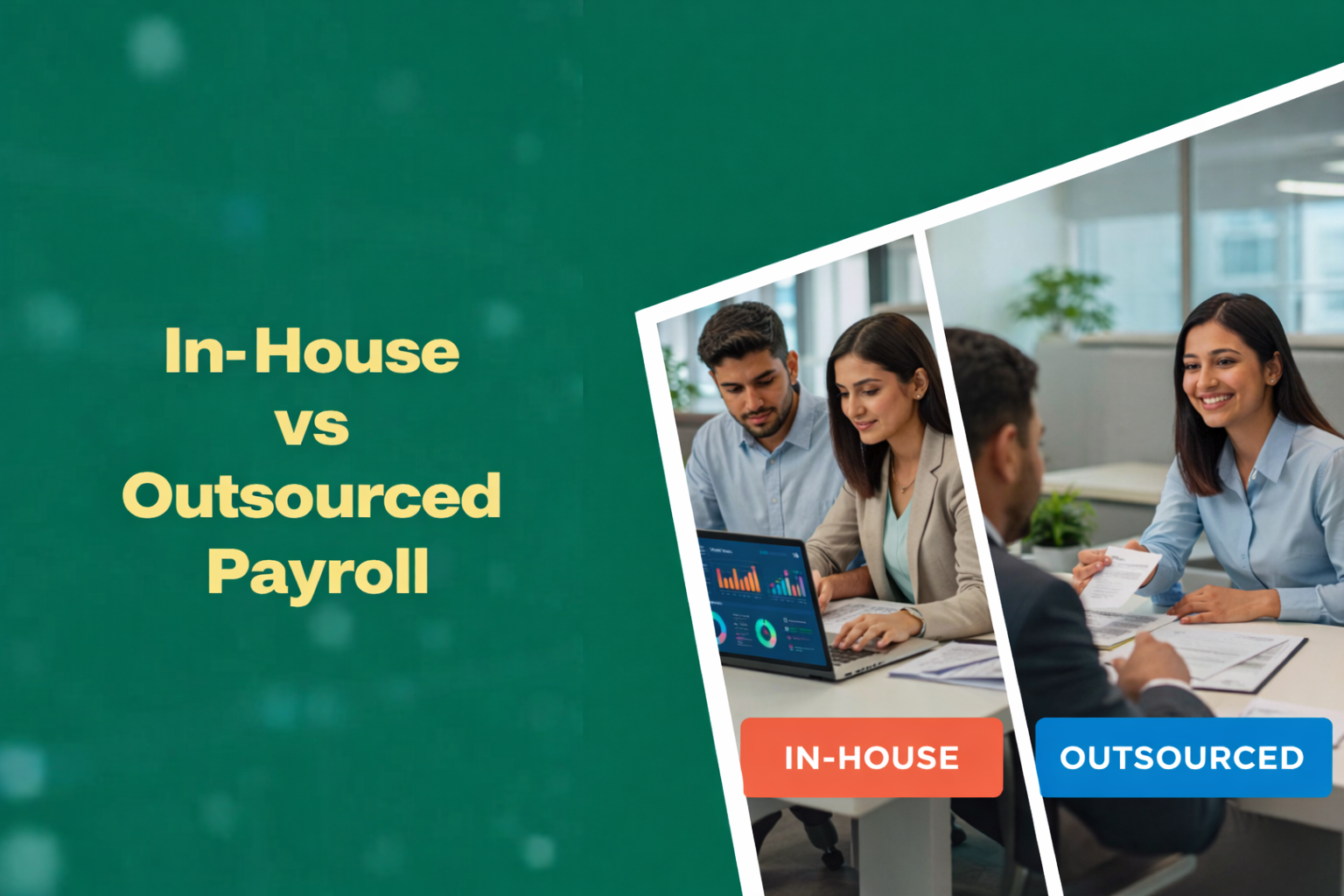
In house payroll vs outsourced payroll services in 2026 isn’t just a finance question anymore. It’s become a strategic call that affects everything from employee satisfaction to your company’s growth trajectory.
I’ve watched HR teams spend countless hours on salary calculations, only to miss a single PF deadline and face penalties that wipe out months of savings. And I’ve seen outsourced setups where businesses lost touch with their own compensation data entirely.
The truth? Both approaches have evolved dramatically. New labour codes are finally getting implemented across Indian states. Cloud payroll software has become surprisingly affordable.
And outsourcing providers now offer AI-driven accuracy that was science fiction five years ago. Your choice between keeping payroll internal or handing it off depends on factors that have shifted significantly.
The wrong decision could cost you lakhs. The right one could free up your HR team to actually focus on people.
Understanding In House Payroll vs Outsourced Payroll Services in 2026
Before comparing costs or compliance burdens, you need clarity on what each model actually involves today. The definitions from 2020 don’t apply anymore. Both options have transformed in ways that matter.
In house payroll means your organisation handles every aspect of salary processing internally. You own the software, employ the specialists, maintain the data, and carry full responsibility for accuracy and compliance.
Outsourced payroll services involve transferring some or all of these functions to an external provider. They use their technology, their expertise, and their processes to manage your employee payments.
But here’s what’s changed. The line between these two options has blurred considerably. Hybrid models are everywhere now.
Some companies run basic payroll internally while outsourcing statutory compliance. Others use external providers for processing but keep control of data and approvals.
What In House Payroll Management Looks Like in 2026
Running payroll internally in 2026 requires more than spreadsheets and a dedicated accountant. Modern in house operations typically include:
- Cloud-based payroll software with automatic tax calculations
- At least one full-time payroll specialist for every 200-300 employees
- Integration capabilities with HRMS, attendance, and accounting systems
- Regular training budgets for compliance updates
- Data security infrastructure meeting current standards
The technology has become more accessible. Indian payroll platforms like HROne now offer enterprise-grade features at SMB pricing. But accessibility doesn’t mean simplicity.
You still need people who understand the Employees’ Provident Fund rules, gratuity calculations under the new wage code, and state-specific professional tax variations.
I’ve worked with companies where the CFO thought buying payroll software meant the job was done.
Six months later, they were dealing with incorrect TDS deductions because nobody updated the tax slab configurations after the budget announcement. The software is a tool. You still need skilled hands to operate it.
How Outsourced Payroll Services Have Evolved for 2026
Outsourced payroll in 2026 looks nothing like the batch-processing services of the past decade. Today’s providers offer:
- Real-time salary processing with same-day corrections
- AI-powered anomaly detection that flags errors before they happen
- Direct integration with client HRMS and attendance systems
- Dedicated compliance teams monitoring regulatory changes across states
- Employee self-service portals for payslips and tax declarations
- Guaranteed accuracy with financial penalties for provider errors
The big shift has been transparency. Earlier, outsourcing meant sending data into a black box and hoping the outputs were correct. Now, dashboards give you visibility into every calculation. You can verify before approval, not after problems surface.
Pricing models have diversified too. Per-employee-per-month remains common, but you’ll also find transaction-based pricing, tiered packages based on complexity, and even outcome-based arrangements where providers share penalty liability.
Cost Comparison: In House Payroll vs Outsourced Payroll Services in 2026
Money talks. And when you’re choosing between in house payroll and outsourced services, the numbers need to be clear. But most cost comparisons miss half the picture.
They look at software fees versus provider quotes and call it analysis. Real cost comparison requires examining everything you’ll actually spend.
True Cost of Running In House Payroll Operations
Let me break down what in house payroll actually costs for a mid-sized Indian company with 500 employees.
Direct Costs (Annual)
- Payroll software subscription: ₹3,00,000 to ₹6,00,000
- Payroll team salaries (2 specialists): ₹12,00,000 to ₹18,00,000
- Training and certification: ₹50,000 to ₹1,00,000
- IT infrastructure allocation: ₹1,00,000 to ₹2,00,000
Hidden Costs (Often Overlooked)
- HR manager time spent on payroll oversight: 15-20% of salary
- Finance team time for reconciliation and audits: 10% of relevant salaries
- Compliance penalty risk: Variable, but one missed deadline can cost ₹50,000+
- Error correction and re-processing: Staff time plus potential employee dissatisfaction
- Opportunity cost: What else could your HR team achieve without payroll burden?
For a 500-employee organisation, realistic annual in house payroll costs range from ₹20,00,000 to ₹30,00,000 when you count everything. That’s ₹333 to ₹500 per employee per month.
The number gets better with scale. A 2,000-employee company might spend ₹200 per employee monthly because software costs don’t rise proportionally. But complexity increases too. More employees mean more edge cases, more queries, and more scope for errors.
Pricing Models for Outsourced Payroll Services in 2026
Outsourced payroll pricing in India currently follows three main structures:
Per Employee Per Month (PEPM) Most common model. Current rates range from ₹80 to ₹250 per employee depending on service scope and provider reputation.
Basic processing sits at the lower end. Full service with compliance management and employee helpdesk reaches the higher range.
Flat Monthly Fees Some providers offer fixed monthly charges regardless of headcount, typically for smaller organisations. You might see ₹25,000 to ₹75,000 monthly for companies under 200 employees.
Tiered Packages Providers bundle services into Bronze, Silver, Gold type packages. Basic tiers cover salary calculation and disbursement. Premium tiers add statutory compliance, tax filing, and dedicated support.
Cost Comparison Table
| In House Payroll | Outsourced Payroll | |
|---|---|---|
| Per Employee Monthly Cost (500 employees) | ₹333-500 | ₹80-250 |
| Setup/Implementation | Software purchase + training | Usually free or nominal |
| Compliance Liability | 100% on company | Shared with provider |
| Growth Cost | New hires, system upgrades | Automatic, per-employee |
| Hidden Costs | High (time, opportunity, risk) | Low to moderate (coordination) |
The pure numbers often favour outsourcing for companies under 1,000 employees. But cost isn’t the only factor. Control, data security, and strategic importance matter too.
Compliance and Risk Management: In House vs Outsourced Solutions
Here’s where payroll gets genuinely complicated. Indian payroll compliance in 2026 involves the new labour codes, multiple state-level regulations, frequent rule changes, and serious penalties for mistakes.
Whether you manage payroll internally or outsource, compliance failures create real consequences.
Handling 2026 Payroll Regulations with In House Teams
The regulatory environment has intensified. Your in house team needs to track:
- The Code on Wages and its state-specific implementations
- Revised EPF contribution rules and ceiling changes
- ESIC applicability criteria and rate adjustments
- Professional tax variations across every state where you have employees
- TDS calculations under current income tax slabs
- Gratuity provisions under the Social Security Code
Keeping up requires dedicated attention. One compliance specialist I know spends the first two hours of every Monday just reading government notifications and circulars. That’s what it takes.
The risk profile for in house payroll is straightforward. Any error, any delay, any misinterpretation falls entirely on your organisation. Late EPF deposits attract 12% annual interest plus penalties.
TDS non-compliance can trigger prosecution under the Income Tax Act. And disgruntled employees can file complaints that invite labour department inspections.
Your mitigation options include regular internal audits, external compliance reviews, and comprehensive documentation.
Some companies hire statutory compliance consultants to supplement their in house teams. That adds cost but reduces exposure.
How Outsourced Payroll Services Handle Compliance in 2026
The compliance proposition is a major selling point for outsourced providers. They offer:
- Dedicated teams monitoring regulatory changes nationwide
- Automatic software updates when rules change
- Pre-processing compliance checks before every payroll run
- Guaranteed on-time statutory deposits
- Support during audits and inspections
- Indemnity clauses for errors caused by provider negligence
But let me be clear about what shared liability actually means. Most provider contracts include indemnification for their mistakes.
If they calculate PF wrong or miss a deposit deadline due to their error, they cover the penalties. If your data was incorrect, or you delayed approvals, or you modified their calculations, the liability shifts back to you.
Read the fine print carefully. The best outsourcing relationships have crystal-clear responsibility matrices. You know exactly what they own and what you own. Ambiguity in compliance responsibilities is worse than handling everything yourself.
One area where outsourcing genuinely excels is multi-state compliance. If you have employees across Maharashtra, Karnataka, Tamil Nadu, and Delhi, each state has different professional tax slabs, different deposit frequencies, and different return formats.
Managing this internally requires expertise in every jurisdiction. Providers already have that knowledge systematised.
Growth Capacity and Flexibility: Choosing Between In House Payroll and Outsourced Services
Your payroll needs today won’t match your needs in three years. Growth, contraction, geographic expansion, workforce composition changes. All of these affect payroll complexity. The right choice accommodates your trajectory, not just your current state.
Scaling In House Payroll for Business Growth
Scaling in house payroll hits predictable friction points:
At 200-300 Employees Your single payroll person becomes overwhelmed. Error rates increase. Processing takes longer. You need a second specialist.
At 500-700 Employees Software that worked fine for a smaller team starts showing limitations. You face an upgrade decision. Often, this means changing platforms entirely because your starter software doesn’t scale.
At 1,000+ Employees You need a payroll manager, not just specialists. Processes require documentation. Audit trails become critical. The function needs its own budget line and reporting structure.
Multi-Location Expansion Opening offices in new states means understanding entirely different compliance requirements. Your Bangalore-trained team may not know West Bengal professional tax rules. Each new jurisdiction adds complexity.
The challenge isn’t just adding resources. It’s maintaining quality while adding resources. New team members need training. New software needs configuration. Every transition period creates error risk.
Flexibility Advantages of Outsourced Payroll Services in 2026
Outsourced payroll scales differently. The mechanics work in your favour:
Instant Headcount Flexibility Adding 50 employees? Your monthly cost increases proportionally, but no new hires or training required on your end. Reducing workforce? Costs drop immediately. No severance considerations for payroll staff.
Geographic Expansion Entering a new state or even a new country? Established providers already have the expertise. You don’t build new capabilities. You activate existing ones.
Seasonal Variations Retail companies with festive hiring, agriculture businesses with harvest-season staff, hospitality operations with tourist-season fluctuations. All of these benefit from payroll capacity that adjusts to demand without fixed costs.
M&A Situations Acquiring a company with different payroll systems? Your provider handles integration. The complexity falls on their expertise, not your limited time during an already chaotic period.
The flexibility argument strongly favours outsourcing for companies with unpredictable growth or variable workforce needs. If your headcount is stable and you’re not expanding geographically, the growth advantage matters less.
Making the Right Choice Between Payroll Modes: Decision Guide for 2026
Enough theory. Let’s get practical about when each approach makes sense for your specific situation.
Use Cases of When In House Payroll Makes Sense
You should seriously consider keeping payroll internal if:
- You have 1,500+ employees concentrated in one or two states. At this scale, dedicated payroll teams become cost-efficient. Geographic concentration simplifies compliance.
- Your compensation structure is highly complex. Multiple incentive schemes, variable pay components tied to individual performance metrics, frequent mid-cycle adjustments. These require contextual understanding that external providers may lack.
- Payroll data confidentiality is strategically critical. Senior executive compensation, equity details, confidential retention bonuses. If leakage risk feels unacceptable, internal control provides more comfort.
- You have strong existing HR technology. If your HROne HRMS handles attendance, leave, and employee data exceptionally well, adding their payroll module creates smooth integration without external dependencies.
- Your HR team wants to own the function. Skilled HR professionals often prefer controlling payroll rather than coordinating with external providers. Motivation and ownership matter for quality.
Use Cases of When Outsourced Payroll Services Are the Better Choice
Outsourcing makes more sense when:
- You have under 500 employees. The cost math typically favours providers at this scale. You get expertise without full-time hiring.
- You’re growing rapidly. Adding 30-50% headcount annually? Outsourcing handles growth without internal scaling challenges.
- Your HR team is small or stretched. If you have three HR generalists managing everything from recruitment to engagement, taking payroll off their plate lets them focus on higher-impact work.
- You operate across multiple states. Multi-jurisdiction compliance is where providers deliver genuine expertise advantage.
- You’ve had compliance issues. Past penalties, audit findings, or employee complaints suggest internal capabilities need strengthening. Outsourcing provides immediate capability upgrade while you decide on longer-term solutions.
- Your industry has unique payroll requirements. Construction sector piece-rate payments, IT sector multi-currency compensation, healthcare sector shift differentials. Providers with industry specialisation handle these better than generic internal processes.
How to Decide Your Payroll Mode ? [Decision Checklist]
- What’s your employee count and projected growth?
- How many states do you operate in?
- What’s your HR team’s current capacity?
- Have you faced compliance penalties in the past two years?
- How complex is your compensation structure?
- What’s your realistic budget for payroll operations?
- How important is direct control versus convenience?
Answer these honestly. The right choice usually becomes obvious.















 Secures Top Spot in
