


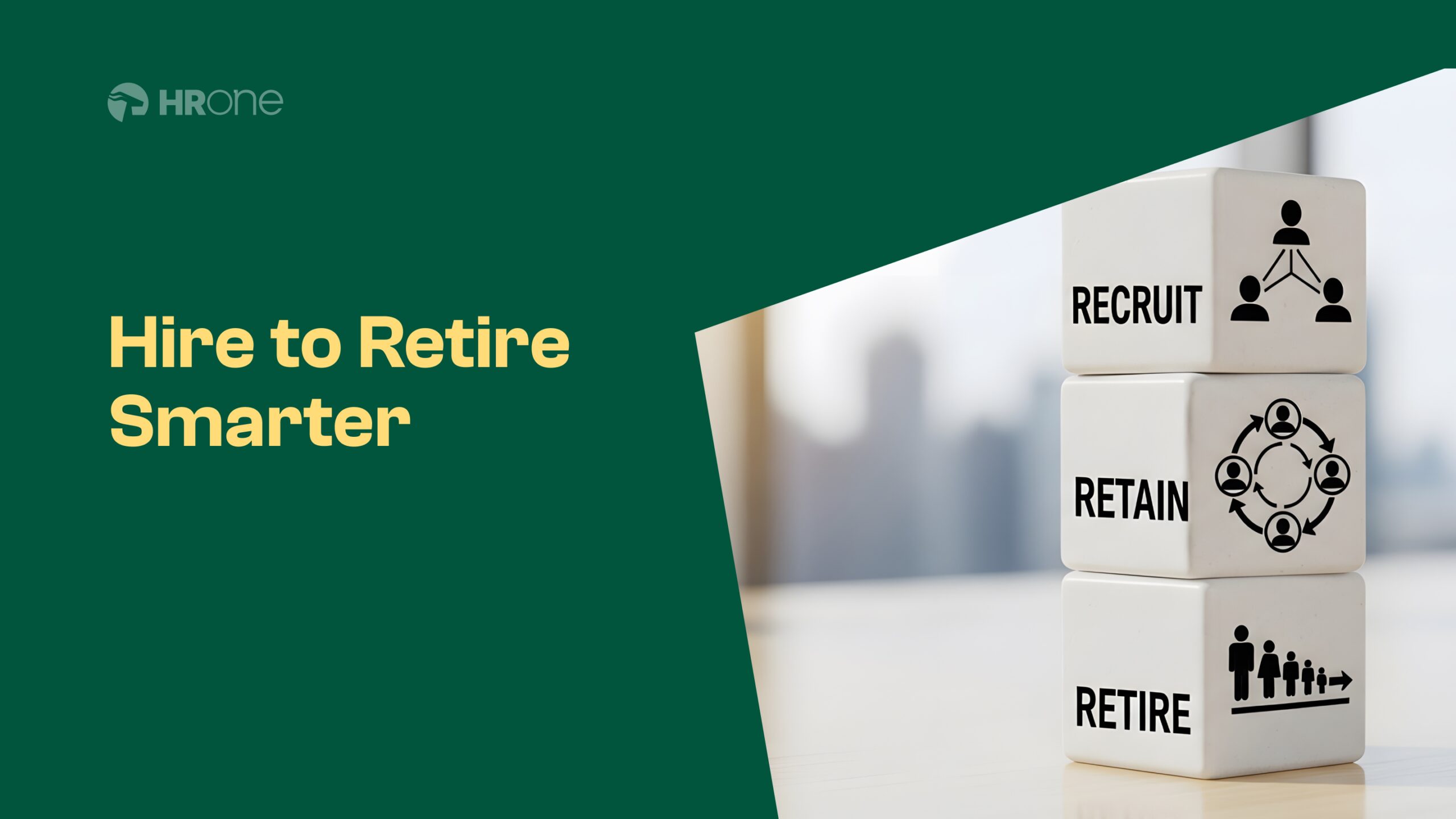
The hire to retire journey breaks down when HR teams juggle seven different HR software tools that don’t talk to each other.
I’ve watched HR managers at mid-sized Indian companies spend entire mornings just reconciling attendance data with payroll systems. And that’s before tackling the actual people problems. The truth is, most organizations treat each HR function as a separate island.
Recruitment lives here. Payroll lives there. Performance management? Somewhere in between.
This fragmentation creates gaps where employees fall through, data gets lost, and compliance risks multiply. What if your entire employee lifecycle operated from one intelligent system?
The difference isn’t just efficiency. It’s the ability to actually focus on your people instead of wrestling with spreadsheets.
Understanding the Hire to Retire Journey in Modern Organizations
The hire to retire journey covers every interaction between an employee and your organization.
It starts the moment a candidate applies and ends when they collect their final settlement. Between those two points lies onboarding, training, performance reviews, promotions, transfers, benefits administration, and eventually separation.
Traditional HR approaches treat each stage as an independent process. Recruitment teams have their ATS. Payroll runs on separate software. Learning management sits in another silo altogether.
This creates three major problems for Indian organizations:
- Data doesn’t flow between systems. When someone gets promoted, you’re manually updating multiple databases.
- Employee experience suffers. New hires fill out the same information four times during their first week.
- Compliance becomes a nightmare. Tracking statutory requirements across disconnected systems increases error rates.
Key Stages of the Employee Lifecycle
Your employee lifecycle includes these distinct phases:
- Talent acquisition and recruitment
- Offer management and pre-boarding
- Onboarding and orientation
- Performance management and goal setting
- Learning and development
- Compensation and benefits administration
- Career progression and internal mobility
- Separation and offboarding
Each stage generates data. Each stage affects employee engagement. And each stage presents compliance requirements specific to Indian labor laws. When these stages operate in isolation, you lose visibility into the complete employee experience.
The companies winning the talent war aren’t just hiring better. They’re managing the entire employee journey as one connected experience.
Kiran Mazumdar-Shaw, Executive Chairperson, Biocon
How Intelligent HRMS Transforms Recruitment and Onboarding
Recruitment and onboarding set the tone for everything that follows. Get this wrong, and you’re fighting an uphill battle for the next several years. Get it right, and you’ve built a foundation for genuine engagement.
Intelligent HRMS platforms change these early stages through automation and integration. Here’s what shifts:
AI-powered screening reduces time-to-hire by automatically ranking candidates against job requirements. No more manually reviewing 500 resumes for a single position.
Automated interview scheduling eliminates the back-and-forth emails. Candidates pick slots. Calendars sync. Done.
Digital offer management speeds acceptance. Candidates receive, review, and sign offers through mobile devices. No printing. No scanning. No delays.
Pre-boarding workflows engage new hires before day one. Document collection, policy acknowledgments, and welcome messages happen automatically.
Simplifying the First Steps of the Hire to Retire Journey
The real shift happens when recruitment data flows directly into onboarding workflows. Information captured during hiring populates employee profiles automatically. IT provisioning requests trigger based on role requirements. Training assignments activate based on department and designation.
HROne’s integrated approach means a new hire in Bangalore completes their joining formalities while their laptop, email access, and first-week schedule get prepared simultaneously.
The hiring manager receives notification when everything’s ready. No manual handoffs. No waiting.
This automation cuts average onboarding time from weeks to days. More significantly, it creates consistent experiences regardless of location or department. Your Chennai office runs the same onboarding process as your Gurugram headquarters.
Performance Management and Employee Development Automation
Annual performance reviews are dead. Or they should be. The organizations seeing real productivity gains have moved to continuous feedback models supported by intelligent systems.
Modern HRMS platforms enable:
- Real-time goal tracking with progress indicators
- Continuous feedback capture from peers and managers
- Skill gap analysis based on current and target roles
- Automated learning recommendations aligned to development needs
- Succession planning visibility for leadership roles
Building Growth Pathways Within the Hire to Retire Journey
Career pathing becomes possible when your system connects performance data with learning opportunities and internal job postings. Employees see clear progression routes. Managers identify high-potential team members objectively.
Here’s how traditional versus intelligent approaches compare:
| Traditional Approach | Intelligent HRMS Approach |
|---|---|
| Annual review cycles | Continuous feedback loops |
| Manager-only ratings | 360-degree input |
| Generic training programs | Personalized learning paths |
| Manual succession planning | Data-driven talent identification |
| Paper-based goal setting | Real-time goal tracking |
The data generated through continuous performance management feeds into broader workforce analytics.
You spot trends. You identify flight risks. You make promotion decisions based on comprehensive performance histories rather than recent impressions.
Performance management should be a conversation, not an annual event. Technology enables that shift from judgment to development.
Josh Bersin, Global Industry Analyst
Learning management integration means development activities automatically reflect in performance records. Completed certifications update employee profiles.
Skill assessments inform project assignments. Training effectiveness gets measured against actual performance improvements.
Payroll, Benefits, and Compliance Throughout the Employee Lifecycle
Payroll errors damage trust faster than almost anything else. One missed salary credit. One incorrect tax deduction. Suddenly, your employee relationship has a crack that’s difficult to repair.
Intelligent HRMS eliminates most payroll errors by connecting attendance, leave, and compensation data in real-time. Here’s what automated payroll processing delivers:
Accurate calculations happen automatically. Overtime, shift differentials, and leave adjustments flow from attendance systems without manual intervention.
Statutory compliance stays current. PF, ESI, professional tax, and income tax calculations follow latest regulations. Updates happen centrally when rules change.
Benefits administration becomes self-service. Employees manage their insurance nominations, investment declarations, and reimbursement claims through employee portals.
Leave balances sync with payroll. Encashment calculations, leave without pay deductions, and accrual adjustments happen without spreadsheet reconciliation.
Maintaining Accuracy Across Every Hire to Retire Touchpoint
Integration matters most for payroll accuracy. When your attendance system, leave management, and payroll processing share a single database, discrepancies become nearly impossible.
Consider this scenario: An employee in Mumbai works overtime on a public holiday, takes two days of casual leave, and has a salary revision effective mid-month.
In siloed systems, HR manually calculates each component, hoping nothing gets missed. In an integrated HRMS like HROne, these events automatically factor into the salary calculation. Audit trails show exactly how each figure was derived.
For Indian organizations, compliance complexity multiplies across states. Different professional tax slabs. Different shop and establishment rules.
Different minimum wage requirements. Intelligent systems handle this variation through location-based rule engines. You configure once. The system applies appropriate calculations based on employee work location.
Exit Management and Knowledge Retention Strategies
How you handle departures affects your employer brand. Former employees talk. They post on LinkedIn. They respond to Glassdoor reviews. Every exit is either a brand ambassador created or a reputation risk introduced.
Structured exit management includes:
- Automated separation workflows triggered by resignation submission
- Asset recovery tracking with clear accountability
- Knowledge transfer task assignments with deadlines
- Exit interview scheduling and feedback capture
- Final settlement calculations with statutory compliance
- Experience letter and relieving document generation
Complete the Hire to Retire Journey with Dignity
The final stage of the hire to retire journey deserves as much attention as the first. Employees remember their last two weeks more vividly than their first two years.
Intelligent exit workflows ensure nothing falls through cracks. The resigning employee sees a clear checklist. Their manager receives handover task assignments. IT knows exactly when to revoke access. Finance processes final settlement within defined timelines.
Exit interviews conducted through the HRMS generate actionable insights. Pattern recognition across multiple exits reveals systemic issues.
If three engineers from the same team cite similar concerns, you’ve identified a management problem worth addressing.
Alumni networks represent an often-ignored opportunity. Your HRMS can maintain connections with departed employees who left on good terms. These former employees become referral sources, potential re-hires, and brand advocates in their new organizations.
Conclusion
The hire to retire journey improves when intelligent HRMS replaces disconnected systems with integrated workflows.
Recruitment data feeds onboarding. Performance insights drive development. Attendance connects to payroll. Exit data informs retention strategies.
For Indian HR professionals, this integration addresses real operational challenges. Compliance becomes manageable. Employee experiences improve. HR teams focus on strategic work instead of data entry.
Evaluate your current technology stack honestly. Count the manual handoffs. Measure the reconciliation time. Identify the compliance risks. Then consider what changes when every employee lifecycle stage operates from one intelligent platform.











 Secures Top Spot in
